
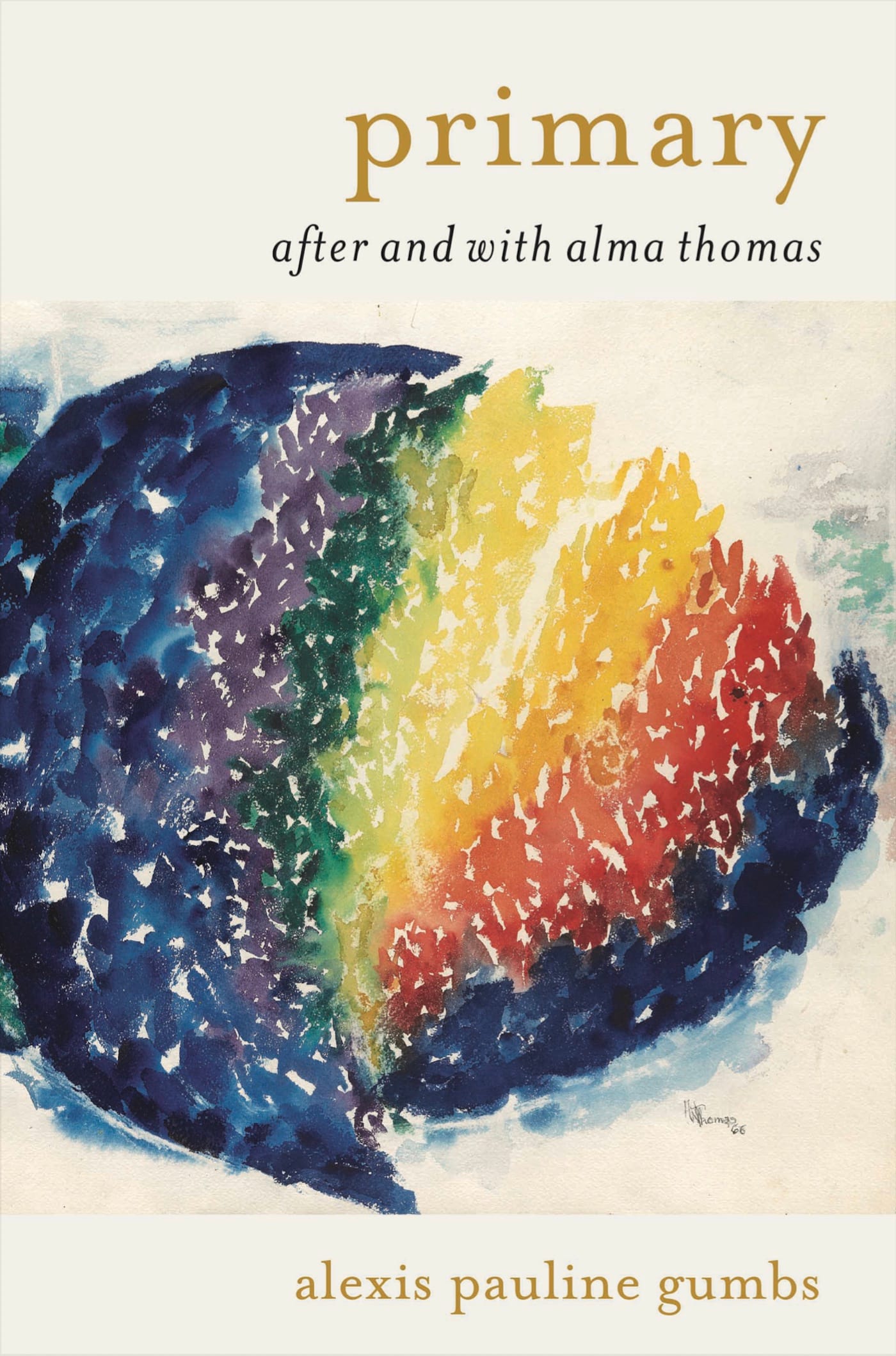
Editor’s Note: The following article is a chapter titled "Field" that has been excerpted from Primary: After and With Alma Thomas by Alexis Pauline Gumbs, published by Yale University Press on September 29 and available online and through independent booksellers. (Copyright © 2026 by Alexis Pauline Gumbs. Published by permission. All rights reserved.)
When Richard Powell, one of the most influential theorists of visual art in the Black diaspora, was a wide-eyed MFA student, or in his sardonic self-description decades later “a young clear-eyed critic striving for objectivity,” he wrote a review of Alma Thomas’s 1975 exhibition at Howard University. His celebration of Alma Thomas’s color paintings may also have been an early critique of other approaches to visual art. Powell the student, knowingly reviewing the work of the first graduate of the very department where he studied, knows that objectivity is impossible for himself or for any of us. He praises Thomas for her choice to “forgo the unreal objectiveness of details and detached photographic realism and dive into what we see and feel.” But he also notes that she moves away from what he calls the “mundanity” of impressionism. Instead she “cornrows and parboils it,” she “aerates the ground as only a native Georgian can and places growing colors in it the way one plants vegetables and fruit in a backyard.” The young Powell prefigures the way that Kellie Jones contextualizes Alma Thomas’s experimentalism years later: “Alma Thomas saw herself surrounded by creativity from an early age, from her mother’s use of color as an expert seamstress to her extended family’s planting and working of southern soil.” For both critics, Thomas’s roots in and continued connection to the very tangible arts of clothing and feeding people do not contradict but enable the experimental approach that Jones will call “Afro-Futuristic.”
When Powell describes Alma Thomas’s color fields as “cornrows” he brings to mind two linked references at once: fields of one of the North American continent’s most abundant plants, and a beloved and infamous African diasporic hairstyle. Never merely descriptive, Powell’s choice of words is also referential. In the first sense, cornrows, like other agricultural fields in the United States, share a colonized kinship with the African laborers forced to toil under captivity to generate the vast fields of monocultural crops that continue to define US food systems. In the second sense, cornrows, a time-intensive hairstyle of close braids and patterned open scalp, have been criminalized and forbidden under racist labor codes post-emancipation. But in his positive review, which asserts that there is liberation available to a viewer who chooses to engage Thomas’s paintings, he uplifts the brightness and nourishment in her “parboiled” but never overcooked images. Powell does not mean for the reference to cornrows to offer a mere lament for labor. We sense a reclamation in Thomas’s paintings and Powell’s love for them. Or let me forgo the pretense of objectivity. I feel a claim. I feel loved. Do you?
Cornrows constitute living archives of sisters and sisterliness. That archive includes my hands in my sister’s hair unbraiding it at the end of the summer, my own patience sitting between the legs of my sisterfriend Kara as she parts and flat-twists my hair before our college graduation. The cornrows gracing the heads of people around the world at this moment are mostly the artwork of a diasporic cohort of feminine workers who either offer their craft to people with whom they are in intimate sisterly proximity or with clients to whom they offer their services. Sometimes the line between sister/friend/stylist blurs. Sometimes in the shops staffed by African women and patronized by African-American and Afro-Caribbean people in cities in the United States, a strained and severed sisterhood across diasporic difference reveals or rejects a longing for tenderness among the tender-headed, tenderhearted, and tense. I would suggest that all of these braiders are modeling the work of sistering, the generative challenge of the closest simultaneous interfaces of similarity and difference.
John Maurice Thomas, Alma’s younger sister, who usually went by “Maurice” and lived in the same Washington, DC, house with Alma their whole adult lives, practiced parting, styling, threading work as an archivist and curator of her older sister’s work and legacy. Her institutional choices of where to place certain artifacts, and especially her penciled notes on the backs of pictures and event programs clarifying Alma’s presence and achievements, have the tight, gentle touch of a person accountable for preserving an intimate witness, a close deviation from her own life.

