Rembrandt’s “Night Watch” Is Alive!
The Dutch masterpiece is teeming with microbes, and scientists hope this invisible life will be a key to unlocking some of the painting’s mysteries.

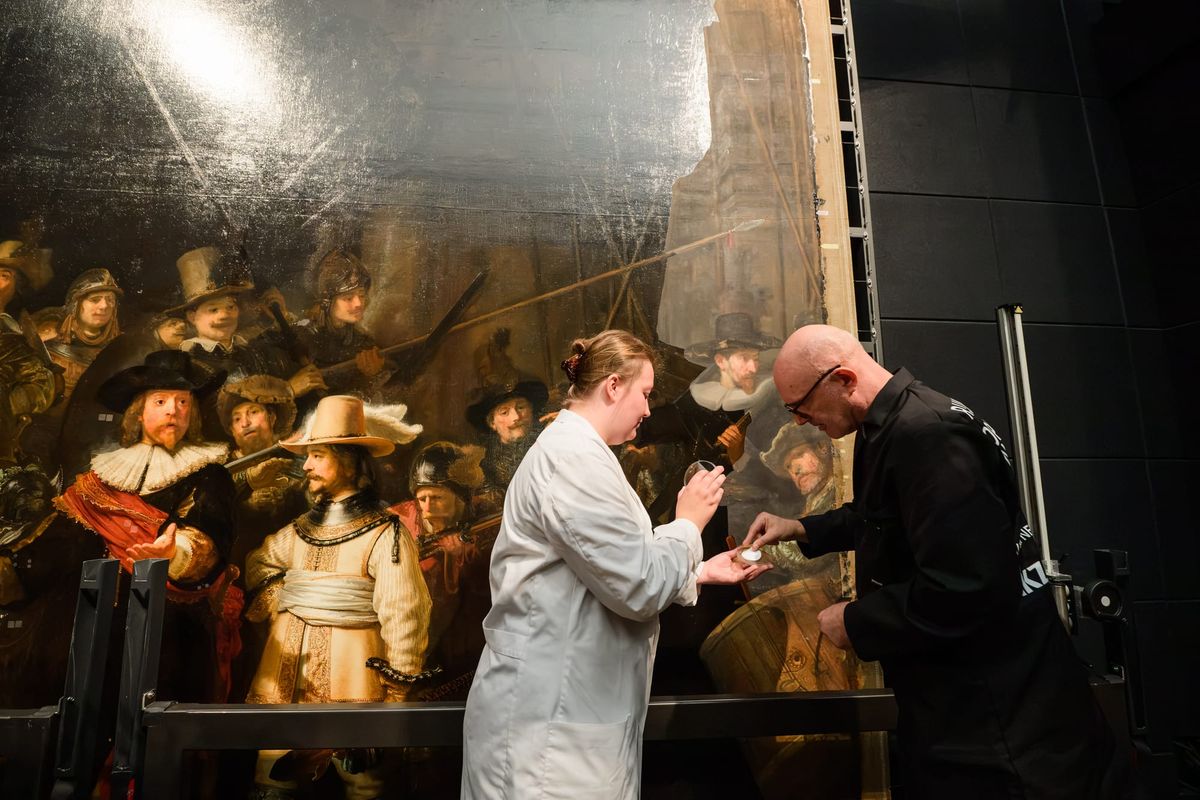
AMSTERDAM — It must have been a peculiar sight at the Rijksmuseum’s Gallery of Honor, where Rembrandt’s “The Night Watch” (1642) is the proud centerpiece: a microbiologist in a white lab coat, carefully taking samples of the canvas and placing them in prepared Petri dishes. “To get that close to the painting was very scary,” Eline van Bloois, the microbiologist in question, told Hyperallergic. “After all, it’s a piece of art that is so well-known to so many people.”
The Amsterdam institution has teamed up with an unlikely partner: ARTIS, the city’s zoo. Or, more specifically, with ARTIS-Micropia, the zoo’s science museum, focused on the study of microbes. Their scientists are researching what invisible life exists on what is arguably the most famous work in the Rijksmuseum’s collection. The findings are on display at The Night Watch Lives, which opened at ARTIS-Micropia on November 11.
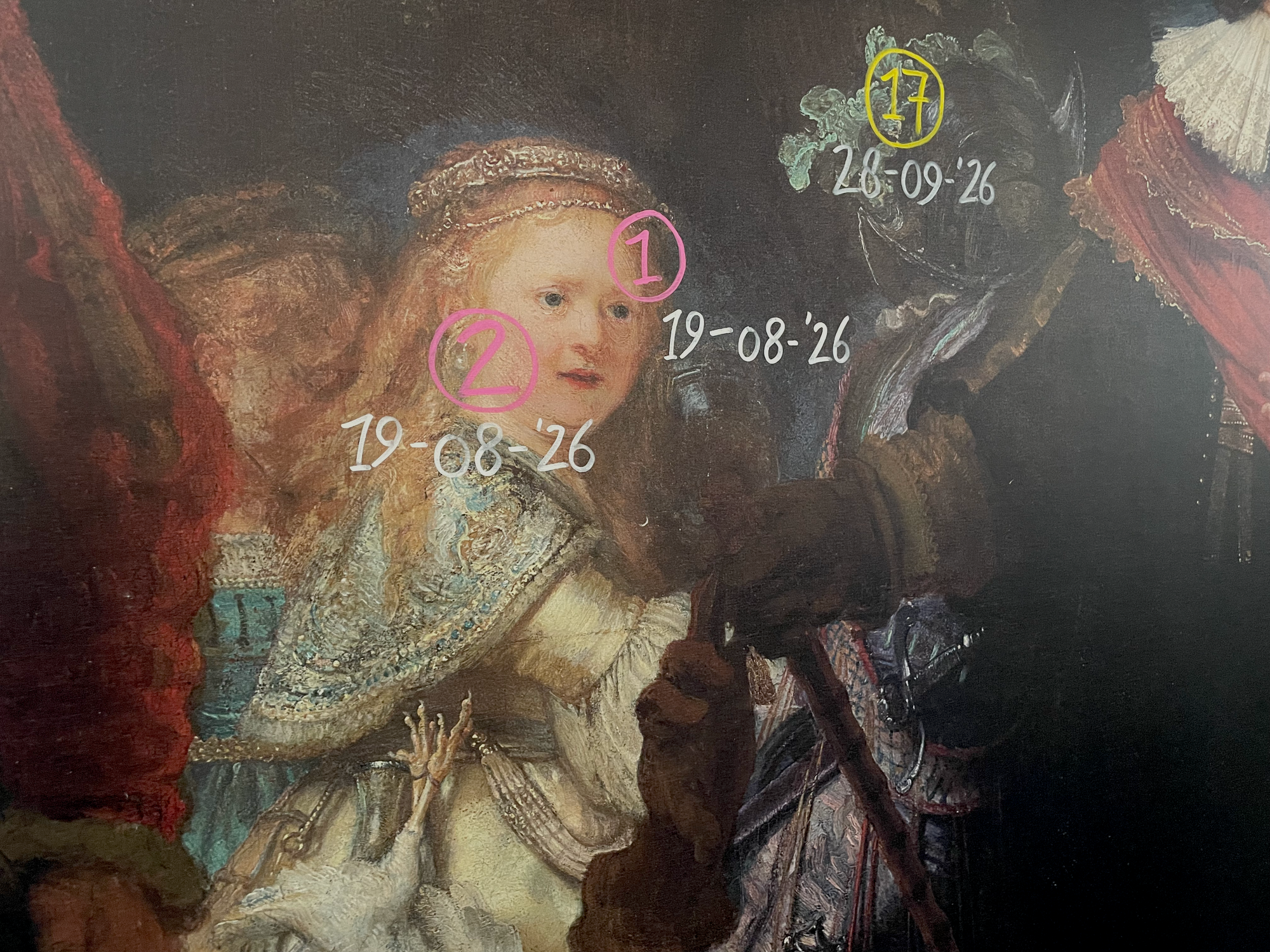
A life-size reproduction of Rembrandt’s Dutch Golden Age masterpiece now adorns the wall at ARTIS-Micropia; different patches of the painting indicate with a number and a date that a sample was taken from there, and when. On a glass display in front of it, the Petri dishes are spread out, showing the microbes in all their splendor and revealing exactly which microorganisms have been found on the canvas.
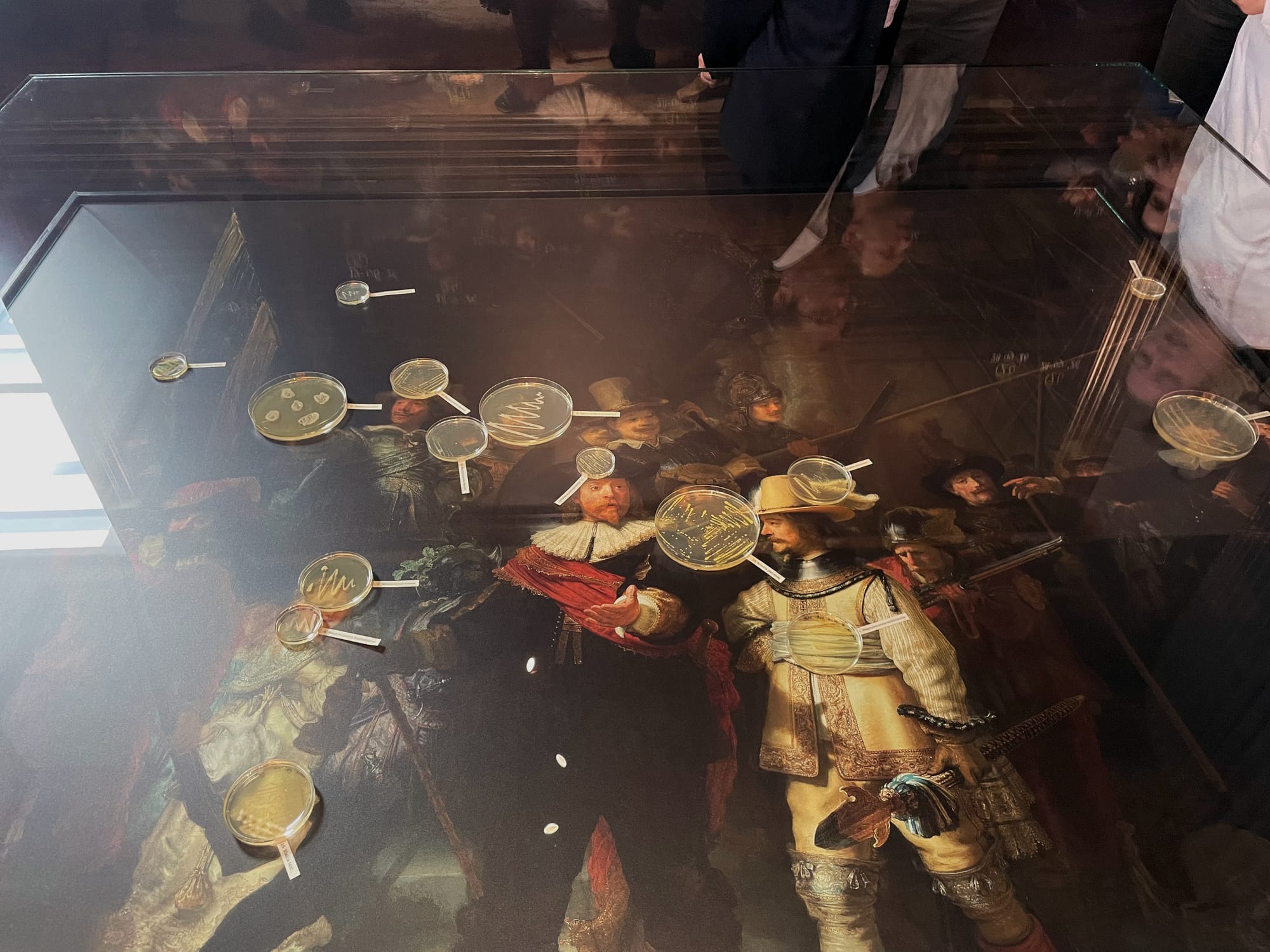
The first results revealed, among other findings, bacteria from soil, often found in plant roots, and well-known skin bacteria meant to protect us against pathogens. But one that stood out immediately was the Microbacterium saccharophilum, a species first identified at a sugar refinery in Japan. How this Japanese microorganism ended up on the Dutch “Night Watch,” or when, is a guessing game.
“This is how it often goes with science,” Van Bloois said, “you start off with one question. You leave with a hundred.”
The installation is still growing in scope. Six microbial trips to the Rijksmuseum have been scheduled, and merely three have been taken thus far. There are 20 bacterial findings currently on display. “There are 10 of them in the incubator right now; they’re brooding and still need to be identified,” said Karlien Pijnenborg, head of the adjoining Groote Museum, who leads the project. “And once they return, they’ll get a name tag and join the others. At the end, there’ll be 60.”
The installation, which will be on display until the end of May, won’t be fully formed until sometime in February. “We want to have taken multiple samples,” said Van Bloois, “so we really have gone over the entire painting.”
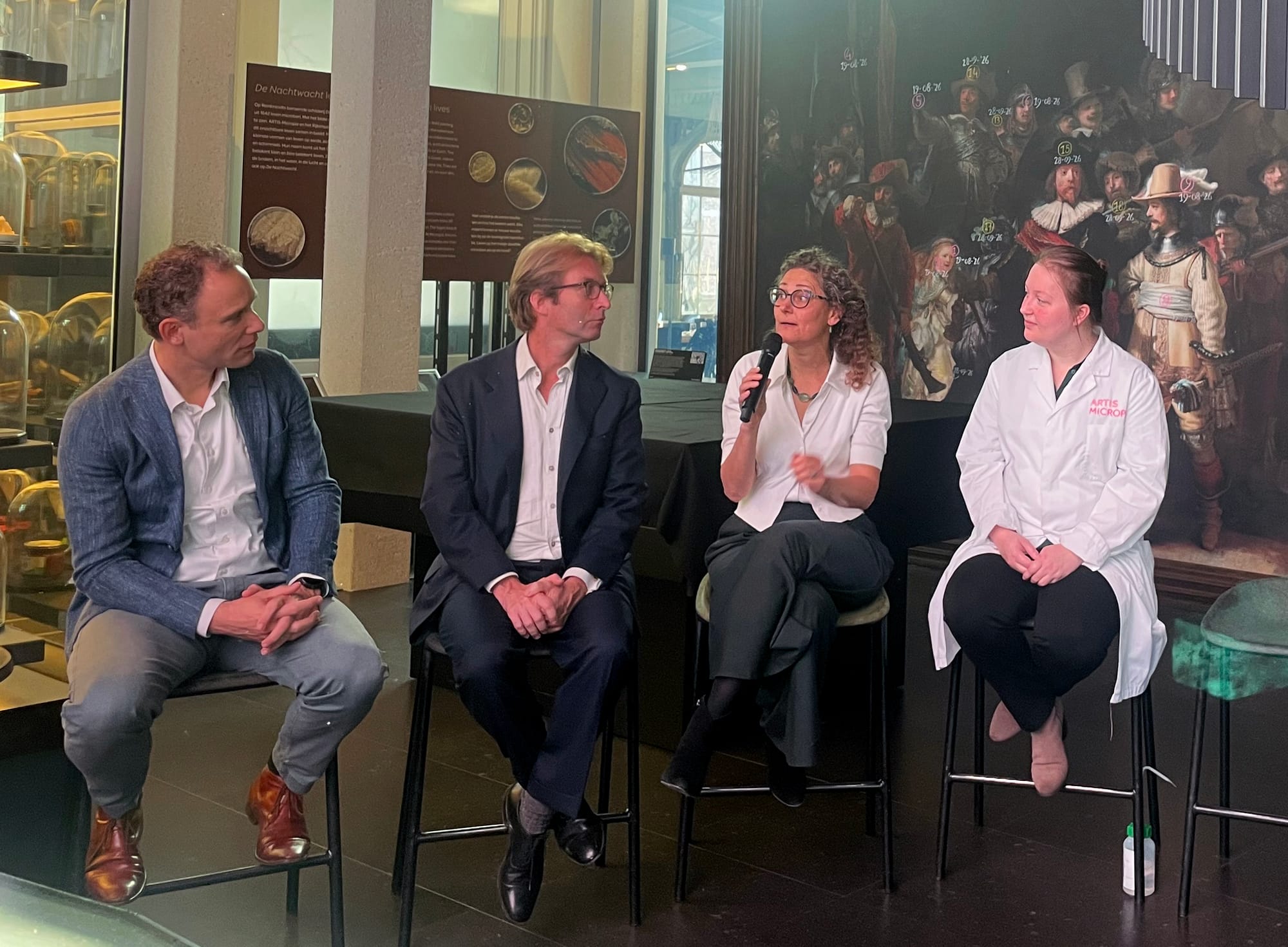
ARTIS-Micropia is the first museum dedicated solely to microbes. “It’s such a niche museum, it mostly attracts people who love and know a lot about microbiology,” said Pijnenborg. “But you of course want everyone to get interested in it, because microbes are so important.”
Most of all, the museum wants microbes to get less of a bad rap out there. “We know a lot about microbes that can make you sick,” said Van Bloois, “but that is only about 1% of all microbes we know.”
According to the museum, it’s the first time this kind of microbial research has been conducted on a piece of art. When Rembrandt finished “The Night Watch” in 1642, microbes hadn’t even been discovered yet. “It really was a whimsical idea of ours,” Pijnenborg said.
The research coincides with Operation Night Watch, the largest and most wide-ranging restoration and research project ever undertaken on the masterpiece, launched in 2019. In 2023, scientists working in the initiative discovered a rare lead compound in the layer underneath the primer. The researchers suspect Rembrandt applied this to better protect the canvas against mold and other microbes, as “The Night Watch” would be hung on a damp exterior wall.
Right now, the restorers are removing old layers of varnish, a process that can be witnessed live at the Rijksmuseum from behind a glass partition. The operation will continue for years to come.
The research conducted by ARTIS-Micropia fits perfectly within Operation Night Watch. As for the Rijksmuseum, they consider the microbial research strengthening for the arts, too.
“Thirty or forty years ago, nobody could have imagined you’d be talking to a chemist or biologist about ‘The Night Watch,’” said Taco Dibbits, the Rijksmuseum’s director, during a press conference. “And I think precisely because this research is broadening — the fact that the humanities and the exact sciences are collaborating — it also leads to it becoming more widely embraced.