What Does the US Arts Community Look Like? NEA Study Sheds Some Light
There are 2.1 million "artists" in the United States, according to the National Endowment for the Arts. The national arts organization has just released a study that examines the demographics of the country's artists. Here are some notable facts …

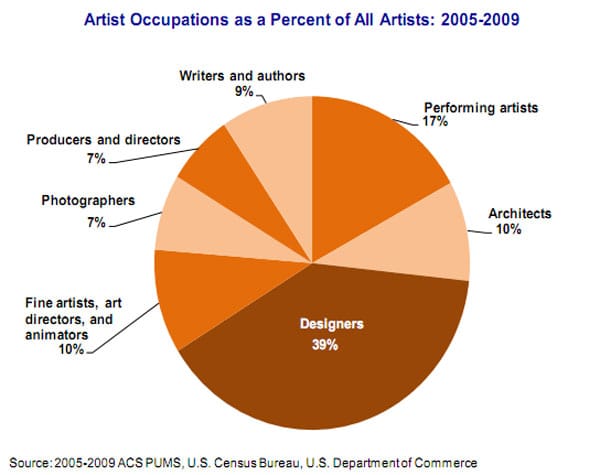
There are 2.1 million “artists” in the United States, according to the National Endowment for the Arts. The national arts organization has just released a study that examines the demographics of the country’s artists. I’ve included the word artist in quotation marks because their definition includes many shades of artistry to reach that number. I don’t think they were wrong to be so inclusive but I do think most people don’t normally associate floral designers, for instance, under the banner of “artist.”
Some notable facts:
- There are 2.1 million artists in the United States. They make up 1.4% of the total workforce, and 6.9% of the professional workforce (artists are classified as “professional workers”).
- Largest categories: designers (graphic, commercial, and industrial designers, fashion designers, floral designers, interior designers, merchandise displayers, and set and exhibit designers) are 39% and performing artists are 17%.
- Fine artists, art directors, and animators make up 10% of all artists.
- Writers/authors and architects each compose 9-10& of all artists.
- More than half of artists (54%) work in the private, for-profit sector; 35 percent are self-employed.
- Women artists earn $0.81 cents for every dollar earned by men artists. This gap is similar to that in the overall labor force (where women earn $0.80 cents for every dollar earned by men).
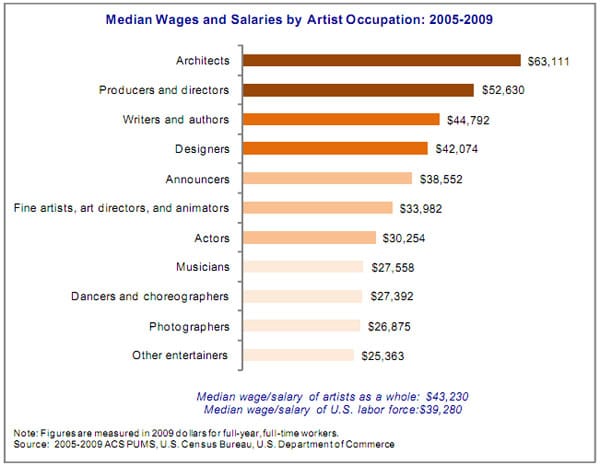
- Artists’ median wages and salaries ($43,000 in 2009) are higher than the median for the whole labor force ($39,000).
- Architects make the highest median wage ($63,000), while workers who are classified as “other entertainers” had the lowest ($25,000).
And here are some notable points I gleamed from the report about the demographics of US artists:
- Artists are less socioeconomically and demographically diverse than the total U.S. workforce, yet diversity levels vary across individual artist occupations.
- Only 13% of writers and authors are non-white and/or Hispanic, compared with 32% of the total workforce
- Yet 27% of actors are non-white and/or Hispanic — roughly the same proportion of musicians, announcers, and other entertainers.
- 41% of all dancers and choreographers are non-white and/or Hispanic — nine points higher than the corresponding share of the U.S. workforce.
- While artists as a whole are less likely to be foreign-born than other US workers, some of the highest-paid artist occupations have the highest rates of foreign-born workers. Architects and designers are the most likely to be foreign-born (14–16%, roughly the same as the US workforce).
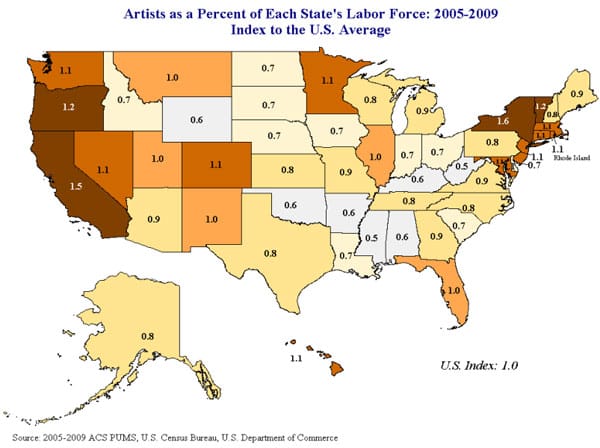
- New York (2.3% of the workforce) and California (2% of the workforce) have the highest numbers of artists in the US.
- Oregon and Vermont have 20% greater-than-average numbers of artists, with writers and authors especially prominent.
- The greater Pittsburgh area has twice the concentration of museum workers nationwide.