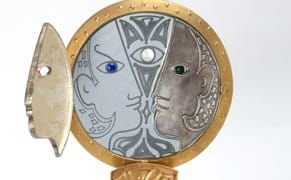
HONG KONG — I fell in love with Jean Cocteau when I was 19. I spent nights taking photographs of his epic 1930 film The Blood of a Poet frame by frame. The infatuation was similar to one I had with Picasso, whose paintings I copied obsessively, determined to learn the language of the man who made “Guernica.” In both cases, my heart was eventually broken. First, I learned Picasso used women like he used his paintbrushes. Then it transpired that Cocteau was a Nazi sympathizer. It was hard to know where I stood with both artists afterwards.
Continue Reading → 
HONG KONG — “I wanted to enter Hong Kong homes forcefully, allowing these mechanisms of art to become a platform of conspiracy for the Filipino domestic workers.” Sun Yuan and Peng Yu discuss their photographic series on view at Art Basel Hong Kong.
Continue Reading → 
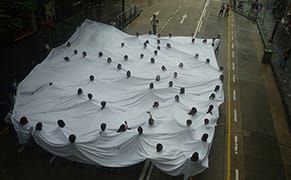
HONG KONG — The staging of Lygia Pape’s 1968 performance “Divisor” on the streets of Hong Kong was a fantasy I never knew I had, but witnessing it was a dream nonetheless. Presented as part of the current exhibition A Journal of the Plague Year. Fear, Ghosts, Rebels. Sars, Leslie and the Hong Kong Story (May 17–July 20 2013) at the nonprofit space Para Site, this current staging of “Divisor” channels the potency of the seminal work into another context, one defined by the effects of colonialism, plagues, politics, contagion, sterilization, and segregation.
Continue Reading → 
LONDON — When God said “let there be light,” he probably didn’t anticipate how much that statement would cost in the 21st century. Regarding the Hayward Gallery’s current exhibition, Light Show, security on hand are quick to note that this is one of the most expensive exhibitions the institution has ever staged, with staff receiving strict instructions to keep viewers’ hands off the artwork, especially Leo Villareal’s “Cylinder II” (2012), an ethereal column of LEDs that reach up into the first gallery’s cavernous space.
Continue Reading → 
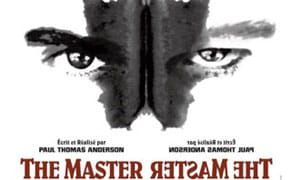
I’ve seen it twice, and it still makes my brain feel like it’s been violated in some sublime way. Visually, The Master is an incredibly beautiful piece of work: the effect of filming a reported 80 percent in glorious 65mm. The movie is saturated with color and tone courtesy of cinematographer Mihai Malaimare Jr., with editing by Leslie Jones and Peter McNulty, who paced the visuals against Jonny Greenwood’s (of Radiohead) odd, whacked-out, jazzed-up staccato soundtrack.
Continue Reading → 
LONDON — Since the outbreak of the Crisis in Greece, many parallels have been drawn between Greece and Germany. Indeed, Paul Mason at the BBC looked back to the Weimar and the rise of fascism as a reflection of the rise of fascism in Greece, while T Magazine called Athens the new Berlin.
Continue Reading → 
GÖTEBORG, Sweden — It should be said that this post is a personal one. That’s because Josefine Camitz is a deeply sensitive young filmmaker whose work is focused solely and seriously on the personal, in all its dimensions.
Continue Reading → 
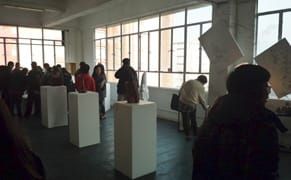
HONG KONG — The Fotanian Open Studios has its roots in 2001, when eight artists from the Chinese University — Lam Tung Pang, Tozer Pak, Tony Ma, Sam Tang, and Gordon Lo — relocated to the industrial neighborhood of Fo Tan after their studio burned down. The group took up residence in the Wah Luen Industrial Building, which now hosts 47 art-related units ranging from shared artist spaces to galleries and design offices, not to mention the studio of ex–Chinese University professor Lui Chun-Kwong.
Continue Reading → 
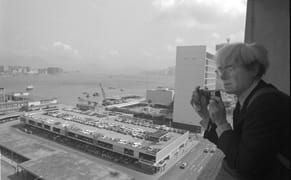
HONG KONG — I wasn’t interested in the exhibition Andy Warhol: 15 Minutes Eternal at the Hong Kong Museum of Art. Not even while knowing that this is the largest ever showing of Warhol’s work in Asia, that it marks the 25th anniversary of the artist’s death, and that it opened in Singapore and will also travel to Shanghai, Beijing, and Tokyo.
Continue Reading → 
HONG KONG — As big as the world may be and as connected as it may seem, there are invisible worlds that most of us know nothing about. Take Greece, for example, a country that, aside from its well-documented economic crisis and accompanying five years of straight recession, has been dealing with the consequences of an EU treaty ratified in Dublin in 2003. The Dublin II Treaty says that applications for EU asylum seekers can only be evaluated in the country where migrants enter. Because of geography, this has essentially forced Greece into becoming the main processor of all asylum seekers and political refugees flooding into the European Union in the past decade.
Continue Reading →