Tumblr

Post image for The Aesthetics of Gendered Dumbness

CHICAGO — What happens when blogs GURLDONTBEDUMB and WEIRD DUDE ENERGY face off in the reblogosphere, dueling it out in a viral battle-of-the-sexes? This post compares these two Tumblrs, both of which index hyper-gendered pop culture tropes, readily spinning off memes for the easy consumption of an A.D.D.-addled web audience.

Continue Reading →

Reactor

Which Artist Did It Better?

by Kyle Chayka on April 11, 2013

Post image for Which Artist Did It Better?

Sometimes it’s not so much about who did something first, but who did it best. In the technology start-up world, it doesn’t matter that dozens of other companies were creating video upload sites before YouTube; YouTube just hit the right combination of community, buzz, and content. Art history is the same. Enduring fame, of the centuries-long variety, doesn’t come to the artist who first followed through on an idea, but to the one who did it the most prominently.

Continue Reading →
Post image for The Way We Share: Transparency in Curatorial Practice

We’ve heard the argument that everyone’s a curator online by means of blogging and reblogging, but what about the professional curators who are responsible for producing major physical exhibitions — how are they using social platforms? The ability to publicly explore new theories, archive research, and participate in creative communities, has signaled a new era of openness and transparency in curatorial practice. One example is the research blog that accompanied Paola Antonelli’s Talk to Me exhibition in 2011 at the Museum of Modern Art. The site, stunningly bold and rigorous in its approach, chronicled projects to research, readings, and inspirational ideas for exhibition design. By providing visitors with a backstage tour, Antonelli and her team aimed to shed an honest light on curatorial process, revealing over a year’s worth of research that lead to the exhibition.

Continue Reading →
Post image for Tumblr, Art, and Web 2.0 Ecologies: The Medium Is Still the Message

On the eve of web 2.0, there were a few sites emerging like Zing.com, an early place for photo sharing. The technology of self-surveillance wasn’t up to speed at that point to make them stick though. Facebook and smartphones would go on to complete the social shift to “sharing.” “Overexposed Dancing” was one of our early works that anticipated this change.

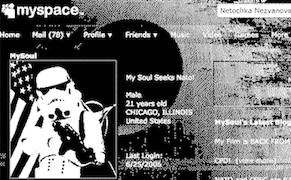
From 1997 to 2003, we worked together on a series of internet art performances, all of which were archived on Cary’s website, Restlessculture.net. Our performances took place on eBay, Evite, Ofoto, MySpace, and a host of other early social media sites that no longer exist. Taking off from Marcel Duchamp’s concept of the readymade, we called these performances “digital readymades.”

Continue Reading →
Post image for Organizing the World

This brief essay will focus on something that I think is important to Tumblr — the need to negotiate with media already in circulation. It is a desire that has been expressed variously throughout the 20th century by other artists and writers who negotiated, or thought about how to negotiate, with a world overflowing with images. Already in the 1980s you have media theorist Vilém Flusser describing a “telematic society of image producers and image collectors.” Before that Susan Sontag had already discussed how just about everything had already been photographed. Today, Hito Steyerl emphasizes that “postproduction has come to take over production wholesale.”

Continue Reading →
Post image for Our Reblogs, Ourselves

For centuries, images were a fairly quantifiable, classifiable thing. One could, if one wanted, generally divide them into two categories: those made by artists and those not; artworks and everything else. There were always complications, of course — where did photojournalism fall, or works made by bad artists, or family photos — but the lines were pretty distinctly drawn: no matter the content or method, art images were those created by artists toiling away in studios or monasteries or workshops; they were shown in galleries and museums and sometimes books, framed very clearly as capital-A Art. Plenty of artists have worked to undermine or discredit this system, like Richard Prince, who upset a lot of people when he started rephotographing Marlboro ads in 1980. Theoretically, the question with Prince went: was this art or copied advertising? The work, however, was shown in specifically designated art spaces, with Prince’s name clearly attached to it. It was undoubtedly art, even if people at first didn’t agree on its qualifications.

Continue Reading →
Post image for The Measure Of Success: Making Art in the “Like” Economy

One of the unique things about the internet is that it’s a quantifiable space. Every action that takes place online is basically an exchange of data, codified in ones and zeroes. Everything you do on the web is increasingly measurable and trackable, which is one of the reasons we’ve come to live in the age of what is being called “Big Data.” With metrics being such a pervasive part of internet culture, the net has developed its own unique value system, which tends to favor and reward two things: the size of your audience (number of eyeballs) and that audience’s level of engagement (how deeply people interact with your content).

Continue Reading →
Post image for The Problem with Tumblr and Photography

A little over ten years ago, when I started blogging about photography, most photoblogs were presenting a single photographer’s work, one photograph at a time, usually per day. They were maintained by the photographers themselves. The scene was very small, and there was maybe a slightly naive earnestness about how it was done, which made following those blogs an appealing experience (even though, I should add, I had other things in mind).

Continue Reading →
Post image for On Coffee Houses, Salons, and the Post Arts

So back in the late 15th century, Ottoman people started gathering to drink together. The beverage they consumed? The magical elixir and arguably the greatest drink known to humanity, coffee.

Continue Reading →
Post image for The Teen-Girl Tumblr Aesthetic*

Twenty-one-year-old Elisa Lam made national news when her body was uncovered in a water tank on the roof of the infamous Cecil Hotel, near Skid Row in Los Angeles. Not long before that, she was just a barely-no-longer-adolescent girl visiting the United States from Canada, exploring the city of angels whilst on spring break. In the Internet land of immediate responses, reactions, and reprimands via text chatter, reblogs, deleted comments, likes, and unlikes, hearts, and de-hearted emotional Tumblr affirmations, Elisa Lam’s 19-year-old friend Jialin began Tumblr blogging about her friend’s death. Was she a bad friend? How could this have happened to Elisa?

Continue Reading →