Art
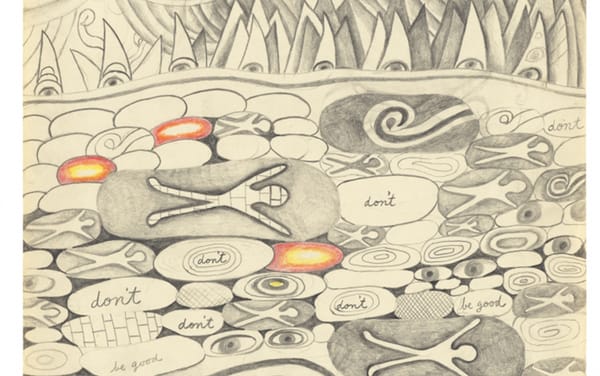
Suellen Rocca Turns an Inward Eye
Rocca's drawings evidence an interior gaze and the working out of psychological states.


Art
Rocca's drawings evidence an interior gaze and the working out of psychological states.

Interview
Children’s scribbles may appear random but they often repeat shapes, like the mandala or the Greek cross, that suggest the beginning of language.
Interview
Children’s scribbles may appear random but they often repeat shapes, like the mandala or the Greek cross, that suggest the beginning of language.

Interview
Last month, Ben Jones exhibited a new body of work at The Hole gallery on the Lower East Side. The gallery’s walls and floor are painted a bright, startling white; Jones’s artwork, usually drenched in hot hues, here consists only of graphite-colored oil-stick line drawings.
Art
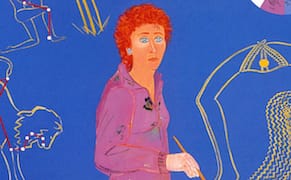
When Joan Brown began attending the California School of Fine Arts in 1955, she was immediately dissatisfied with her classes and the structure of art education in general.
Interview
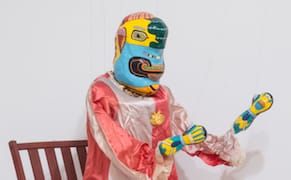
It’s tempting to characterize Karl Wirsum’s recent spate of exhibitions in the city as his New York moment.
Books
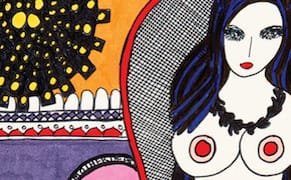
Dorothy Iannone describes her trip to Reykjavík in 1967 as the “journey which seems to have made all other journeys possible.” It was there she met the artist Dieter Roth, with whom she swiftly fell in love and for whom she left her husband and a comfortable life in the United States.

Art
Matthew Palladino’s gallerist calls his new works paintings, but one wonders whether that label is given partly for simplicity’s sake: They are paintings but also sculptural reliefs. They are illusionistic but also real.
Books
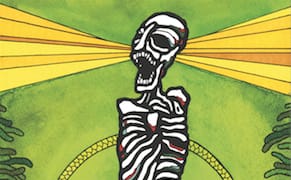
What’s stunning about Matt Kish’s illustrations for Heart of Darkness — one for every page of Joseph Conrad’s text — is how sunny they are. His modest palette comprises yellow, green, black, and white, with the occasional hit of red, orange, or blue. The novel, on the other hand, is tonally dark: se

Books
In July 2004, The New York Times Magazine signaled the advent of the “literary” comic book and described how a significant group of cartoonists — including Chris Ware, Daniel Clowes, Seth and Marjane Satrapi — had popularized these “comics with a brain.”