Beer With a Painter: Hilary Harkness
If paint doesn't feel good coming off the brush, you pretty much have nothing,” said the artist, whose canvases depict humanity in all its rollicking riot and contradiction.
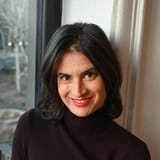
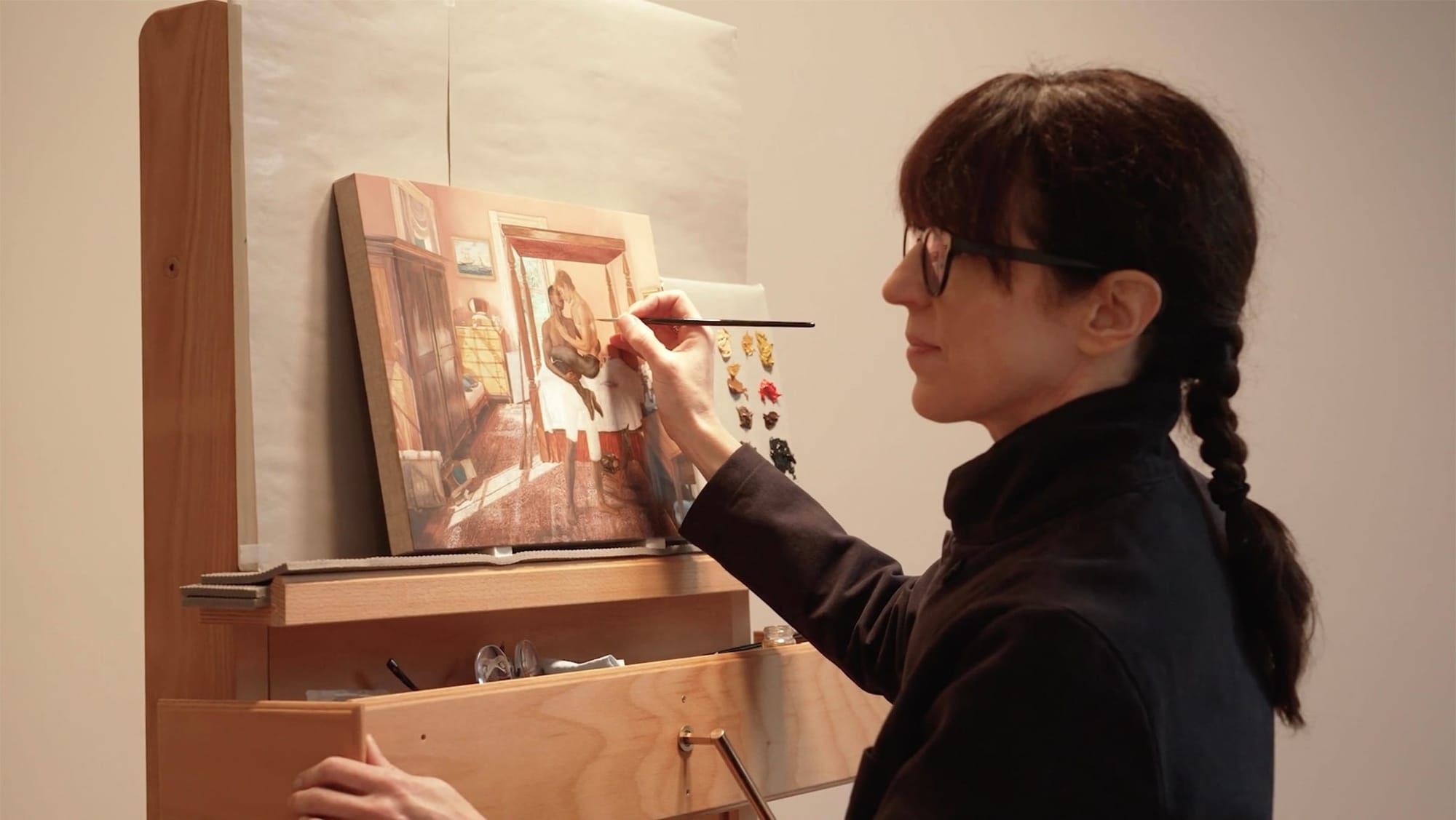
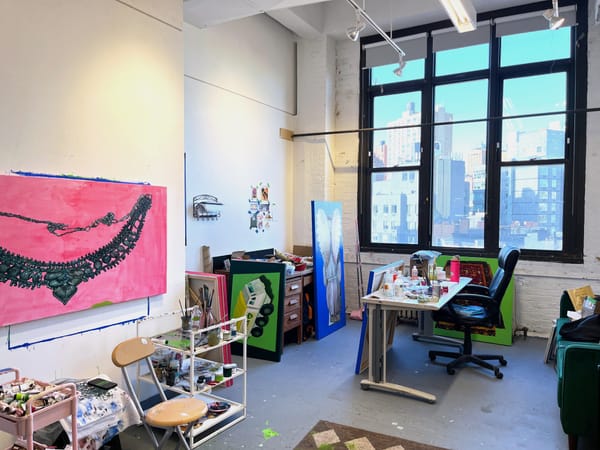
On stunningly small surfaces, Hilary Harkness packs in a vast density of information — over-the-top fantasias that ruminate on a “what-if” proposition applied to known histories. I had gotten to know Harkness socially in the 10-year period between her solo exhibitions, seeing work only occasionally during that time, so I found her 2023 show at New York City’s PPOW Gallery quite literally breathtaking. She requested we meet in January on Zoom, since she was on deadline and lives and works in New Jersey, with the promise that I would “see everything and miss nothing.” Still, even as Harkness pulls open the curtain, she maintains a sense of mystery. She tells me that she is the last person who would paint a self-portrait, avoids being photographed, and often centers others in her own artist talks.
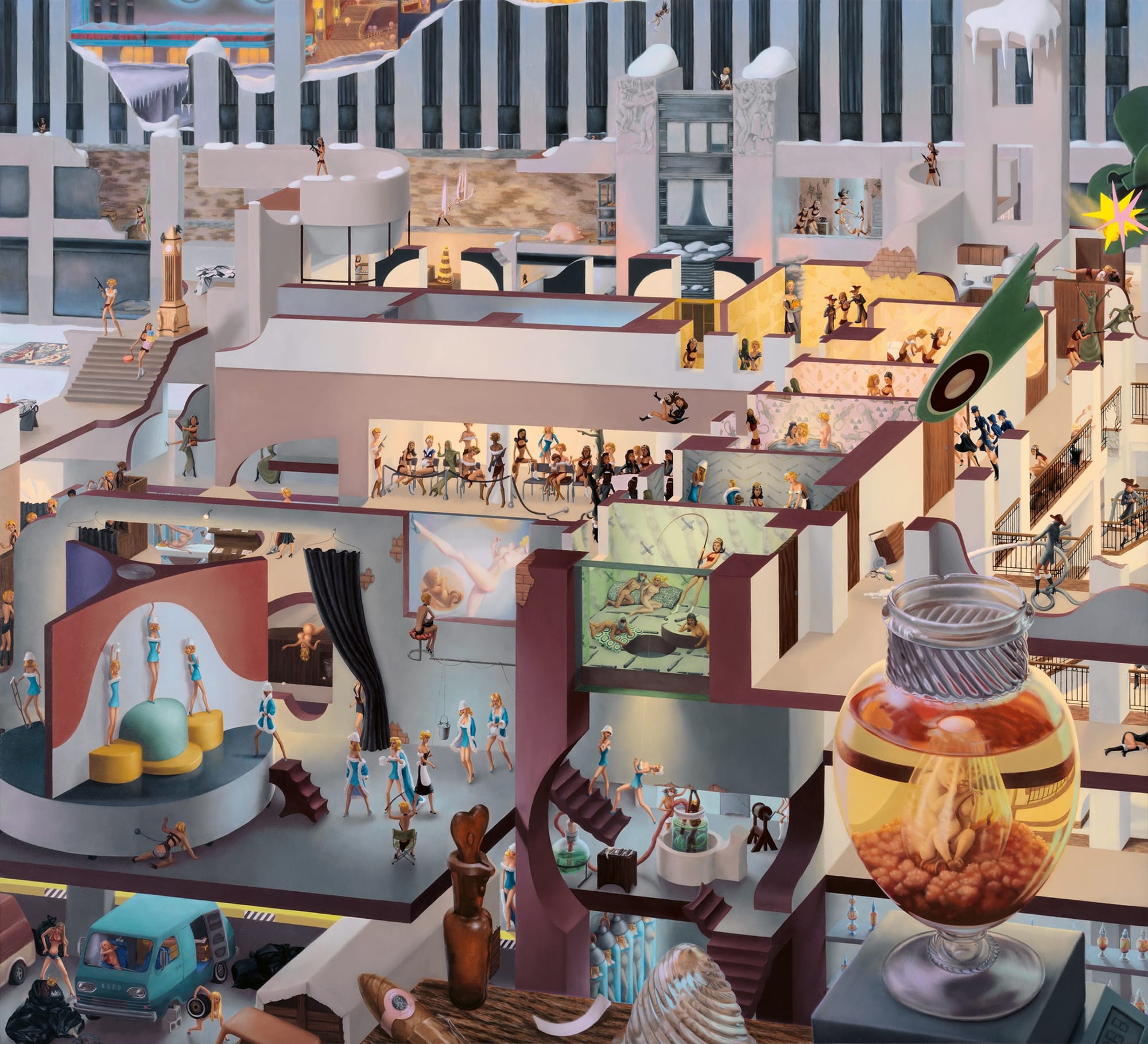
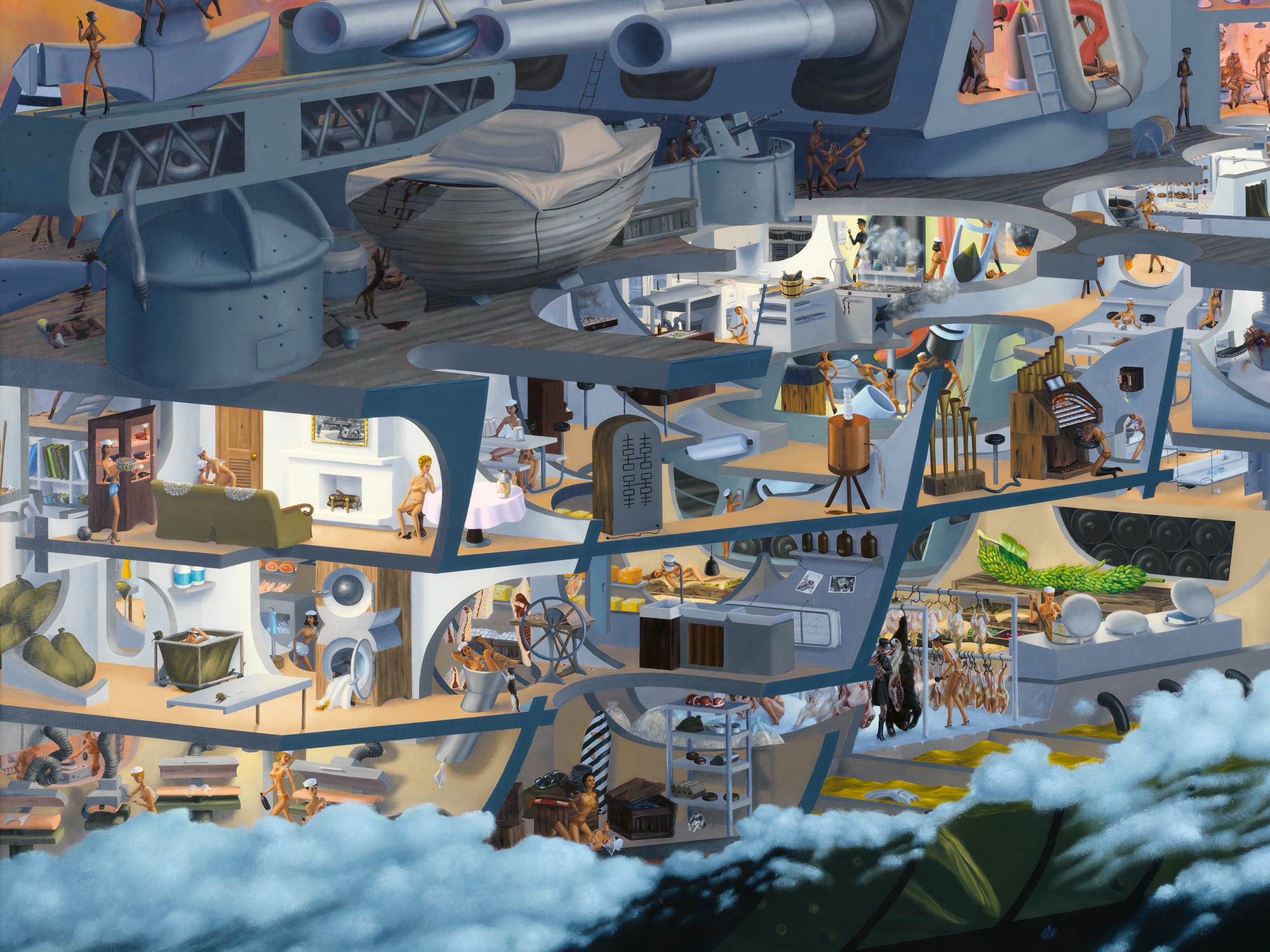
With a hyperrealist, maximalist approach, Harkness builds worlds complete with preternatural beauty, optimism, and joy, while simultaneously littering them with human foibles — revenge, power, hubris, gore, kink. Her cross-sections of battleships inspired by World War II vessels reveal gender-neutral and queer orgies; she exposes psychological truths behind the iconic relationship between writer Gertrude Stein and Alice B. Toklas; and she unveils the disguises worn by women who served in the Civil War. Her canvases lure us in with the bait of recognizable elements and figuration, drawing us into another universe until we find ourselves wondering how we got there.
The way her mind works in conversation feels similar; she can freely reel off facts that I never saw coming. We spoke about Richard Scarry, hydraulic mining schemes, sex on battleships, and the mystical relationship between a violin bow, a quill, and a paintbrush.
Born in 1971, Harkness received her BA from the University of California (UC), Berkeley, and her MFA from Yale University. Her work has been featured in exhibitions at the FLAG Art Foundation and the Academy of Arts and Letters in New York; Museo Thyssen-Bornemisza in Madrid, the Portland Institute of Contemporary Art in Oregon, and the Aldrich Museum of Contemporary Art in Ridgefield, Connecticut, among others. She is represented by PPOW Gallery in New York. This interview has been edited and condensed for clarity.
Hyperallergic: You grew up in Kalamazoo, Michigan. Did you draw or make art as a child? I'm fascinated by a story you’ve told in the past of witnessing an intense tornado tear off the exterior wall of a department store, and I wonder if that was an inspiration for your cross-section paintings.
Hilary Harkness: I had a lot of good art supplies and access to nature. I was always making something or doing something. I was reading at an early age, and Richard Scarry was a favorite. I loved learning about how the world worked and the level of detail at which he portrayed Busytown. I went to excellent public schools, and the teachers I wound up with were very non-traditional. There was no sitting at a desk; it was always free-form classrooms.
My mom wasn't warm and cuddly, but she's the mom who, when the tornado was coming through the neighborhood, went outside to make sure the neighbors’ kids were okay. I did see a five-story building opened up. Who knows — maybe that made me want to do cross sections.
Also, we lived in a neighborhood that was made up of identical tract houses. My parents were focused on spending what money they had on practical matters, like fixing the roof and replacing windows — not the looks of the house. When we pulled out the old curtains after moving in, they never got replaced. So everybody from the street could see what was happening in our house. My mom said, “Well, we have nothing to hide.”
H: You originally studied at UC Berkeley on a pre-med track. What led you to switch to painting?
HH: After completing my pre-med requirements, I felt like I needed a break. I had the opportunity to study with Mary Lovelace O’Neal and Katherine Sherwood. My experience at UC Berkeley was also very free. They taught us to approach everything like a work of art. In other words, not to simply draw something on a page, but to make it into a composition.
H: Many of your early paintings depict labor. Did you feel a connection to the work of Pieter Bruegel? Can you tell me about the subject of the painting “Golden Gorge” (2007)?
HH: I love Breughel’s work. He was living in a difficult time of a struggle between Catholicism and Protestantism. At the same time, his is a gentle gaze.
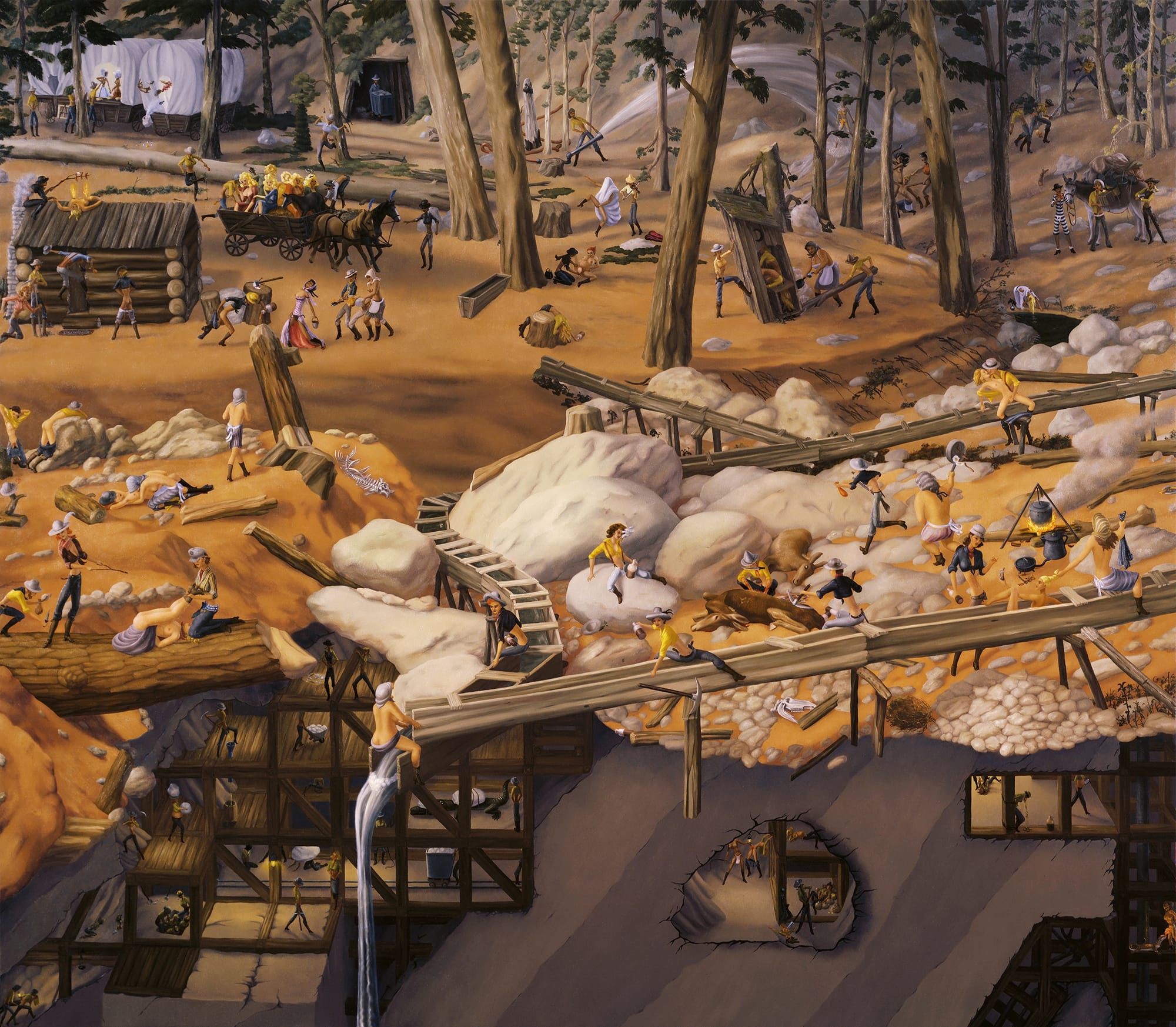
With the painting “Golden Gorge,” I was thinking about the ongoing American fascination with getting rich quick. We know that usually doesn’t work out. After the initial free-for-all of the gold rush, some powerful people established hydraulic mining schemes on the backs of people who failed to get rich through prospecting. If you were a woman who wanted to make money during this time, your best shot was catering to the needs of the downtrodden miners, such as selling pies or even being a madame. While this painting is about people who know “how the world works,” some of my other paintings, particularly the doomed battleships, are more focused on people who are hopeful. My paintings “Motherlode” (2005–6) and “Pearl Trader” (2006) are somewhere in between with intricate views of commerce alongside childbirth.
H: Can you tell me about the women and people who occupy the scenes of battleships, and the themes they allowed you to explore, such as hierarchies and power as well as gender and sexuality?
HH: Most of us don’t know what we’ll be like in a variety of worst-case scenarios. There could be long stretches of boredom mixed with intense fear. You turn to anything to take your mind off the inevitable torpedo, including flirting and having sex. That’s part of it, but I’m also interested in what happens when people feel like cogs without total ownership over the situation. When I was researching stories about these battleships, there were so many accounts of careless mistakes that led to lives being lost. I have real compassion for those sailors.
It’s one of the reasons that I'm in one of the battleship cross sections. It's not a real self-portrait, I’m just one of the multitudes. I was thinking about how I would be scared shitless in this situation, so I put myself hiding in the laundry bin.
H: I was curious about your ongoing series of paintings of Gertrude Stein and Alice B. Toklas. I was thinking of the history of Picasso’s canonical portrait of Stein, and wonder if it was important to you to create likenesses of them.
HH: In general, Gertrude Stein looks like Gertrude Stein. But Alice is always changing. I personally relate to how she avoids depiction. She doesn't look one way, so I don't want it to be literal. Instead I’m trying to embody a certain mood.
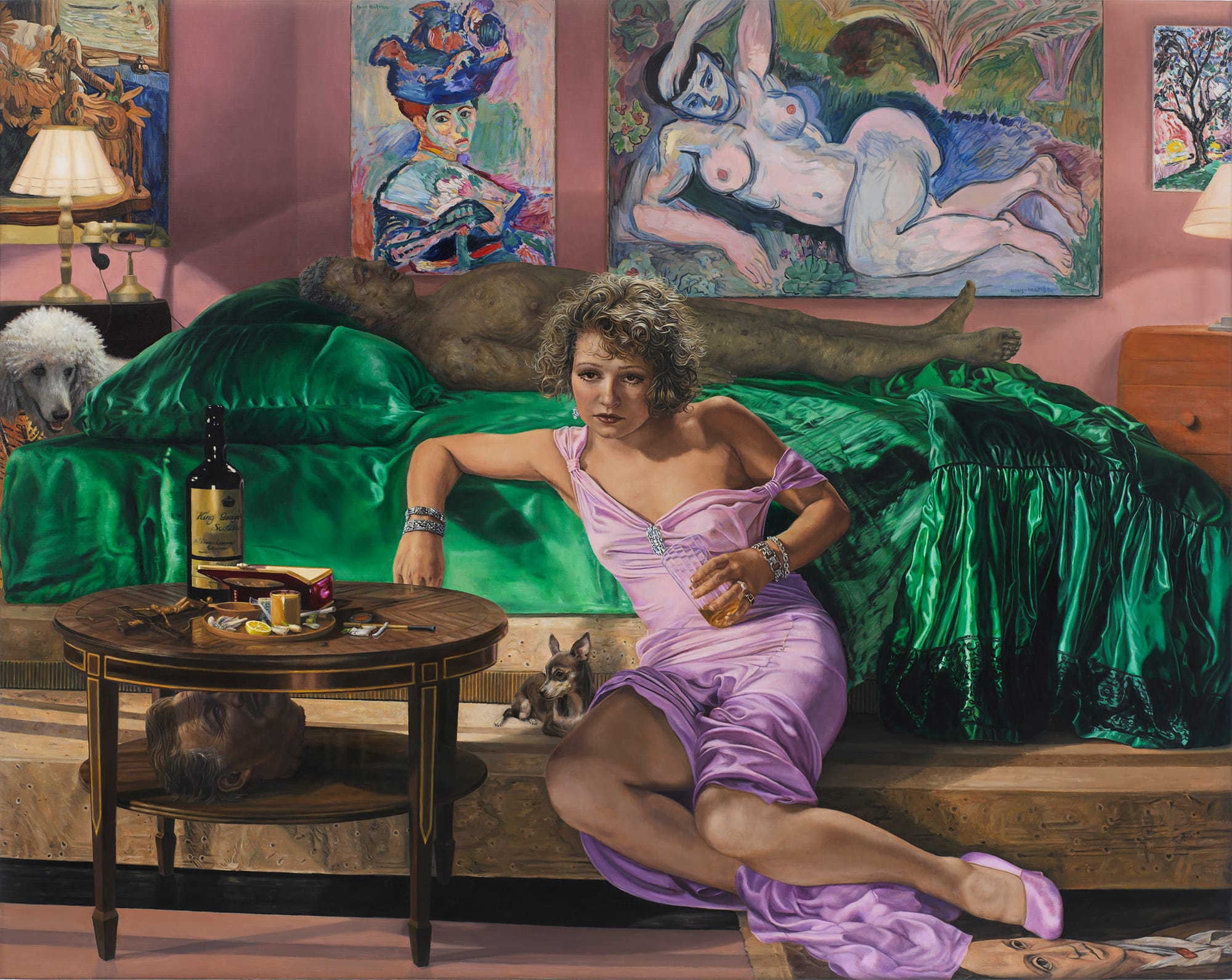
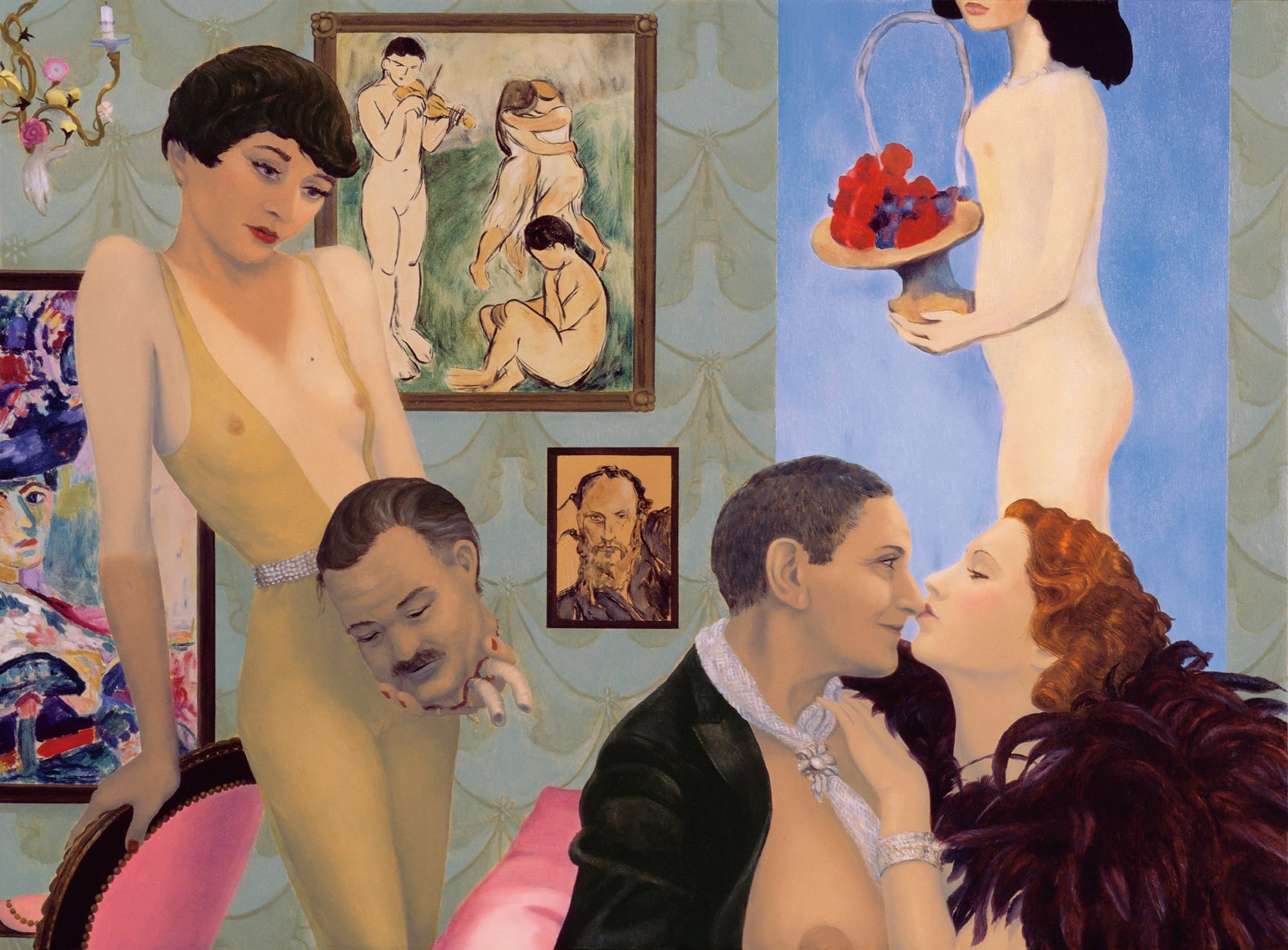
In “Answered Prayers” (2024), Alice is waiting it out with Gertrude’s corpse because she knows that as soon as she leaves the apartment, the Steins are going to take everything and leave her penniless. It’s true that they cleaned Alice out while she was taking an arthritis cure at a hot springs.
H: I hear that you don't usually create a drawing or study for your paintings. Is that true?
HH: For some of the early cross sections, there weren't even thumbnails. I would just make some guide marks on the panels with water-soluble colored pencil and go for it. Oil paint is so forgiving.
“Experienced People Needed” (2018), the painting about Peggy Guggenheim, was hand-drafted. I had to piece it together from several individual photos of installations along a floor plan of the whole space. It was quite a trick to put all that complicated stuff in space and have it recede correctly. That was heavy planning. Instead of making things easier, it slowed things down. It’s hard to know what makes a painting interesting.
H: “Nervous in the Service” (2009) imagines a wild, fantastical, orgiastic cocktail party with dozens of people, set on several floors of a modernist house filled with art. How did that party scene develop?
HH: I had a collector who experienced a lot of loss during the AIDS crisis in the 1980s and ’90s. He had a smoking-hot art collection, which I depicted in the painting. I felt like it deserved an orgy to celebrate the art. This was one of my favorite paintings to make; the props were all there and the people are more like grace notes.
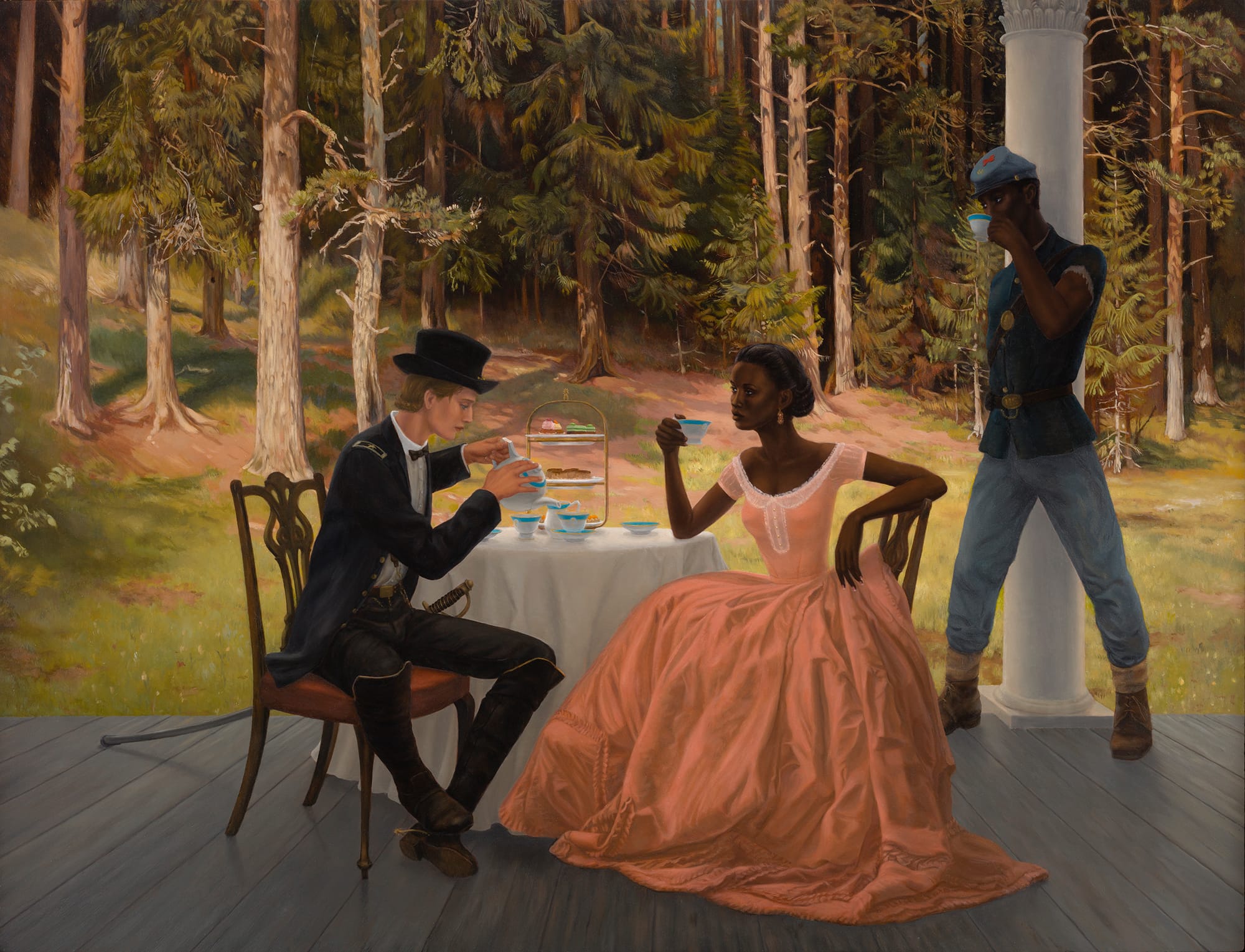
H: Your Arabella Freeman series, which presents a narrative about the relationships between a White genderqueer Union soldier and the family of a Black Union soldier, was originally inspired by copying Winslow Homer’s “Prisoners from the Front” (1866) at the Metropolitan Museum of Art, and changing the race of one of the soldiers. You’ve called it a love letter to your wife, Ara. How did it lead you on a path of exploring how a free Black family might be living in Virginia in the 19th century? How do you balance the over-the-top fantastical elements of your painting with an interest in historical truths?
HH: The Arabella Freeman series came out of me trying to get a very big picture understanding of my wife’s life experience and how it came to be. It’s a story of Black wealth, art collecting, land ownership, and ongoing and increasing systemic and legal attempts to take it all away. It started with a “what if,” which led to the series.
It’s complicated to be a White person who is painting Black people. I don’t have lived experience as a Black person. My wife is Black, and I don't walk in her shoes. But I walk beside her and I see quite a bit. Aggressions, micro and macro, that she’s learned to ignore are still shocking to me. Even knowing as much as I do, and having done the research I've done, I can't fully predict what her response to something will be. My art is not about what I 100% know. It's more about asking questions, engaging, and trying to relate to people and understand the world.
I am working on an extension of the Arabella Freeman series now, but using friends who are artists as models, including Moses Leonardo and Alannah Farrell. It's been the nonbinary and trans people who have been showing up for me and been willing to be playful and generous with me about letting me do the work I need to do. Moses and Alannah are ultra-talented and a delight. With long hours, taking time looking at faces I care for is really a game-changer for my experience in the studio.
H: You’ve been studying calligraphy recently; how did this come about?
HH: In October 2023, I was doing a project for Headmaster Magazine that included dip pen drawings of Oscar Wilde and friends exercising in little ballet slippers with bows. I am not a dip pen artist, and I never wanted to be. But I was fascinated by how hard it was. You have to get the touch just right.
Last November, I went to Brighton, England, for a three-day workshop with a calligrapher typographer named Ewan Clayton. It was a peak life experience. Ewan was very relational and attuned to emotions, and modeled curiosity. He created a non-hierarchical learning environment that was welcoming to everyone, from advanced beginners to professionals.
Currently, I’m learning to write with an actual quill. The quill vibrates and interacts with the paper and is alive in the hand. I'm a former violinist and it feels related. The violin bow is made out of flexible wood and horse hair. With a paintbrush, you are holding a stick; the life is in the tip.
At the end of the day, anyone who's painting is in front of their easel making one brushmark at a time, and that brushmark should feel good. That takes a personal blend of paint and surface, how you're standing, how you're breathing, and how you are holding your brush. If paint doesn't feel good coming off the brush, you pretty much have nothing. It comes down to that micro moment, that daily experience, which has to be rich and feel good.
H: You’ve said the most satisfying thing would be to reach old age and see how many different things you’ve done over your career. Why is that?
HH: When I was an emerging artist, I looked forward to being a painter in my 50s. Cézanne peaked in his 50s, and the long game appeals to me. Now that I’m here, painting is still difficult, even with accrued wisdom and skills and a lot of energy. I’m grateful to be here and in good health. But it is wonderful to also be a bad beginner because that's where all the play is. It is a mindfulness meditation that puts you in “curious mind.” If I could help other artists based on my experience, I’d get them out of trying to “solve” their work with “fix-it” mindset. It’s a recipe for frustration and depression.
What's happening in my studio is a marathon, and that marathon can't be a standalone life. It's not going to keep me growing in the ways I want to grow as an artist. I'm finding myself doing different kinds of things for the mind-body-spirit connection that keeps everything cooking.