Beer With a Painter: Tom Burckhardt
“My favorite phrase lately is ‘mouthfeel,’ which is used in relation to food and drink,” said the East Village artist. “I’m thinking about that textural quality as a parallel to the paintings.”
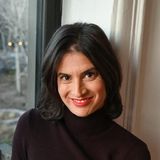
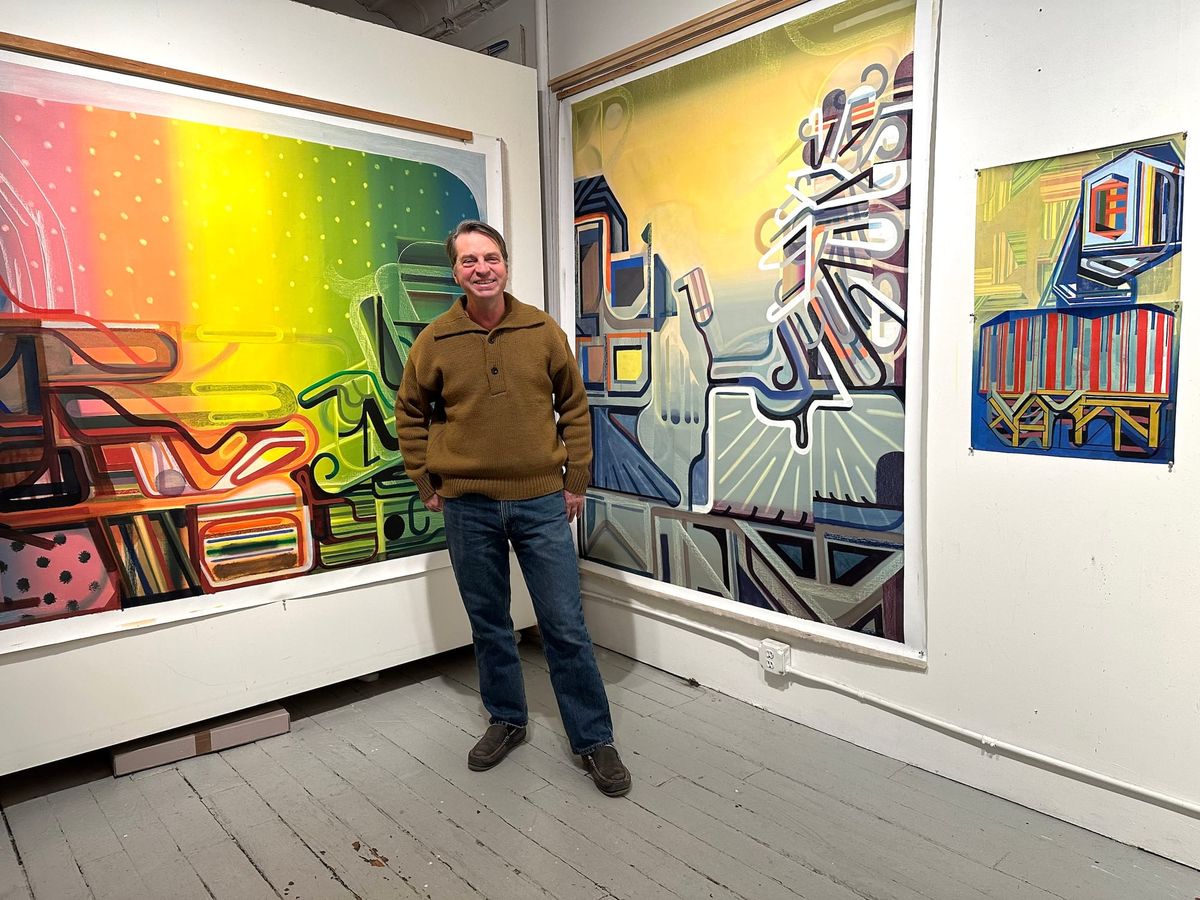
Tom Burckhardt was named after the Apostle Thomas, who pressed his finger into Jesus’s wound to confirm the resurrection for himself — a fact the artist sees as providential. “It’s no mistake that it’s my name,” he said.
Burckhardt uses skepticism as a creative motivator: to erase our attachment to categorization and break down pretension with humor. In his artistic world, language is slippery, large-scale paintings can also be doodles, and we are encouraged to see faces in abstractions — the phenomenon called pareidolia.
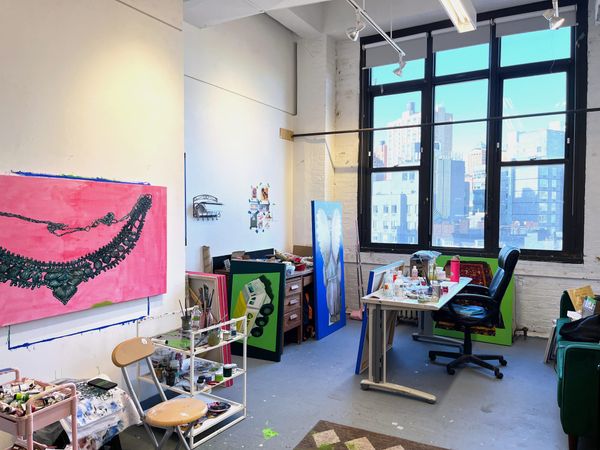
I visited Burckhardt in February in his East Village studio and home, which he shares with his wife, ceramist Kathy Butterly. It’s in an artist loft building on 14th Street that has been home to the likes of Claes Oldenburg and Patty Mucha, Wes Anderson, and Larry Rivers. Burckhardt grew up in New York City with artist parents and a connection to New York School painting and the painter-poet circles, which included Alex Katz, Lois Dodd, and John Ashbery. His work often alludes to these histories, but he is not weighed down by the past — there’s a lightness and pragmatism in his treatment.
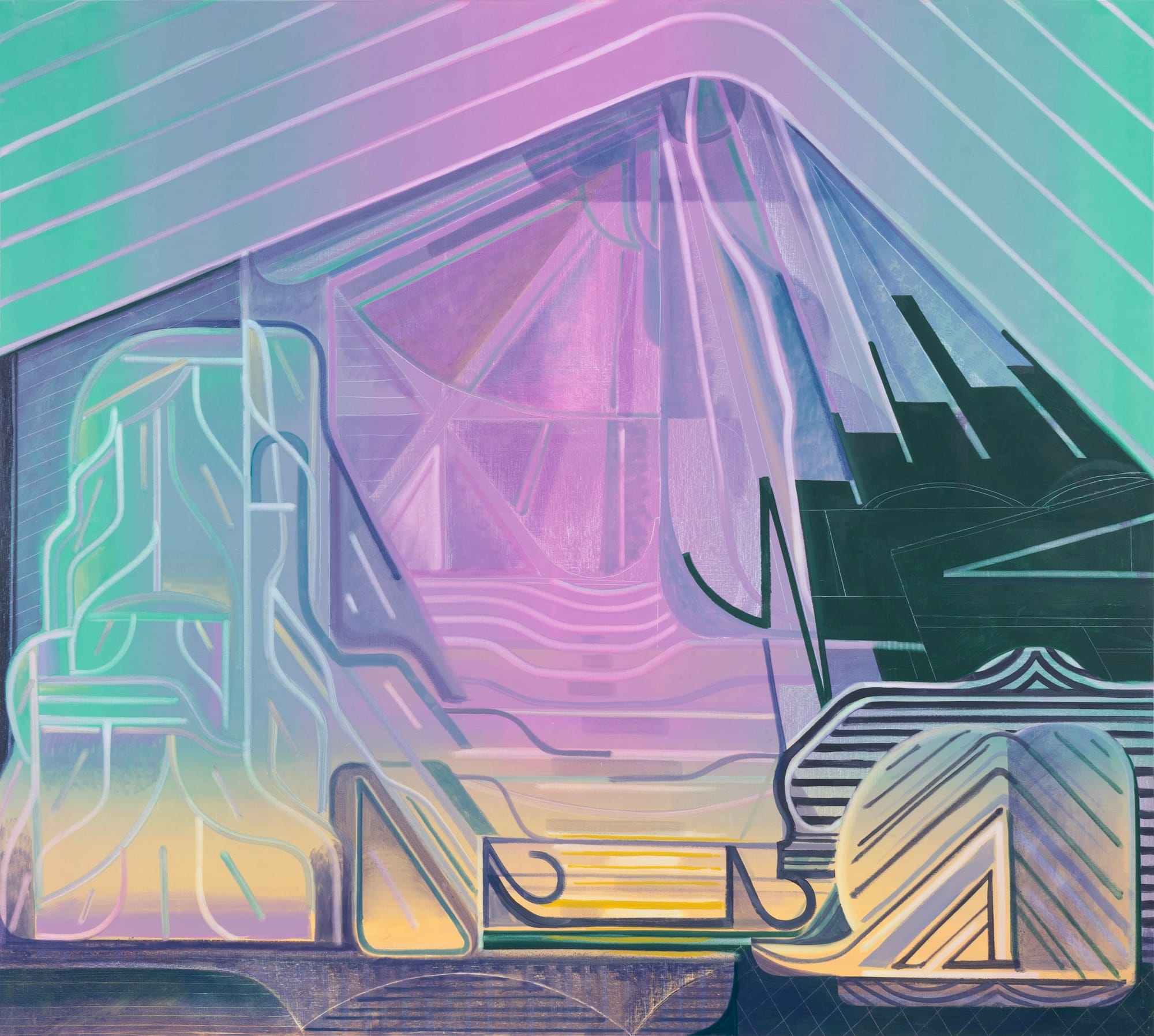
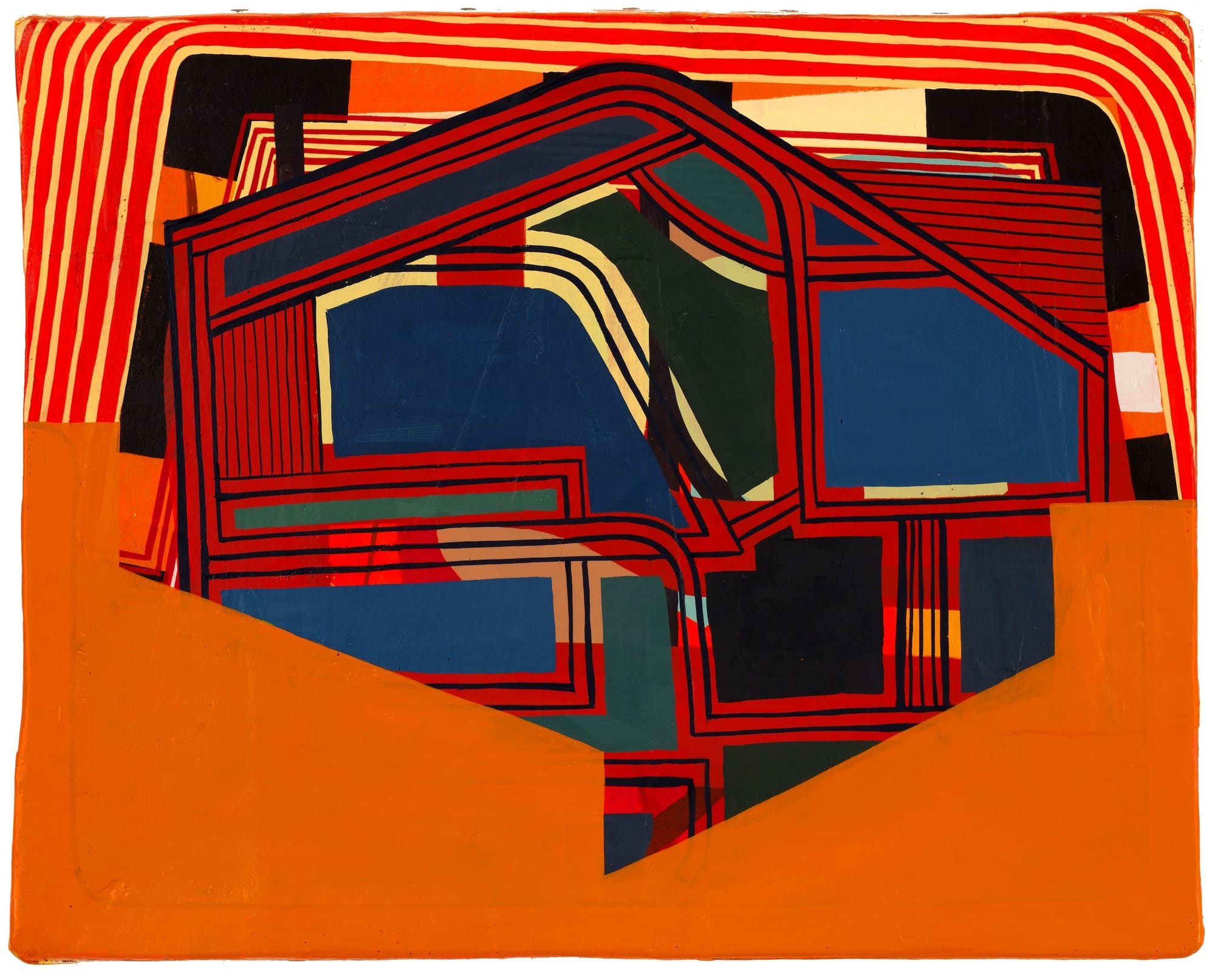
Although best known for his abstract paintings, Burckhardt has also created walk-in installations, plein-air paintings in Maine (where he spends his summers), and intimate collage paintings on found book pages. His most recent abstractions exude an otherworldly light, allowing suggestive forms to breed and layer. He uses and manipulates the logic of grids, directional axes, and linearity while combining colors and forms that invoke a range of visual culture: art historical images, banal patterning, and mechanistic animation.
Burckhardt was born in New York City in 1964, received a BFA from the State University of New York (SUNY) College at Purchase, and studied at the Skowhegan School of Painting and Sculpture. His work has been exhibited at museums including the Bowdoin Museum of Art in Brunswick, Maine; the Columbus College of Art and Design in Ohio; the Weatherspoon Museum in Greensboro, North Carolina; and the Center for Maine Contemporary Art in Rockland, Maine. He has received solo exhibitions at Tibor de Nagy Gallery, George Adams Gallery, and, most recently, High Noon Gallery, all in New York. This interview has been edited and condensed for clarity.
Hyperallergic: You grew up in New York City with artist parents. How did that affect your path as an artist?
Tom Burckhardt: My parents, Yvonne Jacquette and Rudy Burckhardt, were both artists. As a kid, I perceived artmaking as a very normal, regular activity. It was not mysterious, and I'm grateful for that, because that understanding has sustained me as an artist. I understood that, first and foremost, you are fulfilling your own creative interest. My parents were neither failures nor huge successes in the art world. It was very middle-ish, and the middle is a great position.
My father was someone who a lot of people admired, but he was almost pathologically modest. John Ashbery famously called him an “underground monument.” He made about a hundred films, along with his photographs and paintings. He had a “lowfalutin” style of aesthetics. That's a model for me.
My parents knew Red Grooms and Mimi Gross and they were amazing inspirations. Their work had instant accessibility. They were examples of tremendous energy, along with a tremendous lack of pretension. Later, I ended up working for Red for many years.
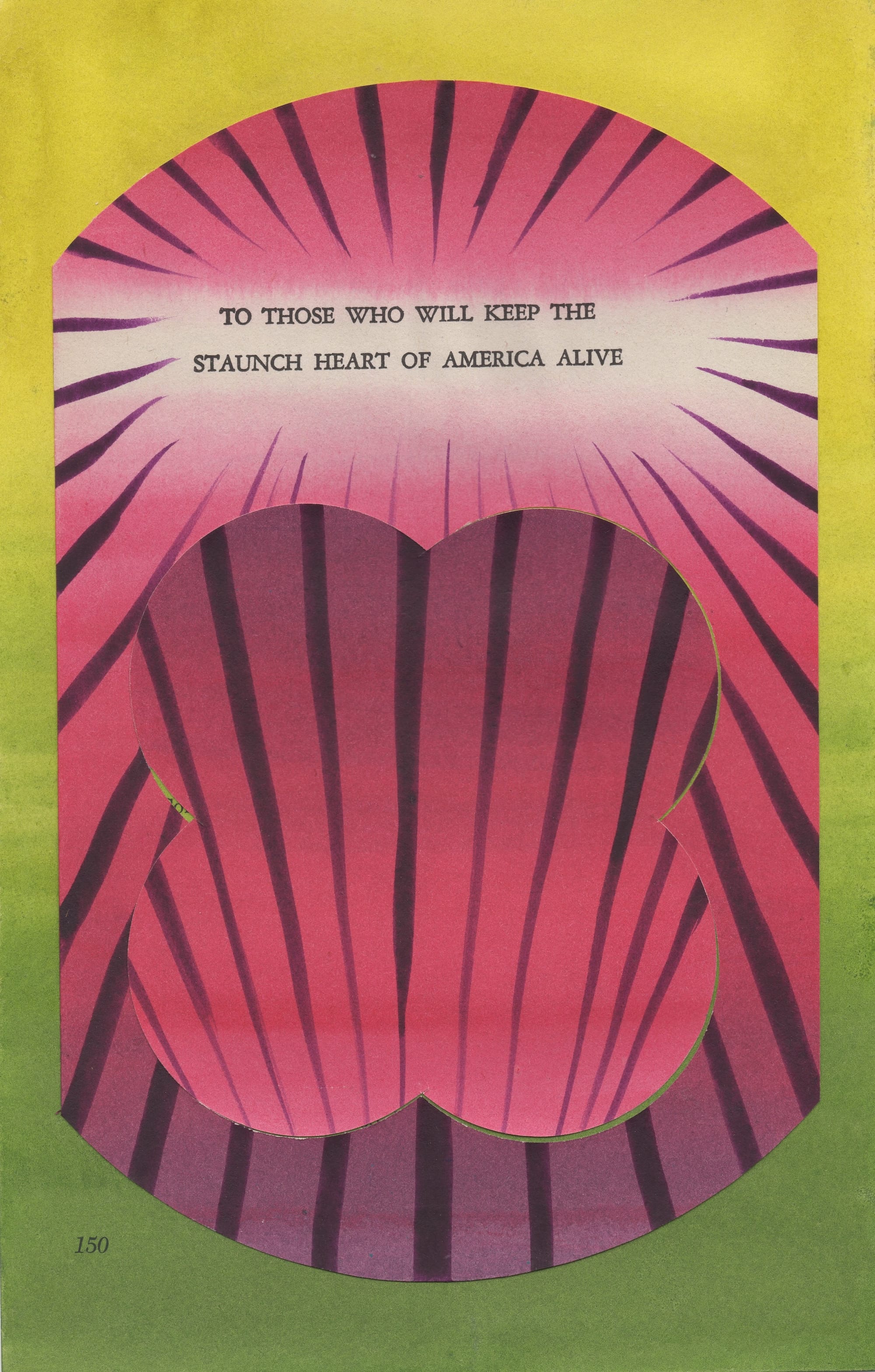
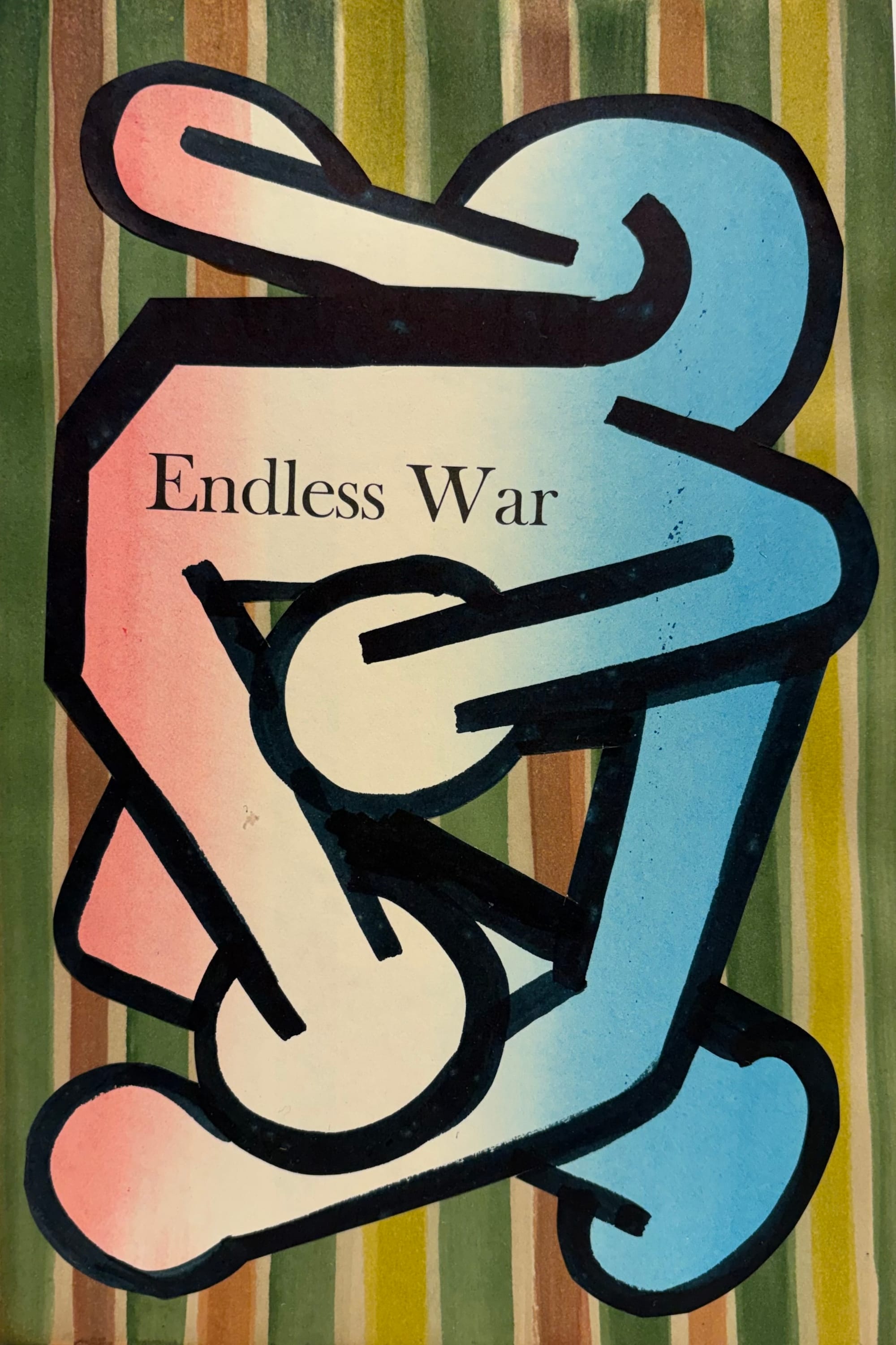
Tom Burckhardt, “Staunch Heart Of America” (2023) (left) and “Endless War” (2025) (right), both ink on book page (images courtesy the artist)
H: Can you tell me about your experience getting your BFA at SUNY Purchase and then studying at Skowhegan?
TB: I worked with Nancy Davidson at the end of my time at SUNY Purchase. She was a fresh voice, compared to some of the other professors, who had gone to Yale and had a certain methodology and deliberateness. I took an existentialism class that was very influential. I realize now that French existentialism is not actually funny, but it's adjacent. I picked up on the absurdity, rather than the nihilism.
From there, I went to Skowhegan. Bill Jensen, Judy Pfaff, and Peter Saul were teaching that summer. They were each so different aesthetically. Bill Jensen was a model for a quasi-mystical, committed artist. Judy was very practical in her advice, and kind. We were both using enamel paint and one day she left $30 worth of paint cans on my doorstep. Wow. I'll always remember that. Peter wanted to upset us, and I thought that was great. He called us all yuppies.
At Skowhegan, I listened on tape to a slide lecture that Mary Heilmann had given the year before. It had a big influence. Her laconic approach is the opposite of the big AbEx boys, and their puffed-out-chest attitude. Her sensibility seems more fitting with my generation, coming up in the 1980s and ’90s. It was a more pluralistic place. We were allowed to choose multiple things from the menu.
H: I know that you chose not to pursue an MFA in graduate school, but you began traveling in Southeast Asia and India. What was that experience like?
TB: I decided to take whatever money I might have socked away for graduate school and travel. That felt more valuable experientially, artistically, visually.
I remember looking at these amazing signs in Thailand and thinking they were the most ravishing visual things. I had no idea what they were trying to tell me. The actual transmission of meaning was short-circuited by a cultural and language gulf, but the visual transmission was fantastic.
H: Can you tell me about some of your early work, including abstractions using enamel paint and your 2005 installation piece?
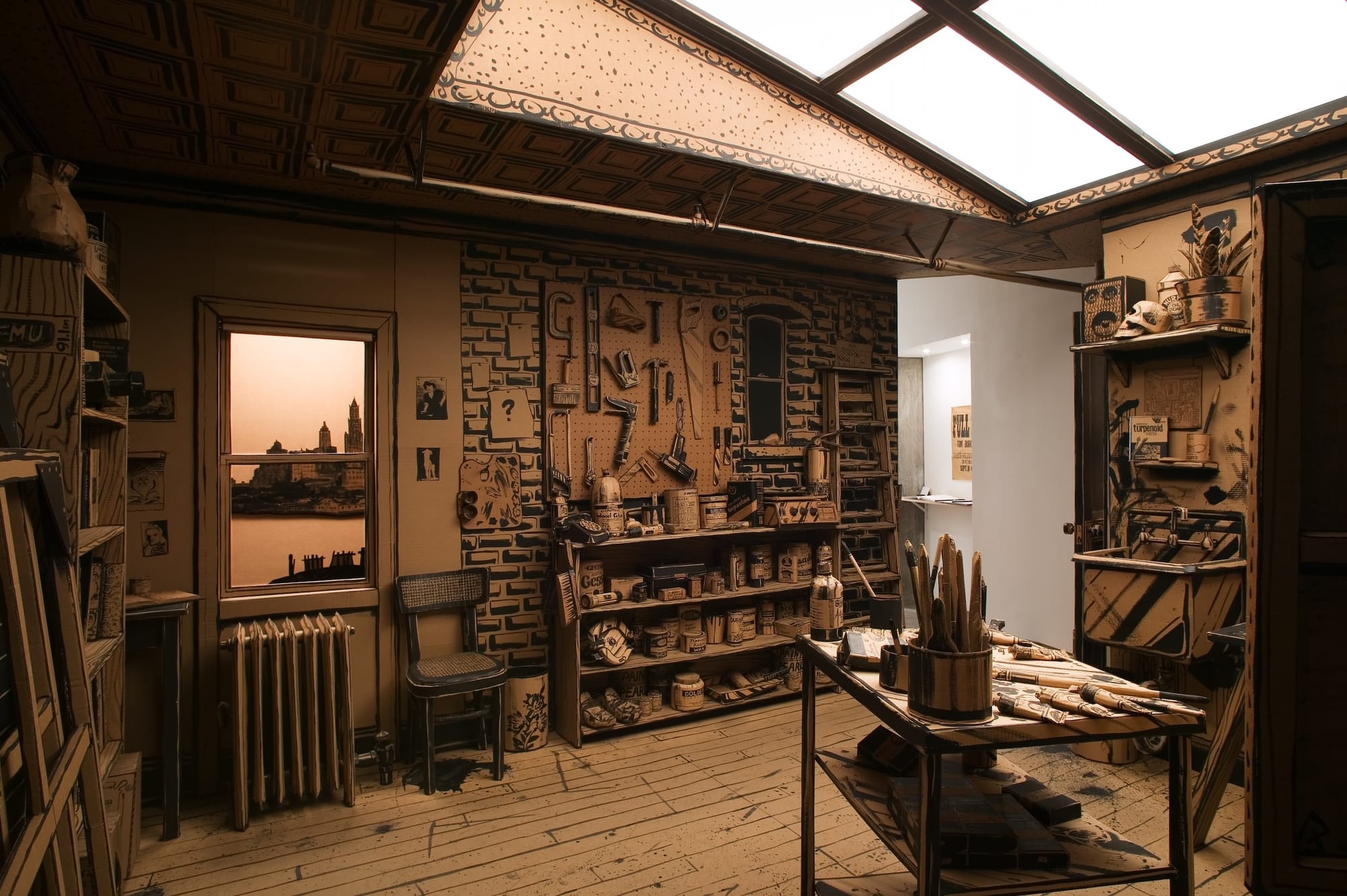
TB: For 15 years as a young artist, enamel was my paint. It has a very thin profile, and I could keep painting without the overwrought, clotted quality that oil paint can get. Working in enamel was almost like being an abstract Pop painter. When I eventually switched to oil paint, the way I painted was very influenced by those 15 years. I want to have sharp edges that feel like they're cut with scissors. From there, I made a major pivot, creating a large-scale installation piece, “Full Stop.” It is made of cardboard and replicates an artist’s studio. It’s about a painter who doesn’t know what to do anymore and grinds to a halt. The installation is full of fake cardboard canvases with dots on the side that look like tacks.
This led to making paintings on cast plastic supports. They were influenced by Allan McCollum's surrogates. It was the time when “provisional painting” was around. I was thinking that a stretched canvas already has quality. It’s halfway there. So instead I made molds of canvases, and started with a plastic cast. It was a conceptual gesture meant to squash down the quality level to a deficit. Then, to make up for it, I would have to do real serious painting with integrity.
H: You have consistently engaged parallel activities as an artist. These include your collaged book pages, road sign paintings, and installations, along with your abstractions. How have the different series and media fed one another?
TB: It is a matter of keeping interest and excitement instead of doing the same thing. I need to feel like I am new enough at something to kind of discover it. I don't want to just steer the work, I want to participate in it. When I've kind of settled into modes of knowing exactly what I'm doing, the work gets very stuck.
Since I was a younger artist, I've always taken issue with trying to enforce purity in abstraction. It telegraphed a certain kind of elite thinking that you had to achieve through education or being allowed into the club. Its full understanding could only be found with foreknowledge and the wall label. I wondered if abstraction could be funny. How would you achieve that? I think you have to muddle it with figuration. Bodies are funny, circles and squares not so much. I think of Mary Heilmann’s work as funny, because she tweaks the purism and the structure with her messed-up grids and finger painting.
All of my work is about ways to hybridize abstraction with something impure and taint it from its well-trod but also problematic place, which is self-important and insistent on its own wisdom. The border between the figurative and the abstract is the impure place, that “bad abstraction.”
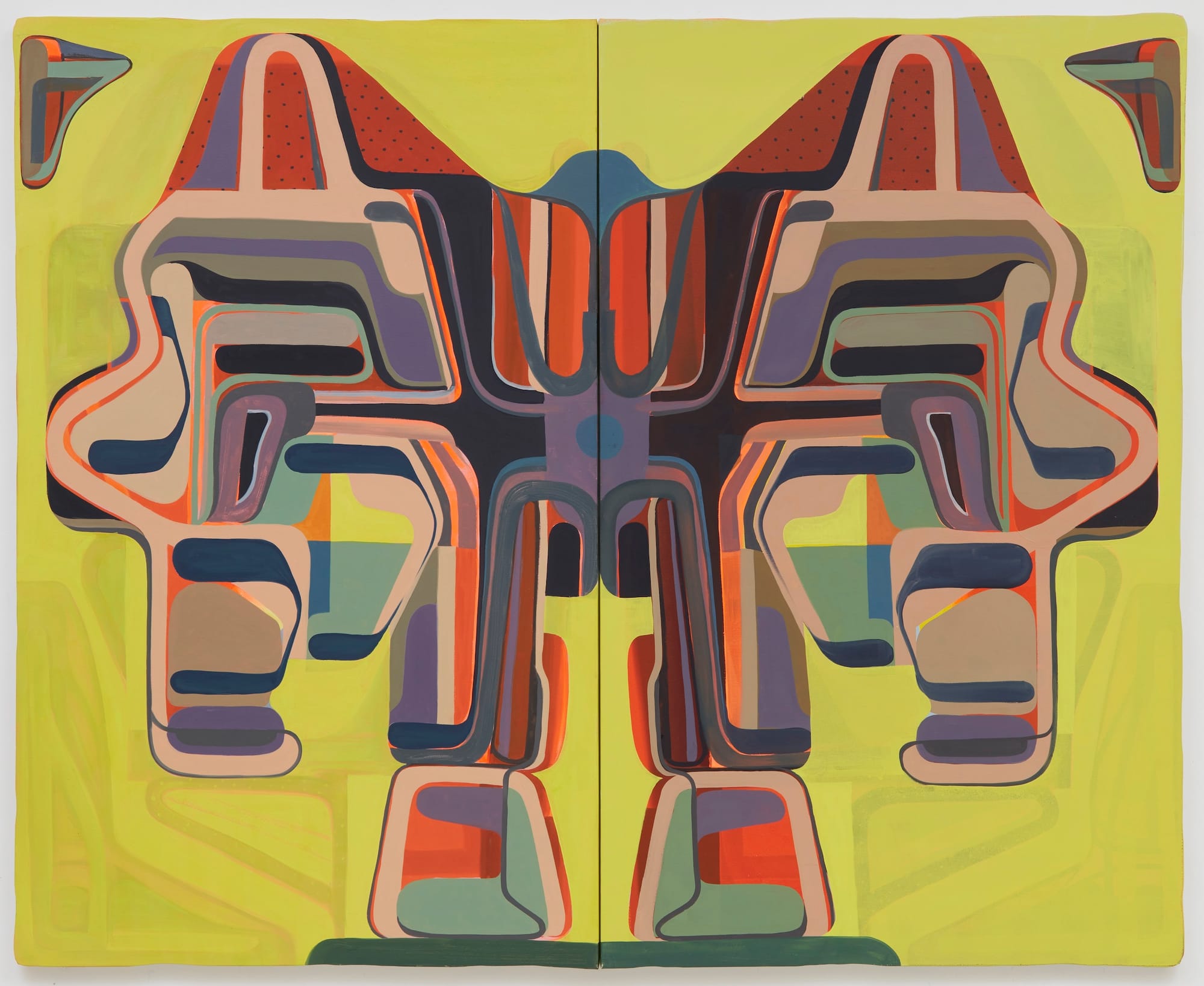
H: More recently, your paintings reference Rorschach inkblot tests and the concept of pareidolia. How do these forms in your work evolve as you construct a painting?
TB: I want to play with the mechanism of pareidolia — which is the tendency to perceive specific figurative forms within random visual stimuli. For the viewer, it is an echo of creating the painting. We reassemble the forms in terms of meaning. Abstraction is reflective; it is mirror-like. That can be confusing or uncomfortable for people to engage with.
When I start a painting, I am making very basic formal moves: colors and shapes, lines and trajectories, speeds and angles. That is activating my arm and hand. They are not associative. But if you step back, these lines start to feel like they're articulating something. If I was a “good” abstract painter, I would get rid of two circles and a line that looks like two eyes and a smile. But I’m in love with the original lack of intent that can lead to recognition.
The Rorschach device is an ink blot — an accidental creation — that is folded to create a symmetrical pattern. Because we have such a strong relationship to symmetry, we recognize it as important, rather than random. They are designed to articulate the salient, experiential things within us. Herman Rorschach was influenced by the German philosopher Robert Vischer’s concept einfühlung, which means “feeling in.” It’s about the connection between us, our psyche, and things in the world. We animate them with “feeling in.” It's the participatory aspect that I’m after.
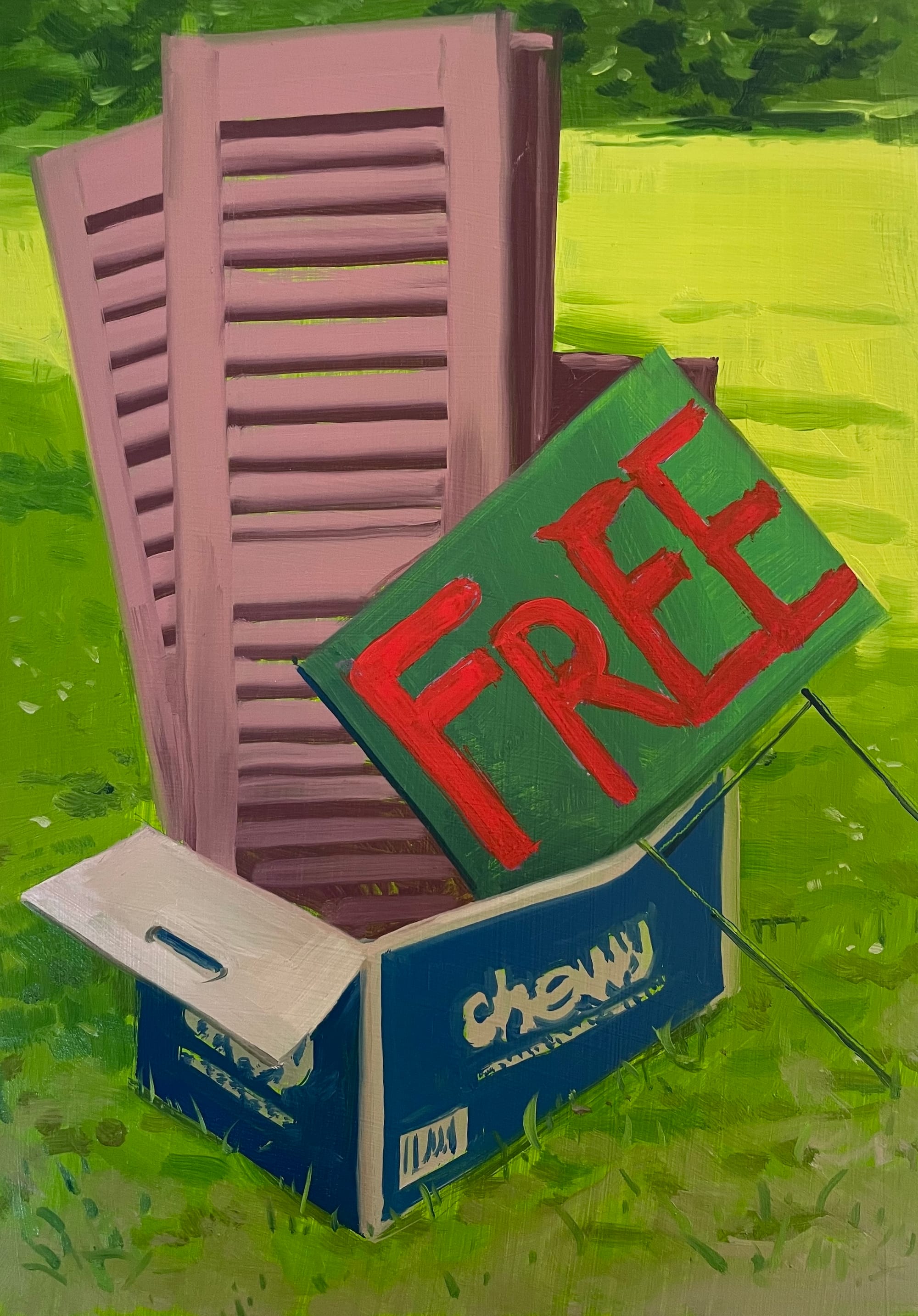
H: Can you tell me about your interest in what you call “found text”?
TB: The title of my last show was FRESHF LOWERS. It comes from a store sidewalk awning — a misprint of “Fresh Flowers.” I thought about how it unintentionally expressed what we are going through politically: fresh lows. Every day is a fresh low.
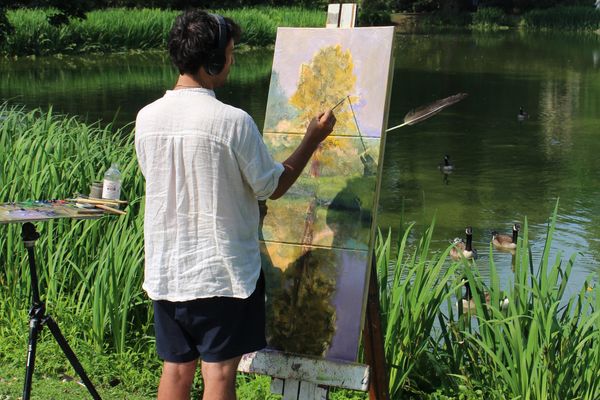
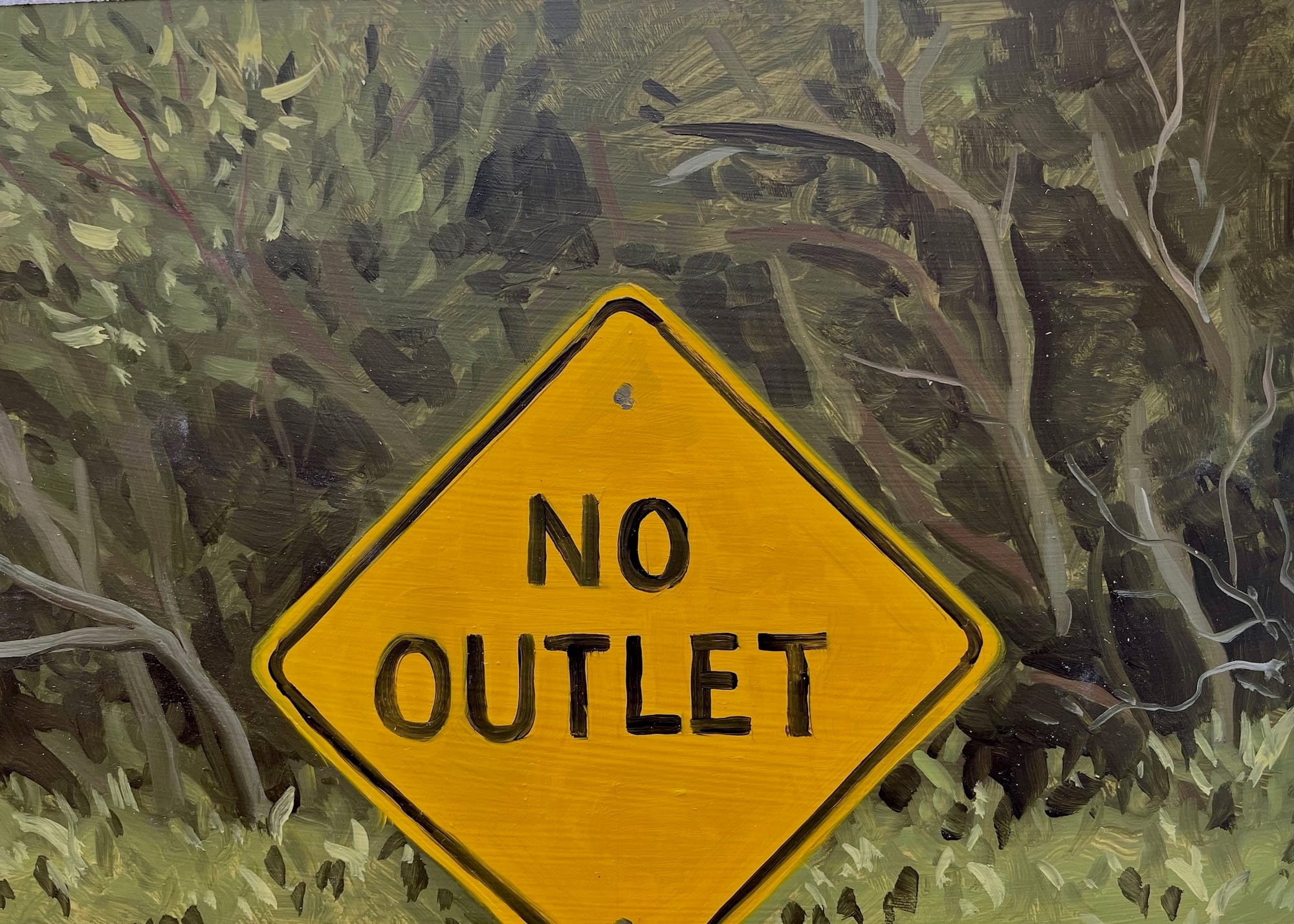
In Maine, where I live and work in the summer, I make plein-air road sign paintings. By the side of the road there are so-called “free piles” of giveaway items. A sign that says “free” will be in front of an abject still life, that might include a single barbell, a milk crate, and an old football. Seeing that word “free” repeated can lead to considering all of its meanings. It is supposed to be the foundation of this country. Yet here it is, describing a bunch of crap. Then, there is the political way it is battled over and very much a question right now. Who gets to own it?
A word can be repeated and rolled in your mouth to the point where you disassociate from it and lose the meaning. The ridiculousness of it comes forward. It untethers from its functionality. My favorite phrase lately is “mouthfeel,” which is used in relation to food and drink. I’m thinking about that textural quality as a parallel to the paintings. In poetry, the feeling of the words becomes prominent. The expediency of narrative is not the point.
H: What does that materiality in painting represent to you?
TB: The physical object of the painting has been important to me. The thingness of it, the lumpy funk to it, rather than the perfect stretched canvas. For a while, I cut the edges of my paintings with a jigsaw. It gave them a wobbly edge which made them more object-like, less perfect, and more human.
I have no interest in perfect people, whereas people that have experiences and foibles and stories are great. They are individuals. I still think of paintings as being like personas and the dawning of recognition as a process.
Paintings can show their humanity — with decisions made, changed, and new ones layered on top. I like the gesture of not knowing, not being overconfident or prideful. My process is apparent, so that, hopefully, if you look at the paintings, you relate to me, as another person decoding and figuring things out.