Cuban Artist Luis Manuel Otero Alcántara Exiled to the US
The dissident artist arrived in Miami after serving five years in a maximum-security prison outside Havana.

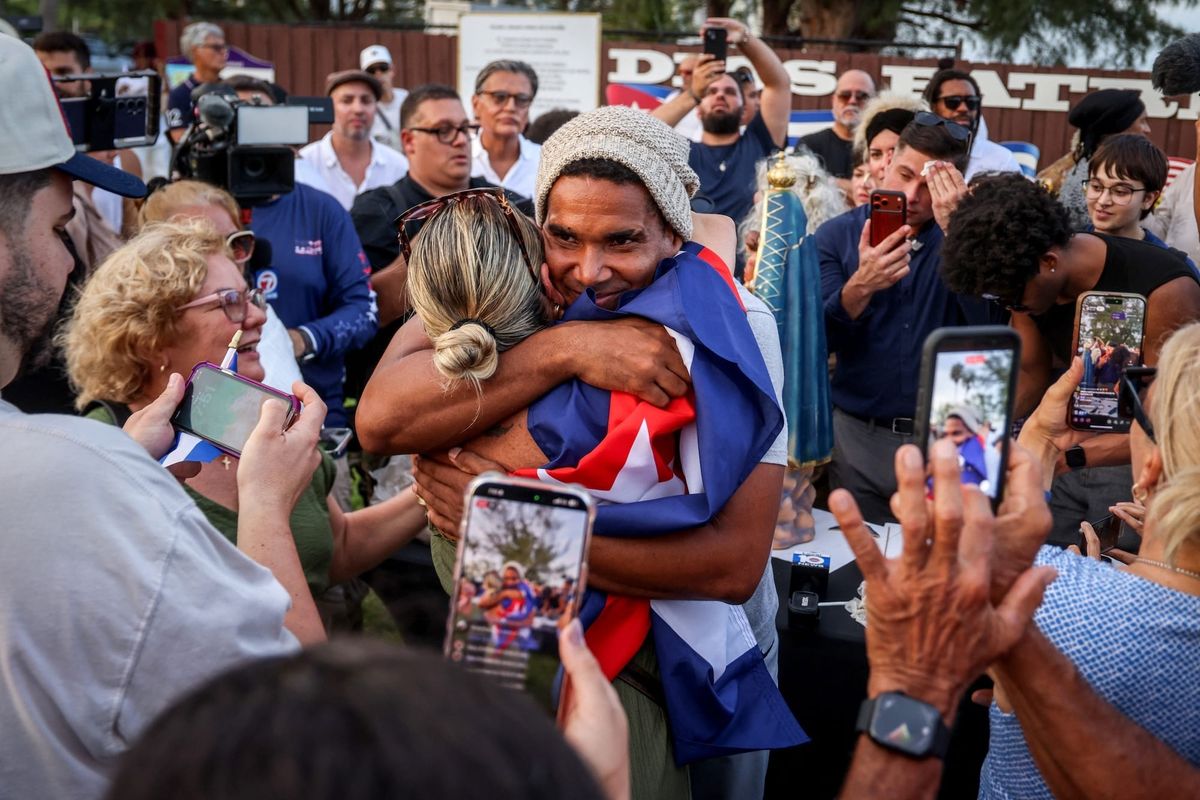
After over a week of ambiguity surrounding his whereabouts following his scheduled release from a five-year sentence for “contempt, defamation, and public disorder,” Cuban dissident performance artist Luis Manuel Otero Alcántara arrived in Miami on Saturday, July 18.
A self-taught artist, Otero Alcántara co-founded the San Isidro Movement (SIM) in 2018 alongside other artists and scholars organizing against Decree 349, a Cuban law requiring prior state approval for all public and private performances and exhibitions.
“As the end of his sentence approached, his support team contacted the US Embassy in Havana to request humanitarian parole for Luis,” said SIM member and Cuban-American artist Coco Fusco, who liaised extensively with Otero Alcántara during his incarceration and advocated for his unconditional release, in an email to Hyperallergic.
“We assume that he was taken to what Cubans call a 'protocol house' — an official state residence used for keeping dissidents incommunicado,” Fusco continued, expanding on what may have happened to the artist after the state removed him from prison on July 7. She added that as soon as the United States State Department approved his humanitarian parole on July 17, the Cuban Foreign Ministry put Otero Alcántara on a flight to Miami the following day.
The artist was detained and arrested in July 2021 while he was on his way to participate in the historic anti-government protests targeting resource shortages and waning civil liberties. Just two months before his arrest, Otero Alcántara, who had been detained several times for his activism and art, was forcibly hospitalized by the state after embarking on a hunger and fluid strike to protest the confiscation of multiple artworks during a police raid on his studio.
Otero Alcántara was held in custody and moved to the Guanajay maximum-security prison before being handed his five-year sentence for “crimes of insulting the symbols of the homeland, contempt, and public disorder” in June 2022. In mobilizing against Decree 349, Otero Alcántara personally invoked the Cuban Flag in live and documented performance work, alongside other symbols critical of the government. The artist initially declined the government's offer of exile in exchange for release, as he indicated in a letter published by Hyperallergic ahead of his sentencing.
However, Otero Alcántara eventually accepted exile while serving time, telling El País, “I never thought of leaving, but the regime has insinuated that there’s no option for me to walk through the streets of Cuba, because of the threat they’ve made me believe I am, or that people believe I am.”
“I realize that the art I make represents a danger for them,” the artist continued during the 2024 interview with the Spanish newspaper. “The options are between exile, or remaining [in Cuba] and always being in trouble.”
Fusco pointed to two other prominent political prisoners, Felix Navarro and José Daniel Ferrer, who were arrested in 2021 and paroled in 2025, only to be arrested again shortly thereafter, in her email correspondence with Hyperallergic.
The artist's partner, curator Claudia Genlui Hidalgo, wrote that “Alcántara is treated differently from the rest of the prisoners” in the foreword of an interview with the artist for Hyperallergic in 2023, reporting that he was routinely denied his right to personal phone calls and letters, and “subjected to harassment and psychological torture.” Nevertheless, from myriad hunger strikes over the brutality in Guanajay and the detention of political prisoners, to honing in on drawing and participatory conceptual art, Otero Alcántara continued his activism and art practice while incarcerated.
“I am very glad that Luis does not have to suffer the deprivations he lived with for five long years,” Fusco said, noting that the artist wants to enjoy his new life in the US and continue his art practice. However, she recognized “forced exile is just one more injustice committed against him.”
Though Otero Alcántara is no longer incarcerated, other dissident artists, including Grammy-winning rapper and fellow SIM member Maykel “Osorbo” Castillo Pérez, remain behind bars as political prisoners. Pérez, whose song “Patria y Vida” (2021) became emblematic of the July 2021 protests, was arrested alongside Otero Alcántara and sentenced to nine years in 2022.