DHS Appropriates Japanese Artist’s Work in Racist X Post
Hiroshi Nagai, best known for painting leisurely beach and poolside scenes, told Hyperallergic that he is “at a loss” after the agency used his work to promote its agenda.

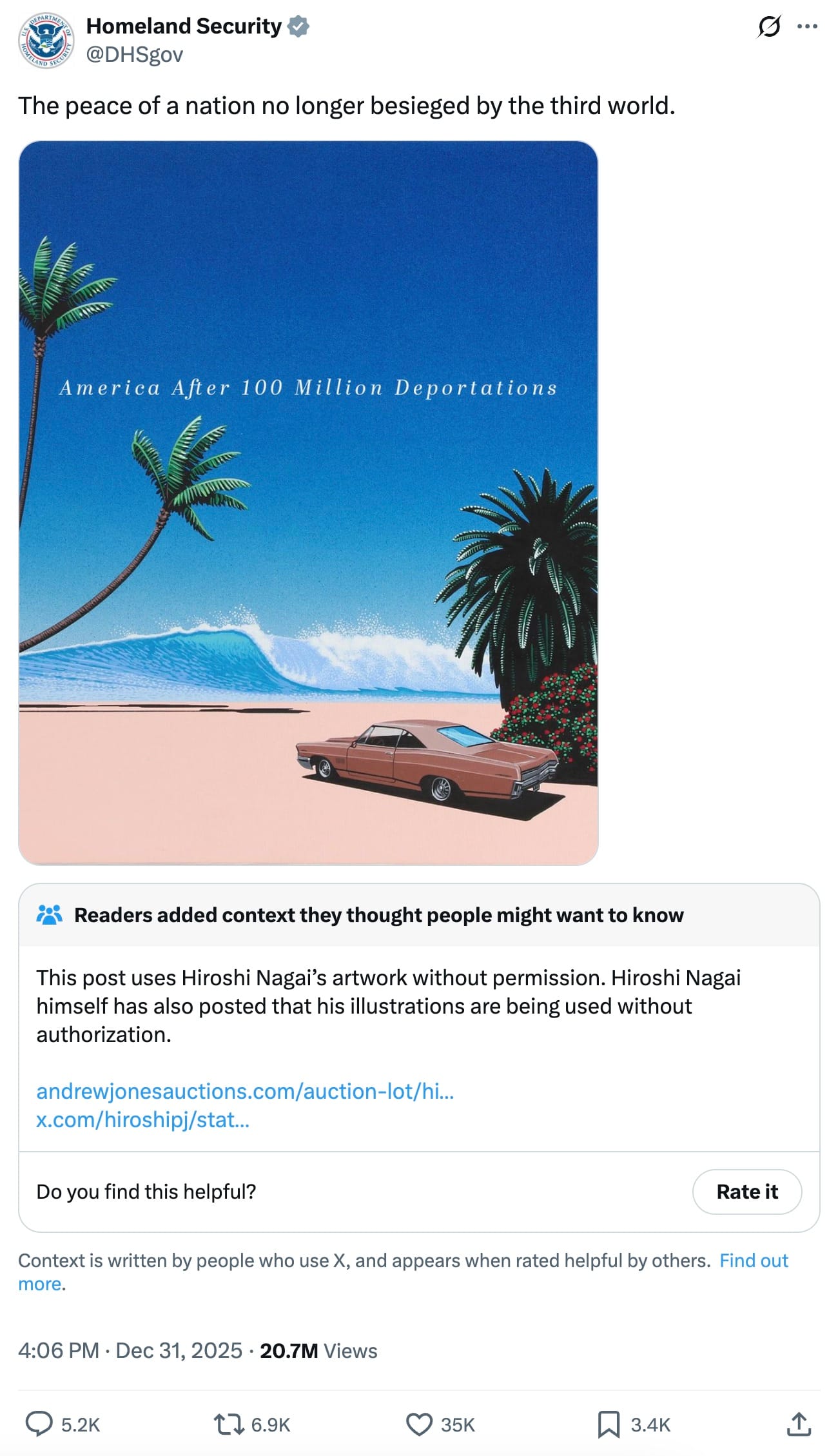
On December 31, 2025, the official X account of the US Department of Homeland Security (DHS) appropriated an artwork by Japanese artist Hiroshi Nagai. The original painting, which depicts a lush beachside scene with palm trees, surging waves, and a pink Buick Wildcat, was cropped and superimposed with the phrase, “America After 100 Million Deportations.” The text of the post reads, “The peace of a nation no longer besieged by the third world.”
A 2024 record from Andrew Jones Auction identifies the work as an untitled 2017 painting from Nagai’s Beachcomber series. However, neither the artist nor the fact that the image derives from an artwork is acknowledged in the DHS post. Moreover, the appropriation was unauthorized, as the artist confirmed soon after in a repost: “The U.S. Department of Homeland Security is using my artwork without permission ... What should I do …”
“Since the other party is so large, I’m honestly at a loss,” Nagai, age 78, told Hyperallergic in an email. “I’m disappointed and cannot hide my surprise that a government agency — which is supposed to be strict about copyright — is using my work without permission and attaching political messages that I do not endorse.”
Months earlier, the DHS and its then-Secretary Kristi Noem had already come under attack for their unauthorized use of copyrighted artwork and music in social media posts, including paintings by Thomas Kinkade and Morgan Weistling and music by Sabrina Carpenter, Olivia Rodrigo, and Zach Bryan, among others. None of these instances of use was permitted by the artist or rights-owner nor supported by proper citation.
While platforms often remove videos that use protected music, image copyright is harder to enforce. The DHS’s post now bears a Community Note that cites Nagai’s X statement and clarifies that the artwork was used without permission, but the image has not been removed. Meanwhile, DHS has remained undeterred by social media backlash. In response to requests for comment on the agency’s use of the work by Nagai, a department spokesperson told the Guardian, the Independent, and the Daily Beast that it “will continue using every tool at its disposal to keep the American people informed as our agents work to Make America Safe Again.”
Nagai, who has been active since the 1970s, is best known for his album cover designs — most famously for Eiichi Ohtaki’s A Long Vacation (1981) — which helped define the visual aesthetic of Japanese city pop, an upbeat, optimistic genre meant to be listened to on the go.
His work often features beaches, pools, palm trees, waves, and modernist architecture, conjuring up scenes of comfort and leisure that reflected the aspirations of Japan’s middle class during the economic boom of the 1980s. He uses bright acrylic colors; his strokes are disciplined, almost mechanical; his forms are clean and precise. This visual language can be traced to his early career as a graphic designer, as well as the influences he has cited — from American Pop art and Surrealists such as Salvador Dalí to modernist architects like Le Corbusier and Junzo Sakakura, who advocated social reform through purist, absolute aesthetic principles.
In a 2017 interview, Nagai described his travels in the United States in the 1970s, in particular a trip to the West Coast, as pivotal to his artistic development. He recalled the long shadows cast by cars in an airport parking lot under the Californian sun — imagery that recurs in his paintings and lends them a nostalgic and timeless quality. His work rarely depicts specific places; instead, it presents Japanese audiences with idealized visions of happiness modeled on the Californian upper-middle-class lifestyle, propped up by swimming pools and luxury cars.
One notable feature of Nagai’s paintings is the absence of the human figure in the context of markedly manmade leisure spaces. “I avoid including people because their presence creates a narrative, and I want to build a surreal world,” Nagai said in the email. Paradoxically, this makes his work more susceptible to recontextualization and appropriation. In the DHS post, Nagai’s city pop imagery takes on white supremacist projections of a purified society and a utopian time of economic and technologically enabled abundance — both an imaginary past and future, fundamentally severed from reality.