Don't Believe What Art Basel Qatar Is Trying to Sell You
I fled Qatar to live freely as a queer person. A country that criminalizes LGBTQ+ existence should not be celebrated as a global hub of creative freedom.
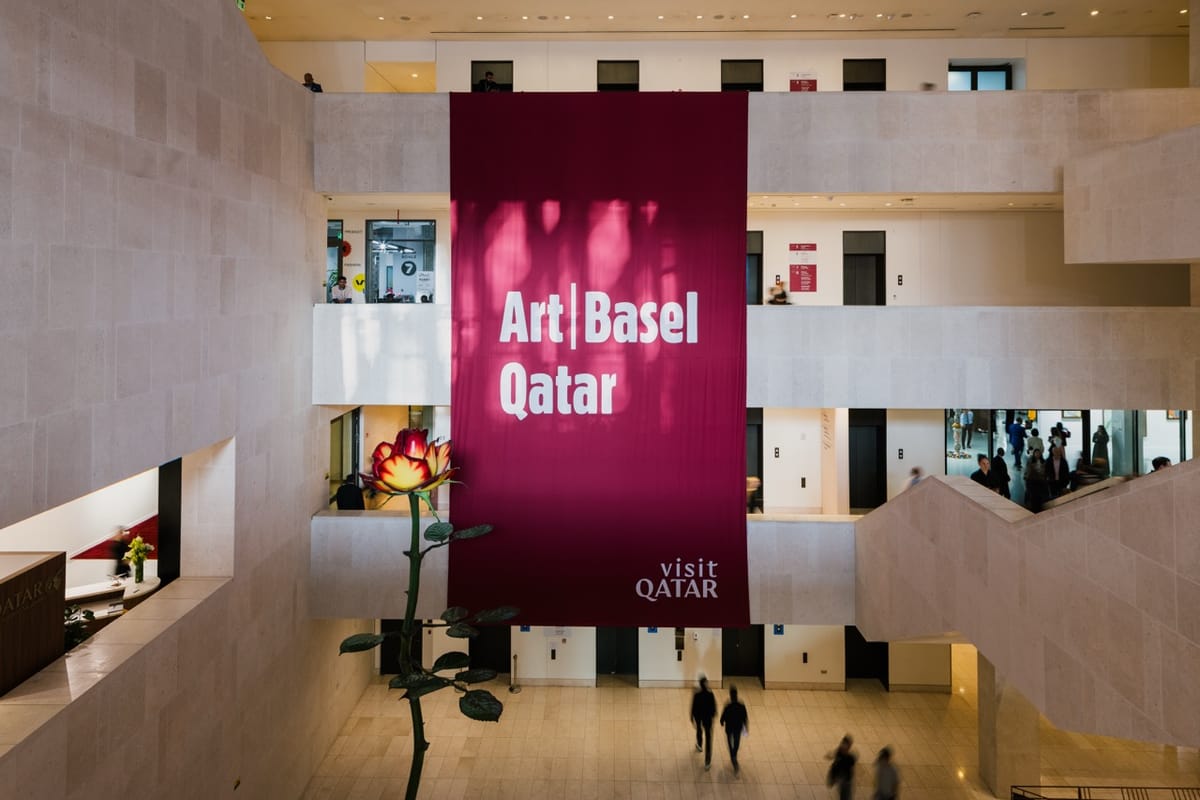
Art Basel Qatar debuted in February as, in its own words, a showcase celebrating Qatar’s “vibrant cultural landscape” and “dynamic arts ecosystem.” This is not the Qatar I know.
I grew up in Qatar as a queer person. In Qatar, LGBTQ+ people are silenced. Stepping out of line comes with severe punishment. It is not safe to challenge your family, the country, or religious teachings. You are forced to disappear in order to survive.
The open and vibrant Qatar presented through Art Basel is not the state that exists.
The system I grew up in Qatar was a totalitarian, authoritarian dictatorship. A ruling family keeps passing control of the country and all of its resources from generation to generation. It's an extremely classist system: who your family is and your relationship to the ruling family dictate the power dynamics. It’s a country with nearly three million people, in which the Qataris are a minority. I was a minority within that minority.
I grew up in what I now recognize as a propagandized environment. It was a nation-first, strongly Islamist upbringing where we were taught to honor God and the nation above all. We were raised with duties, and one of those duties was to form a family. I was taught that I did not have the freedom to believe differently. I did not have the freedom to choose for my own body or who I loved. Even my straight peers did not fully have those freedoms.
While I was growing up, a lot of the things you see in the news about Qatar did not exist yet. It really was a desert. I didn’t have access to the internet. I only spoke Arabic and didn’t even have the word for what being gay meant. Stepping out of line came with severe punishment. It was not safe to challenge your family, the country, or Islamic teachings. I went to medical school at Cornell University’s campus in Qatar and started traveling to New York. That’s where I leaned more into my identity, and I knew I could not go back. After my training in 2015, I fled to California and filed for asylum.
Qatar sits on significant resources like oil and gas, and hosts the largest US military base in the region. To maintain control over those resources and that military strategy, Qatar must appear modern and diplomatic to the outside world.
Qatar brings the world to it. It brings world leaders to a small patch of land and hosts some of the biggest events, including the FIFA World Cup and Art Basel. It aligns itself with the value systems of those platforms so that the world meets it through them. As these platforms grow, they become sentiments that dictators can take and tug on, because they can control people and control perception. This is textbook artwashing.
Visitors are allowed to be themselves. They can have agency over their bodies and beliefs. They can even be openly gay. They bring money, relationships, and legitimacy. Many see that locals do not have these freedoms, but speaking out comes at a personal and diplomatic cost. The global art and sports worlds continue to celebrate these events while turning a blind eye to the people who cannot live freely there.
When I saw that Art Basel would debut a fair in Qatar, I felt compelled to speak out. Art is all about freedom of expression. By bringing a major international art event to Qatar, you promote the false notion that this is a place where people can be free to express themselves artistically and otherwise. That’s blatantly untrue. A country that criminalizes LGBTQ+ existence should not be celebrated as a global hub of creative freedom.
My story is the plea of a queer person, but it is also about a system of power that never wanted me to be fully human. And yet the world continues to celebrate Qatar’s cultural rise as if these human realities do not exist.
When I think of art, I think about pushing boundaries without punishment. When I think of the World Cup, I think about belonging and people coming together as equals. These are platforms where humanity merges.
But authoritarian governments can take these platforms and shape perception. Even when people are aware of the fabricated image, it still works. The World Cup itself is a perfect example: Even after numerous reports about the abuse of migrant workers, the games continued. That is why the spotlight must shine on the entire reality and not just what governments want you to see. The art world cannot claim to champion freedom while ignoring the people who are denied it.
Artists and cultural institutions have the same responsibility I do: Bring your full truth everywhere. Do not code-switch. Do not dim your values. There is no reason for a human to be less human, and there is no reason for art to be anything less than expressive and powerful.