Artists Issue Urgent Call to Defend First Amendment Rights
In New York City's Federal Hall, where the Bill of Rights was introduced, cultural leaders decried attacks on free expression, from book bans to censorship.

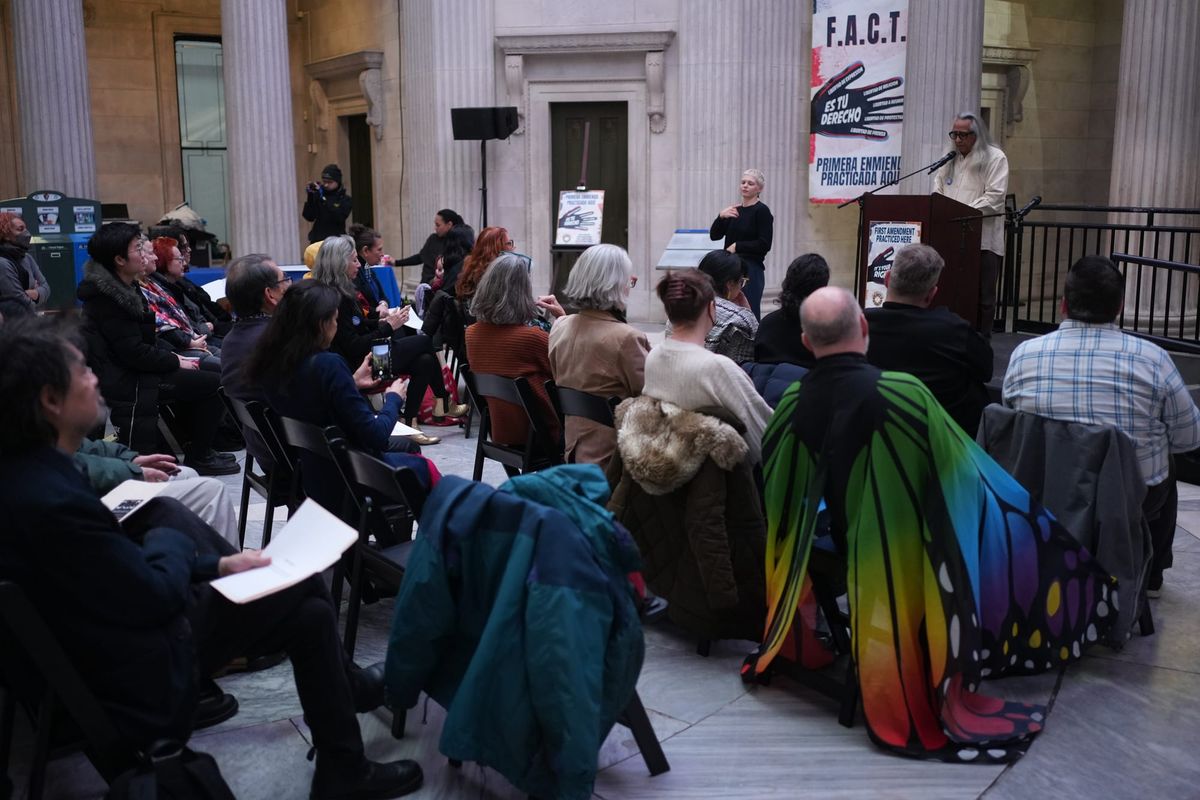
A group of cultural leaders, artists, and local politicians gathered today, December 15, at the Federal Hall rotunda in New York City, where the Bill of Rights was introduced 234 years ago, with a deceptively simple message: “The First Amendment was born here; we will not let it die here.”
Co-organized by the National Coalition Against Censorship, New Yorkers for Culture & Arts, and the First Amendment Culture Team (FACT), the event brought together members of the city's arts community, including Coco Fusco, Karen Finley, and George Emilio Sánchez, in defense of creative freedom in the United States.
Among the speakers was at least one artist who has been directly targeted by the Trump administration. Felipe Galindo Feggo's illustration of migrants watching July 4th celebrations through a border fence was withdrawn from a display at the Smithsonian Institution's National Museum of American History after the White House included it in a list of objectionable artworks. The gallery dedicated to Latine art where Galindo's work was being shown was quietly shuttered ahead of schedule, Hyperallergic reported in August.
“I am proud to be an American of Mexican heritage, yet today I also feel vulnerable,” Galindo said in his address. “I cannot help but ask: Is this how artists in Hitler's Germany felt when their work was labeled ‘degenerate’ art?”
“Freedom of expression is a cornerstone of democracy, and every attempt to suppress it must be fiercely resisted,” he continued.
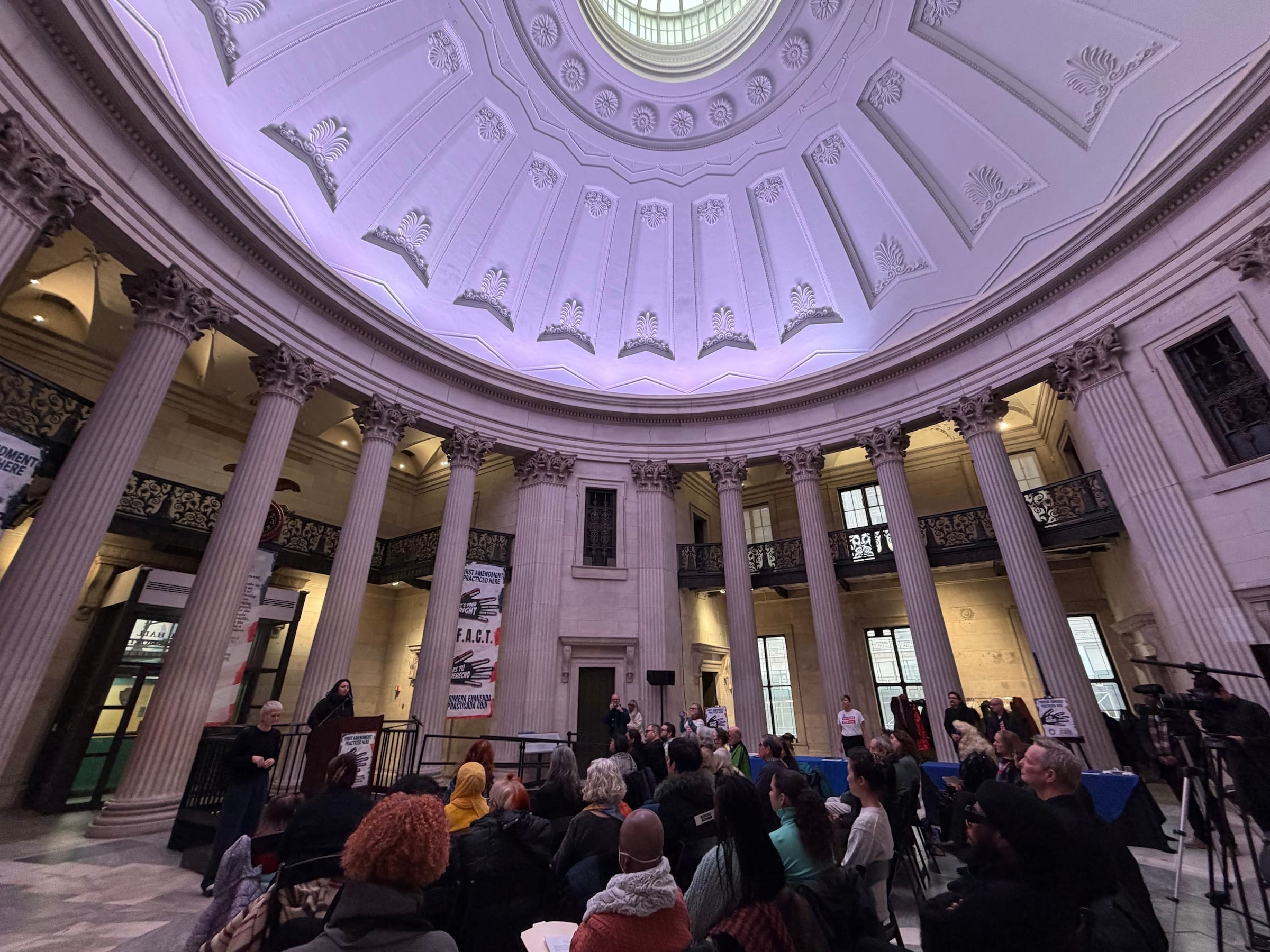
The hour-long “First Amendment Day Rally” drew a small crowd of just around 50 attendees to the admittedly rarefied confines of the Federal Hall rotunda in a city that's seen as a progressive stronghold. But the issues raised by participants — not only the censorship of individual artworks, but also mass book bans, federal funding cuts, and right-wing attempts to erase Black and LGBTQ+ history — are having far-reaching and devastating consequences across the nation. Speeches were punctuated by live performances, from poetry by Carl Hancock Rux and a reading of the 14th Amendment by Fusco to the a cappella vocals of Madison Lindo and Jay Rodriguez Sierra's soaring saxophone.
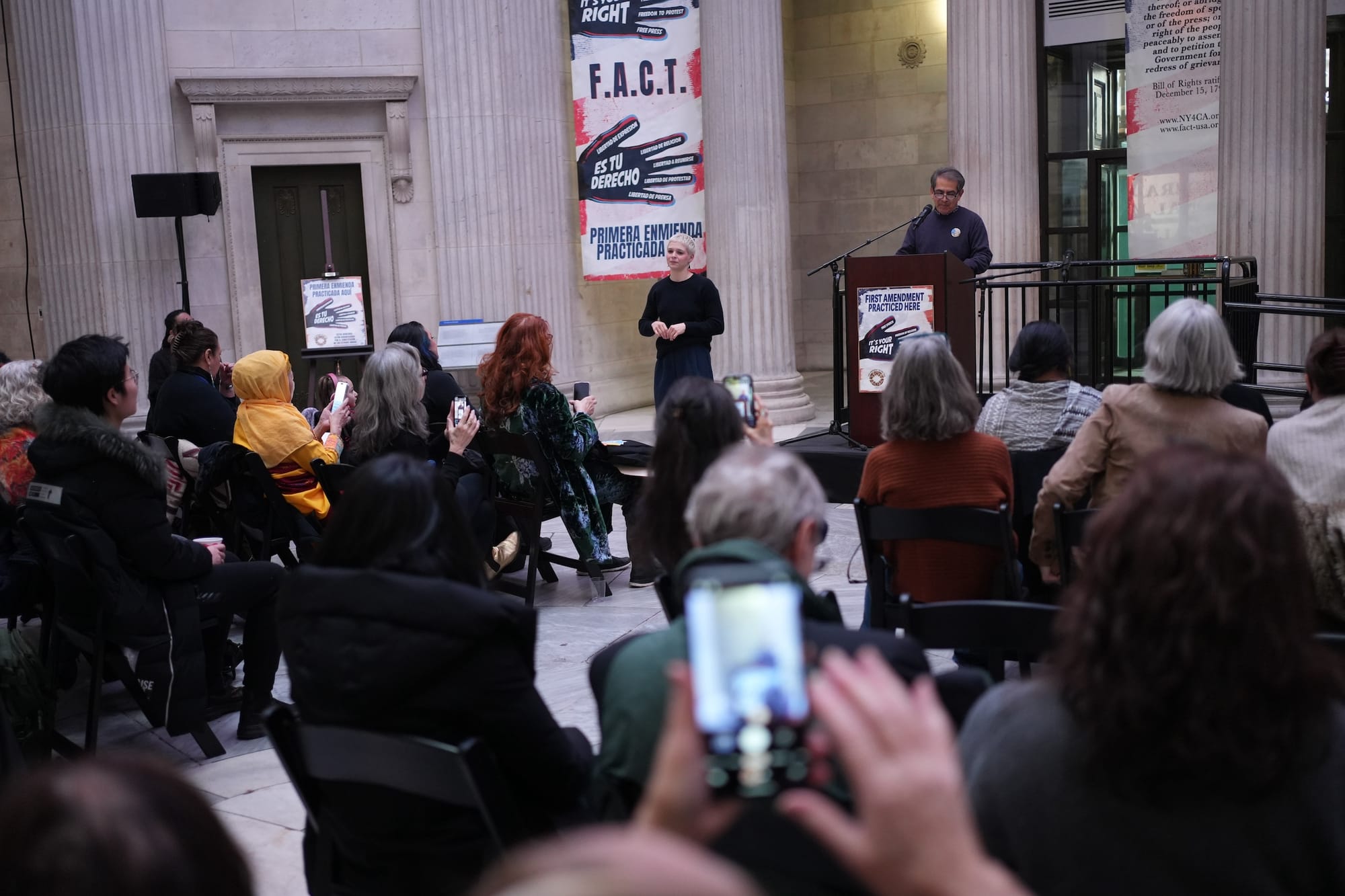
To some of the rally's participants, the current climate of oppression feels like a chilling repetition of history. Finley is one of the NEA Four, a group of performance artists who sued the National Endowment for the Arts in the early 1990s after their grants were vetoed due to a Republican-backed “decency clause.” Though a district judge ruled in the artists' favor, the Supreme Court overturned the decision, and the NEA stopped funding individual artists altogether.
“Our case really was a precedent because it decided that the government could deny funding or support based on ‘decency,’ and now what do we have? We're seeing books being banned, we're seeing what's happening at universities, with research funding, and in terms of healthcare, whether it's trans healthcare or reproductive rights,” Finley told Hyperallergic.
“So much of what we were fighting for within our own work — what we were creating art to bring awareness about — is now even more in jeopardy,” Finley said.
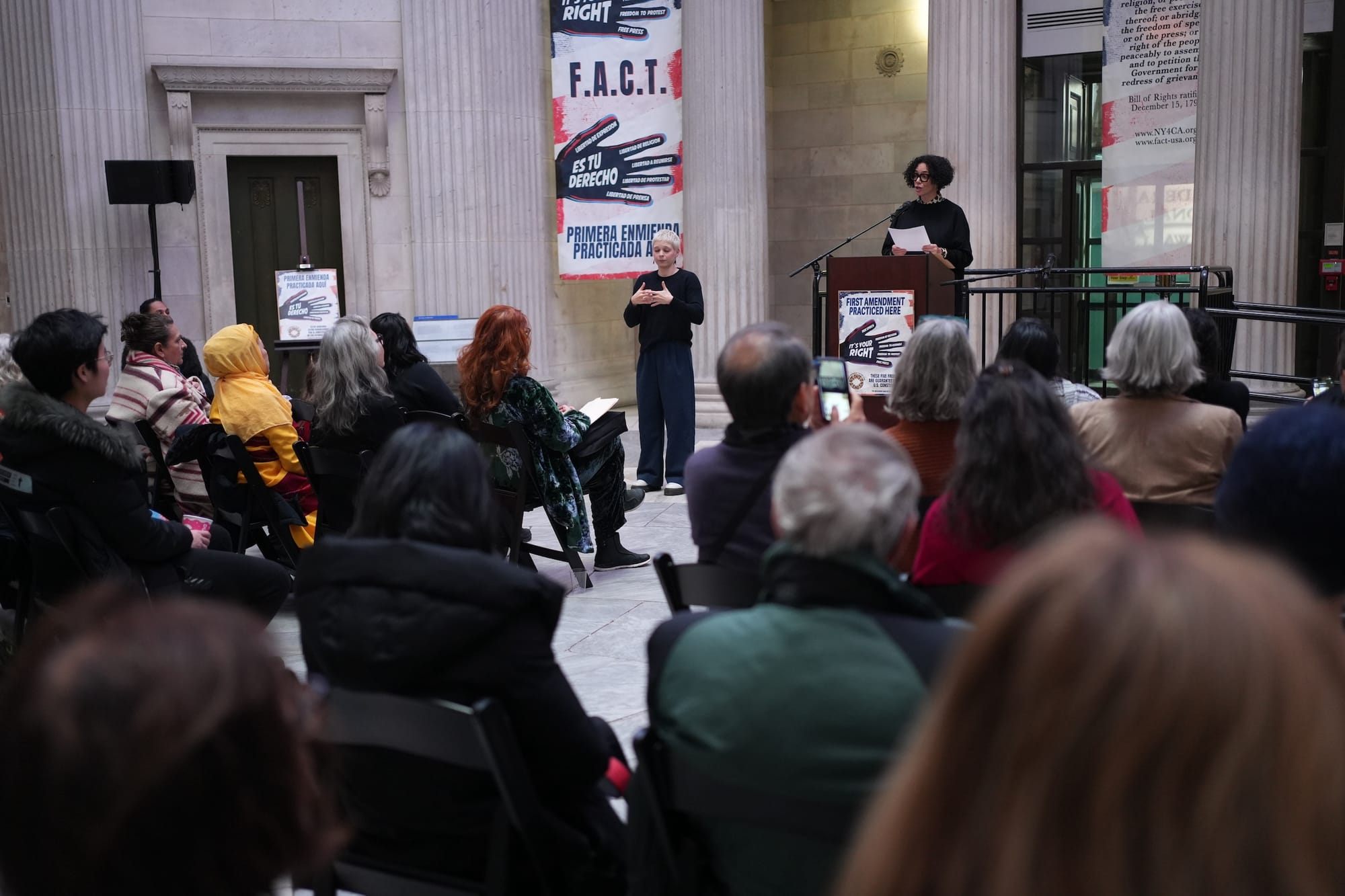
One of the rally's most moving statements came from the self-described disabled choreographer and dancer Alice Sheppard, founder of the Kinetic Light ensemble.
"For disabled people, art and the social fabric are intimately connected,” Sheppard said, addressing the public. “My creative practice, my life, depend on the work of those who fought for accessibility. My creative practice, my life, depend on those who fought for my freedom.”
“So no, I will not be silent,” she continued. “As the government attempts to silence us, I will not be quiet.”