Joe Macken Spent 22 Years Building a Miniature New York by Hand
“It’s a lifelong project,” he said about the 50-foot replica, now on view at the Museum of the City of New York. “I’ll never, ever, ever be finished with it.”

On a Sunday evening last summer, Joe Macken revealed to his daughter that he’d made significant progress on his miniature scale model of New York City, a robust project to which he’d devoted the previous two decades. “I was done with the city and just continuing on, building Westchester,” he said in a recent phone call. “She said, ‘Well, if you’re done with the city, why don’t you put it on TikTok?’” Macken had no social media apps. He downloaded TikTok and uploaded a blurry three-minute video showcasing his downtown Manhattan landmarks, including the Twin Towers, his favorite (Macken’s New York includes the Towers alongside One World Trade Center). Within a week, it had 10 million views.
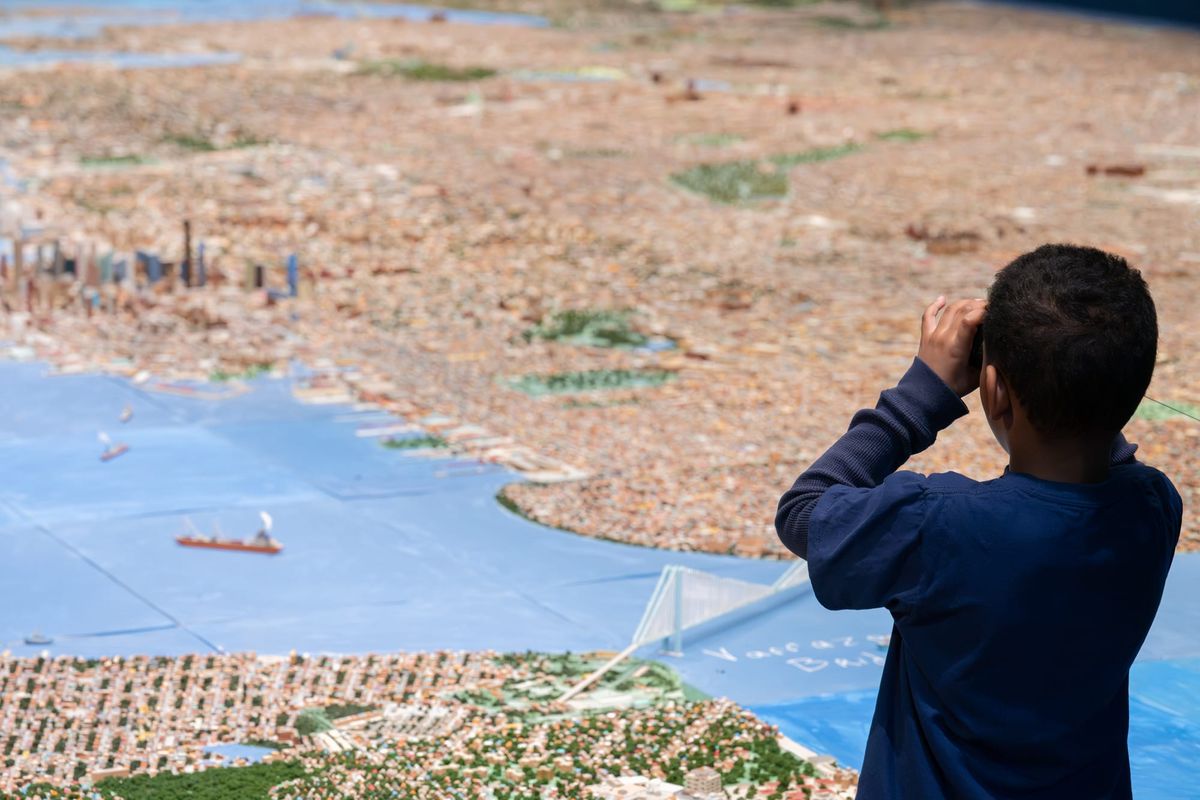
The handmade model is now housed at the Museum of the City of New York (MCNY) in an ongoing exhibition entitled He Built This City: Joe Macken’s Model, located in the Museum’s Dinan Miller Gallery. A monumental feat, it is constructed entirely of wood (primarily balsa wood), cardboard, and glue, measures 50 by 27 feet (~15.2 x 8.2 m), and comprises 342 individual sections, like a puzzle. Elisabeth Sherman, the MCNY’s deputy director and chief curator, explained that the museum’s install team set up tables, organizing the panels by borough. “Each panel was labeled with a numbering system created by Joe, which served as a helpful reference throughout the process,” Sherman said. “Working in an assembly-line format, team members handed panels to Joe, who completed the installation piece by piece.” Visitors can stand at the top, bottom, and corners of the massive model, utilizing binoculars at its edges to get a closer look.
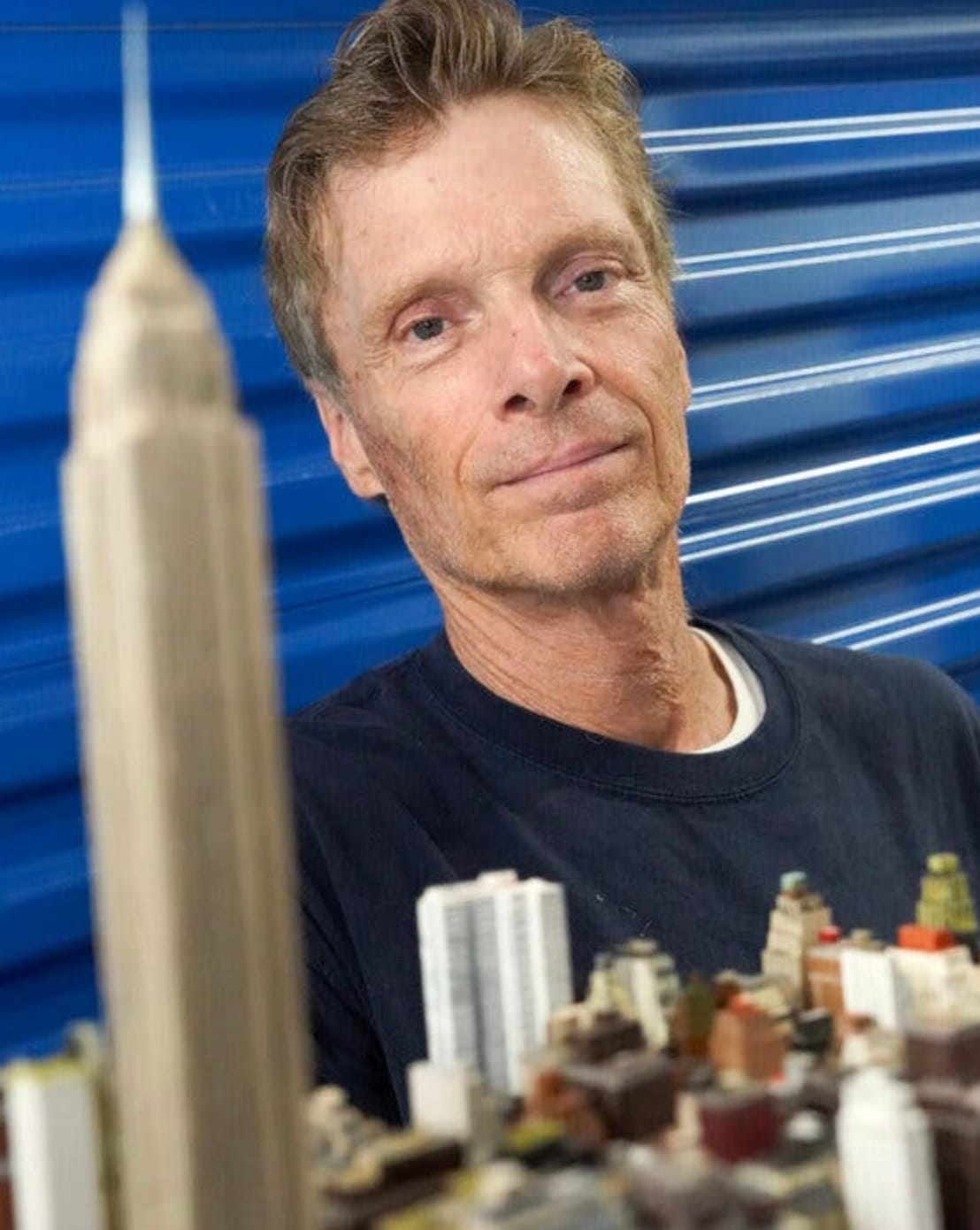
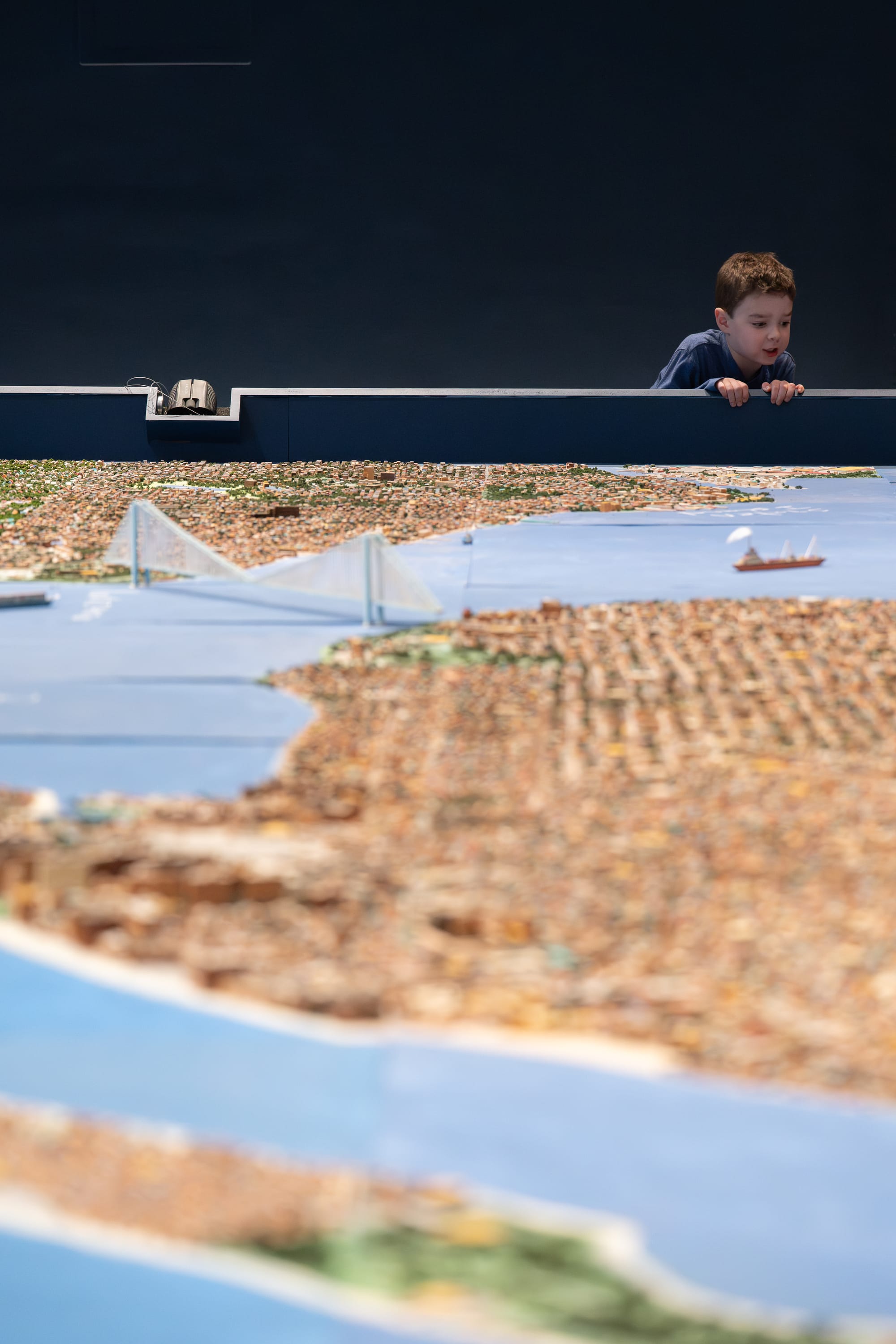
Left: Joe Macken with his mini model of New York (photo @macken3991 via Instagram, screenshot Lisa Yin Zhang/Hyperallergic); right: visitors at He Built This City: Joe Macken’s Model (photo Filip Wolak)
This isn’t Macken’s first New York City-inspired model. The project’s predecessor was, charmingly, a hybrid bridge — a combined Brooklyn, Williamsburg, and Manhattan Bridge — made with tongue depressors and stretching 6 feet long and 1 foot high (it was damaged in transit during the family’s move from Long Island to Clifton Park in 2004, which prompted him to start constructing the five boroughs). Macken, a truck driver, loved to build as a child. “I used to play with Lincoln Logs and Legos. In the first grade, we went on a field trip to the Queens Museum, and they have the Panorama there — a scale model of New York City made for the World’s Fair. It was just amazing. I said to my classmate who was sitting next to me, ‘I’m going to build one of these myself one day.’ I didn’t start it until I was in my 40s, but I kept my promise.”
Macken started with 30 Rockefeller Plaza in Midtown; growing up in Middle Village, Queens, he could see both the World Trade Center and the Empire State Building from his bedroom window, but 30 Rock required a bit more work to visualize. “I would have to walk across the street and go into the park, get a little closer, and then I could see it. I wanted to start somewhere in the middle and work my way out. I think the next building was St. Patrick’s Cathedral, and then I just built another one, then another.” He’d ultimately spend 22 years building the rest of the city — its landmarks, neighborhoods, and waterways. “I was basically just spending my free time in my basement carving wood. It was just me and the model.”
Sherman was one of the millions of viewers who’d seen Macken’s viral video and those that followed. “I am drawn to artists and work that are extraordinary in the literal sense of the word,” she shared. “Joe’s passion, perseverance, and persistence for over 20 years to one task is, in and of itself, worth celebrating and sharing.”
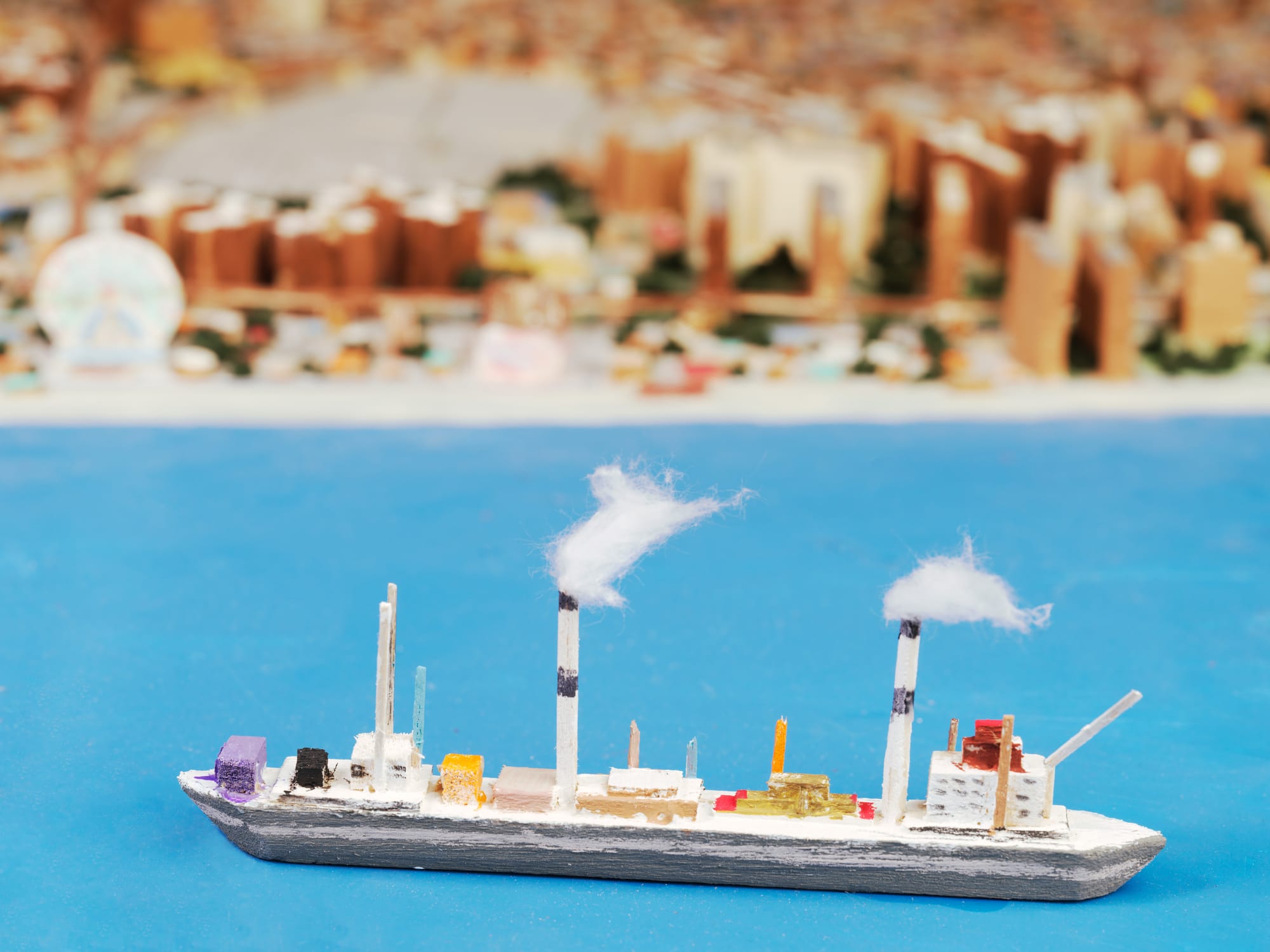
I visited the exhibit at the beginning of spring, and made a beeline for Brighton Beach, looking for my grandmother’s apartment, and then moved northward to find the hospital where I was born. (I found both.) “It’s so fun watching people’s reactions,” Macken shared. “They can’t really get a good scope of what it looks like from pictures.” He’s right; colossal in size, with a naïf, sweetly cartoonish quality — a city for dolls — it’s nearly a one-to-one replica. The apartment buildings are relatively boxy, but they’re almost all accounted for, and the most recognizable structures are remarkably detailed. There are tiny boats in the water, tiny trees in the parks, a tiny Wonder Wheel in Coney Island. Years ago, Macken used maps and photos and long walks to accurately reconstruct Manhattan, but with the development of Google Maps, “I was flying,” he told me. “I was starting on the outer boroughs at that point, and I just got so much faster at it.” Guests were looking for their apartments, schools, and favorite soccer fields, a task Macken often assists with when he visits the exhibition.
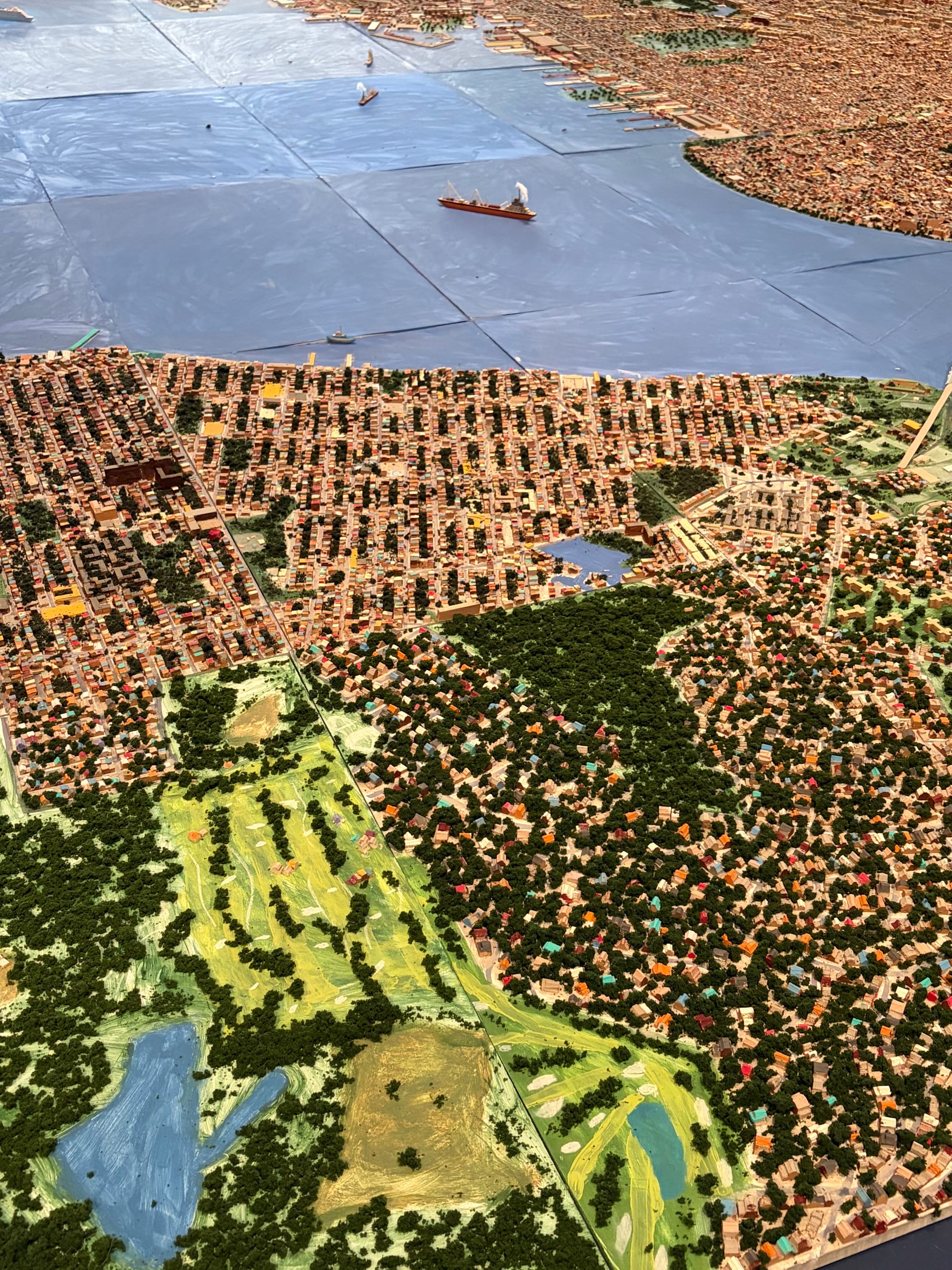
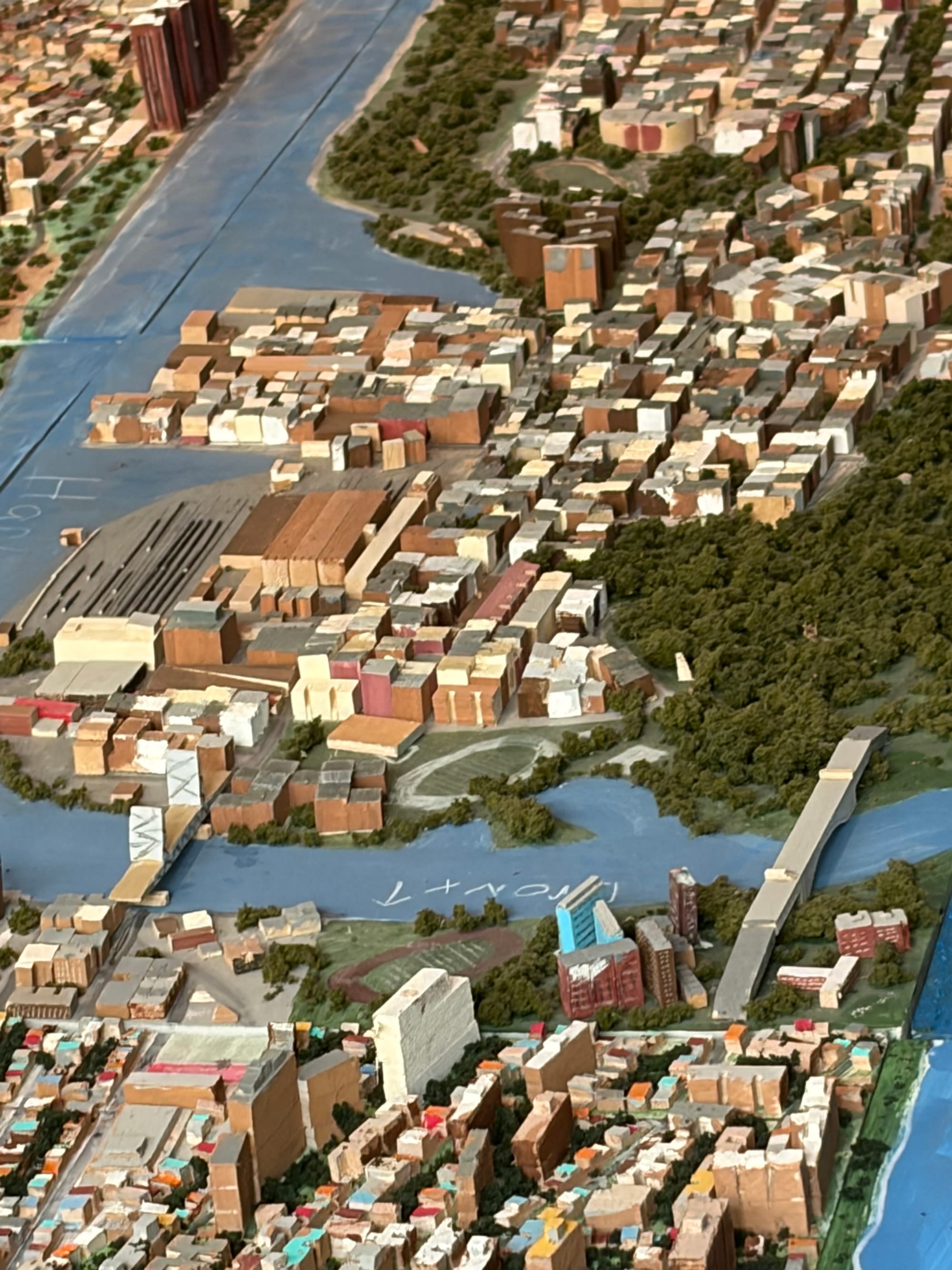
Details of Joe Macken's model of New York (photos Monica Uszerowicz/Hyperallergic)
I love miniatures. For reasons I can’t explain, there is something uniquely joyful about dioramas, little cities, the real transformed into something like a toy. Simon Garfield, the journalist and author of In Miniature: How Small Things Illuminate the World (2012), once wrote that “at its simplest, the miniature shows us how to see, learn, and appreciate more with less.” The magic of New York, even for a New Yorker, is the impossibility of ever wholly knowing it; Macken’s shrunken, magnificently detailed version of it feels like a triumphant attempt. “There are so many different ways that we all try to understand the vast, ever-changing, complex nature of New York,” Sherman said, “and Joe’s model is one of them.”
Macken recently visited his old neighborhood in Queens. “It was so amazing. It felt like I never left. But looking at the skyline from the park, I realized that all the neighborhood trees had grown so much; now they block most of the view.” His small New York is expanding. “I’m building Westchester, all the way up to the Tappan Zee Bridge, which will add another 30 feet. I want to get Newark Airport and the Meadowlands, where the Jets and the Giants play, and then Nassau County, Long Island, all the way out to Plainview. That’s where my mother lives and I want to do that for her. It’s a lifelong project. I’ll never, ever, ever be finished with it, ever.”