Pratt Manhattan Gallery Presents “RugLife”
Sculptural carpets, woven works, and reimagined textiles by 14 contemporary artists examine housing, technology, social justice, and the environment.

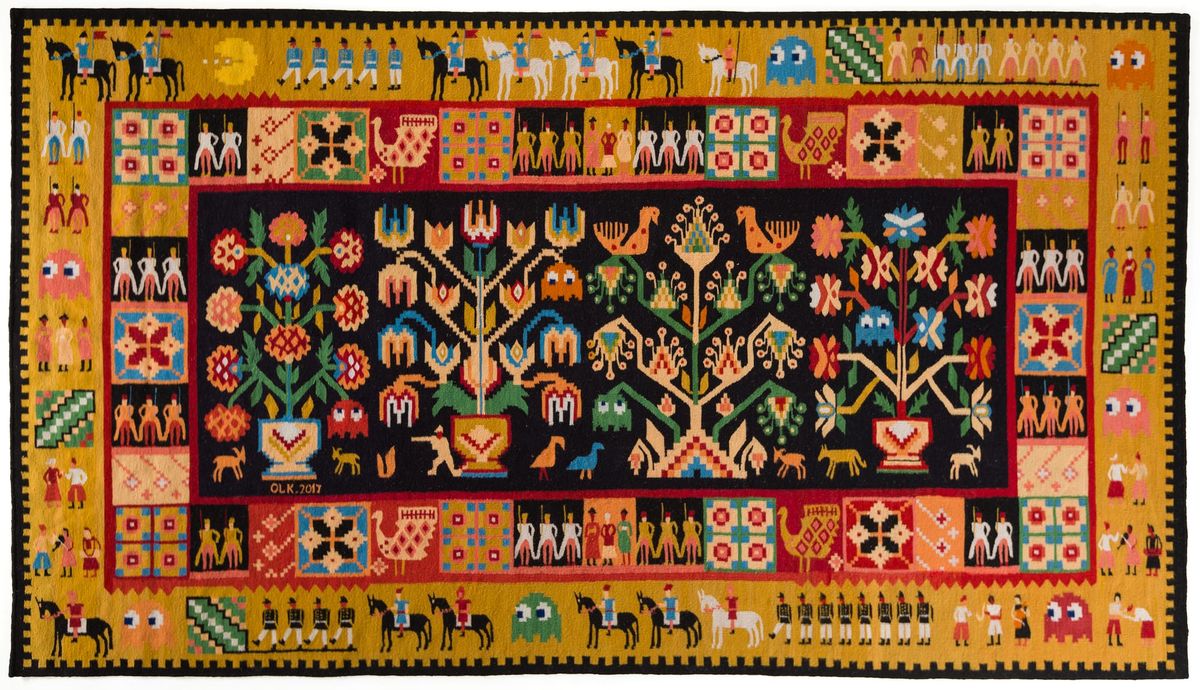
RugLife, a nationally touring exhibition curated by Ginger Gregg Duggan and Judith Hoos Fox of c2-curatorsquared, makes its final stop at Pratt Manhattan Gallery on 14th Street in Manhattan this winter. The show features the work of 14 contemporary artists who use the rug as a medium to engage with cultural concerns related to religion, technology, social justice, housing, and the environment. The diverse roster of artists from the United States, Europe, the Middle East, and Asia work across a variety of media, including yarn, cardboard, repurposed carpets, and hair combs, to transform this functional object into a site of experimentation — manipulated, reinterpreted, and made new.
Ukrainian artist Oksana Levchenya produces traditional kylym rugs, a technique for carpet weaving dating to the 16th century, while introducing contemporary imagery that combines folk ornament with pop culture. In “Pac-Man and Cossacks” (2022), Levchenya deploys hybrid symbolism — historic Cossacks battling Pac-Man — using humor to underscore deeper reflections on cultural icons past and present.
Sonya Clark draws on Black vernacular hair design and cultural symbolism in works that reimagine the rug as both sculpture and statement. Her “Comb Carpet” (2008) is made from hundreds of black plastic combs, teeth facing upward. The piece operates as an expression of cultural identity — Clark identifies as African American, Caribbean, and Scottish — and layers meaning related to racial stereotypes, reappropriation, and hair as both a literal carrier of DNA and a metaphorical link to ancestry.
Rugs also shape how we understand space, from the domestic to the global. In “Grandpa’s Monobloc” (2023), Ali Cha’aban covers every surface of a standard white plastic chair with carpet, creating a poignant meditation on Arab identity and displacement. The ubiquitous Monobloc chair — often seen in temporary homes, resettlement contexts, and refugee circumstances — becomes a platform for the artist to reintegrate cultural material and dignify the design of displacement.
Political and environmental concerns surface throughout RugLife. Commissioned for the Tomorrow’s Tigers project to support the World Wildlife Fund’s conservation work, Ai Weiwei created “Tyger” (2022), drawing on the tradition of Tibetan tiger rugs while shifting its posture and orientation. “Through the rug design, I hope to be able to do something for tigers; the meaning of their existence surpasses the scope of our comprehension, and yet 95% of tigers in the wild have gone extinct over the last 100 years, very sadly,” Weiwei said.
The featured artists are Ai Weiwei, Azra Akšamija, Nevin Aladağ, Ali Cha’aban, Sonya Clark, Liselot Cobelens, Nicholas Galanin, Johannah Herr, Oksana Levchenya, Noelle Mason, Wendy Plomp, Stéphanie Saadé, Slavs & Tatars, and Andrea Zittel.
RugLife is on view at Pratt Manhattan Gallery from February 6 through May 23, 2026. There will be a public reception on Thursday, February 5, from 6 to 8pm. The exhibition originated at the Museum of Craft and Design in San Francisco, California, and traveled to the Weatherspoon Museum of Art at the University of North Carolina, Greensboro, and the Weisman Art Museum at the University of Minnesota, Minneapolis, before its presentation in New York City.
For more information, visit pratt.edu.