Preservation Group Appeals Dismantling of SF Brutalist Fountain
The Vaillancourt Fountain in Embarcadero Plaza could be removed as soon as February.

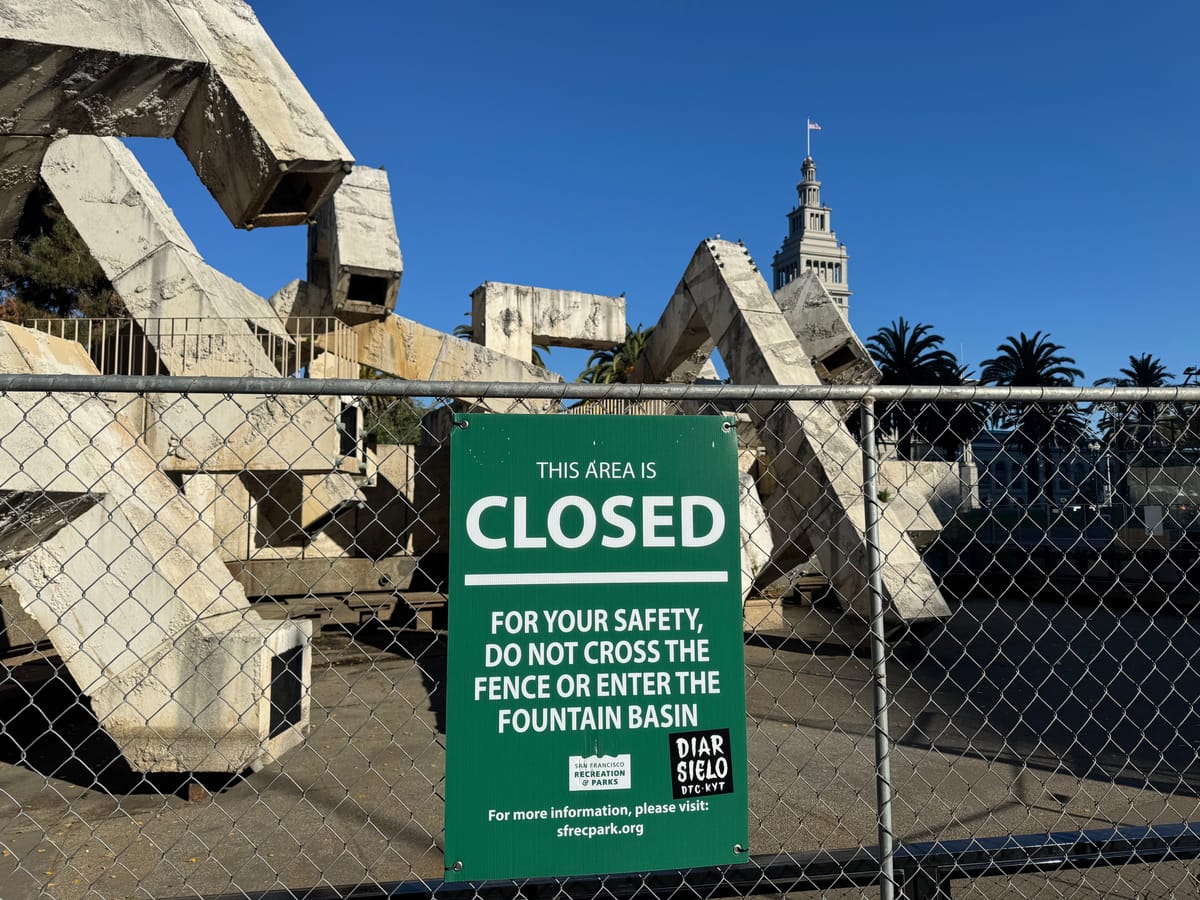
SAN FRANCISCO — A month after the city arts commission ordered the dismantling of the iconic Vaillancourt Fountain along the Embarcadero, a local organization is formally challenging the work's destruction.
In an appeal sent to San Francisco's Board of Supervisors on Monday, December 1, Northern California’s chapter of Docomomo US, a nonprofit organization dedicated to preserving Modernist sites, argued that the city’s parks and recreation department had unlawfully bypassed a mandatory review process in its pursuit to build a park over the fountain.
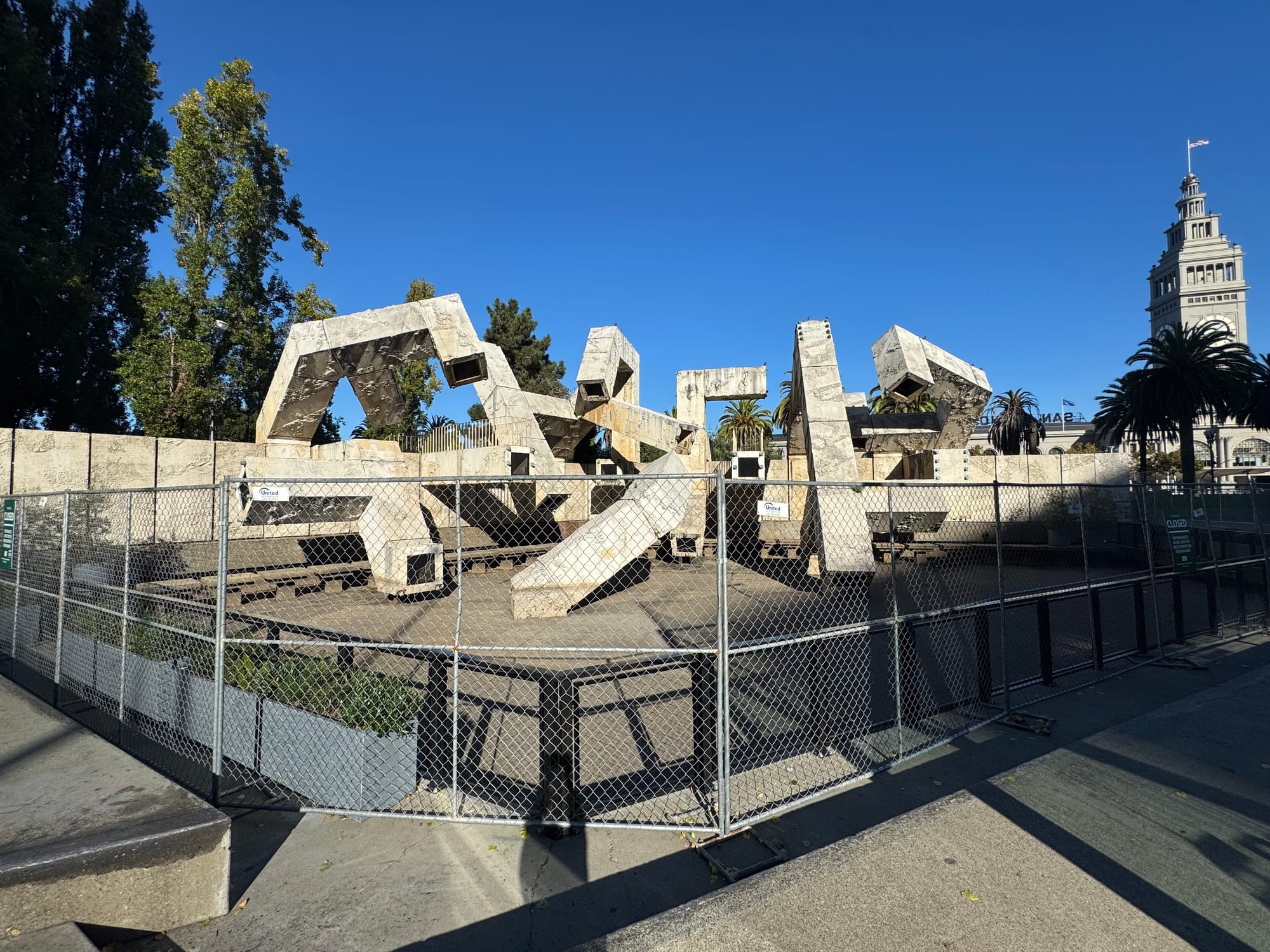
The jutting Brutalist fountain, created by 96-year-old Canadian sculptor Armand Vaillancourt in 1971, has long marked architect Lawrence Halprin’s Embarcadero Plaza and the surrounding structures, including the San Francisco Ferry Building. The work, also known as “Québec Libre,” was graffitied in 1987 by U2’s Bono and stood at the epicenter of the city’s skateboarding culture in the ’80s and ’90s. But earlier this year, the Board of Supervisors approved the creation of a multi-million-dollar waterfront park covering the fountain and surrounding area, drawing opposition from cultural preservationists, community members, and the artist himself.
The San Francisco Arts Commission voted to dismantle and store the artwork for up to three years on November 3, citing “public safety hazards.” The city reportedly found lead and asbestos at the site. A city spokesperson told Hyperallergic that the work’s hazardous conditions exempted it from an environmental review under the California Environmental Quality Act.
Docomomo, however, argued in the recent appeal that the deteriorating state of the artwork was the result of the park department’s “calculated, long-term deferred maintenance.”
“The emergency exemption is not supported by the facts. It is intended to rationalize a pre-approved project, violating the definitions of emergency established in California law,” Susan Brandt-Hawley, an attorney for Docomomo, wrote in the appeal shared with Hyperallergic.
Rehabilitating the sculpture would reportedly cost the city around $29 million, while the dismantling and storage is estimated at $4.4 million.
The work could be removed as soon as February, a San Francisco Arts Commission spokesperson said. A spokesperson for Docomomo told Hyperallergic they expect a hearing with the Board of Supervisors after the holidays.
Hyperallergic has contacted the Board of Supervisors for comment.
Approaching his 97th birthday, Vaillancourt told Hyperallergic in a video interview about his dismay at the prospect of the destruction of his fountain, describing the sculpture as “the best of me.” The artist and his family belong to a coalition led by Docomomo that wants the city to rehabilitate rather than destroy the work.
The artist moved to San Francisco in 1967 after winning an international design competition to create a sculptural fountain in the plaza, and stayed for four years during its construction. Vaillancourt recounted driving over the Golden Gate Bridge every day on his way north to the town of Petaluma, where he constructed parts of the fountain in a field.
Vaillancourt said he rented a studio from the city, which he later opened to American Indian Movement demonstrators who occupied Alcatraz for 19 months from 1969 to ’71, reclaiming the abandoned federal land on which the former prison stood.
The city of San Francisco didn’t like that. Vaillancourt said he was asked to remove Native demonstrators from his studio who sought “safe haven” there, but refused to do so. Instead, he threatened to halt the creation of the fountain.
“ I couldn't stay there four years to make my fountain and shut up,” Vaillancourt recounted. “I had to keep nourishing my soul.”
At the inauguration of the fountain, Vaillancourt reportedly jumped into the structure after being held back by police officers and painted "Québec Libre," a slogan of the Quebec independence movement, across it.
“ That idea was to say: Stop the Vietnam War, stop the injustice in the world; stand up for justice at the price of your life you need to,” Vaillancourt said.
Over 550 pages of public testimony were collected by the San Francisco Arts Commission before it voted eight to five to dismantle and subsequently store the work for up to three years. One individual called the sculpture “hideous” and advocated for its removal. Others defended its place in San Francisco's cultural history. Alexis Vaillancourt, Armand’s son, took his father to meet with the arts commissioners earlier this year, he told Hyperallergic. He said he wanted them to know his father is still alive.
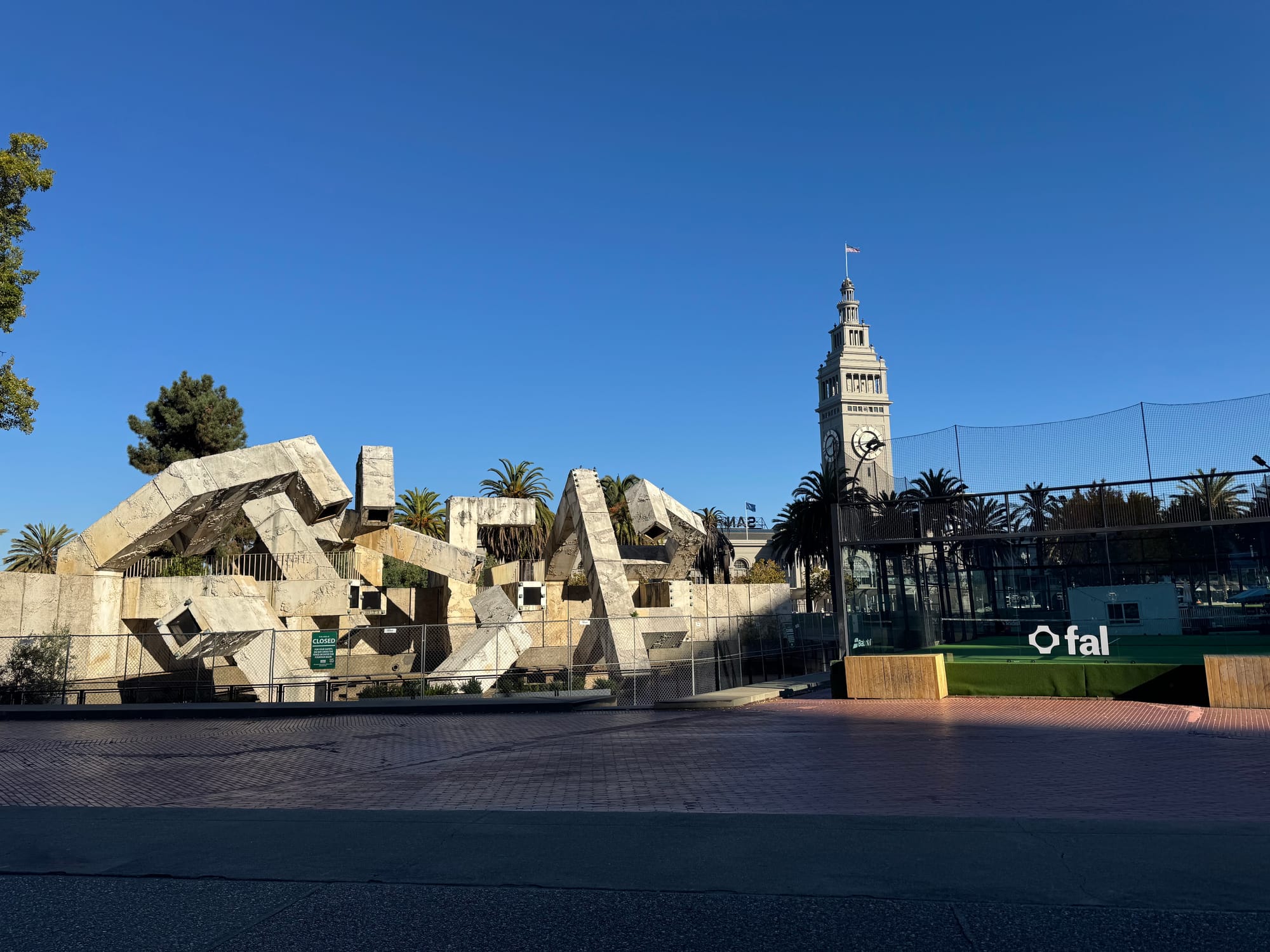
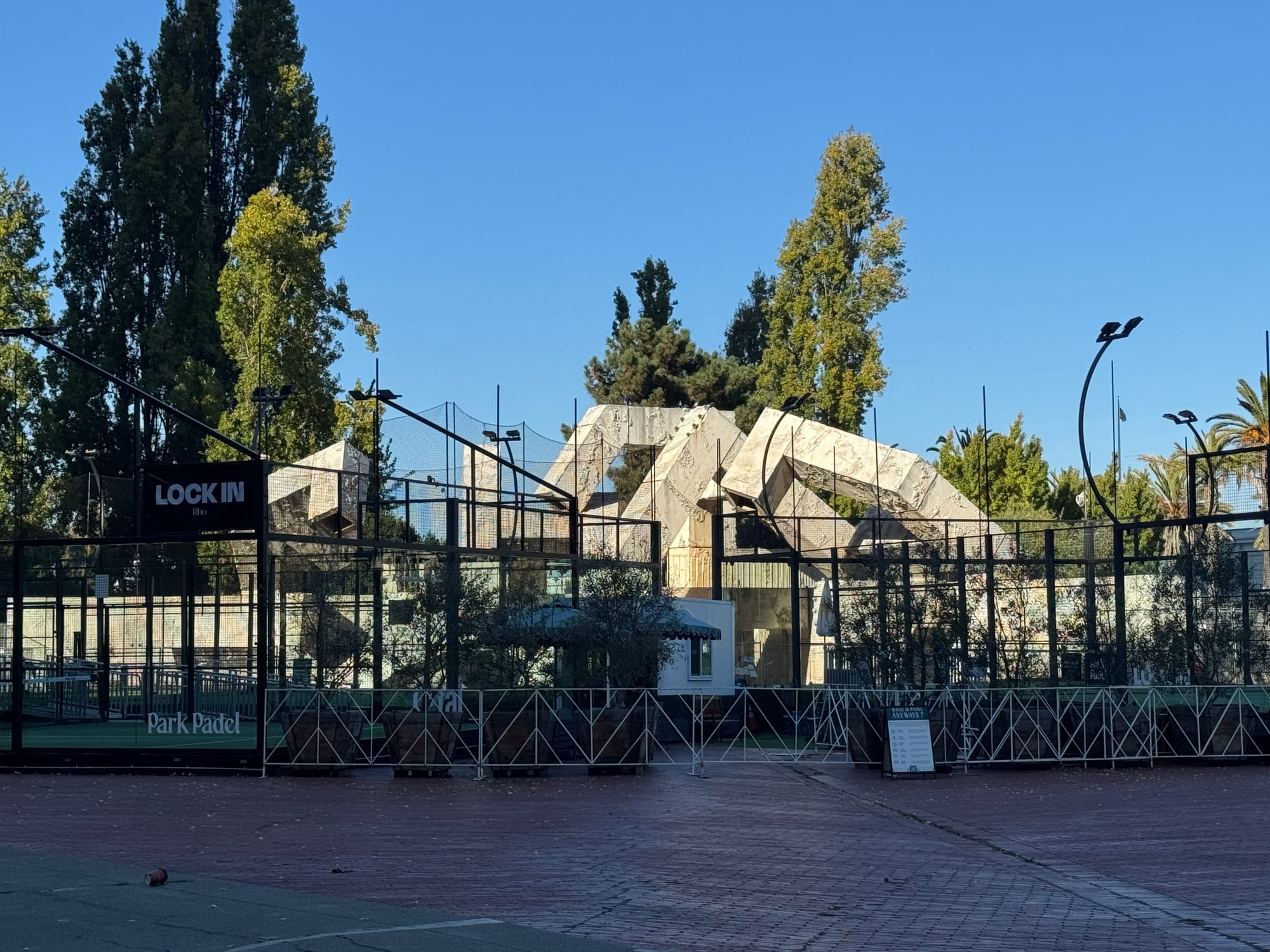
Today, there is no water in the fountain, and the city has cordoned it off with a fence. A tennis court almost eclipses it on one side. Nearby, the parks department has installed a towering sculpture of a naked woman created by Marco Cochrane at Burning Man in 2015.
Trey Alioto, who grew up in San Francisco, took a moment to look up at the fountain while walking through the plaza on November 26.
Alioto said the fountain always “felt like something out of my imagination” when he was a kid.
“ It's kind of sad to see it go, but also at the same time, I get that this is sort of a relic of the 20th century,” Alioto added. “Sometimes you do have to eventually outgrow things. The pipes break down. Maintenance costs too much.”