Rare Wifredo Lam Portrait Lands in New York
The 1927 work is the first painting by a Cuban artist to enter the Hispanic Society Museum and Library’s collection.


A rarely seen portrait from Wifredo Lam's early career has landed in the Hispanic Society Museum and Library's collection, making it the first painting by a Cuban artist to enter the institution's permanent holdings. Painted in 1927, Lam's “Portrait of a Boy” exemplifies his brief but impressionable time spent in the Spanish city of Cuenca.
In a phone call with Hyperallergic, the museum's Director and CEO Guillaume Kientz said that he had never seen the painting before, as it only recently emerged from a private collection in its city of origin late last year during Sotheby's Modern Day Auction. In tiny, hand-painted text above Lam's signature are the words “para Hugo,” indicating that the work was a gift for an individual named Hugo Dosantos, according to the provenance text.
“What is very important for us about this painting is that it's not the Wifredo Lam that one expects,” Kientz said. “Therefore, it fell through the cracks of scholarship and market dynamics, making it a great opportunity for a museum especially, because we are about telling the stories that are perhaps overlooked or forgotten, and this very painting helps us do that.”
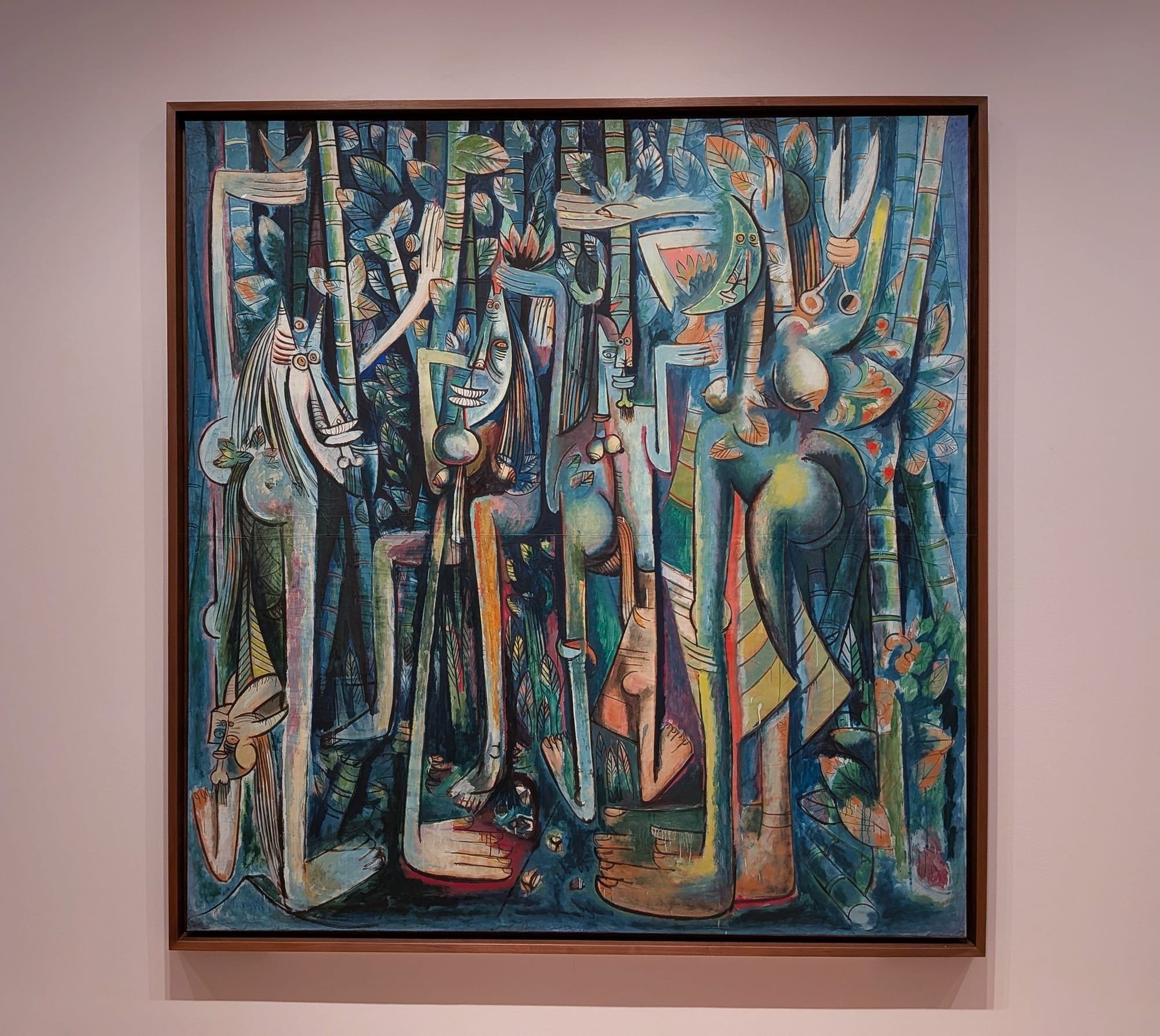
Like much of Lam's early work, “Portrait of a Boy” looks remarkably different from the style the artist is most celebrated for, which blended elements of Surrealism and Afro-Cuban culture and spirituality. Initial recognition in his hometown of Sagua La Grande earned Lam a government-funded grant to pursue further artistic training in Madrid in 1923, where he enrolled at the Real Academia de Bellas Artes de San Fernando, and later the Escuela Libre de Paisaje.
While the Real Academia emphasized classical rigidity, the workshops at Escuela Libre de Paisaje introduced Lam to the experimental sensibilities and trends of modern Spanish art, influenced by the fledgling emergence of Surrealism and the broader avant-garde. Lam also frequented the Museo del Prado, where he both immersed himself in and reproduced the works of master artists, including Francisco Goya, Hieronymous Bosch, El Greco, and Diego Velázquez, among others.
However, Lam lost his scholarship in 1925 after General Machado was elected as the Cuban president, leaving him in dire straits overseas. After the artist pivoted to classical portraiture commissions in order to financially support himself, his close friend Fernando Rodriquez Muñoz invited him to stay with his family in the city of Cuenca. The town's medieval architecture, mountainous terrain, and welcoming local arts community were crucial influences for Lam, who would return to Cuenca for three consecutive summers.
“Portrait of a Boy” came at the precipice of the artist's waning adherence to representational portraiture. Very soon afterward, the visual language that would define Lam's practice — born of his rumination on the colonial classifications of “Primitive” art, personal experiences as an ethnically Afro-Caribbean and Chinese individual, exposure to Surrealism, and perceptions of observed inequalities — would begin taking shape. Certain elements of the painting itself toe the line of Surrealism.
“I don't think he was still learning in the academic sense, but he was still very young and vividly finding his path as a painter,” Kientz said of Lam's practice during this period. He also said that the acquisition was not only critical to the museum's expansion of its Caribbean art holdings, but also as a bridge connecting its collection of late 19th-century and early 20th-century paintings.
“A little thing that I like about this painting is that it's also a portrait of a kid,” Kientz continued, sharing that the work, which is currently on view at the museum, complements Velázquez's portrait of a young girl from the collection.
“I think it's so important to give more visibility to kids in the museum, because when you're a kid walking through the galleries, and you see only images of older people, you don't feel like you belong,” he said. “This is just such a magnetic portrait that so many kids of all ages will feel compelled to engage with.”