Required Reading
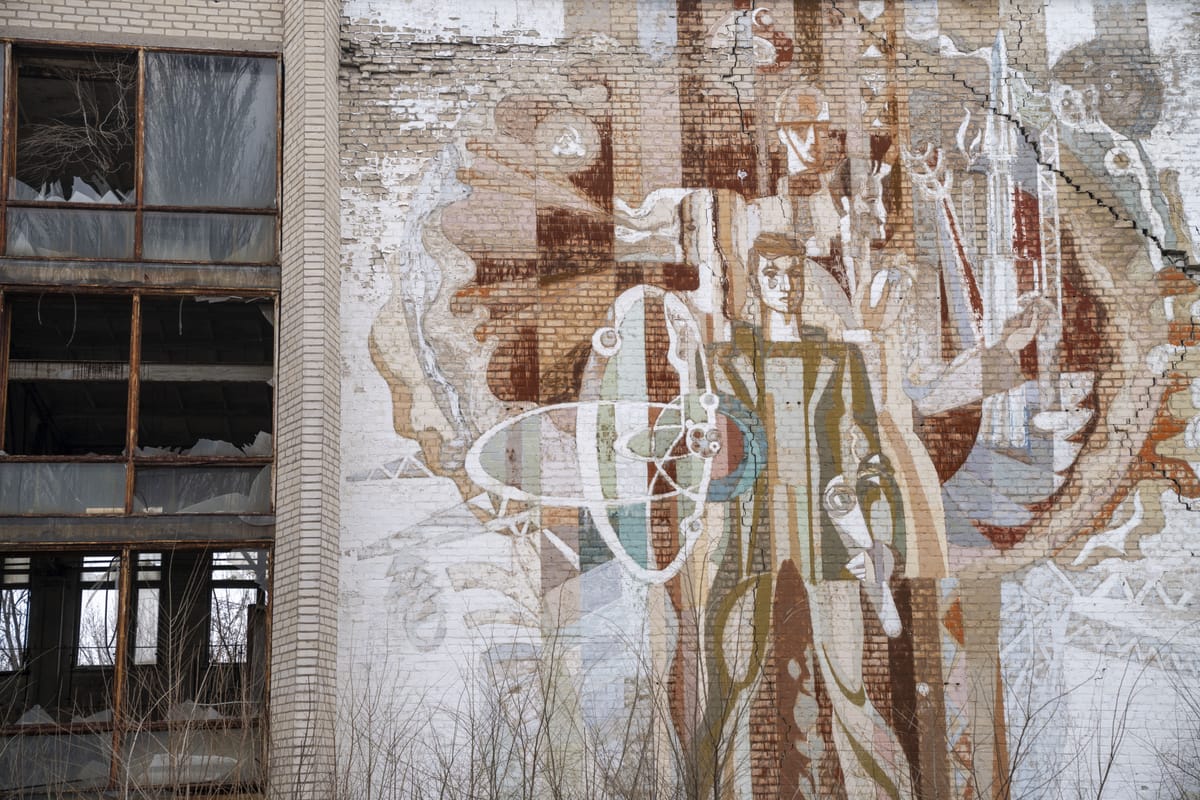
This week: Ukrainian mosaics, artists and motherhood, Dolores Huerta speaks out, copaganda in the US, wall labels versus artworks, and is your diet a little bit fascist?

Megan O'Grady writes for the Yale Review about motherhood and the artists who inform her understanding of it:
When I first saw Heji Shin’s Baby photos—closely cropped large-format portraits of crowning infants—at the 2019 Whitney Biennial in New York City, I felt a shock of recognition. Here, writ enormous, was Schneemann’s “vulvic space.” Gory, rumple-faced, with blood pooling in their eyes, the babies abstracted nothing.
They seemed to Shin like something from The Exorcist, she told me when I reached out and asked about her initial reaction to the results of the shoot. (She had worked with a midwife to obtain permission from the mothers, who received a set of conventional photographs of the delivery in exchange for allowing Shin in the room.) Her retoucher had started to cry on first sight of the images. But as the horror-movie thrill of them wore off, the Baby photos took on other meanings. Men often reacted more positively to the images, Shin said, finding in them an analogy for art-making. Once babies entered the realm of metaphor, they were deemed acceptable as art.
Talking to Shin—who is not a parent—I realized that looking at the Baby series was probably the first time I had seen new motherhood depicted unsentimentally. To have a child is to take a risk, to make art is to risk, and here, embodied in Shin’s bloody babies, was all the fragility of the human animal and its ferocity of will. The photographer seemed relieved when I told her they were the closest thing I’d ever seen to my own experience. I didn’t find the Baby series transgressive, nor did I see the images in metaphorical terms. They were true, and they were a relief.
For Southwest Contemporary, Lynn Trimble interviews three artists from the region about the astronomical costs of showing work at an international biennial:
Taos-based artist Nikesha Breeze (who uses they/them pronouns) says it will cost at least $100,000 to put up their Living Histories installation at the Biennale of Sydney 2026, which runs from March 14 to June 14. The monumental installation “animating the firsthand narratives of elder African Americans who experienced enslavement as children” through sculpture, sound, and performance, appears inside the central Turbine Hall at White Bay Power Station.
Breeze created the installation in Australia because shipping costs from the U.S. would have been prohibitive. Although the biennial commissioned the work, Breeze describes having to cover myriad expenses including documentation. “I’ll be in debt, and that should not be the case.”
Whether you're tired of Banksy or not, Reuters journalists Simon Gardner, James Pearson, and Blake Morrison take a deep dive into the secrecy of his identity and what it means for the market viability of his work:
How much would the revelation of Banksy’s identity affect the value of his work? Reuters contacted more than a dozen major galleries, museums and auction houses. Most declined to comment on Banksy. Views differ among those who spoke.
One of the largest Banksy dealers, Acoris Andipa, said his clients are enticed by the art, “not because he’s masked, not because he’s a Robin Hood-character.”
Gallery owner and dealer Robert Casterline sees a potential drop in the market value of Banksy’s work. “It depends how he spins it,” Casterline said of the way Banksy responds to being named. “And it depends on what he creates next and whether someone wants to hang it on their wall.”
Apparently, half of American broadcast network dramas focus on police, Adam Epstein reports for Quartz:
A 2018 joint report by the racial justice group Color of Change and the University of Southern California found American police shows tend to normalize injustice in the minds’ of viewers. “The Crime TV genre, which reaches hundreds of millions of people in America and worldwide, advances debunked ideas about crime, a false hero narrative about law enforcement, and distorted representations about Black people, other people of color and women,” the report said. It also pointed out that the creators, writers, and show runners of these shows are overwhelmingly male and white.
Not only are there dozens of cop shows across US networks, but several of them are among the most-watched series each year. Cop shows accounted for four of the top 10 and 17 of the top 50 most popular TV series last year, according to Nielsen. NCIS, which has aired on CBS since 2003, averaged 15.3 million viewers each episode—more than ESPN’s weekly National Football League games.
All power to Ana Murguia, Debra Rojas, and Dolores Huerta — whom I was lucky enough to meet years ago — for sharing their stories of abuse at the hands of Cesar Chavez. Hannah Fry writes in the LA Times about the horrifying revelations that came to light this week:
“I carried this secret for as long as I did because building the movement and securing farmworker rights was my life’s work,” she said. “The formation of a union was the only vehicle to accomplish and secure those rights and I wasn’t going to let Cesar or anyone else get in the way.”
The New York Times quoted two women who said Chavez sexually assaulted them as girls in the 1970s and that some of his behavior had been whispered about within the UFW.
“The knowledge that he hurt young girls sickens me. My heart aches for everyone who suffered alone and in silence for years. There are no words strong enough to condemn those deplorable actions that he did. Cesar’s actions do not reflect the values of our community and our movement,” she wrote.
Amber Husain explains the fascist overtones of diets and the politics of food, writing in the Nation:
Modern-day fascists are not just “colonizing” health foods, they are using ways of eating them to foment ideological violence. When we dismiss this mobilization of food and how it is eaten as a mere appropriation of this innocent thing called diet, we misunderstand not just the power of food but the nature of the fascism at hand. What we also risk forgetting is the potential in culinary culture as grist for the left. Food justice organization Food Not Bombs, for example, distributes vegan food as a way of inspiring the public not to change their own diets but to participate in the anti-capitalist transformation of the food system. The group’s horizon is one of ending poverty, homelessness, war, and climate devastation, processes that thrive on the cheapening of life, both animal and human. “Food is a right, not a privilege,” insists the group, which has over 1,000 estimated chapters active in over 60 countries. “Solidarity not charity.”
Gothamist's Giulia Heyward reports on the Heated Rivalry musical parody — yes, you read that right — coming to NYC soon:
The production will be a staged reading — meaning the cast will be performing with scripts in hand — with more than a dozen songs, and a runtime of roughly an hour and a half.
Fans of the show should expect to see references to iconic moments, such as the tuna-melt scene (“I’m not going to give away the joke but it totally gets referenced,” said Kliffer) to the sexually charged sharing of a water bottle in a hotel gym. Even the sometimes-hard-to-follow time jumps will get a mention.
Do I "like" every painting reveal on TikTok on my fyp? Yes. Do they also irritate the hell out of me? Also yes. Seema R., aka @art_lust_, gets to the bottom of this phenomenon:
Unfortunately, despite not having an art history degree, I am the latter:
@discovernewfields Which one are you? 🔎🖼️ Come plan your visit soon, and browse the IMA Galleries whichever way your heart desires. Plan your visit at discovernewfields.org today. #DiscoverNewfields #NewfieldsToday ♬ original sound - Newfields
@amissa_pots These videos are getting way too good. That’s why I’m calling for a zero tolerance ban on AI pottery videos 😤 #pottery #ceramics #ai ♬ original sound - amissa_pots
Required Reading is published every Thursday afternoon and comprises a short list of art-related links to long-form articles, videos, blog posts, or photo essays worth a second look.