Salvador Dalí’s Frustrating Vision of the Divine
Having abandoned the profane for only the sacred, Dalí’s “Nuclear Mysticism” renounced the richness of experience for the aridity of metaphysics.

Three weeks after Easter in 1961, at Glasgow’s red-brick, resplendent, rococo Kelvingrove Art Gallery and Museum, a 22-year-old man took a rock to Salvador Dalí’s enigmatic 1951 painting “Christ of Saint John of the Cross.” At a red museum in a green corner of a gray city, out of a surfeit of zealous religious conviction, a vandal had torn an eight-foot gash in the body of Christ. It would not be the only act of vandalism perpetrated against the Dalí painting, for a little less than two decades later, another aspiring iconoclast took an air rifle to the canvas, though this time curators had seen fit to seal it behind a thick layer of clear acrylic in preparation for precisely this possibility. In an excellent 2022 essay for the Los Angeles Review of Books, writer Kasra Lang describes being surprised that, upon first seeing the painting himself, he “fought back the strange urge to punch or claw at the canvas.” And yet, “Christ of Saint John of the Cross,” a work based on the dizzying visual perspective of a crucifixion sketch by the eponymous 16th-century Spanish Carmelite mystic, was not intended by Dalí to be a heretical painting — far from it.
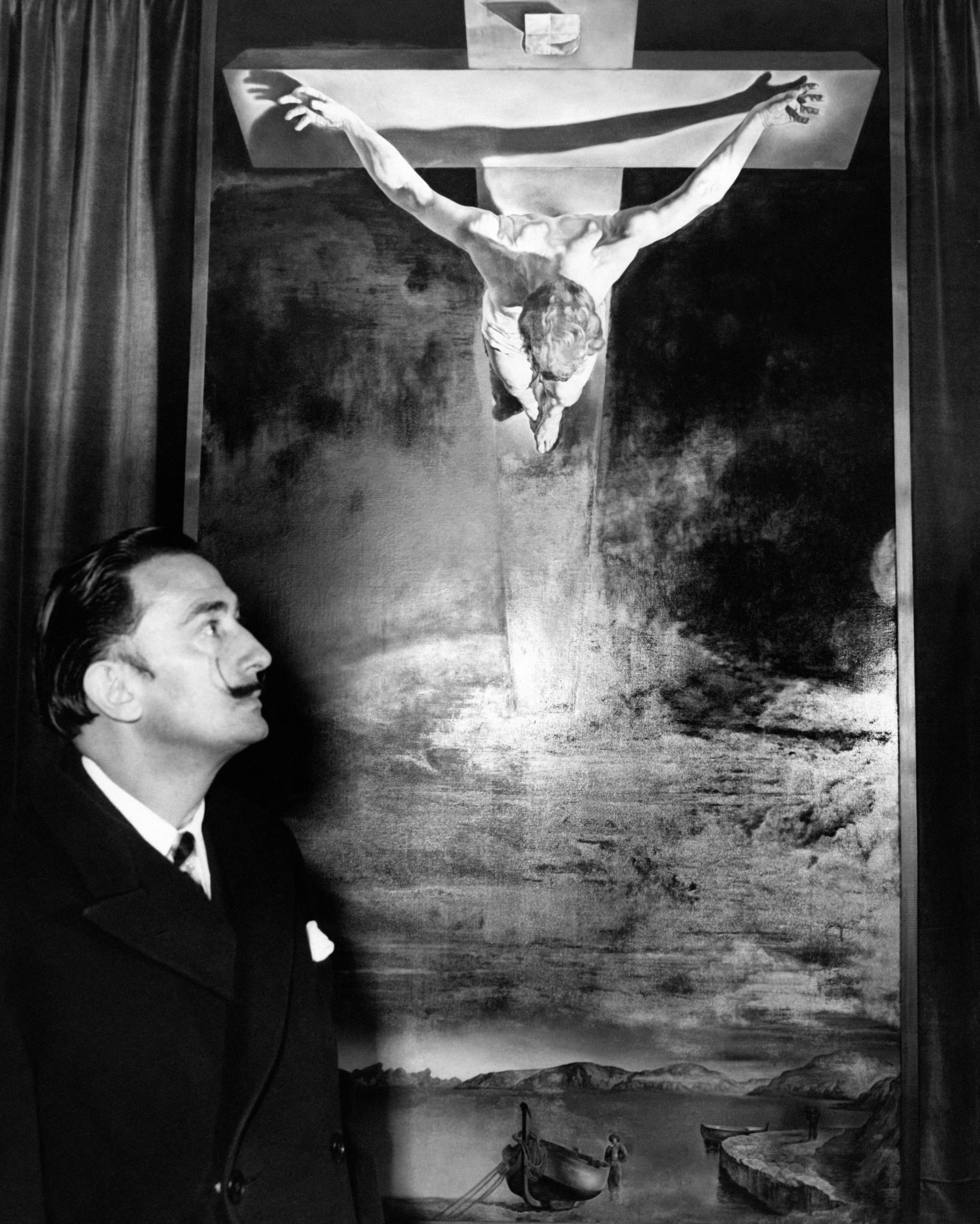
Part of Dalí’s mid-career embrace of Roman Catholicism, along with an enthusiasm for the extreme nationalist Falangists who’d been responsible for the execution of his friend, playwright and poet Federica García Lorca, during the Spanish Civil War, “Christ of Saint John of the Cross” was categorized by the painter as an example of his “Nuclear Mysticism.” Despite the conventionality of subject — for few themes are so thoroughly plumbed as the crucifixion — Dalí does something rather amazing: He refashions the narrative in a novel manner. Dalí’s toned and pale Christ is depicted from top down, as if viewed from above. The cross, brown and unblemished (save for a creased bit of paper where the “INRI” sign is traditionally affixed), appears to sustain itself in Platonic perfection, floating in an otherworldly blackness, Christ’s body suggesting that most Trinitarian of shapes, the triangle. The artist attributed this vision to a “cosmic dream,” likening his Son of Man to the “nucleus of the atom ... This nucleus later took on a metaphysical sense; I considered it the very unity of the universe, the Christ.”
To fully understand the anatomical effects of suspending a body in such a manner — which muscles would tense and what bones would protrude — Dalí paid acrobat Russel Saunders — Gene Kelley’s stunt double in Singing in the Rain (1952) — to hang from a cross that dangled over the artist’s studio in Port Lligat, Catalunya. At the bottom of the composition, beneath a sfumato of gray-blue clouds which haze out from the abyss, a small, apostolic fisherman’s boat sits not on the banks of Galilee, but the bay outside Dalí’s studio window.
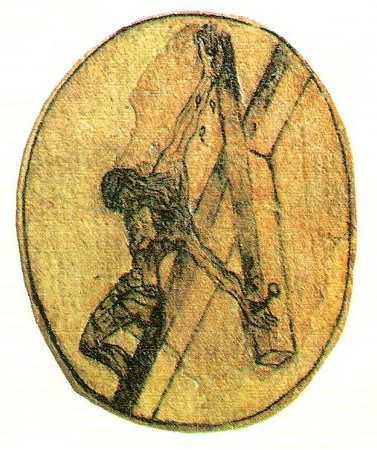
Why “Christ of John the Cross” was attacked not just once, but twice — in fact, why Lang imagines himself vandalizing the piece — is a perplexing question. Courting blasphemy seems far from Dalí’s intent with the piece (he is no Andres Serrano or Chris Ofili in that regard), but a certain irreverence is nonetheless implicit in it. Puckishly describing himself to the press as a “Catholic without faith,” Dalí’s Christ has no crown of thorns and no stigmata, no side wound and no scourged flesh. In fact, his impossibly lithe and beautiful stunt double of a messiah floats incongruously in front of the cross, for no nails mar his palms or feet. That strange perspective, meanwhile, gives us a view from on high, as if we were God watching the execution of his only Son. Lang writes that “Dalí’s later work, and his religious paintings in particular, have rarely commanded serious critical attention,” and yet any work someone is willing to take a rock to or shoot with an air rifle has already garnered another type of attention. There is something awful about “Christ of John of the Cross,” in the truest sense of that word, but also an aspect of genuine devotion which frustratingly cannot be dismissed.
When compared to the other luminaries of Surrealism — Man Ray, Max Ernst, Dorothea Tanning, Joan Miró, Méret Oppenheim, Luis Buñuel, Remedios Varo, and André Breton, who famously kicked him out of the group in part due to his fascination with Hitler — Dalí may be more of a household name, he of the melting clocks and inchoate fleshy protuberances. But he’s also often reduced to kitsch. This is the artist who, a New York Times critic in 1945 remarked, made the avant-garde “as comfortable as a pair of scuffed old-fashioned slippers … He has put Surrealism in curl papers for the night and given it a glass of warm milk.” Much of this has to do with his flamboyant performativity, the political and religious chameleon disdained for his freshman-level readings of Sigmund Freud, the artistic toreador with his waxed mustache and cape, delivering lectures in a diving suit and driving to an exhibition opening in a Rolls-Royce filled with cauliflowers. In Dalí, conventional wisdom has it, there is more schtick than assurance, more self-promotion than experimentation. The founding generation of Surrealism was rife with authors of utopian manifestos whereby Breton could enthuse that the “marvelous is always beautiful, anything marvelous is beautiful, in fact only the marvelous is beautiful,” while an aged Dalí would genuflect to Generalissimo Franco and pay the bills by making holograms of rock star Alice Cooper and designing the logo for Chupa Chups lollipops. He was regarded as a cartoon of an artist whom George Orwell, as early as 1944, would call a “good draughtsman and a disgusting human being.”
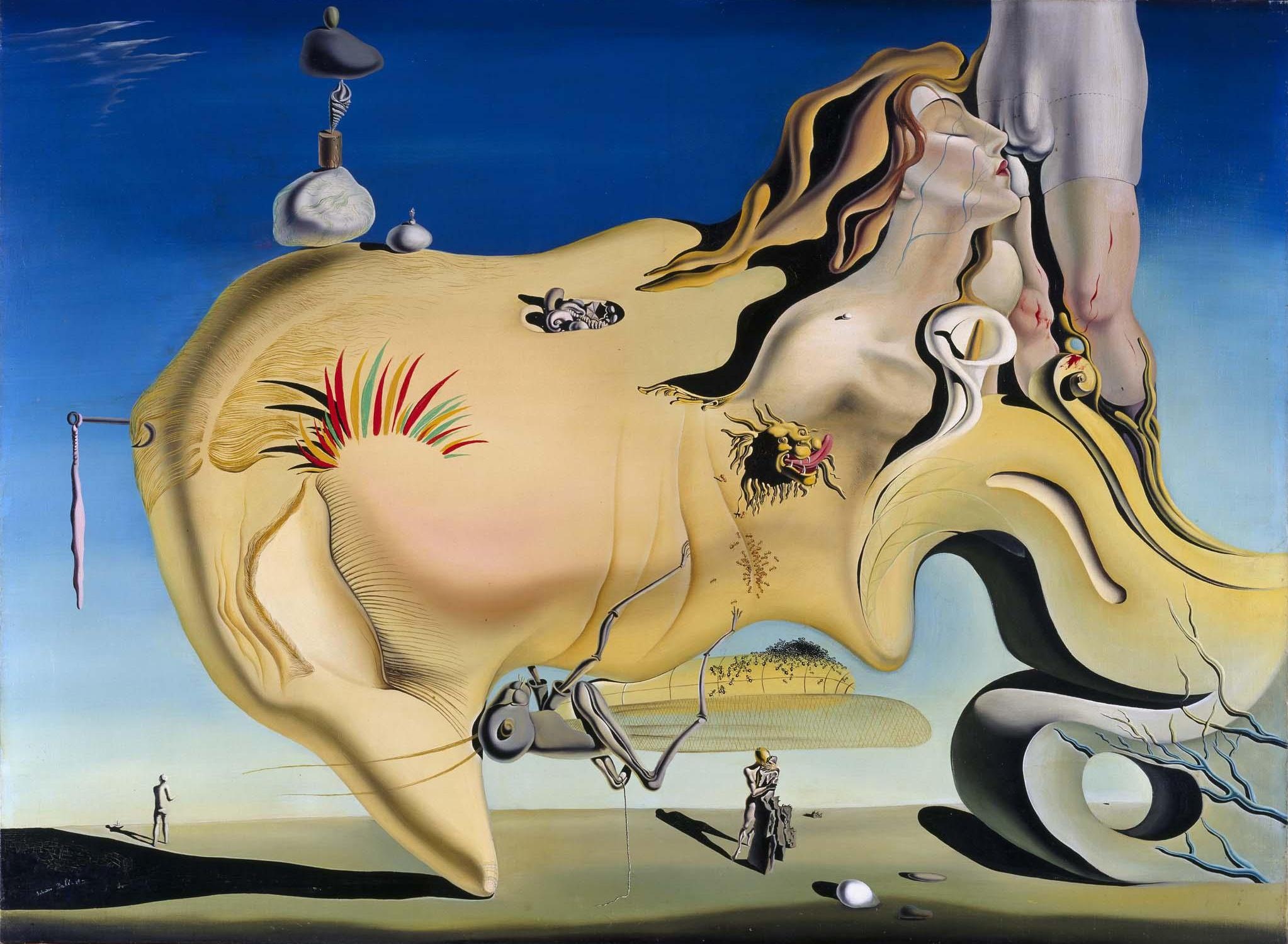
If a begrudging art critical respect is still extended to his most iconic early works, “The Persistence of Memory” (1931) and “The Metamorphosis of Narcissus” (1937), then the so-called Nuclear Mysticism pieces, including religious paintings like “Christ of Saint John of the Cross,” are still often regarded with a cringe, or as “simply junk” in the appraisal of the respected Protestant theologian Paul Tillich in 1956. The hard-bodied beach himbo of Dalí’s 1951 crucifixion may in fact be junk, but not straightforwardly so. Nor is that true of the other Nuclear Mysticism works, which remain somehow both reverential and disquieting, revolutionary and deeply flawed, pious and inadvertently sacrilegious.
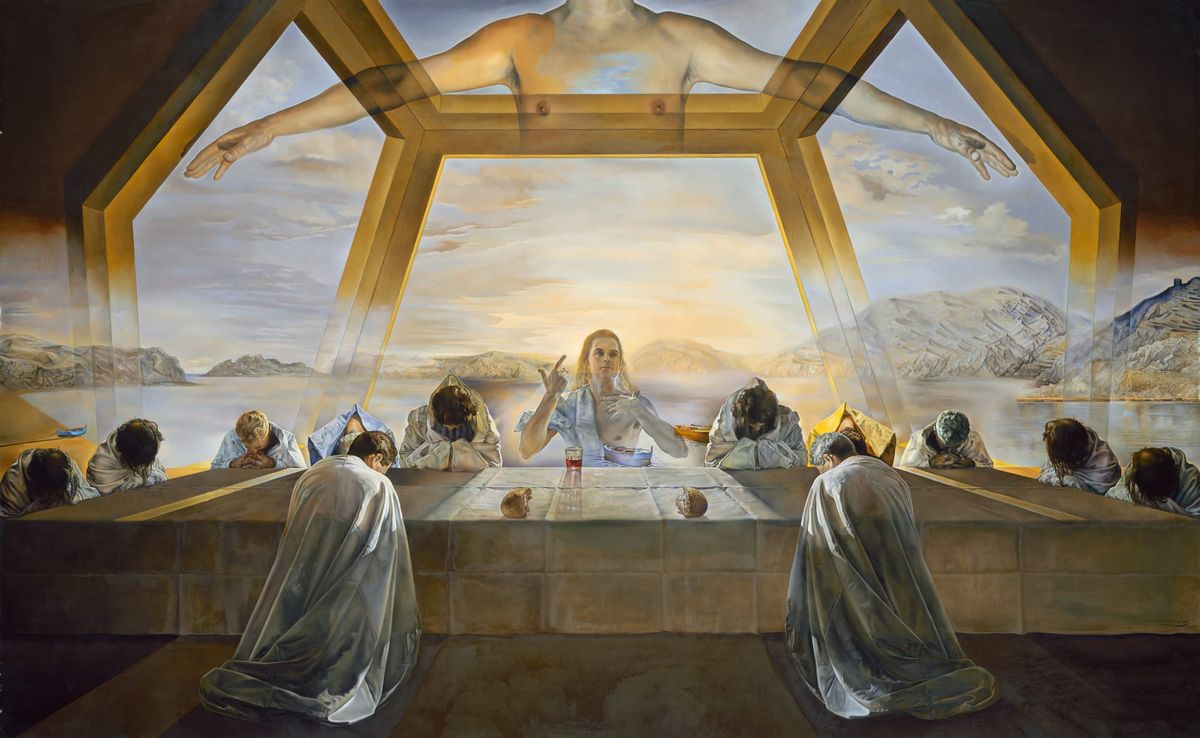
Tillich was referring to Dalí’s 1955 “The Sacrament of the Last Supper,” which takes as its focus not Friday of Holy Week but Thursday. Here, the 12 apostles sit around the eucharistic table, another worryingly Aryan Jesus sitting before the bread and wine of this first communion, while an ethereally transparent dodecahedron levitates above and permeates through the scene, the torso of a perfected and transcendent Christ above. Dedicated visitor to the Museo del Prado that he was, Dalí was strongly influenced by the smooth and uncanny perfection of the figures in the compositions of 17th-century Baroque painter Francisco de Zurbarán, and indeed part of what’s so disquieting about both of these works is that he gives us the crucifixion without blood, the passion without a passion. The Nuclear Mysticism of Dalí, which he defined by his union of interests in the theological and the scientific, is concerned not with the material but with the transcendent, with Christ rather than Jesus. A sacramental aesthetic for after the wafer and wine have already been transubstantiated. But the wafer and wine are transformed into flesh and blood, of course, which is where Dalí courts awfully close to heresy, for in excising the human, he threatens to exorcize God.
The ultimate expression of Dalí’s Nuclear Mysticism is evident in the 1954 “Crucifixion (Corpus Hypercubus),” an even more shockingly strange depiction of Christianity’s central event than that of the earlier “Christ of Saint John of the Cross.” Here, another physically perfect Christ, outfitted in a loincloth, floats before the instrument of his death, though in this case it’s not the conventional cross but rather what is known in non-Euclidean geometry as a “hypercube.” In typology, this refers to an unfolded tesseract, whereby a tesseract is a cube in four dimensions; as a cube is to a square, so is a tesseract to a cube. When a tesseract is “unfolded” into three dimensions, it resembles a cross — a series of eight conventional cubes organized in a vertical row of four with the subsequent four each horizontally attached to the penultimate cube from the top. By placing Christ in this realm, in a direction to which no human can fully point, Dalí is in the tradition of Edwin A. Abbott’s satirical 1884 classic Flatland: A Romance of Many Dimensions, whereby a three-dimensional Sphere explains to a two-dimensional Circle that the former exists “Upward, not Northward.” “Crucifixion (Corpus Hypercubus)” is an equation suggesting that for us, God and all his angels exist in a similar direction. Whether we’re to interpret the hypercube cross as metaphor, reality, or some totally undefinable other is part of the transcendent power of the composition.
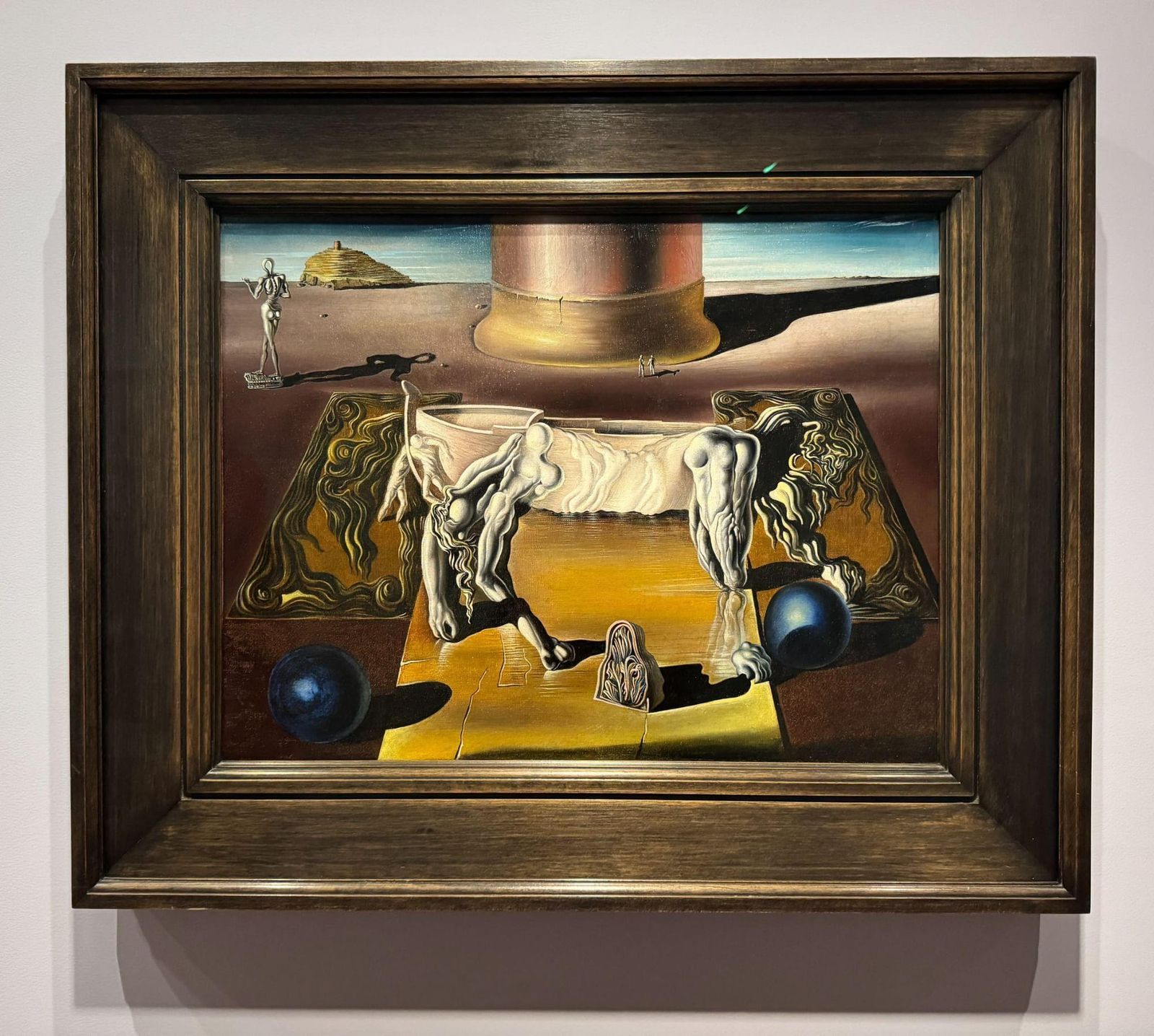
In drawing from mathematical higher dimensionality, whereby the unpierced and unbloodied Christ floats in a Platonic realm above the checkerboard geometry of the ground beneath the execution, Dalí evocatively conflates the discoveries of the new physics with the sublime themes of faith. In Art and Physics: Parallel Visions in Space, Time, and Light (1991), Leonard Shlain argues that for the “visionary” Dalí, the “fourth dimension is spirit.” Despite his well-earned reputation as a paragon for irrationalism, the Surrealist was nonetheless attracted to the absurdities of the new physics, of general relativity and quantum mechanics, whereby space and time could be united and an object could be composed of both waves and particles. By the 1950s, Dalí repudiated the psychoanalytic influence of Freud, of the inner dreamscape viewed as practically synonymous with the Surrealist project. Instead, he exclaimed in his 1958 Anti-Matter Manifesto that “my father, today, is Doctor Heisenberg,” one of the founders of quantum mechanics. The conversion from psychiatry to physics — and also to religion — appears genuinely inculcated by the United States bombing of Hiroshima and Nagasaki in 1945, a horrific act of violence that captured his imagination. In his obsession with atomic theory, the adjective in Nuclear Mysticism was anything but ironic. Correctly intuiting that contemporary physics, having long shorn off the dry determinism of the Newtonian universe, was rendered in a language as inscrutable and mysterious as kabbalah, Dalí’s new work understood science as a verification of the occultism that had motivated Renaissance figures like Saint John of the Cross.
Dalí’s Nuclear Mysticism, then, is a genuine expression of reverential faith. It sees the macrocosm of apocalypse hidden within the microcosm of every atom, an undeniable truth after the perfectly named Trinity Test of the Manhattan Project, and posits God as every bit as paradoxical as a photon or the space-time continuum. Even more so than “Christ of Saint John of the Cross,” his “Crucifixion (Hypercubus)” performs something genuinely religiously shocking — not by trading in predictable debasements and impieties, but by imagining something as tired and canonical as the death of Christ in a completely novel way. Displayed at the Metropolitan Museum of Art, none other than the atheist Ayn Rand supposedly meditated upon it reverentially for hours at a time despite what she considered its “revoltingly evil metaphysics.” Rand, in a rare moment of accuracy, may have been correct about the works’ metaphysics, but predictably not for the reason that she thought.
If there is sacrilege in the painting, which in its dream-like eeriness is nonetheless beautiful, it’s that it is a painting of Christ, but not of Jesus. There is no incarnation here, no sense of the union of the divine and human that is the operative point of the passion. Having abandoned the profane for only the sacred, Dalí divorced the human from the divine, renouncing the richness of experience for the aridity of metaphysics while veering close to idolatry. There is, in the unlined, unbrutalized, untortured body of Dalí’s Christ, an object as perfect as a geometrical idea and one just as apt to offer little in the way of connection or consolation, of redemption or salvation. The painting, as beautiful as it may be, is not of a man, much less the Son of Man, but only of an idea, a hollow fantasy as cold as the pitch-black abyss that surrounds its central figure.