
Art
Terrible Taxidermy from When Exotic Animals Were Unknown in the West
Exotic animal visitors to Europe in the 18th and 19th centuries were more frequently dead than alive.

Art
Exotic animal visitors to Europe in the 18th and 19th centuries were more frequently dead than alive.

In Brief
Some scribbles dismissed in the 1920s by the then-director of the Victoria & Albert Museum as "irrelevant notes and diagrams in red chalk" were recently revealed to represent Leonardo da Vinci's first record of the laws of friction.
Art
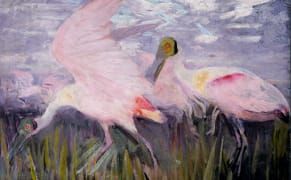
Before coming across an unusually calligraphic painting of a mountain, Williams College Museum of Art Curator Kevin Murphy considered the turn-of-the-century artist Abbott Handerson Thayer "a one slide guy," a man known for portraits of placid angels, who in an art history class might get one mentio
Art
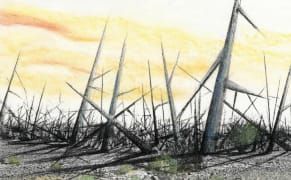
Consider a wanderer 10,000 years in the future discovering a strange construction of granite thorns in the New Mexico desert, their points weathered by centuries, their shadows stretching at sinister angles.
Books
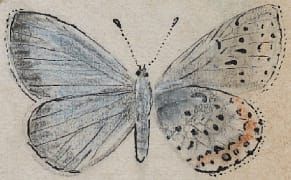
At the end of Vladimir Nabokov's poem "Pale Fire," he describes how "White butterflies turn lavender as they / Pass through its shade where gently seems to sway / The phantom of my little daughter's swing."
Art
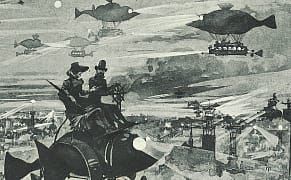
WASHINGTON, DC — Science fiction rose to prominence in the 19th and early 20th centuries, when authors like H. G. Wells, Jules Verne, and Mary Shelley imagined the extraordinary possibilities of advances in technology and exploration.
Art
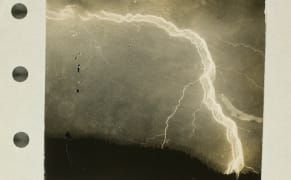
In the 1880s, William Nicholson Jennings set out to prove the diversity and unpredictability of lightning's path, capturing the electric light with his plate camera.
Books
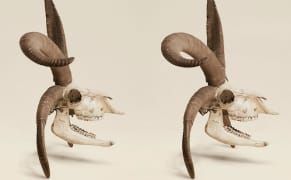
Natural history storerooms are a bit like drowned Noah's Arks, with specimens from every realm of the animal world posthumously preserved.
Art
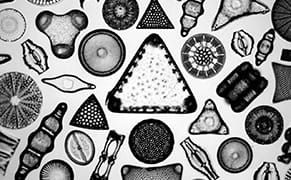
If it hadn't been for Carl Strüwe, a German graphic designer and self-taught photographer, the world may have never come to appreciate the unlikely beauty of a cockroach's stomach.
Books
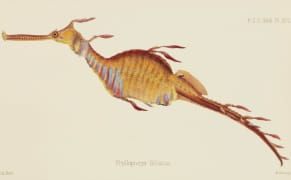
In the 16th century, Pierre Belon published one of the earliest scientific depictions of a dolphin: a woodcut with finely hatched skin and pointed teeth.

Art
Richard Evans Schultes took peyote with the Kiowa in Oklahoma in the 1930s, was the first scientist invited to a hallucinogenic yagé ceremony in the Amazon's Sibundoy Valley in the 1940s, and inadvertently helped launch the psychedelic era of the 1960s.
![Damien Hirst's Pickled Animals May Have Leaked Carcinogenic Fumes [UPDATED]](https://storage.ghost.io/c/51/f8/51f871d8-b6be-4a73-b958-0ca4fff0110a/content/images/size/w600/hyperallergic-newspack-s3-amazonaws-com/uploads/2016/04/hirst-fumes-home.jpg)
In Brief
Damien's Hirst's formaldehyde-filled installations don't just ooze money and pretension — some may also leak potentially dangerous gas.