Thaddeus Mosley, Beloved Self-Taught Sculptor, Dies at 99
The Pittsburgh artist remained largely overlooked until the last decade of his life.

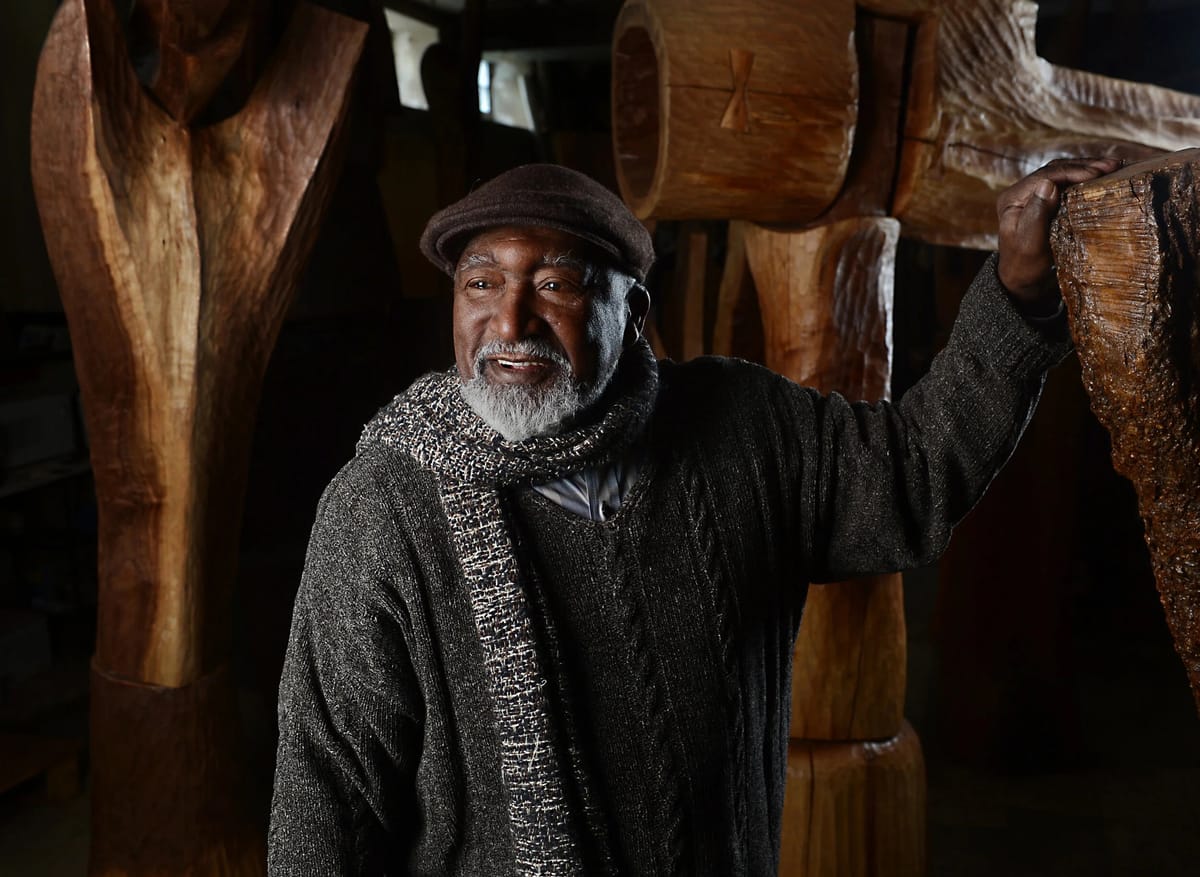
Thaddeus Mosley, a self-taught artist who became an internationally known sculptor and a beloved Pittsburgh public figure, died on Friday, March 6, at the age of 99.
Members of the artist’s family, including Pittsburgh City Councilor Khari Mosley, one of his six children, announced that he had died at his home after spending time in hospice care.
In a statement he shared on social media, Khari Mosley described his father as a “dedicated family man, ubiquitous community pillar, and an inimitable creative force who embodied the hard-working ethos of his blue-collar Western Pennsylvanian roots and the innovative essence of the classic jazz music that served as his spiritual inspiration.”
For more than 70 years, Mosley carved figures using mallets and chisels out of salvaged wood from Pennsylvania forests before finding acclaim in his ninth decade with shows at the Musée National Eugène Delacroix in Paris, Bergen Kunsthall in Norway, the Baltimore Museum of Art, the Nasher Sculpture Center in Dallas, and elsewhere.
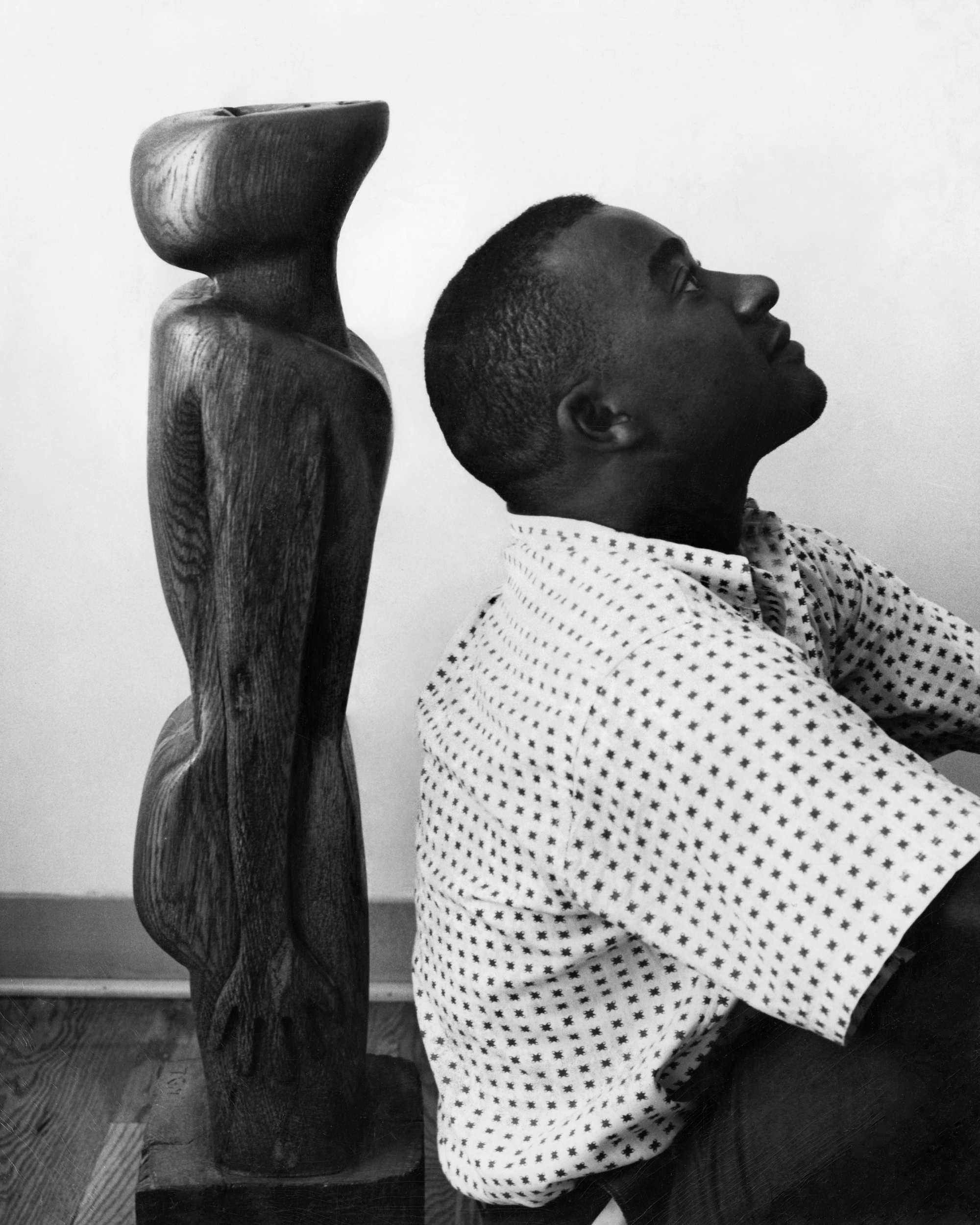
Mosley frequently characterized his method as “sculptural improvisation.” Inspired by Constantin Brancusi, African tribal art, and Isamu Noguchi, for whom he had a particular affinity, as well as classical jazz, he approached his work by letting the forms of his raw materials speak to him. Instead of making variations on a theme or imposing a shape onto logs of wood, Mosley used a chisel and gauge to respond to the natural gradations of its surface.
“I try to make things that generate their own spirituality so that people might feel something about it,” Mosley wrote in a 2021 exhibition catalogue of his work at Karma Gallery. “What presence is to make something have a life of its own — the alchemy of turning something natural into something alive.”
Mosley was born in 1926 in New Castle, Pennsylvania, a small city about 50 miles northwest of Pittsburgh, as one of five children to a coal miner. He served in the US Navy during World War II and graduated from the University of Pittsburgh in 1950 with a degree in English.
He stayed in the steel city to become a sportswriter for the Pittsburgh Courier, a weekly African-American newspaper. Then he worked other jobs, including a four-decade career as a mail sorter for the United States Postal Service, while beginning to carve two-by-four planks of wood into animal figures that were displayed at a Downtown Pittsburgh department store.
A close-up encounter with Noguchi’s work in 1959 proved significant. A friend photographing the sets of a Pittsburgh performance of Martha Graham’s ballet Appalachian Spring invited Mosely to carry some equipment in order to get a better look at Noguchi’s set design for the show. Mosley began making more abstract pieces in the vein of Noguchi and other sculptors like Brancusi and Alberto Giacometti.
“My main idea, of course, is the idea of weight in space, and that idea is that the piece, the sculpture, should look like it's levitating, it should look like there is movement,” Mosley said in an interview with the Seattle Art Museum.
A decade later, Mosley met Noguchi at a lecture the Japanese American artist gave at the Carnegie Institute, now the Carnegie Museum of Art. Noguchi was already aware of his work; then-director Leon Arkus championed Mosley’s art by exhibiting a solo show and displaying one of his pieces on the museum's stairs.
He remained virtually unknown outside of Pittsburgh, despite several group and solo shows at the Carnegie Museum and a number of large public sculptures commissioned throughout the city. That began to change in 2018 when his work was included in Carnegie International, the 57th edition of the international art show, at the age of 92.
Soon, commercial galleries started calling and Mosley went on to display sculptures in New York, London, Amsterdam, Norway, Western Massachusetts, and Maine. His exhibition at Karma Gallery in 2020, just before the pandemic hit, paid tribute to his artistic heroes while also referencing his longtime love of jazz. “I never know exactly what I’m doing. That’s also the essence of good jazz,” a press release for the exhibition said.
In a review of the show, Hyperallergic’s John Yau wrote that he appreciated how Mosley inserted a “sharp knowing wit” into his freestanding vertical pieces. He argued the art world should have been paying attention to Mosley’s genius decades ago.
“As reasons for this belated awareness, we might consider the rise of the investment class of collectors; racism in the guise of supposedly neutral theory; and the continuing triumph of period styles and theoretical positions over artists who determinedly follow their own trajectory,” wrote Yau.