The Death of the Art School
The rampant corporatization and "administrification" of American higher-education institutions has turned students into mere consumers.

In a faculty meeting last year at Purchase College in New York, a colleague in the administration referred to students as "consumers." It was a casual statement, and I pushed back. The exchange was brief, but it has deeply bothered me ever since. Not because the intention was sinister. Because their statement was precise. Once you call students consumers, you have already restructured every relationship on which the university depends.
Definitions matter. Terms like participant, member, student, client, user, customer, citizen, and constituent carry distinct social logics. A participant or member belongs to a shared institution. A buyer or subscriber belongs to a market.
Students are not buyers or consumers. They are participants in the production of knowledge. More importantly, they are future members of a public that does not yet exist. In that sense, an art school, college, or university is a factory. But what it produces is not a commodity. It is a capacity for thinking, for argument, for questioning without a predetermined answer. Faculty do not work for students the way a salesperson works for a client. They work with students toward something larger. That is not a transactional relationship. Faculty and staff are meant to serve a public. Tuition is not proof that students are customers. It is proof that the liberal state has failed them, just as it has failed them in healthcare. Rather than treating education as a public good, elected officials shift the burden onto individuals, underfund institutions, and protect a system that redistributes wealth upward. Financialization destroys the relation between education, citizenship, and the public world that the university is supposed to build.

The neoliberal university has been doing this for decades. Tenure lines have been replaced with precarious contracts. Public funding has been cut. Austerity returns again and again. When success is evaluated by market metrics, every relationship collapses into a transaction. Students become customers, knowledge becomes a product, and faculty become service providers. The institution is increasingly run like a business rather than a public good.
Then there is “administrification.” A study by the American Association of University Professors has shown that between 1976 and 2011, non-faculty professional positions, especially in student services and administration, grew by roughly 369%, while full-time tenured and tenure-track faculty grew by only 23%. In recent years, that pattern has only intensified. Universities have added more administrative layers while shifting teaching onto cheaper, less secure, and more precarious labor. At Purchase, where I teach, the local record reflects the same trend. Tenure-track positions are being eliminated, often justified by the “demographic cliff,” and replaced with visiting lecturer lines, not even visiting assistant professorships.

In the meantime, between 2016 and 2024, average top salaries for administrators at Purchase College rose by more than 45%, while average assistant professor salaries rose by just around 14%. Cumulative inflation over the same period was 31%. In real terms, the people doing the intellectual work lost ground while the managerial and policing apparatus grew. Among the 25 highest-paid positions at the college, only one is held by a professor. Fifteen are held by administrators and nine by police officers. The Purchase numbers are not a local anomaly. According to a recent CUPA-HR study, which tracks compensation across more than 1,000 institutions, administrator salaries have outpaced inflation nationally for three consecutive years while tenure-track faculty have seen no real salary increase in over a decade.
The new administrative order sets the terms and decides what counts. What this produces, beneath the numbers, is steady deintellectualization. And it is students who ultimately bear the cost of this transformation, even if they are the last to see it. Learning does not happen under bureaucratic control. It happens in a free community where the people responsible for producing knowledge are encouraged, respected, and not silenced by administrative pressure.
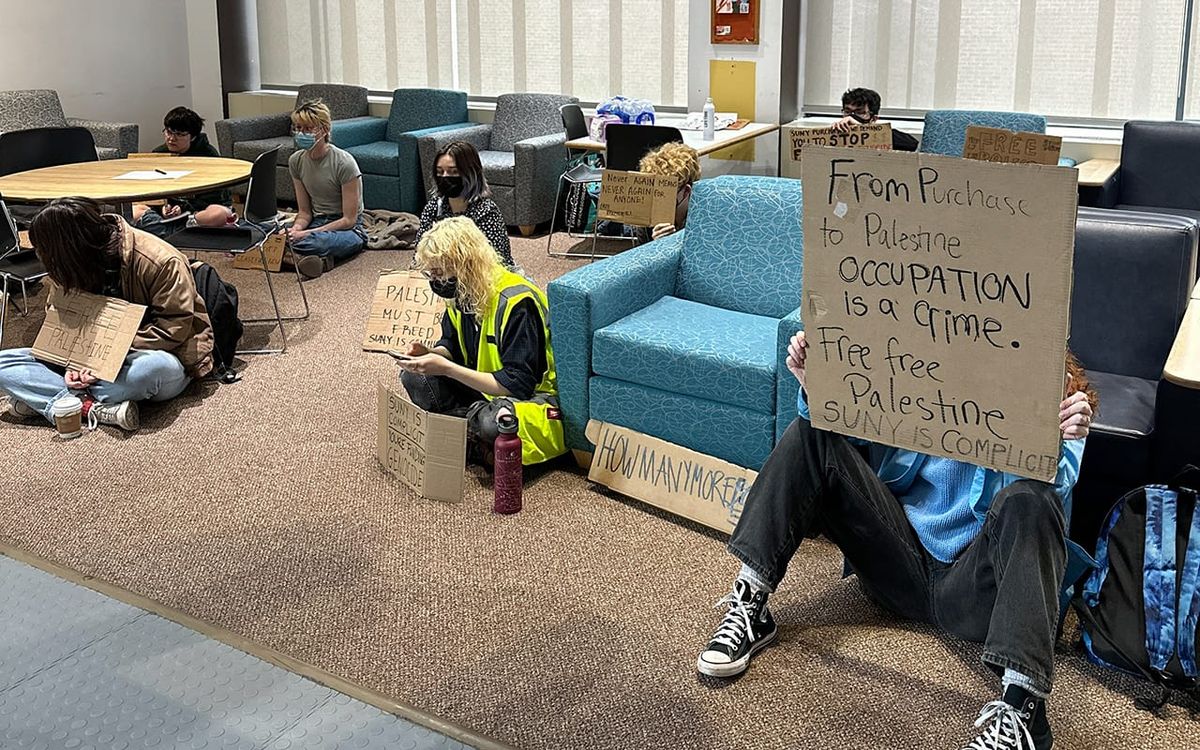
The aftermath of the Gaza protests made this concrete. When students organized for human rights on several campuses in May 2024, the response was swift. Police were called in, and encampments were cleared. Students were suspended or even expelled. The same institutions that had dedicated years to publishing statements about critical thinking, civic engagement, decolonization, and land recognition moved against all of it the moment it became inconvenient. The response revealed how quickly universities abandoned their stated commitments once political pressure intensified. The university had effectively become a policing institution, controlling speech and disciplining bodies in the name of public order.
There is another ledger worth examining. In New York alone, universities have been spending heavily on capital projects as architectural statements of ambition. The New School built a 16-story University Center at 65 Fifth Avenue, its largest capital project ever. Cooper Union, which had offered free tuition since its founding in 1859, cut that commitment in 2014 after accumulating debt through the construction of a $175 million building at 41 Cooper Square, a financial crisis the New York Attorney General's office confirmed was rooted in that project. Columbia is reshaping Manhattanville. New York University (NYU) has been overbuilding in Greenwich Village. Even the City University of New York (CUNY) and State University of New York (SUNY), two public systems with chronic funding crises and faculty on contingent contracts, have invested in buildings, centers, and institutes that project ambition while neglecting the labor that sustains intellectual life.
When deficits occur, the administrative class does not bear the burden. Faculty and students do. At the New School, for instance, where adjunct instructors already make up roughly 90% of the teaching workforce, the president (who makes more than $1 million a year) and senior administration refused to cut their salaries while steadfastly eliminating full-time and part-time faculty lines.

Rather than building a resilient community or developing cooperative democratic frameworks with the people who actually constitute the institution, administrators turn outward. Consultancy firms, composed largely of MBAs with no stake in intellectual life, are routinely hired to redesign curricula, restructure departments, and recommend enrollment strategies. In 2023, Purchase College spent hundreds of thousands of dollars on Gray Associates, a consulting firm engaged to study enrollment trends. The recommendations were obsolete within a few years. What is remarkable is not that this happens but that it passes as expertise.
Academic leaders, provosts, deans, and directors now function primarily as intermediaries of growing discontent. This is not a criticism of individuals. It describes a structural function. The job, in practice, is to absorb faculty frustration and translate institutional dysfunction into compliance. The growing alienation among faculty and staff, the slow disillusionment of people who once believed their work mattered, has become a problem to be managed rather than a signal to be heard. In the post-Gaza context, faculty of color bear this most directly as they are belittled, undermined, and pushed aside through various administrative processes.
In an art school context, this failure is especially acute. Art schools do not produce knowledge the way research universities do. Art schools produce something harder to measure and easier to destroy: collective cultural and artistic imagination. It is the capacity to rethink form, to work across disciplines, to engage new and challenging ideas, and to build something that did not exist before. That capacity depends entirely on community. On proximity, trust, and the kind of intellectual friction that only happens when people are genuinely invested in each other's work.
For many young people, art school (or university) is the first place where life opens up beyond what they have inherited. It is where they become adults, where local cultural bubbles begin to crack, and where repressive structures can be named and challenged. Students encounter differences, unfamiliar cultures, histories, and ways of living and being. They test the most provocative ideas. They imagine futures that did not seem available before.
Today's students have come of age under conditions that liberal institutions have consistently failed to address. They face job insecurity, debt, isolation, and a world visibly coming apart. Many are lonelier than previous generations, and more skeptical of institutions that speak the language of care while delivering precarity. What they are searching for is not a service. It is a society that takes them seriously as participants rather than customers.
What students need are durable public institutions. They need schools that can sustain dissent and risk, and provide continuity and belonging over time. What they are given instead is a managerial culture that speaks endlessly of excellence while dismantling the conditions that make any of those things possible. The bitter irony is that the administrators most committed to this logic are often the same people who perform the deepest reverence for academic values in speeches, mission statements, and strategic plans. The performance is often sincere. That is what makes it effective. They have internalized a system of incentives and stopped seeing what those incentives destroy.
Finally, there is the right-wing attack on universities. In 2021, JD Vance delivered a keynote address at the National Conservatism Conference in Orlando titled "The Universities Are the Enemy." He called for an honest and aggressive attack on higher education and closed by quoting Richard Nixon: "The professors are the enemy." That is not a fringe position. It is now government policy that has real consequences. Humanities departments are defunded as faculty are systematically targeted by the state.
But the external attack and the internal one are not equivalent dangers. Politicians dictate tone and threaten to defund the arts and humanities. But the administrative machinery is already doing the work, draining higher education of intellectual substance and shrinking the conditions under which free expression is possible. In this regime, you do not need to attack the university from outside if you have already hollowed it out from within. The internal assault is quieter and more complete.
The ideal university is a self-governing community of scholars and students. The phrase universitas describes this founding political logic. The university, unlike a corporation, a court, or a church, belongs to those who inhabit it. It is organized around a shared purpose, the production of secular knowledge, and that purpose is what gives it authority, not the other way around.
That logic has a long genealogy. Wilhelm von Humboldt, designing the University of Berlin in 1810, insisted that neither teacher nor student exists for the other. Both exist for scholarship. John Dewey, in Democracy and Education (1916), saw education as woven into democratic life itself. Socrates refused to sell philosophy. He practiced it in the agora, without a fee, in open conversation with anyone willing to think. Socrates understood that once philosophy becomes a service, the philosopher becomes answerable to the client. Inquiry gives way to satisfaction. Two and a half thousand years later, we are reenacting that problem on an institutional scale. The customer does not exist in the university because the university exists precisely to produce the kind of person who cannot be reduced to a consumer.
Those conditions require freedom to pursue knowledge without market justification, and freedom to challenge students rather than satisfy them. Art schools matter because they provide the space in which artistic and political imagination can take collective form. They allow people to test other ways of seeing, making, and living. Financialization attacks those conditions directly. This is not incidental to the crisis of the university. It is the crisis.