The Jewish Sisters in Renoir’s “Pink and Blue”
Author Catherine Ostler follows the lives of the two cherubic girls in “Pink and Blue” (1881), whose rarefied lives in an elite, artistic French family would be toppled by the horrors of the Holocaust.

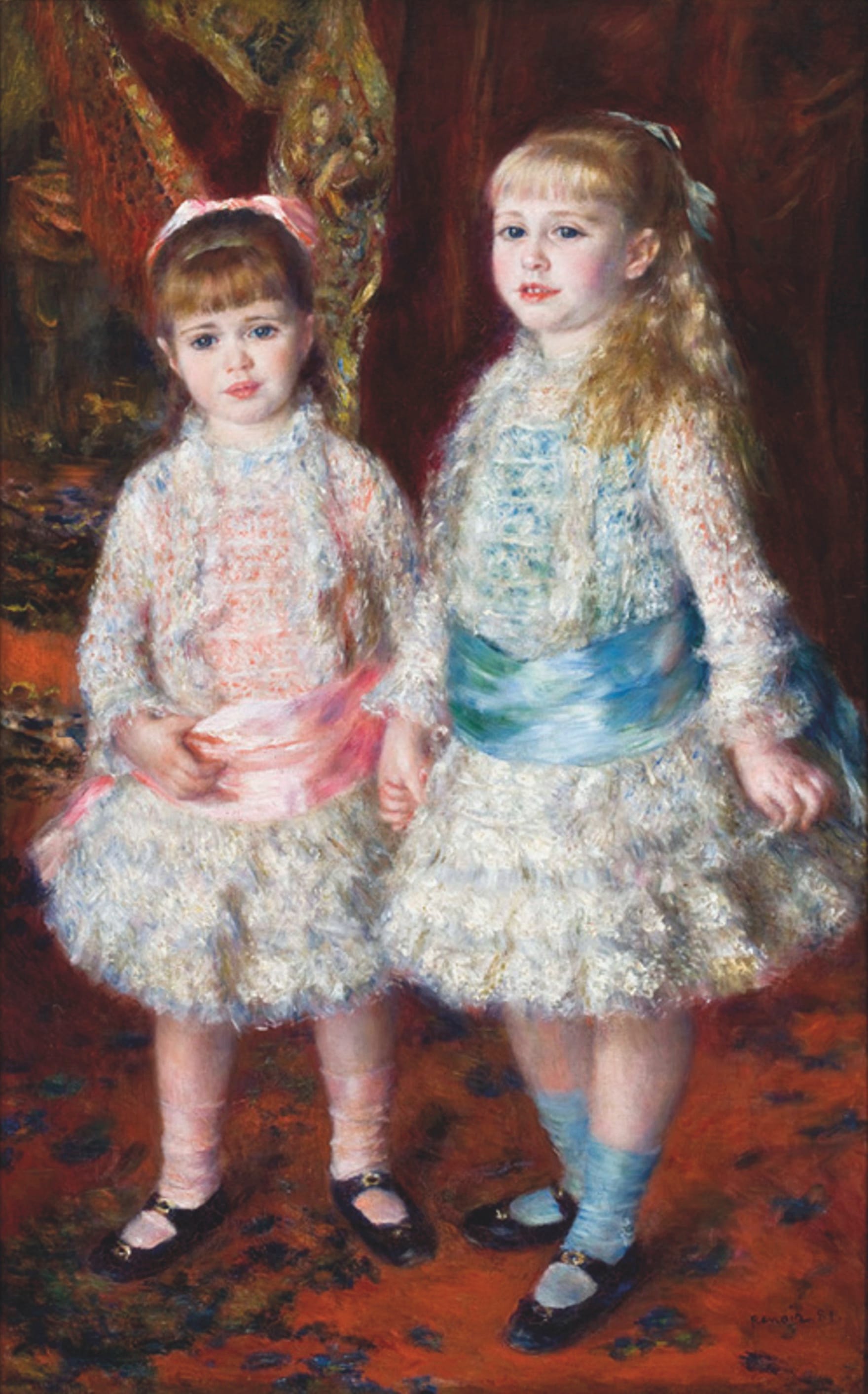
In 1881, at the dawn of the Belle Époque, Pierre-Auguste Renoir steps into the ritzy Parisian townhouse of the Cahen d’Anvers family to paint a double portrait of four-year-old Alice and six-year-old Elisabeth, daughters of the Antwerp-born Jewish banker Louis and salonnière Louise. In the finished canvas, “Pink and Blue, the Misses Cahen d’Anvers” (1881), the two cherubic girls with rosy cheeks and reddish-golden hair stand in a sumptuous salon, holding hands, enveloped in a cloud of lace and satin.
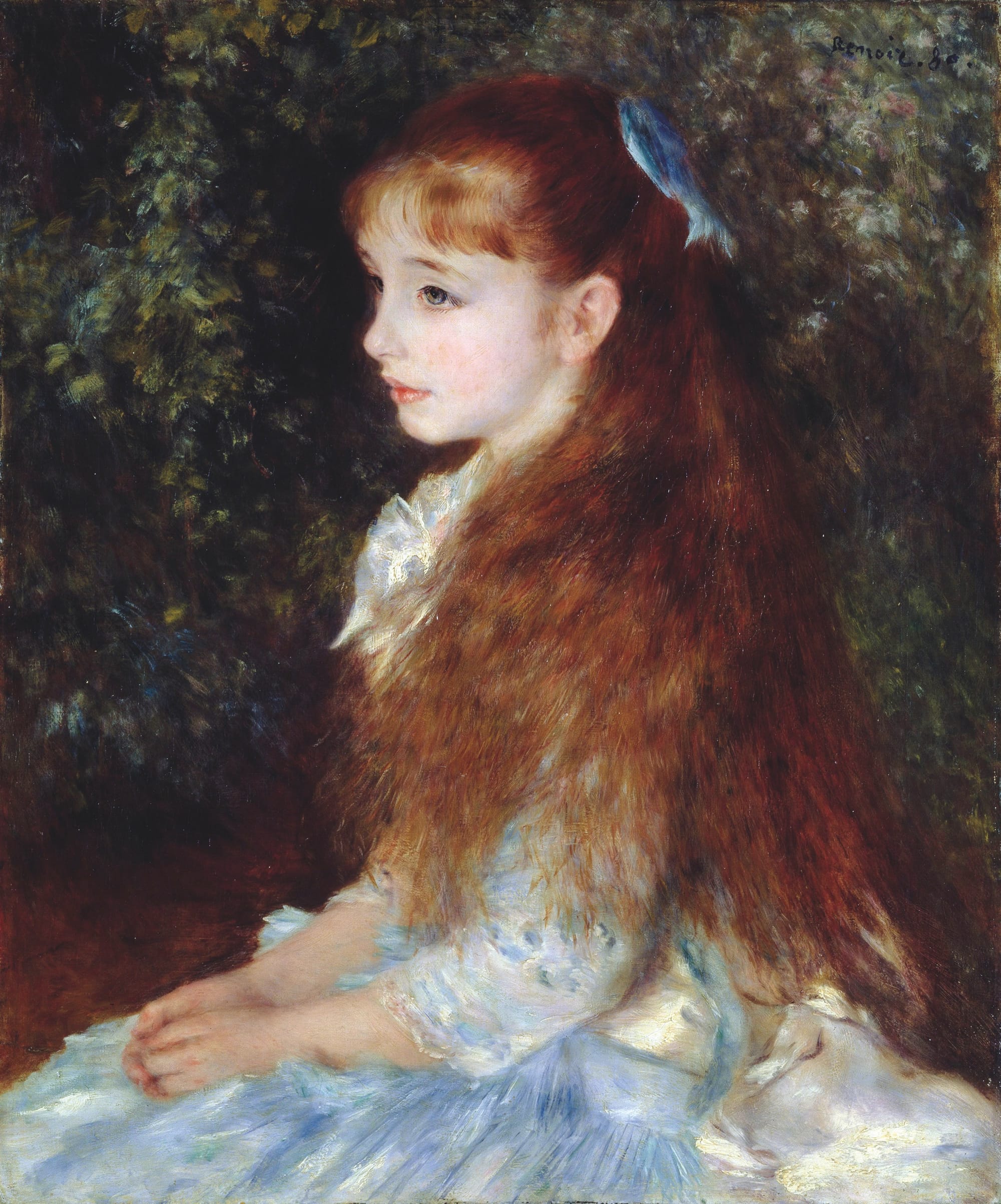
This “duet of sugared-almond-colored-sweetness,” as author Catherine Ostler puts it, and “La Petite Irène” (1880) — a portrait of their older sister, painted by the artist a year earlier — are the springboard for her book The Renoir Girls.
From the opening pages, Ostler’s exhaustively researched, deftly structured book conjures the gilded world of fin-de-siècle Paris, leading the reader through the brocade curtains of the Cahen d’Anvers family’s dazzling life as members of the Jewish elite to their tragic end in the Holocaust. At center stage is the art patron Louise; Marcel Proust was a close friend, and her famed salon drew artists, writers, and members of the conservative Catholic aristocracy alike. And there was her lover, the collector and art critic Charles Ephrussi, who had arranged for Renoir to paint the girls and was suspected of being Alice's biological father. But alongside this world of opulence and privilege, in which every ball and horse race the Cahen d’Anvers women attended made it into the newspaper columns, ran another Paris, one divided by inequality and political instability, which fueled antisemitism and punctured the sisters’ rarefied lives.
Ostler captures the collision of these two worlds with the dreadful inevitability of a train derailing in slow motion. Despite the French Revolution and the Napoleonic Code having ensured equal rights for France’s Jewish population, antisemitism was insidious across the country. It took the form of resentful grumbles “aligned with the times”: “I really give up with the Jews,” wrote Renoir to a friend complaining about Louis’s “stingy” payment. It took the form of the anti-Jewish venom of diarist and, perversely, frequent visitor to Louise’s salon, Edmond de Goncourt. And it reached its peak with the Dreyfus Affair of 1894 to 1906, in which a Jewish French army officer was framed for treason. While the Cahen d’Anvers and their close circle belonged to the Dreyfusard camp, some members of the Jewish elite — the haute Juiverie — seemed to waltz through this moral and political crisis, which polarized the nation. Amid political assassinations and anarchist bombs, Louise and Louis went on worshiping the 18th century and restoring Château Champs-sur-Marne to its ancient regime glory. Meanwhile, the girls continued on their path to assimilation, not without puzzling twists and heartbreaks.
In 1895, at the height of the Dreyfus Affair, a 21-year-old Elisabeth converts to Catholicism and marries a penniless aristocrat, whom she later divorces. In 1897, the adventurous, anglophile Alice meets the ambitious British Colonel Charles Townshend in Egypt and, a year later, ties the knot in an Anglican ceremony at her parents' chateau. And Irène, the only one to enter into an arranged marriage, leaves her husband, Moïse de Camondo, for the head of his stable. But in the 1930s, the glittering carousel comes to a screeching halt, and Ostler’s account of the Nazis’ occupation descends into a harrowing tale of persecution.
The Cahen d'Anvers’s love for France and desire to belong run deep throughout the book. Their forebears adapted their surname to sound more aristocratic; Irène’s son, Nissim de Camondo, fought for France and died in World War I. They gave generously to philanthropic causes, restored dilapidated historical properties, and later donated them to the French state. But neither their wealth nor their belief in the values of the Enlightenment could shield them from the catastrophe to come, and four members of the family perished in concentration camps, including Elisabeth, who, in 1944, old and infirm, was betrayed by the mayor of the village where she was hiding and died in or on the way to Auschwitz.
As for the paintings, “Pink and Blue” now hangs at the Museu de Arte de São Paulo Assis Chateaubriand, where it is one of the institution’s most popular works. “La Petite Irène,” on the other hand, was looted by the Nazis, restituted to Irène, and then was subsequently bought by the Swiss arms dealer and war profiteer Emil Georg Bührle. It is now on view at the Kunsthaus Zürich, its sweetness belying a story of devastation and betrayal amid one of the darkest chapters of European history — a story Ostler’s engrossing, kaleidoscopic chronicle vividly brings to life.