What Happens After Repatriation?
“Tide of Returns” investigates the histories and futures of handmade dolls repatriated to an Indigenous Australian community.

VENICE — In November 2018, scholars and historians Felwine Sarr and Bénédicte Savoy released The Restitution of African Cultural Heritage: Toward a New Relational Ethics, a landmark report that called for the return of African artworks and artifacts removed during the colonial era. More than a question of legal ownership, the authors argued that restitution could repair historical injustice, restore cultural memory, and establish a new relationship between Europe and Africa based on reciprocity rather than colonial domination.
The report gave new momentum to demands for restitution, while repatriation efforts more broadly have involved not only celebrated treasures such as the Benin Bronzes but also more modest objects.
In 2023, the Manchester Museum returned 174 objects to the Anindilyakwa people of Groote Eylandt, a community of Indigenous Australian islanders, in an important example of cultural repatriation. These objects, called Dadikwakwa-kwa, are small dolls made from shells, fibers, textiles, beads, and found materials. They were traditionally used to teach children about kinship, clan relationships, fertility, and connections to the land. Many have individual names and are understood as living presences that preserve stories and ancestral knowledge. In celebration of their return, the Repatriates Collective — a group of artists and researchers from Australia, Africa, Latin America, and Europe that investigates the histories and futures of returned objects — conceived of the project Tide of Returns, on view now at TBA21's Ocean Space in Venice.
Curated by Khadija von Zinnenburg Carroll, Tide of Returns occupies the monumental deconsecrated Church of San Lorenzo and unfolds across film, archival material, sculpture, and sound to examine the movement of cultural objects between Europe, Africa, and Australia.
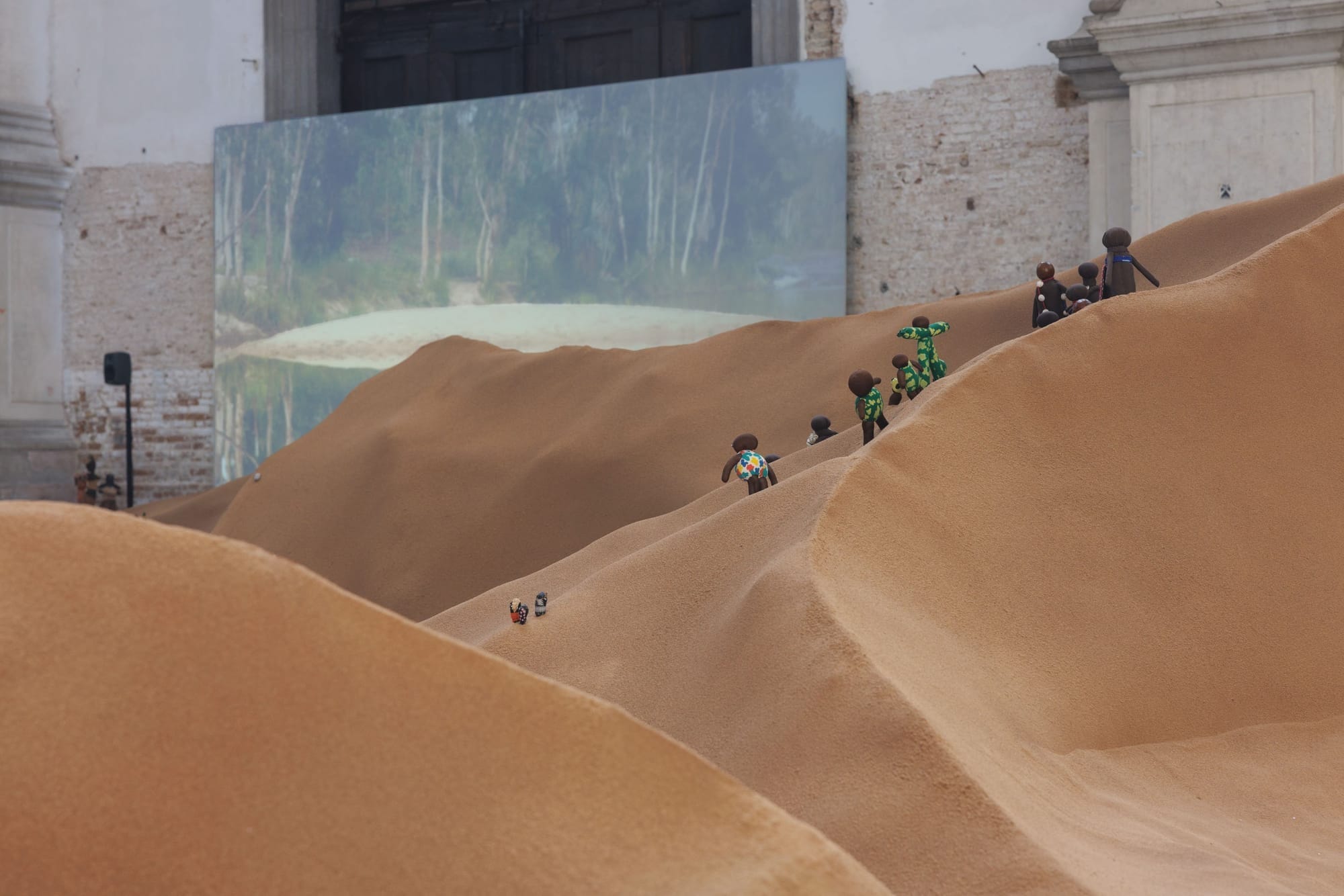
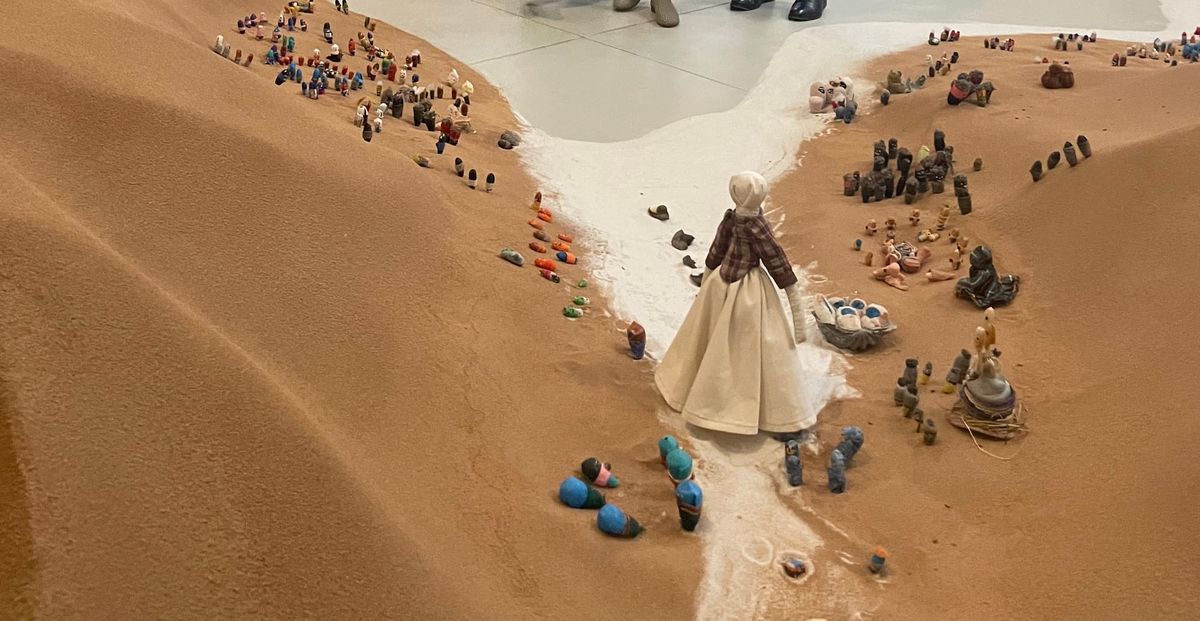
Upon entering the church, visitors encounter Repatriates Collective’s installation “From My Mother's Country” (2026), made of heaps of ochre sand brought from Australia's Gulf of Carpentaria and populated by thousands of tiny Dadikwakwa-kwa. Accompanying the dunes is a film by von Zinnenburg Carroll, made with Kasimir Burgess, Britten Andrews, Noeleen Lalara, and Rebekah Wilson, in which Anindilyakwa women re-dress the dolls and engage in rituals of “reanimating” them in preparation for their journey to Venice. Shimmering scenes of these preparations unfold alongside the multitude of dolls scattered across the undulating landscape.
Spread across the dunes like a Lilliputian society, the shell dolls suggest a world in which cultural continuity survives distance, displacement, and colonial violence. The symbolism is hard to miss: Objects removed from their communities are imagined returning to a landscape where social and ancestral ties remain intact. The dolls serve less as individual protagonists than as eloquent illustrations of the exhibition's broader argument about return.
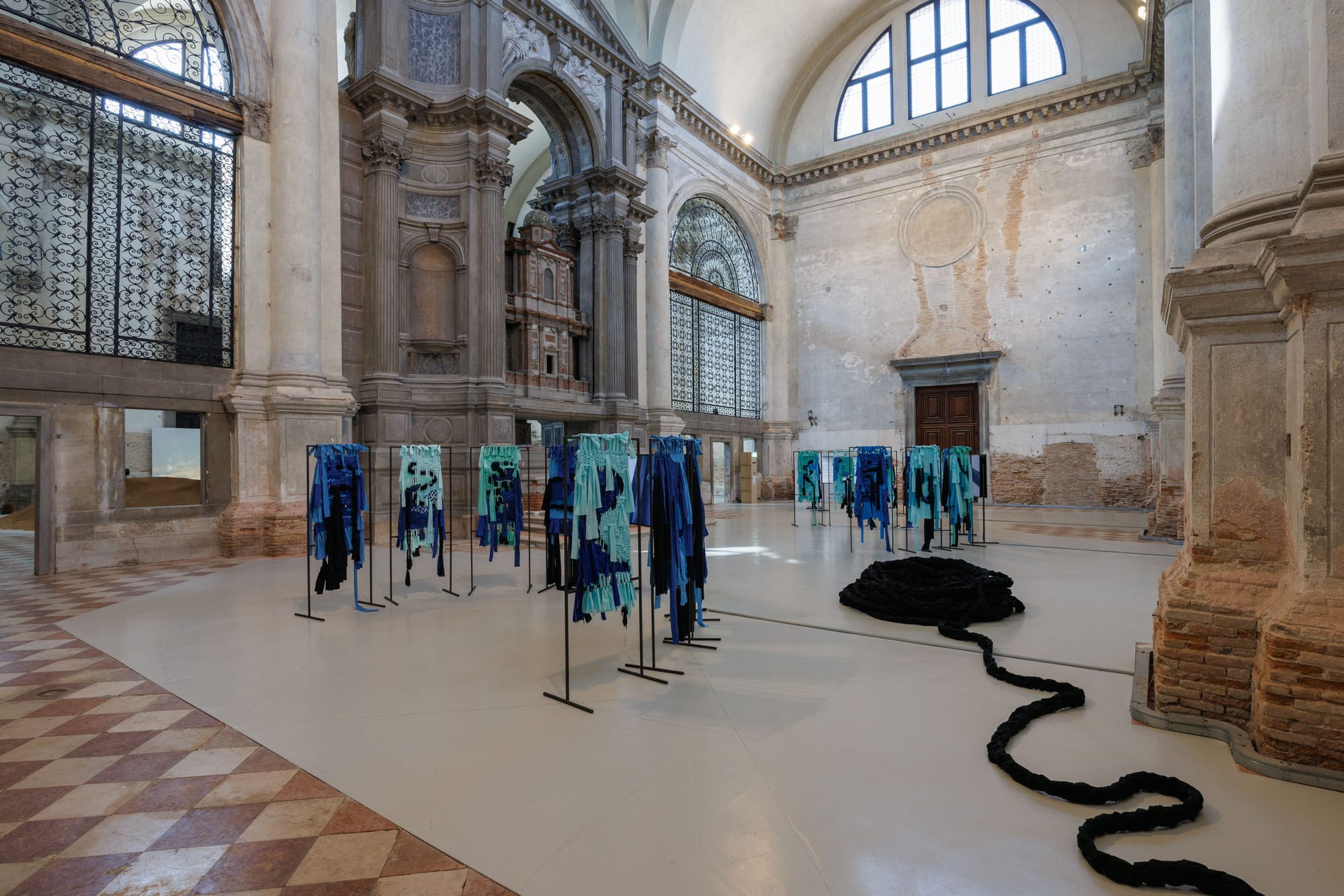
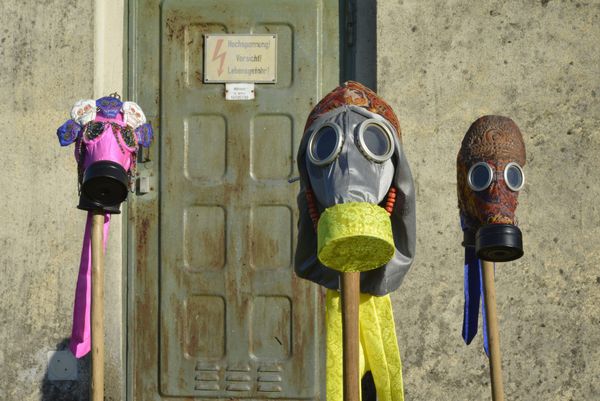
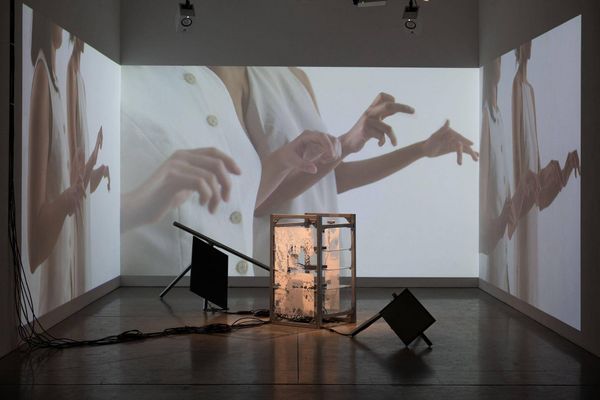
An installation by the German-Bolivian artist Verena Melgarejo Weinandt occupies its own wing of the church. “Weaving Connections” (2026), which is inspired by the continuous cycles of water, features textiles richly saturated in various shades of blue, an enormous black fabric braid unfurling across the floor, and a three-channel video. The braid serves as a synecdoche for Bolivian Indigenous womanhood, while the video depicts female performers engaged in silent rituals, such as washing cloth braids in the waters of the Danube. In the exhibition catalog, Melgarejo Weinandt explains that the work stems from her research into German fantasies and stereotypes surrounding Indigenous peoples. Yet the installation raises an enduring question: How does one visualize stereotypes without, at least in part, relying on the very imagery one seeks to interrogate?
Some of Tide of Returns’s arguments are well-worn, but the exhibition still makes restitution seem less an endpoint than a point of departure for harder questions about who gets to possess, represent, and remember.
Tide of Returns continues at Ocean Space (Chiesa di San Lorenzo, Venice, Italy) through October 11. The exhibition was organized by TBA21–Academy and is curated by Khadija von Zinnenburg Carroll.