This Handprint May Be the World's Oldest Rock Art
The painting predates 66,000-year-old rock art attributed to Neanderthals in Spain, which was previously believed to be the earliest example of its kind.

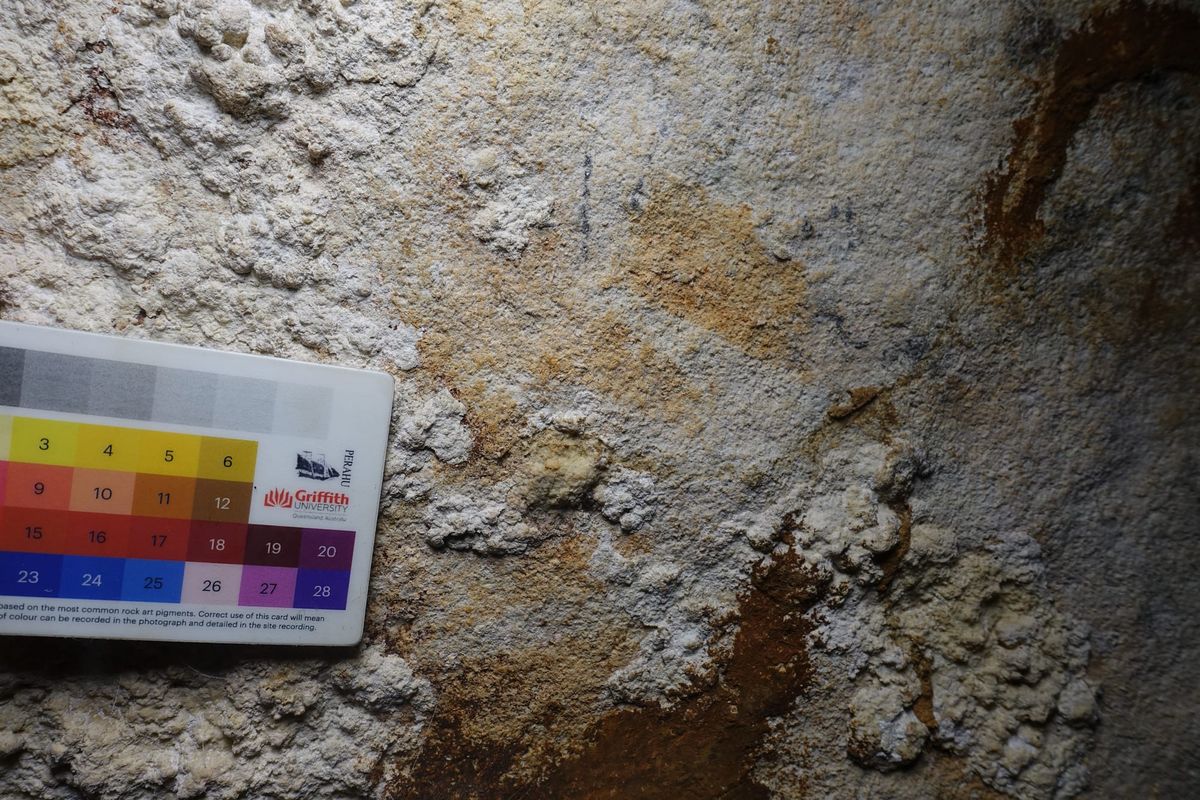
Scientists have identified what may be the earliest rock art ever in a limestone cave in Indonesia from about 67,800 years ago, at least 1,100 years earlier than previously thought.
According to new findings published in Nature by a team of Australian and Indonesian researchers, a partial hand stencil with outlined fingers was found inside a cave on Muna, a satellite island of Sulawesi. The painting predates 66,000-year-old rock art attributed to Neanderthals in Spain, which was believed to be the earliest example of its kind. It is also older than 51,200-year-old cave art of human figures interfacing with pigs in Sulawesi, dated by the same research team in 2024.
The cave where researchers discovered the faded marking is also filled with more recent artwork, with some dated to 20,000 years ago.
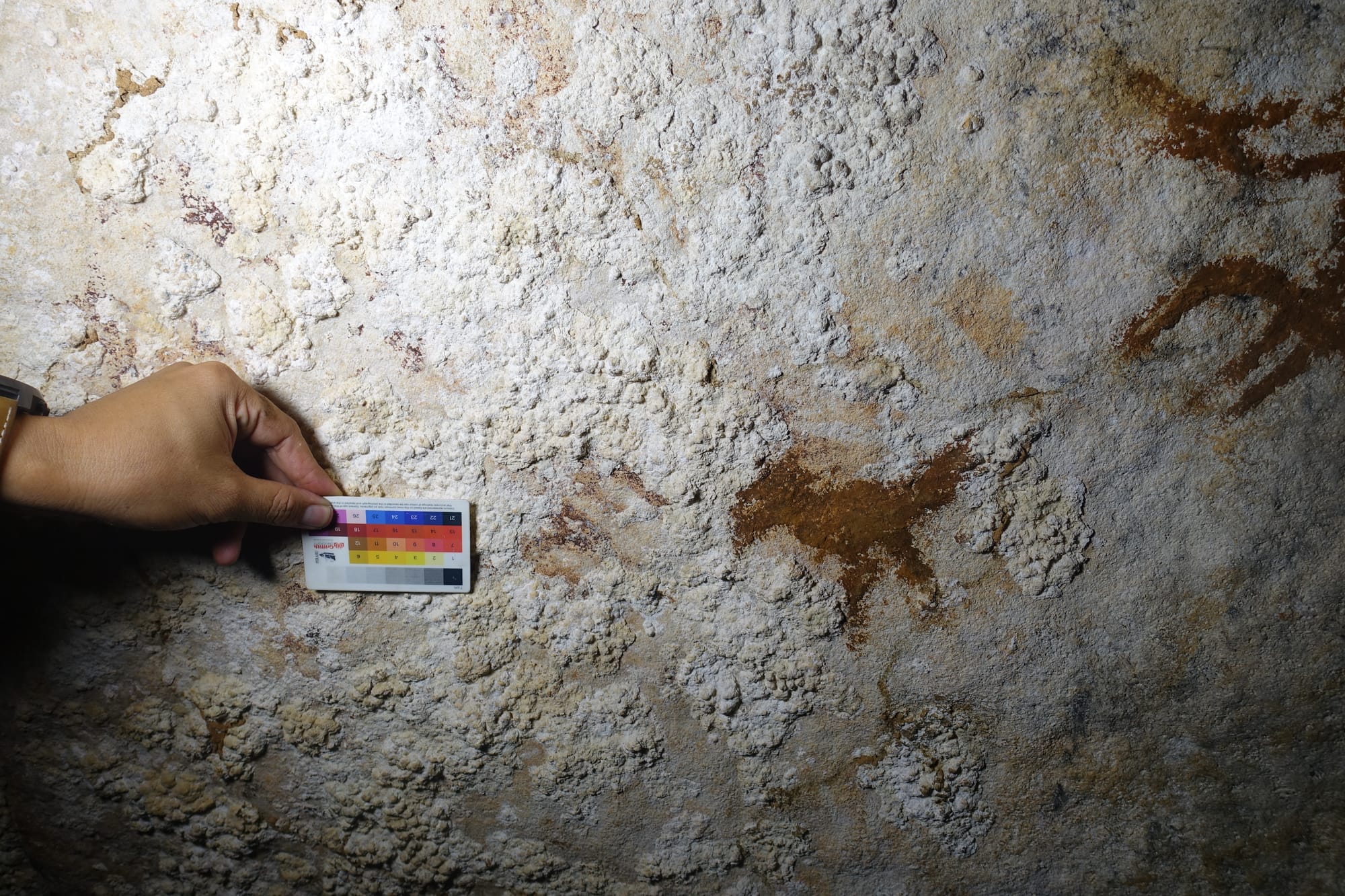
The project was led by researchers from Australia’s Griffith University and Southern Cross University, with support from Indonesia’s National Research and Innovation Agency. In a press release shared with Hyperallergic, the researchers said their findings provided insight into the contested timeline of human settlement in present-day Australia, Tasmania, and New Guinea when they comprised one supercontinent known as Sahul, until sea levels rose during the last Ice Age about 18,000 years ago.
Archaeologists believe that early inhabitants reached the landmass between 50,000 and 65,000 years ago or more. One of the speculated routes of human migration into Sahul includes Sulawesi.
“It is very likely that the people who made these paintings in Sulawesi were part of the broader population that would later spread through the region and ultimately reach Australia,” Indonesian archaeologist Adhi Agus Oktaviana, who co-authored the study, said in a press release.
“This discovery strongly supports the idea that the ancestors of the First Australians were in Sahul by 65,000 years ago,” Oktaviana said.
The researchers also noted that the hand marking appeared to have been altered at some point after it was created. They theorize that the early artists narrowed the fingers, creating the outline of a “claw-like” hand.
In the press statement, Griffith University archaeologist Adam Brumm speculated that the alterations could have reflected beliefs about the connection between humans and animals.
Maxime Aubert, another Griffith University archaeologist and co-leader of the study, added that the discovery brings scientists one step closer to understanding visual culture of the Paleolithic era.
“It is now evident from our new phase of research that Sulawesi was home to one of the world’s richest and most longstanding artistic cultures, one with origins in the earliest history of human occupation of the island at least 67,800 years ago,” Aubert said.