Training and Critiquing AI Through Art at WashU
Tiffany Calvert creates historically inspired still life paintings with an AI twist through a collaboration with engineers at Washington University in St. Louis.

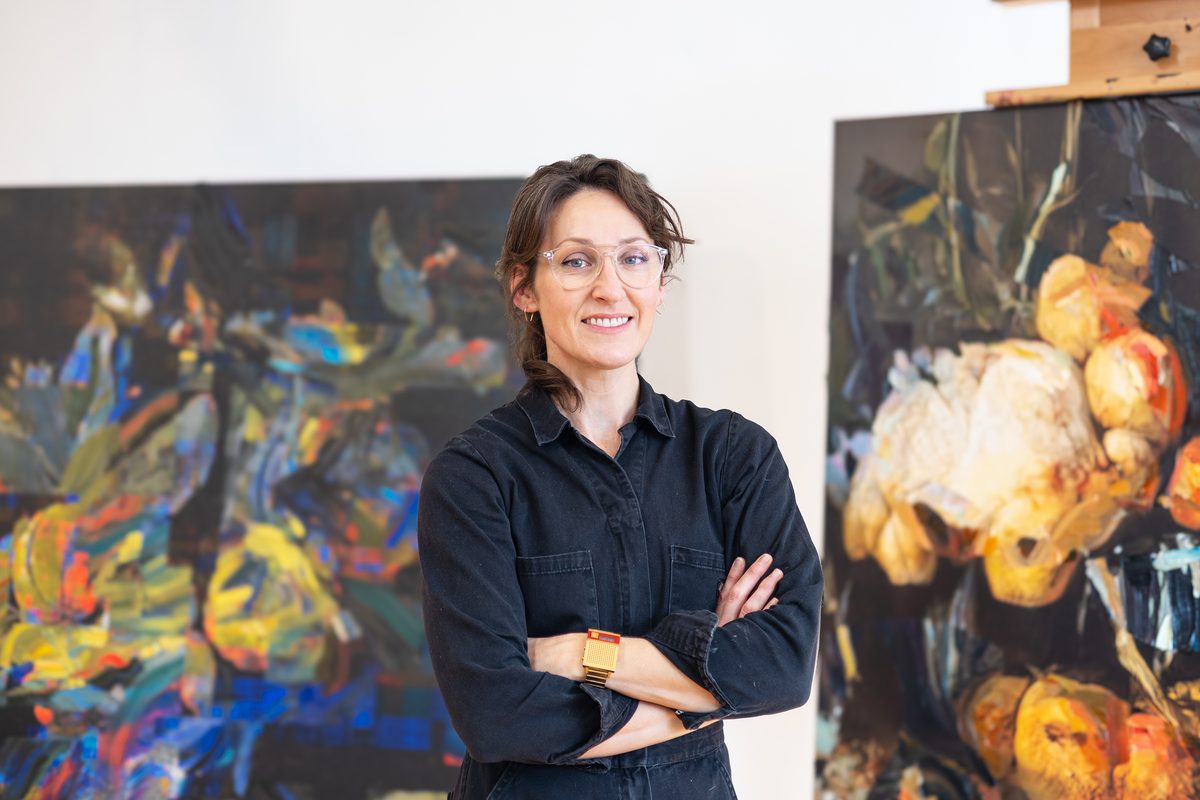
Tiffany Calvert is wrapping up a day in her studio, putting the finishing touches on a large-scale still life oil painting. In 2025, it seems like an anachronism. The catch: the image was created in part by a custom AI diffusion model.
Calvert, who chairs WashU’s MFA in Visual Art program, has always been interested in blending old and new techniques. She sees value in exploring historical traditions in modern contexts.
“I chose abstract painting as a mode on purpose — its intention is to interrupt an image and make it harder to look at, so you have to think about your own process of looking,” she says.
Calvert started focusing on Dutch and Flemish still life paintings in 2014. “They’re so incredibly detailed that in some ways they become abstract — they’re no longer realistic,” she remarks. She gathered some 650 images of still life paintings from various internet archives and entered them into a StyleGAN, or style-based generative adversarial network. She then generated still life images to use as a springboard in her work, which involves painting abstractly in response to and on top of the still life.
Then, a roadblock. Just as Calvert arrived at WashU in 2024, the program she used changed its protocol and no longer supported precise control over the image set. She couldn’t progress without technical help.
“I was so happy to be at WashU at that moment, because there is real intent and motivation behind putting together teams for interdisciplinary research,” she says. Calvert connected with a team of WashU engineers working on a custom diffusion model that can use smaller data sets — like Calvert’s set of 650 images — with higher accuracy. The model doesn’t collage bits and pieces from different images, but invents a truly new image.
For what happened next, visit samfoxschool.washu.edu.