Unlike Josh Kline, I Choose New York
His new article taps into deep frustrations about affordability, but I throw my lot in with those making change, rather than moving out.

“The first step towards a cure is admitting you have a problem,” Josh Kline writes in “New York Real Estate and the Ruin of American Art,” which appeared online last week and immediately set the art circles I belong to abuzz. The problem, as Kline sees it, is pretty unarguable: New York City’s deeply inequitable real estate market is having an impact on what art is made, where it is shown, how it is sold. “Meaningful art, relevant for society and our time, may not be sustainable under the current conditions here,” he says.
Why bother writing a response to a piece whose basic premise is correct? Because if the first step towards a cure is admitting you have a problem, the second step is diagnosing its causes in a way that points us to a cure. And then there’s the matter of timing: What use is it to admit the problem if you’re doing it decades late, once the damage is well and truly done? It’s easy to identify the fatal disease during an autopsy.
In his opening gambit, Kline writes: “American art is suffering a polycrisis that combines a lack of belief in and support for its artists born after 1975.”The markers of this polycrisis that Kline lists — very real problems, to be sure — are generally agreed to be impacting millennials (those born between 1982 and 1996, give or take) and Gen Zs (1997 to 2010) most directly: recession, the aftereffects of Covid-19 lockdowns, private equity’s role in driving up housing prices, student debt load, declining salaries, and what Kline correctly describes as “epochal transfers of wealth” to the already wealthy.
The artists I talk to who were born before 1975, except for the most privileged few, are not immune to these conditions. Kline’s repeated invocations of “boomer galleries” and “boomer artists” — the latter of which he accuses of taking up too much space in a field that already offers too-limited resources for those born after 1975 — seem like cheap shots. Generational arguments cannot replace structural analysis if the goal is to build the solidarities that we need to get out of this mess. “Boomer galleries” have been closing as fast as “millennial galleries” or “Gen Z galleries.” The problem is not with the age of the gallerists but — as with everything — the concentration of wealth in the hands of the few. That concentration has cascading effects: as with the movie industry, more emphasis on marquee names and blockbusters, less room for indie experimentation.
Rapacious landlords may have priced artists out of their studios, but can we also talk about how artists have long played a role in the gentrification that pushes boomers, artists or otherwise, out of their neighborhoods? Art workers are at best harbingers and at worst catalysts of gentrification, and we have to own that. And, as Krzysztof Wodiczko has been exploring in his work for decades, and Rosalyn Deutsche has been writing about for decades, artists — especially those making public artworks — have always been handmaidens to real estate speculation. We have to own that too.
Black, Indigenous, or POC artists, or, in many cases, White woman artists, have suffered for decades, career-wise, because of a lack of access to studio space or exhibition opportunities, not to mention time to make art. Why the urgency now? I suspect because these realities are beginning to affect more privileged segments of our art world — artists who have hit all the right career milestones, including prestigious MFAs, gallery representation, museum shows, and biennial and art fair appearances. As always, had we paid attention to the plight of artists who were operating without access to those things for so long — and not written off their complaints as mere “identity politics” — we might have already built the political movement we need to move the needle now.
The problem is so entrenched and long-standing that even the city’s newly elected mayor has identified it as a priority for New York. It is so entrenched that the young artists Kline urges to look elsewhere to do their work have already largely come to that realization themselves.
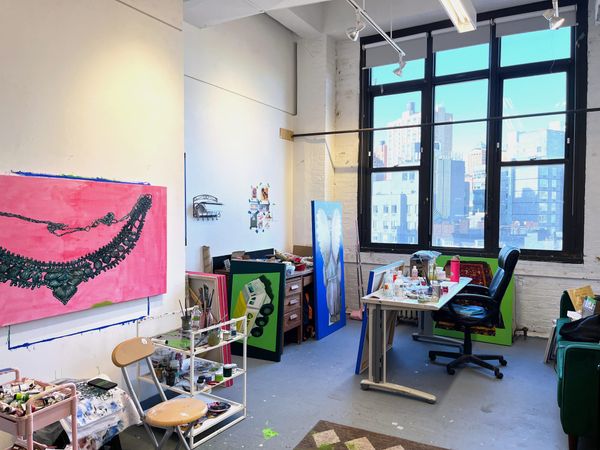
We’re long past knowing where the problem lies. What we need to do now is figure out what to do about it. Kline’s article offers a litany of reasons why current solutions are doomed to fail. Transform empty commercial office space into artist’s studios? Tax law — apparently immutable? — makes it impossible, and besides, when Christopher Wool did it, it wasn’t radical enough, he says. Turn to more sellable media? Kline tells us several times what he thinks about painting. Artist-run spaces? Too beholden to donor interests and the art market. (Also, and here I agree with Kline, almost impossible to imagine with today’s real estate prices.) The only solution he seems to see — and notably only for younger artists, not those who have built their lives here already — is just to abandon New York altogether. A solution, for sure. But I refuse to believe it’s the only one.
We do need more affordable artist studios. We do need more affordable housing, period. We do need more support for artists, and more possibilities for artist-run spaces and galleries. We need more focus on class — which also means recognizing that much of the art we see by non-White, non-male artists is rooted in class analysis. We need all of these things. I understand that right now all these possibilities seem hopeless — the world seems hopeless — and Kline’s article taps into our deep frustrations with the world. But we also have glimmers of hope: a new mayor, a new culture czar, and — as far as I can see from the artists I talk to — a new determination not to let New York’s culture scene wither away. I’m throwing my lot in with those culture workers and local policy-makers I see trying to make a change, rather than lamenting a problem that we’ve been staring at for at least two decades, and throwing up our hands.