What Artists Sign Away
Long consignment periods, moral rights waivers, and opaque "standard" contracts serve the institution more than the artist.

There is a moment in many artists’ careers when they realize the art world is far more comfortable protecting objects than protecting the people who make them.
It rarely announces itself. There is no singular betrayal. More often, the shift happens quietly, inside a document presented as routine. “Standard agreement.” “Minor revision.” “Just a formality.” The moment arrives when an artist stops skimming and starts reading.
Mine came before an exhibition had even opened.
I was preparing for a show with a gallery I was working with for the first time when I received the initial consignment agreement. A consignment agreement allows a gallery to take possession of artwork and sell it on the artist’s behalf while retaining a percentage of the sale. Until a work is sold, ownership remains with the artist, but control over its sale is defined by the terms of that agreement.
I had recently completed an Art Law-focused program, and it was the first time I felt equipped to read a contract with confidence. Not just scan it. Read it.
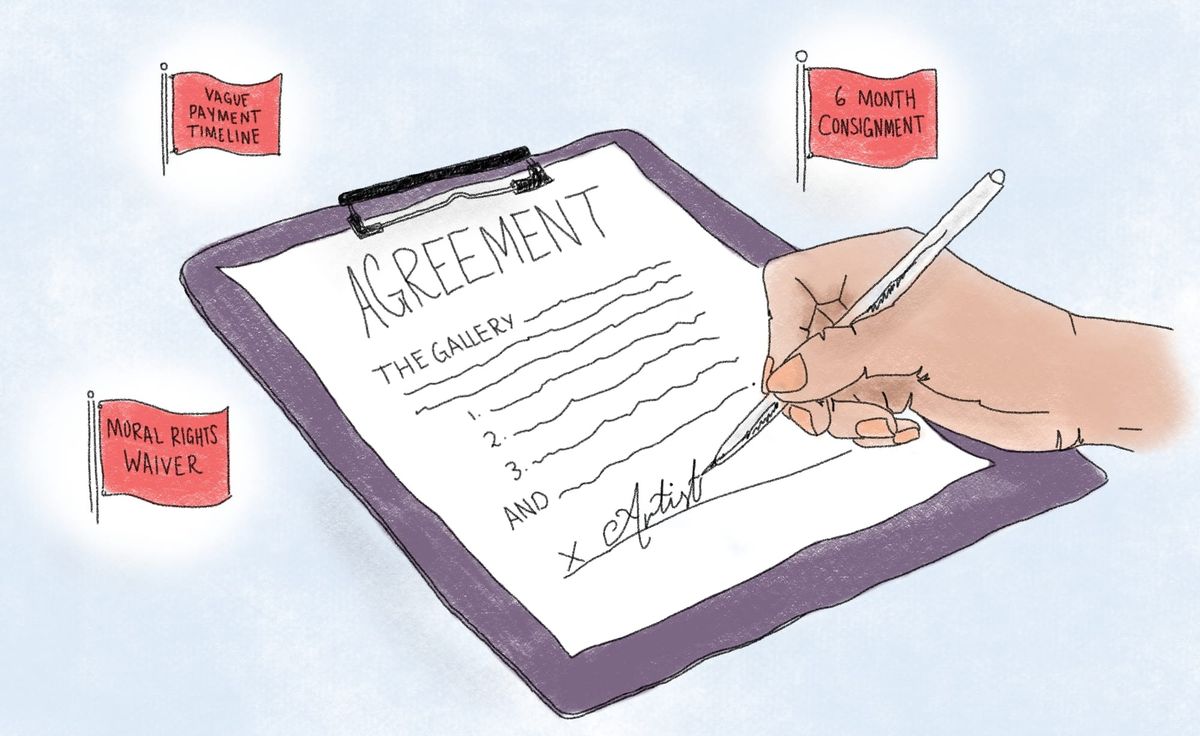
As I went through the agreement, one clause held my attention. The consignment period extended six months beyond the close of the exhibition. Even after the show ended and the work returned to my studio, it would remain under consignment with the gallery.
In a different context, that length of time might not raise concern. For artists with an ongoing relationship with a gallery, where there is a clear commitment to continue placing work beyond a single exhibition, a longer consignment period can function as an extension of that partnership. The gallery continues to advocate for the work, and the terms reflect an established level of trust and mutual investment.
This was not that situation. This was a new relationship, with no defined trajectory beyond the exhibition itself.
I asked if we could shorten that period to three months. The request was not confrontational. It was practical. There was no plan for the gallery to store the work or continue presenting it. The pieces were coming back to me. And if the work is physically in my studio but contractually tied to a gallery that is not actively facilitating its sale, something shifts.
The work is visible in my studio. It is available. But it is not fully mine to move. It sits in a kind of contractual limbo, and more importantly, it is not fully mine to sell.
Under a standard 50–50 split, I would still be obligated to give the gallery half of the sale, even if the collector came through my own network, my own outreach, or a studio visit they had no role in facilitating. The contract preserved their entitlement to the sale without requiring their active participation in it.
They agreed to revise the term. When the updated version came through, the duration was exactly the same.
That moment clarifies more than any clause. Either the request was not taken seriously, or it was assumed I would not read the agreement again. In either case, the outcome is the same. The terms remain. The burden shifts back to the artist.
I pointed it out. They acknowledged it. And then no revised contract ever came.
The show moved forward. The work was installed. The relationship, at least on the surface, continued. But the structure had already been established. Not through what was said, but through what was left unchanged.
This is how precedent is set. The first agreement is not just administrative. It establishes how much of the relationship will be negotiated, and how much will be absorbed.
The second moment was less procedural and more direct.
I was invited to participate in a residency whose agreement included a waiver of moral rights. These protections, partially codified in the United States through the Visual Artists Rights Act, allow artists to prevent distortion, control attribution, and protect the integrity of their work over time. They are among the few legal mechanisms that recognize that a work does not fully detach from its maker once it leaves the studio.
A moral rights waiver does the opposite. It allows an institution to alter, modify, or present the work in ways the artist may not approve of, without being held accountable for it.
There are situations where a waiver like this can make sense. Public artworks exposed to weather. Installations embedded into architecture. Projects where change is part of the premise.
None of that applied here. This was a residency.
What followed was not a revision, but a reframing. The clause was described back to me in ways that suggested it carried less weight than it actually did. That it was standard. That it was not something to be concerned about.
That kind of explanation is not neutral. It depends on an imbalance of knowledge. It assumes the artist does not have the resources to verify what is being presented, and that the language will not be read closely enough to challenge it.
Before moving forward, I had an art lawyer review the agreement. When I relayed how the clause had been explained to me by the residency’s legal representative, his response was direct. That was not an accurate description of what the waiver did.
That level of access is not standard. In many cases, the explanation provided by the institution is the only one available.
The language itself was clear. It did not require interpretation to understand what was being asked. A waiver like that does not clarify a relationship. It expands one side’s control while removing the artist’s ability to intervene.
The clause remained. So I declined the residency.
Walking away is not a neutral decision. It is one of the few points where an artist can interrupt the terms being set for them. It does not shift the system on its own, but it defines the boundary of what will be accepted within a given relationship.
Most artists sign agreements like these. Not because they agree with them, but because the cost of pushing back can feel higher than the risk of signing. Access, opportunity, and timing all shape those decisions. Not every artist can afford to walk away. That is part of how the system sustains itself.
The art world runs on informality until informality stops serving the institution.
For a field that builds entire markets on provenance, it remains remarkably loose about the terms under which that value is produced. Artists routinely consign significant value with limited contractual protection. Payment timelines are vague. Insurance is unclear. Termination is often undefined.
In any other industry, that level of ambiguity would be unworkable. Here, it is framed as trust.
Trust is not a contract. Trust is what a contract protects when circumstances change.
Contracts are not neutral documents. They are instruments that determine where value flows over time. Who retains control. Who assumes risk. Who benefits long after the work leaves the studio.
This imbalance is not incidental. It is structural. Galleries and institutions secure flexibility. Artists absorb uncertainty.
This tension is not new. More than 50 years ago, Seth Siegelaub and Robert Projansky proposed “The Artist’s Reserved Rights Transfer and Sale Agreement,” a contract designed to rebalance the relationship between artists and the market.
At its core, it proposed something simple. The value of an artwork does not end at the point of purchase, and neither should the artist’s stake in it.
If the contract was so clear, why did it not take hold?
Collectors resist ongoing obligations. Galleries protect those relationships. This leaves the artist to insist on change with the least leverage. The agreement did not fail because it was impractical. It failed because it redistributed power in ways the market had no interest in absorbing.
As Pierre Bourdieu writes in The Field of Cultural Production (1994), cultural fields sustain themselves by naturalizing the structures that reproduce inequality. As Olav Velthuis argues in Talking Prices (2005), opacity is not a flaw in the art market but one of its defining features.
What appears informal is often highly structured, just unevenly distributed.
What has begun to shift is not the structure itself, but artists’ willingness to accept it without question. More artists are reading closely. Asking questions. Comparing notes.
That shift matters, but awareness alone does not redistribute power. It clarifies where it sits, and who benefits from it.
In practice, most contracts will still arrive framed as standard. The question is not whether a term is common. The question is what it does. A longer consignment period is not neutral if it restricts your ability to sell your own work. A moral rights waiver is not procedural if it removes your ability to intervene in how your work is altered or presented. Vague payment timelines are not flexible if they delay compensation indefinitely.
The language will rarely announce its consequences. You have to locate them.
That does not mean every clause will move. Not every institution will adjust. But the document is not separate from the work. It is part of how the work circulates, accumulates value, and remains attached to its maker.
For those without access to legal counsel, the margin for error is smaller, but not nonexistent. Conversations with other artists matter. Seeing how others have navigated similar agreements matters. What is described as standard is often just what has gone unchallenged long enough.
Contracts establish precedent. What is signed without question becomes easier to ask of the next artist.
The document arrives. The language is presented as standard.
Read it anyway.