Street Art via Infographic? [UPDATED]
Infographics never tell the whole story in that they omit details and attempt to make clear narratives where none exist. But Daniel Feral's GRAFFITI & STREET ART graphic, which is labeled “a 75th Anniversary celebration of Alfred H. Barr, Jr's CUBISM & ABSTRACT ART diagram,” attempts to create reaso

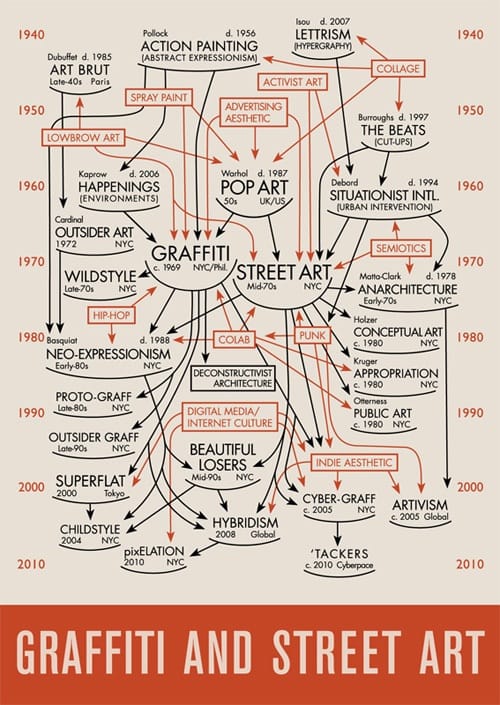
Infographics never tell the whole story in that they omit details and attempt to make clear narratives where none exist. But Daniel Feral’s GRAFFITI & STREET ART graphic, which is labeled “a 75th Anniversary celebration of Alfred H. Barr, Jr’s CUBISM & ABSTRACT ART diagram,” attempts to create reason out of the more chaotic narratives of Graffiti and Street Art movements.
The image was recently broadcast to art peeps as part of the latest press release from the people behind the PANTHEON: A history of art from the streets of New York City exhibition, which you may remember from our post about their Kickstarter a while back.
I wonder if Feral realizes how reviled Barr’s original 1936 diagram is nowadays. Or maybe he’s doing this as a parody — which I thought it must be, when I first heard about it. Either way, I like the level of ambition in the diagram but it is a very subjective diagram — much like Barr’s — that demonstrates its maker’s own perspective, preferences and biases.
The images exclude a lot of categories and subcategories, and also emphasizes other facets that seem more marginal.
Looking at Feral’s infographic, here are the questions that come immediately to mind:
- Where is the Chicano Mural Movement or the Mexican Muralists? The more I think about these groups the more influential their work seems.
- What about gang graffiti?
- Why is “Beautiful Losers” labeled as an NYC movement, even though it has always felt more like a left coast (or at least national) thing?
- I really don’t know what Feral means by “Advertising Aesthetic,” since sign painters, and advertising have long influenced all of modern art. Perhaps its an attempt to find common ground?
- Tom Otterness as “Public Art” in a graffiti/street art graphic is something I just don’t understand … not to mention “Deconstructivist Architecture” descends from graffiti … you got me with that one.
- Also, I think tattoo culture seems like a large enough influence to get its own bubble.
Details aside, I hope more street artists create graphs like this, allowing us a glimpse at the their influences and thoughts about the graffiti and street art scene, as well as its history. Right now this infographic only exists online. Who’s going to put this thing on the side of a building? Now that would be street art history.
UPDATE: Jake Dobkin took up the infographic challenge and we thought we’d annotate it … hehehehe