A Snapshot of the 2015 World Press Photo Winners
The World Press Photo Contest 2015, this year culling from 97,912 images from 5,692 photographers representing 131 countries, announced its winners on February 12.

The World Press Photo Contest 2015, this year culling from 97,912 images from 5,692 photographers representing 131 countries, announced its winners on February 12. The sheer number of images submitted suggests the contest to be truly representative of international photojournalism. Submissions fall into eight distinct groups: general news, spot news, contemporary issues, daily life, portraits, nature, sports, and long-term projects. Each category awards three prizes and has a specific set of rules regarding the date range of the images (though most require that the photos hail from 2014) and number of individual photos that may be submitted by each photographer. In addition to cash prizes, winning photographers will be honored in an April 24–25 ceremony in Amsterdam, and winning pictures are exhibited in approximately 100 cities around the globe. This year’s exhibition begins in Amsterdam on April 18 at the De Nieuwe Kirk.
Digital manipulation is, unsurprisingly, a sticking point for the judges. As PhotoShelter blog noted, this year a full 20 percent of submitted photos were disqualified for what the jury deemed excessive manipulation. The contest is grounded in principles of journalism; excessive changes to a photo render it non-representative and/or non-factual. However, as PhotoShelter author Allen Murabayashi suggested, the boundaries for what is considered “excessive” have yet to be clearly outlined in our age of easy digital manipulation.
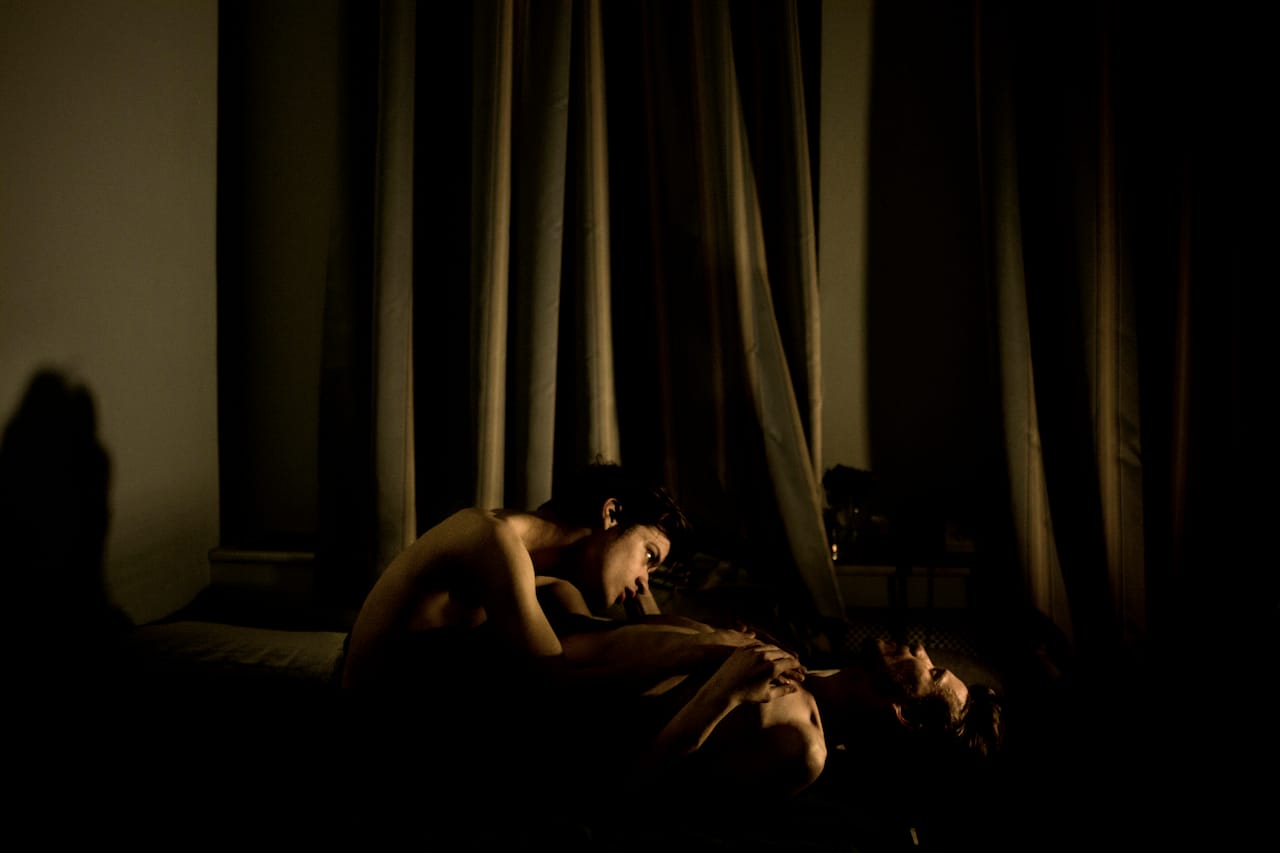
Some of the most compelling work from this year’s contest resides in the contemporary issues category. This year’s World Press Photo of the Year, by Danish photographer Mads Nissen, shows two nude men in an intimate moment. The caption, “Jon and Alex, a gay couple during an intimate moment, St. Petersburg, Russia,” suggests political oppression in the shadowy obfuscation of the photo’s figures. The image reflects the repression of homosexuality by capturing figures in a moment both intimate and partially concealed.
The third-place winner of contemporary issues in the stories/portfolio subcategory, Blue Sky Days, a series by Belgian photographer Tomas van Houtryve, also approaches a political subject with the tools of visual obfuscation. Van Houtryve placed his camera on a drone. In the resulting images, figures are often only represented by the shadows they cast. The series is strikingly, if understatedly, political; one cannot help but realize that drone operators often see their targets represented in shadow — simple demarcations in the place of flesh and blood.
It is facile, if at least partially true, to think of press photography as driven solely by conflict and politics. The World Press Photo Contest reminds us that the role of documentary photography is to capture the times, not just the action. While war photography is essential, images of nature, sports, and daily life offer documentation necessary to both the contemporary world-in-flux and to posterity.