Activists Sue to Stop Frida Kahlo Works From Leaving Mexico
It’s the latest in the battle over the Gelman Santander Collection, a trove of 161 works by artists including Kahlo, Diego Rivera, and David Alfaro Siqueiros that is slated to travel to Spain this fall.

Just weeks before a historic collection of 20th-century Mexican art is slated to leave the country for an exhibition in Europe, a group of advocates is suing Mexico’s principal cultural entity over allegations regarding the legal basis for exporting the nation’s artistic heritage.
The three lawsuits were filed by the advocacy group Defendamos la Colección Gelman (“Let’s Defend the Gelman Collection”) on June 29 and July 1 against Mexico’s National Institute of Fine Arts and Literature (INBAL), the agency responsible for issuing export permits for artworks protected under cultural heritage laws. The legal actions concern the imminent international tour of a private collection that includes works designated as “artistic monuments” and thus subject to strict statutes regarding their circulation.
Assembled by Jewish émigré film producer Jacques Gelman and his wife Natasha Zahalka in Mexico City in the 1940s, the recently renamed Gelman Santander Collection comprises 161 works by artists including Frida Kahlo, Diego Rivera, José Clemente Orozco, David Alfaro Siqueiros, and María Izquierdo. In January, it was announced that the Gelman Collection would be managed by the Santander Bank Foundation. A three-party, five-year agreement revealed that the collection had been under the partial ownership of the cement billionaire Zambrano family since 2023 and that it will depart Mexico later this year for a two-year tour that begins in northern Spain, where it will be shown as part of the inaugural exhibition program at Faro Santander, the bank’s “new cultural project” set to open on September 8.
About 30 works in the grouping are designated as “artistic monuments,” meaning they may only leave the country temporarily and with INBAL’s permission. While such works are legally restricted to one-year export and return permits, with the possibility of a two-year extension, the terms of an original agreement seemingly licensed their international circulation through 2030, with the possibility of renewal.
In March, hundreds of Mexican cultural workers signed an open letter calling for greater transparency surrounding the collection’s travel, particularly with regard to the works of Kahlo.
"It's striking to see the disparity between the effort that has gone into repatriating the nation's archaeological heritage, in order to enforce the law, and the lax way in which they are allowing the departure of major works, not only by the most relevant Mexican artist today, but by painters who, together, helped build a significant part of our national artistic identity,” the letter read.
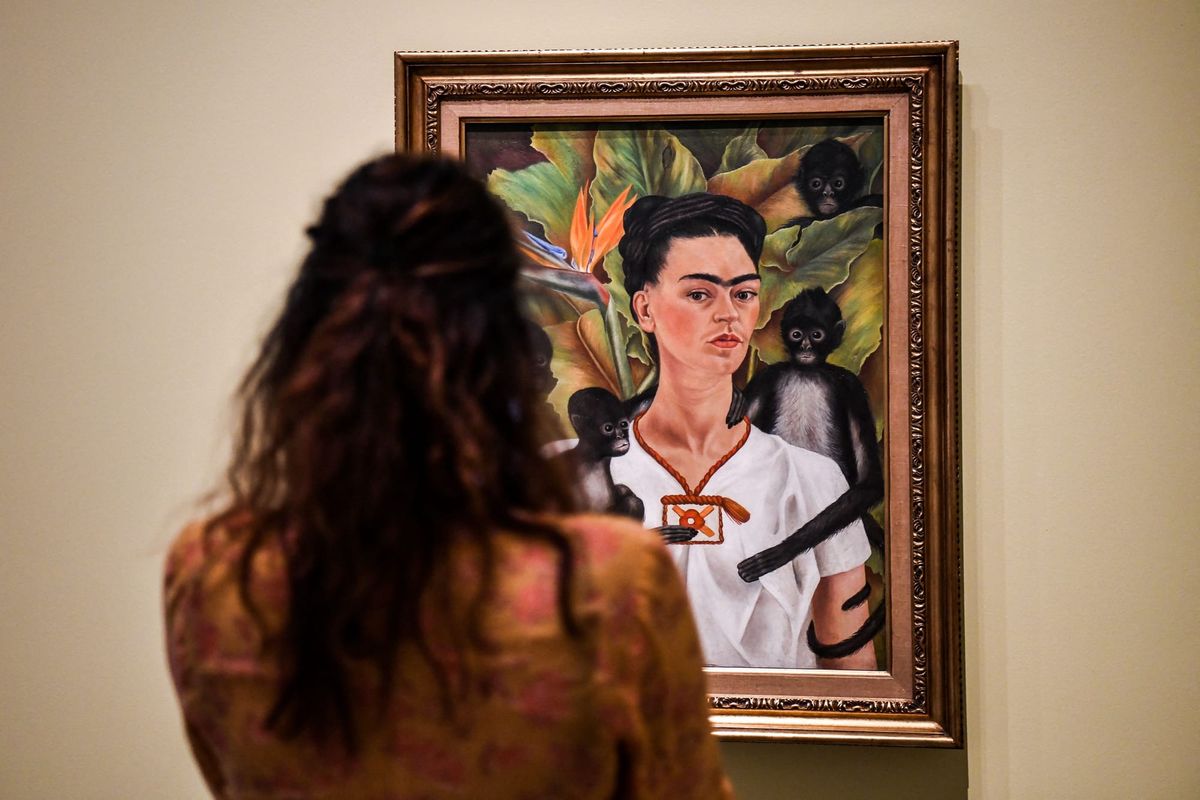
Of the 161 works, which include Kahlo’s oil paintings “Self-Portrait with Monkeys” (1943) and “Diego in My Mind” (1943), 68 are currently on view to the Mexican public for the first time in nearly two decades at the Museo de Arte Moderno in Mexico City. However, upon the closing of Modern Stories: Emblematic Works from the Gelman Santander Collection on July 19, they will depart for Spain with the rest of the collection.
Upon learning of the change of the collection’s name and its shuffling in ownership and management, art historian Francisco Berzunza and two friends formed Defendamos. They soon began asking questions regarding the duration of the protected works’ export and speculation that the Zambranos took out a $150 million loan on the collection. They also questioned the specifics of the Zambranos’ purchase of the collection in 2023 from Robert Littman, the executor of Natasha Zahalka’s will, who, according to Defendamos, “subsequently became not only curator of the collection, but also its owner, for reasons that are still unclear.”
In a statement shared with Hyperallergic, INBAL said that after leaving Spain, the collection will travel to the Fondation Beyeler in Basel, Switzerland, followed by the National Museum of Norway. In 2028, the works will return to Mexico for an exhibition at the Museo de Arte Contemporáneo de Monterrey, INBAL said.
“The agreement with Banco Santander Foundation is limited to research, conservation and international cultural programming,” the statement said. “It does not entail the transfer of ownership or the sale of any artwork to foreign institutions. The name Gelman Santander Collection reflects this institutional alliance only.”
In April, the Santander Bank Foundation also said that it “will comply at all times with Mexican laws” and that the collection would return to Mexico in two years.
The foundation shared another statement with Hyperallergic that described its "commitment to Mexico" as "long-standing, substantial and deeply rooted."
Even with these assurances, there are a number of requests that Berzanza says still have not been answered.
“The government till this day has refused to show the permits, it refused to show the agreement, it refused to explain why Santander said that Mexican law is flexible,” he said to Hyperallergic.
Berzunza also said that such questions have even been met with hostility. The lead plaintiff in the lawsuits told Hyperallergic that members of the activist group have faced political backlash and other pressures in the weeks leading up to and after the filings, alleging that members “have had funding withdrawn” and that their relatives “have had commissions canceled” since the group initiated their public-facing actions in March.
“These questions led to us being publicly shamed by the president on national TV, accused of being political adversaries to her regime,” he said, referring to Mexican President Claudia Sheinbaum’s dismissal of fears over the collection’s fate.
The president’s reaction prompted the group to begin a different course of action.
“We decided the government would only act if we were to act legally,” Berzunza said. “And we began legal proceedings.”
Despite these pressures and others, including “anonymous threats on social media” and their “presence at public events, at public institutions” being called into question, Berzunza and Defendamos remain steadfast in their action.
“And if we didn’t raise our voice, this could be lost because the adversary is the global free circulation market,” he said.
Amid the last days of the collection’s public display at the Museo de Arte Moderno, the fate of the Gelman Santander Collection remains a hot-button issue regarding the role that governmental agencies, arts institutions, and the public play in protecting national cultural heritage.
“No major museum today would knowingly present a collection that was looted or acquired through conflict,” Berzunza said. “Yet Santander has dismissed the legitimate concerns of the people of Mexico and the serious questions surrounding how Mr. Littman acquired the collection. Ethics, it seems, is not part of Santander’s vocabulary.”