African-American Blacksmiths Forge a Lineage of Sankofa
Blacksmiths in the South have long embedded West African symbolism into gates, rails, and window bars, proof that the craft evolved with every hand that held the hammer.

This article is part of a series focusing on underrepresented craft histories, researched and written by the 2025 Craft Archive Fellows, and organized in collaboration with the Center for Craft.
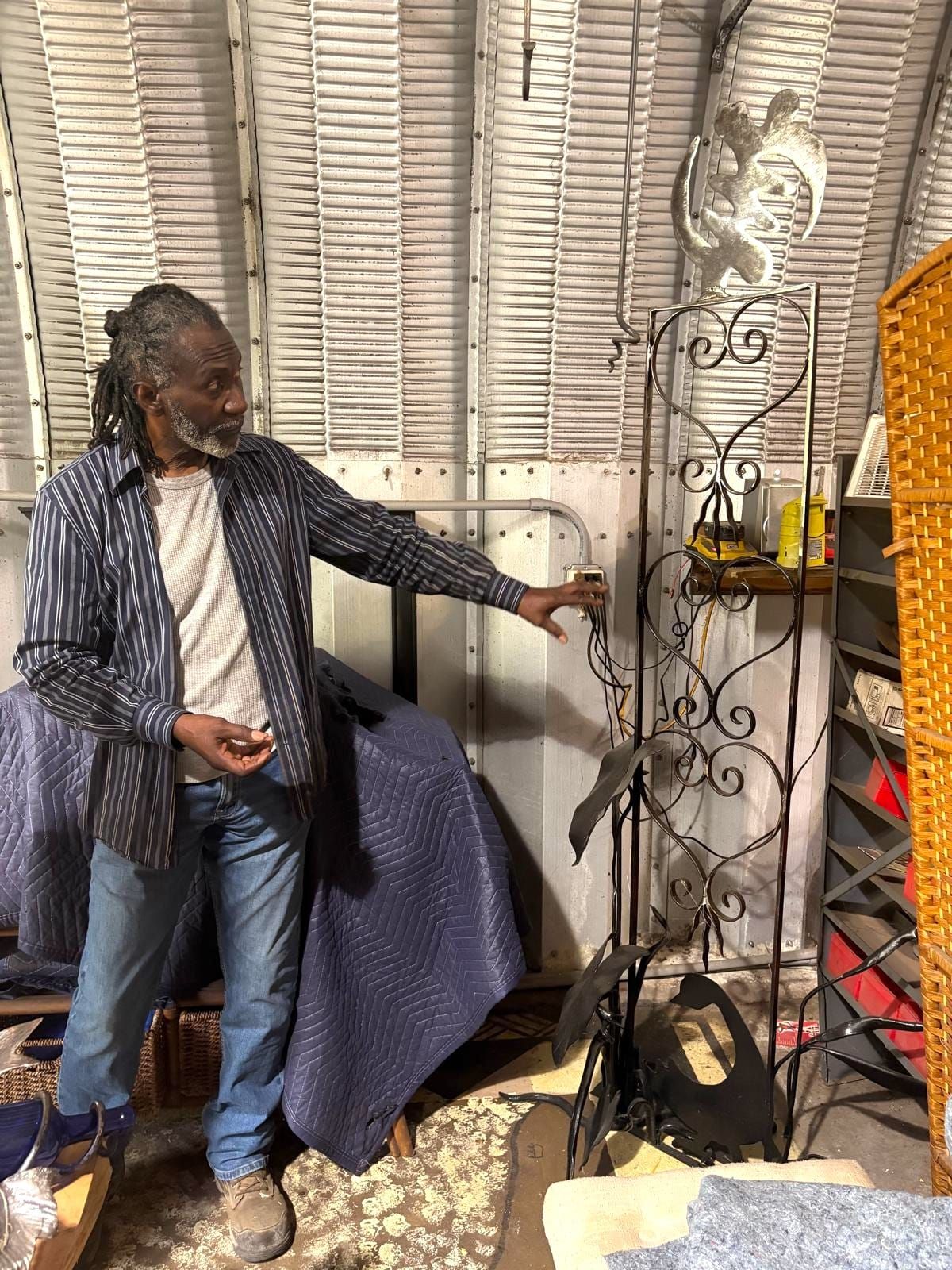
Growing up between New Orleans and Savannah, I was aware of the ironwork around me, but I didn’t really see it. While visiting a friend in New York City last year, I stopped mid-sentence to photograph a window with two metal Sankofa symbols. New York immediately felt familiar through that one piece of ironwork. I’ve been paying particular attention to Sankofa symbols in ironwork on gates, stair rails, and window bars. They’re usually black, other times painted white, sometimes incorporating leaves, flowers, or, in New Orleans, the fleur-de-lis. But again and again, I noticed that familiar heart.
Having studied West African traditions, including Ghanaian Adinkra symbols, I was familiar with Sankofa. It translates roughly to “go back and fetch it” in Akan, an exhortation to revisit the past and retrieve what’s needed for the present. Sometimes it’s a bird turning backward to retrieve an egg from its back (its past). Other times, it resembles a conventional heart with inward-spiraling coils.
Because Adinkra symbols originate in West Africa, where most African Americans have ancestral roots, I wondered if our blacksmiths embedded reminders to not forget where we came from into the ironwork. Was the design more than decoration? If so, was it ever legible within the Black community?
Interviewing blacksmiths and scholars and digging through the archives shifted my focus. Instead, I wanted to investigate how cultural knowledge is transmitted and how we recognize cultural continuity when the evidence isn’t linear.
Dr. Earnestine Jenkins, a professor of art history who curated a 2022 exhibition on African-American blacksmithing at the Metal Museum in Memphis, Tennessee, helped me understand why that evidence rarely falls into a neat line. “Whenever people migrate,” Dr. Jenkins explained, “naturally, they don’t do the things the same way they did them in their homeland. They have to make adaptations.” Cultural continuity ain’t the absence of change, but what manages to travel through it.