After the Strike, Will Art Galleries Be Allies?
If deleting the social media post tomorrow would change nothing about how artists are paid or how resources are allocated, the gallery’s allyship is disposable.

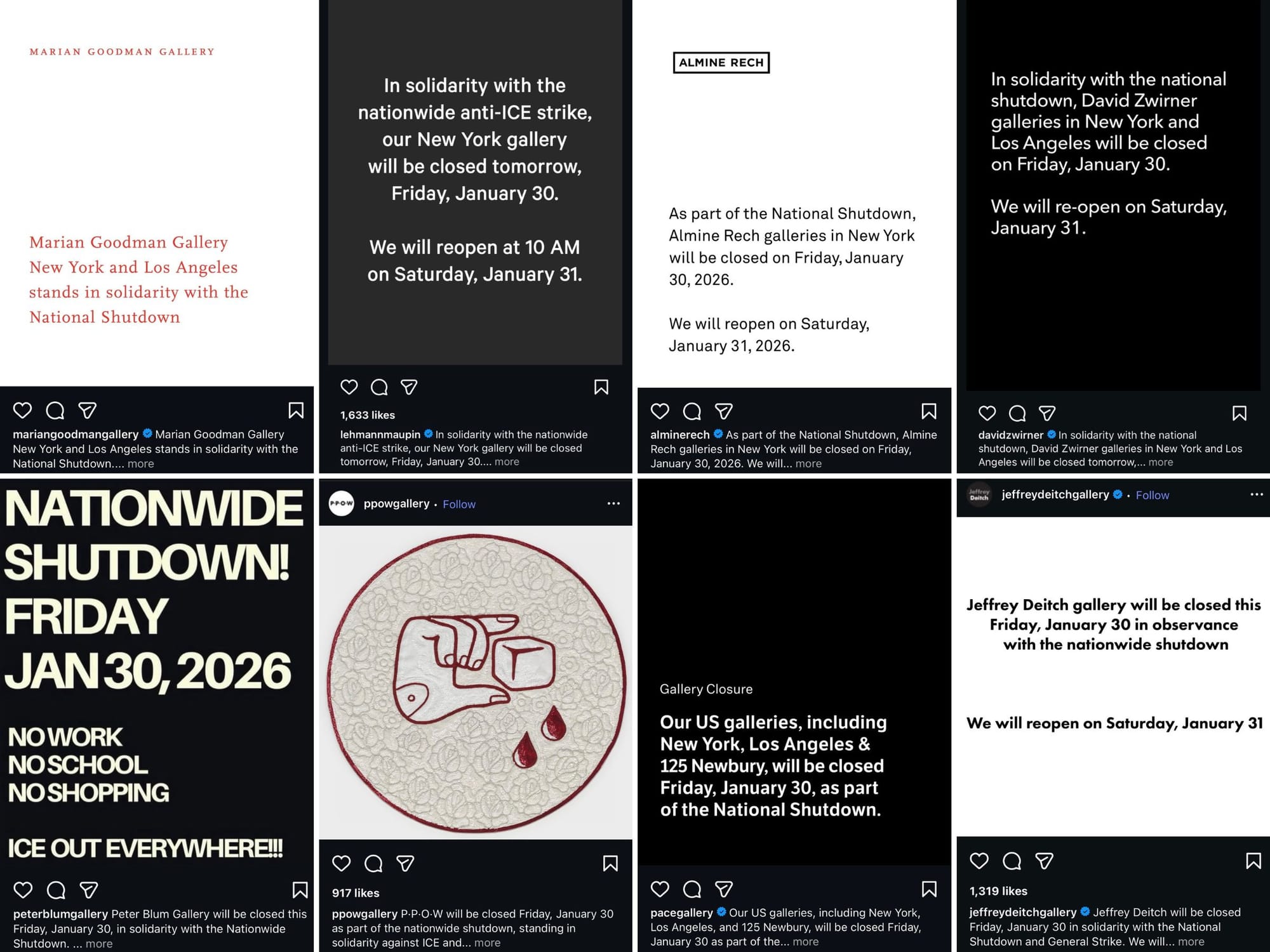
Over the last few days, my feed has filled up with galleries posting statements about standing in solidarity with protests against Immigration and Customs Enforcement (ICE). Black text on white backgrounds. Thoughtful fonts. Promises to “hold space” and “support our communities.”
As activists across the United States call for a nationwide strike against ICE today, the question facing cultural institutions is not whether to take sides rhetorically, but whether their material practices can withstand the moral pressure of the moment. I don’t doubt that many of the people writing these statements mean them. But in the art world, sincerity has a way of settling into style while the underlying terms of business remain untouched.
We already have a name for one version of this pattern: performative allyship. In 2015 and 2016 it took the form of safety pins worn to signal safety and moral alignment. In 2020 it appeared as black squares posted in near unison across social media feeds. In each case, the gesture oriented itself toward being seen on the right side of history. Because its primary function was reputational, it was almost entirely frictionless. Nothing about how an institution actually operated, who it funded, or how it distributed power had to change.
But not all frictionless allyship is cynical performance.
Something can be heartfelt and well-intentioned and still leave the machinery perfectly smooth. A sincere caption. A beautifully designed solidarity graphic. A day off on an already quiet Friday when collectors are out of town. Meanwhile, the opening still happens, the 50% commission still applies, the art-fair invoices are paid, and artists still wait months to receive their money after a sale.
All performative allyship is frictionless.
Not all frictionless allyship is performative.
The difference between those categories is intent. The difference that matters here is effect.
Frictionless allyship is solidarity that requires no operational change. Real solidarity introduces drag. Something in the schedule, the budget, or the contract has to hesitate because the institution chose consequence over convenience.
This idea of friction has deep roots in how protest makes injustice legible to people otherwise insulated from it.
During the lunch counter sit-ins of the Civil Rights movement, students didn’t release statements about segregation. They sat at Whites-only counters and asked to be served. That act shut counters down, cost businesses money, and forced ordinary patrons to confront racial violence in the middle of their lunch break.
The point wasn’t just to get a sandwich. It was to make the cost of injustice visible to those who benefited from not seeing it. Private harm became public inconvenience.
Protests against ICE use the same grammar of interruption. Immigration enforcement is built to be administratively smooth and socially distant: a pre-dawn knock on the door, a parent taken from a workplace, a sudden transfer that makes a court date unreachable. By the time a family understands what has happened, their loved one may be hundreds of miles away in detention.
Protest jams that quiet efficiency. Streets close. Traffic backs up. Daily routines detour around the fact that detention and deportation are not abstract policy, but lived rupture.
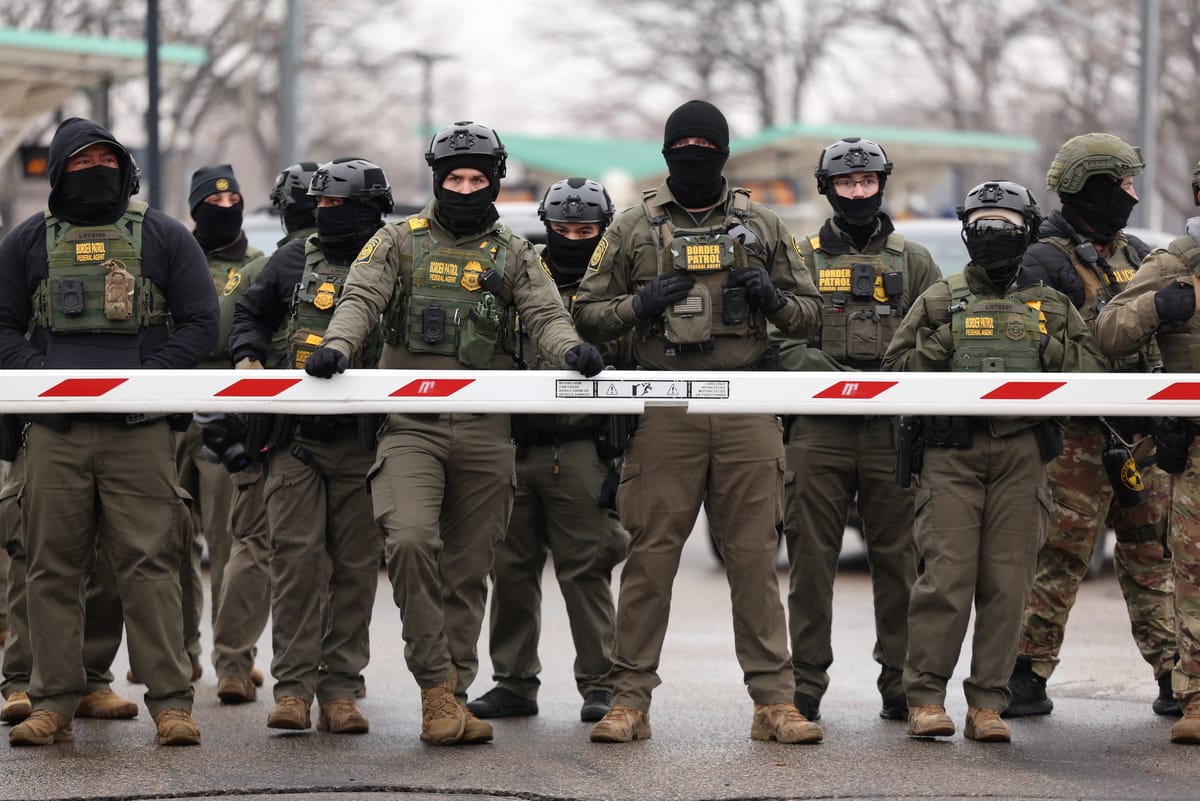
Today, a nationwide strike known as "ICE Out" calls for “no work, no school, no shopping” in protest of recent fatal shootings and expanded federal immigration enforcement. Tens of thousands of people are participating in an economic blackout and mass demonstrations in Minnesota against ICE operations, with labor unions, community groups and local businesses closing in solidarity and pressuring for an end to ICE funding and accountability for federal agents’ actions. Restaurants, cafes and other businesses in cities including New York are closed or performing solidarity actions in support of the strike and protest, a form of collective action that involves real economic sacrifice rather than symbolic endorsement of a cause.
Friction is communication, not chaos.
In a consumer economy, friction can also look like refusal. Today, many Black Americans are deliberately creating that friction by refusing to spend money at Target. This is not random consumer drift but a collective decision to withdraw participation from a corporation whose image has long been burnished through cultural philanthropy.
For years, Target sponsored free museum days that expanded access for families who might not otherwise afford admission. Those days mattered. But they also created a loop: Black consumer spending funded corporate philanthropy, philanthropy produced cultural legitimacy, and that legitimacy softened the corporation’s public image. Even after those programs disappeared before the pandemic, the reputational glow remained.
The current refusal breaks that loop by turning absence into pressure. The disruption shows up not as a statement but as a number on a balance sheet.
If the absence of Black dollars can register as leverage in a corporation’s ledger, then solidarity that never registers anywhere in a gallery’s ledger is not leverage at all.
Keeping ICE at the center clarifies the stakes. This is opposition to a system that separates families and cages people in detention while relying on bureaucratic smoothness and public distance to keep that violence tolerable.
If a gallery’s solidarity leaves its own openings, payment timelines, commission structures, and fair schedules exactly as before, then the solidarity is only visual. It borrows the language of disruption while protecting the conditions of comfort.
You don’t need insider access to tell the difference. Ask a few blunt questions.
Did this gesture cost the institution anything measurable?
Did it move money, time, or decision-making power toward immigrant artists and communities most vulnerable to ICE’s violence?
Will anything still be different after the news cycle passes and the next show opens?
If deleting the post tomorrow would change nothing about how artists are paid, how commissions are split, or how resources are allocated, the allyship was frictionless, whether sincere or strategic.
Friction requires observable, tangible change. That might mean paying artists on delivery rather than after collectors pay. Temporarily reducing the gallery’s commission and publicly committing to that timeline. Delaying or downsizing an art-fair booth in order to redirect those funds to immigrant legal defense. Creating emergency support for undocumented cultural workers. Hosting know-your-rights clinics in the gallery space.
Not gestures that decorate the program, but decisions that reorient priorities toward people whose lives are already being interrupted.
The art world is adept at metabolizing critique as aesthetics, hanging dissent on the wall while leaving the contract in the back office untouched. A solidarity post risks becoming another polished object in the feed, adjacent to installation shots and press clippings, carrying no more operational weight than an exhibition announcement.
Performative allyship is about looking right.
Frictionless allyship is about nothing having to move.
Real solidarity is about choosing, on purpose, to let institutional comfort give way to human urgency.
If institutions want to stand with people whose lives have been upended by detention and deportation, their solidarity has to show up as time, protection, and material support that outlasts the post and reaches the people who are actually at risk.