An App that Lets Blind People Experience the Solar Eclipse
A new, free mobile app allows the blind and visually impaired to witness the eclipse through sound and touch.

This coming Monday, millions of people across the United States will enjoy a rare opportunity to observe a total solar eclipse — or, at least, a partial one, for those unable to situate themselves within the 2017 path of totality. But the astronomical phenomenon is much less accessible to many others, beyond reasons like distance, travel cost, or work; for the blind, it may seem impossible to experience.
A new, free mobile app aims to dispel that notion by allowing the blind and visually impaired to witness the eclipse through sound and even through touch. Eclipse Soundscapes, currently available for iOS, will geolocate users and present them with audio descriptions of the solar eclipse as it happens in real time. These descriptions use specialized language developed by the National Center for Accessible Media, a nonprofit whose mission is to make media accessible for people with disabilities.
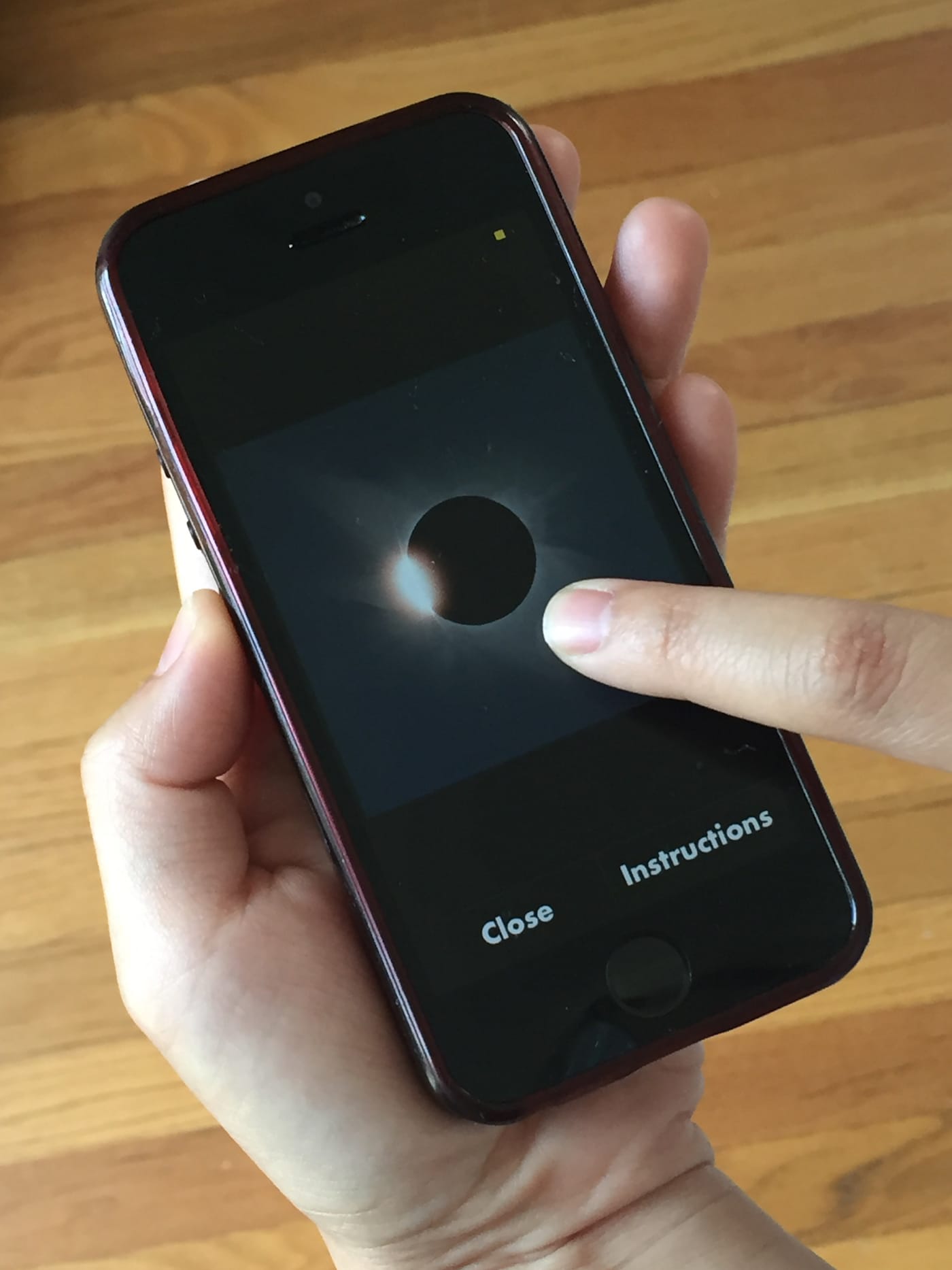
It will also invite users to understand the eclipse by using their fingers. One feature that users can explore right now is the Eclipse Soundscapes’ collection of interactive “Rumble Maps” that allows you to, in a way, touch the shifting sun through your phone’s vibrations.
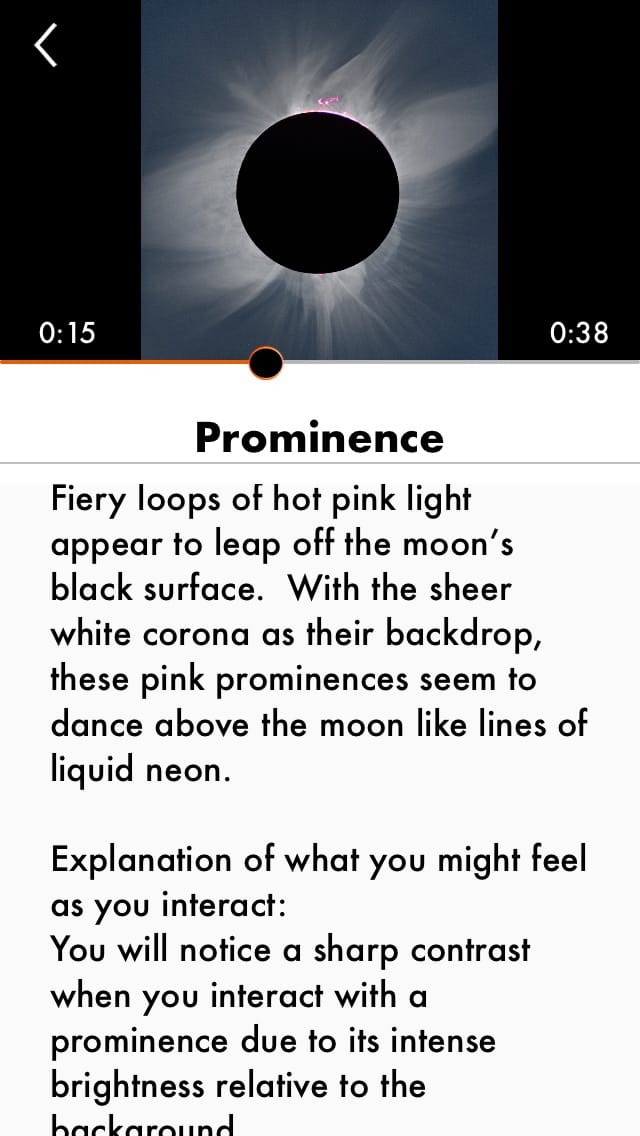
There are five maps available to illustrate five qualities of a total solar eclipse, from the corona — the sun’s thin outer atmosphere that shines like a ring during totality — to Baily’s Beads, orbs of light that appear near the start and end of the eclipse. Each shows a photograph of that effect; when you press your finger on the image, the app will read the pixel value of that spot and not only vibrate at a strength that corresponds to the spot’s darkness but also emit audio tones. A dark spot will yield gentle vibrations and hums of low frequencies; dragging your finger to an area of white light will increase the tremors from your screen and make your phone crescendo in a weird, alien warble. (The tones bring to mind the noises that paranormal tracking devices in movies emit.) While you have to manually open the rumble maps — the app can’t line them up to correspond to the eclipse in real time — the technology presents an easy-to-understand translation of the solar phenomenon’s visuals that is personal and intimate.
Of course, a solar eclipse is far more than a striking visual event. The sounds of the natural environment, too, change dramatically during this slow, planetary dance. Because of the darkening light and cooling air, the activities of nocturnal and diurnal animals follow a different schedule: crickets will chirp earlier, for instance; frogs have been known to croak when the sun vanishes behind the moon. During the forthcoming eclipse, organizations including the National Park Service and the podcast Science Friday will be recording this symphony of aural fluctuations that will occur. They will then add them to the app shortly after the occasion so anyone may re-experience the natural noises of the moment long after the moon ceases to cover the sun.
For now, you can gear up for the momentous event by playing with the Rumble Maps. And make sure to check out the app’s Eclipse Center, which features a countdown to the solar eclipse in your area as well as information on its peak and end time.