Art Problems: Should I Sell My Work to People Whose Politics I Hate?
Paddy Johnson explains how to make it in the art market without selling your soul.

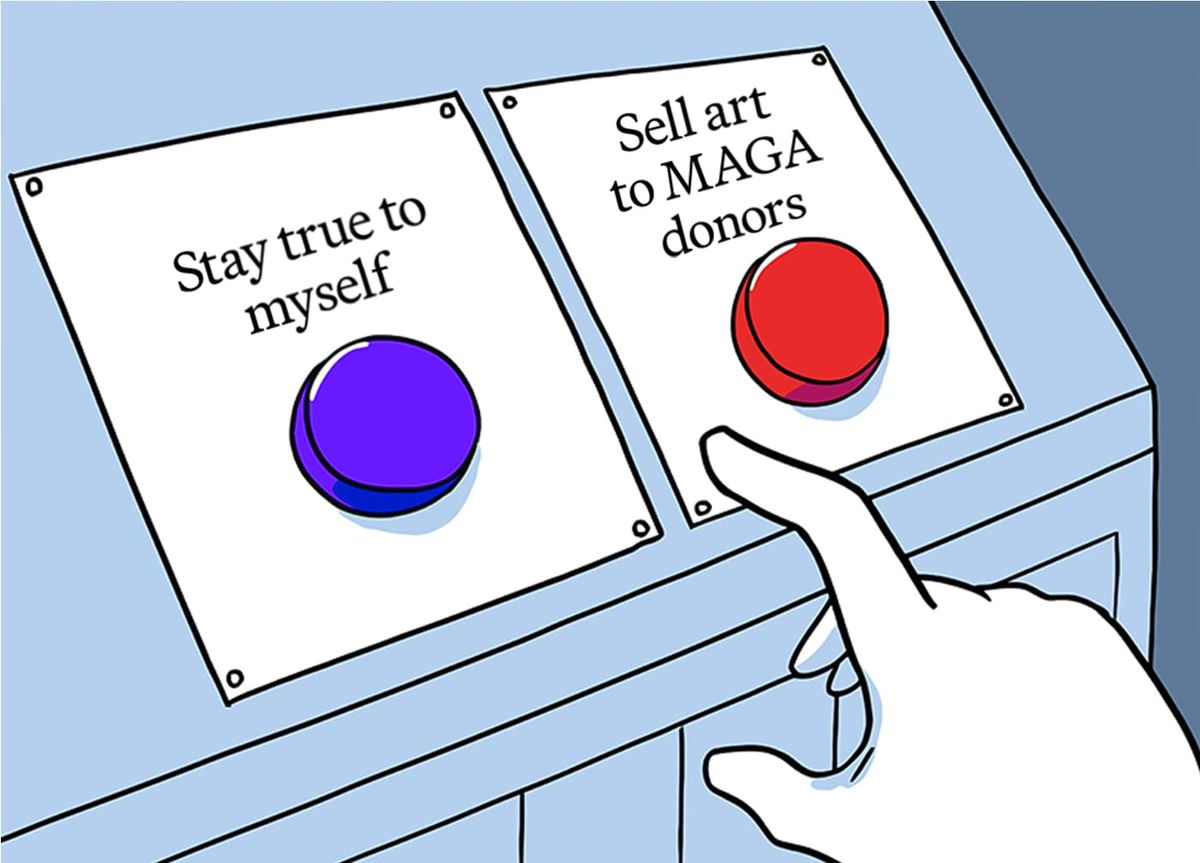
Should I allow my work to be sold to people whose politics I hate? I’m not okay with the ongoing injustice in Minneapolis and I don’t want to pretend this is just a difference of opinion. —distraught painter in America
Short answer. No. You should not allow your work to be sold to MAGA supporters. The entire administration is corrupt and supporting it is a choice. You don't owe them your work.
Whether you can exercise that right, though, depends on your financial situation, your relationship with your gallery, and how much leverage you have. For some artists, decision-making will be straightforward. For others, it comes at a high cost. You decide whether you can incur that cost.
But individual artists have more agency in this situation than in most other parts of the art world.
MAGA affiliation constantly compromises the ideals of institutions that are structurally dependent on wealthy people. A museum can't easily tell a MAGA-supporting board member to take their money elsewhere because that person controls funding, connections, and often other board members. Galleries face similar pressures with their collector base. The question for institutions isn’t just, "Can the entity take the financial hit?" but also, "Should we close?" To date, only The Kennedy Center's forced closure provides a high-profile example of MAGA politics shutting down an arts operation entirely. Shuttering isn’t failure. Nobody wants to lose art, but it’s more important to save your soul. The goal isn't just to keep operating. It's to center your values within what you do so your work means something. If we don't have that, we have nothing.
An artist has far less to lose when declining a sale. Your exposure is different. You might need sales to survive, but any given collector is usually replaceable. You're not structurally dependent on one specific buyer the way a museum is dependent on its donor base or a gallery is dependent on its collector base.
So how do you avoid selling to MAGA?
If you sell directly to customers on your website, you may not be able to vet each customer, but you can promise to donate a percentage of your proceeds to a non-profit like Communities United Against Police Brutality,a Minnesota-based organization that provides direct support for families affected by police violence. That should be sufficient repellent for the average ICE supporting MAGA collector.
If you sell through a gallery and you want to refuse sales to MAGA supporters, you’ll need to tell your gallery what you want to do, have them disclose buyer identity before finalizing sales, and be willing to absorb any friction that creates.
That's not nothing. Some galleries will cooperate easily. It’s not that hard to tell a collector the work isn’t available without explaining why. But other dealers will push back; they may rely on the sales or have relationships that need special consideration.
And if you need the sale, or this gallery is your only representation, the power dynamics get complicated fast. Refusing a sale might mean damaging your relationship with the dealer, which could mean fewer opportunities going forward.
Even when galleries want to do the right thing, their reliance on collectors can limit their actions. On Friday, January 30th, most New York galleries posted that they would be closed in solidarity with the victims of ICE violence. The closures were symbolic — a signal that even sharks like Gagosian don’t want to see citizens gunned down in the street — but it didn’t cost anyone anything. No one said they’d stop selling to MAGA. I doubt a single MAGA collector was even inconvenienced by the strike.Arguably, those with the most leverage to make an impact are high-profile artists. Amy Sherald cancelled her entire show at the National Portrait Gallery when the museum considered removing one of the works for political reasons. Philip Glass withdrew his new symphony Lincoln from the Kennedy Center after Donald Trump took over the board. He said the values of the center were in direct conflict with the message of his Symphony. Nicholas Galanin and Margarita Cabrera withdrew from a symposium at the Smithsonian American Art Museum, citing censorship concerns after the institution made the event private.
Each of these actions made headlines, a rarity in this news environment.
As an individual artist, your power might be somewhere in between that of a gallery or museum, which is very limited, and a high-profile artist who can afford the cost incurred by taking a stand.
Rather than thinking about this in terms of whether you can afford to lose a sale, instead, consider the cost of reputational risk.
Right now it might feel like "just a sale." But if this administration continues down the path it's on — more deportations, more censorship, more violence — do you want your work hanging in the homes of people who funded and supported it? Do you want to be on a collector list that includes people whose values you find reprehensible?
For many artists, the answer to that question, quite reasonably, is, “No”. If you can work with your gallery to refuse those sales, do it. But even if you can’t, even if you need every sale or if your gallery won’t cooperate, you still have economic power. Research who owns the companies you buy from. Avoid companies like Uline and Amazon, known for their support of the Trump administration. Buy from small companies that benefit from your business.
It may seem like a small effort compared to refusing collector sales. But these are places where, together, our dollars make a difference. This year, it’s time to make our dollars count.