Beyond the Myth of Chico da Silva
Presenting da Silva with Amazonian artists of different generations undermines the Western notion of the artist as an isolated genius.

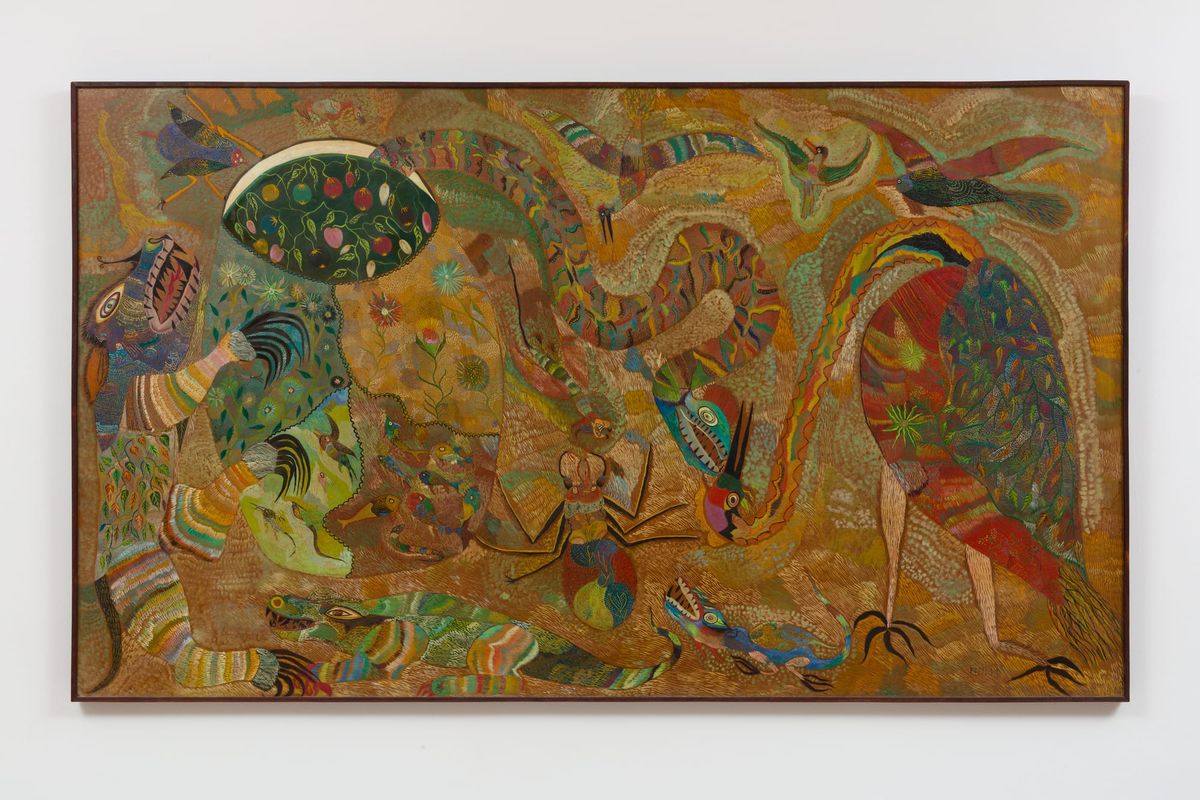
The rise and fall of Chico da Silva in the global art world is a cautionary tale. He was born in 1910 in the Amazon Rainforest, the son of an Indigenous Peruvian fisherman and a Brazilian woman from Ceará, along the Atlantic Ocean. After his father died from a snakebite, she brought her son to Fortaleza, the capital of the state of Ceará, settling in the impoverished neighborhood of Pirambu. In the 1940s, da Silva, who never learned to read or write, and whose parents’ names remain unknown, began to become locally known for drawing mystical, Amazon-inspired murals with black charcoal, chalk, and natural pigments on the exteriors of fishermen’s houses. This situation changed in 1943 when Jean-Pierre Chabloz, a Swiss critic and artist who had moved to Brazil because of World War II, went to Fortaleza on business and saw da Silva’s murals. Soon after, Chabloz began supplying da Silva with art materials, such as gouache, tempera, and canvas, effectively changing him into a European’s idea of an artist.
Here, the story follows a familiar but distressing path. Chabloz successfully introduced da Silva’s art to the rest of Brazil. Eventually, this led to da Silva receiving an honorable mention in the Brazilian pavilion presentation at the 1966 Venice Biennale. In these works, da Silva found a way to transfer his visionary world of spellbound animals, fantastic flora and fauna, magical line and pattern onto canvas and paper with gouache and tempera. However, instead of completing the transformation and becoming an artist (or “inspired genius”) in Western eyes, he remained true to his roots and started the Pirambu School, an informal artist workshop in the community that had sustained him. He taught neighbors how to paint in his style and signed the works as his own, infuriating Chabloz, who judged the work done in the workshop as “fake,” ending the art world’s interest in da Silva. Less than two decades later, he died destitute and forgotten.