Blue Is the Color of Desire
Blue Is the Warmest Color, which clocks in at just under three hours, may be one of the most ambitious film love stories ever made. There are movies that paint first romance as a coming-of-age story; others try to capture the process and feeling of falling in love; some dissect the series of events

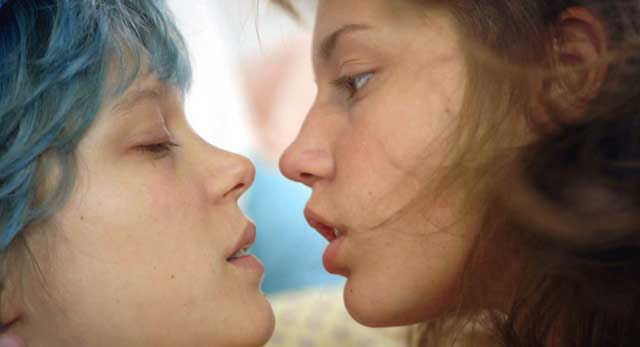
Blue Is the Warmest Color, which clocks in at just under three hours, may be one of the most ambitious film love stories ever made. There are movies that paint first romance as a coming-of-age story; others try to capture the process and feeling of falling in love; some dissect the series of events leading to the end of a relationship. In Blue, director Abdellatif Kechiche (Black Venus, The Secret of the Grain) has brilliantly captured all of the above, while simultaneously meditating on fate, education, and growing up.
The first half of the movie — all of which is based on a 2010 graphic novel written by Julie Maroh — follows high school student Adèle (Adèle Exarchopoulos) as she discovers sexual desire. Kechiche obsessively trains his camera on Adèle, whose beauty emanates from a tension between childlike innocence and adult sexuality. The audience comes to know her every expression, from the slight frown she makes when thinking to her obsessive tinkering with her hairstyle, up in a messy ponytail and down again around her face.
Adèle exhibits the excited nervousness of most high school girls when her friends point out that a cute boy in their grade keeps looking at her. She’s intrigued by his desire for her. But on the way to their first date, Adèle spots a woman across the street. The woman has short blue hair and a confident, sexy way of laughing, talking, and walking. This may be love at first sight; Adèle flushes and loses her sense of place. Suddenly, whatever she feels for the boy pales in comparison. This brief moment of attraction and eye contact as the two women pass on the street feels like chance, but when Adèle later sees Emma (Léa Seydoux) again at a bar, it seems to be fate.
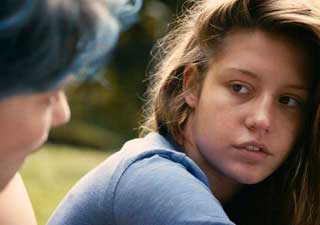
Desire feels so tangible in Blue, not ephemeral. Perhaps Kechiche is using the color blue to signal the unexplainable heart of attraction at the center of romantic love. Adèle’s room in her parents’ house is blue, as is Emma’s hair — the color becomes a literal unifying element throughout the film. But it also seems to signal a shared essence that transcends the two women’s differences. Emma is an artist, working towards her degree in fine arts. She’s intellectual, individualistic, free-spirited, and comfortable being out to her parents and in the world, unlike Adèle, who’s younger and struggling to find out everything. The two are united by a sexual desire for each other that’s beautiful in its strength. It makes Adèle and Emma’s relationship seem inevitable.
Passion is excruciatingly real, Kechiche suggests, and perhaps great love is fated. But the daily confines of romantic relationships are difficult. Adèle graduates, becomes a teacher, and moves in with Emma, who’s trying to start a career as an artist. Adèle is Emma’s muse, but soon differences in their interests, backgrounds, and day-to-day realities come to a head. There is loneliness, followed by infidelity. The relationship ends.
Much of the critical discourse about Blue has focused on whether or not Kechiche’s male gaze is problematic when trained on a love story between two women. Most notably, Manohla Dargis, writing in the New York Times, scathingly criticized the director for fetishizing and destructively filtering female desire and the body through a male-focused construction. Dargis’s take seems to stem from a reading of the first half of the film, in which Kechiche’s focus on Adèle’s body is constant. Dargis writes: “…the camera roves over her body even while she is sleeping. Is Adèle, I had wondered then, dreaming of her own hot body?” Later in her article, Dargis quotes Julie Maroh’s take on Kechiche’s portrayal of sex between the two women: “It appears to me that this was what was missing on the set: lesbians.”
Paradoxically, both Dargis’s and Maroh’s views actually present a troubling narrowing of what female sexuality is all about, even as they criticize Kechiche for doing the same. Much of the outrage around the sex scenes comes from a position that can be crystallized as “this is not how real lesbians have sex.” But Blue is not a film about lesbian identity, although at moments it is thematically incorporated. Adèle is attracted to men and women. To reduce the discussion of sex to an assessment of whether it is a befittingly female-centric portrayal of “lesbian” sex is to define sexual identity in stultifying, binary terms. Who’s to say how these two female characters might have sex?
And while Kechiche’s obsessive focus on Adèle’s body can seem problematic in the first half of the film, by end of Blue it’s clear that the goal is to portray a physical coming-of-age as well as an emotional one: Adèle’s demeanor changes along with her maturation. The excessive focus on her body ends up a concrete documentation of what it looks like to “grow up” — the ways in which mannerisms, body language, and nervous ticks morph. Dargis’s critical eye was so turned off by the first part of Blue that she completely neglected to analyze the second.
The excessive focus on the sex in Blue (if the love scenes were between a man and a woman, I daresay the critical analysis of them would drop markedly) has eclipsed other important thematic elements of the film. While the center of the story is undoubtedly the relationship, a substantial amount of screen time is also given to scenes of the classroom — a powerful laboratory from which mostly formed persons emerge, shakily, to become themselves. Starting with Adèle’s experiences in high school and ending with her teaching a classroom of her own, the theme of education parallels the love story. Kechiche paints education not as the memorization of information, but rather as the discernment of which ideas we make a part of ourselves in the process of maturation, and which ones we discard.
In a meet-the-family scene, Adèle is asked by Emma’s parents to expound upon her interests. She says she would like to become a teacher. Emma’s parents seem disappointed — far too bourgeois. But Adèle explains that she’s been exposed to ideas in school she didn’t learn from her parents or friends, and that she’d like to pass on that experience to others. After the breakup, Adèle continues to teach, and it seems to save her, letting her further define her identity, separate from Emma’s intellectually defined worldview, as a giver of potential.
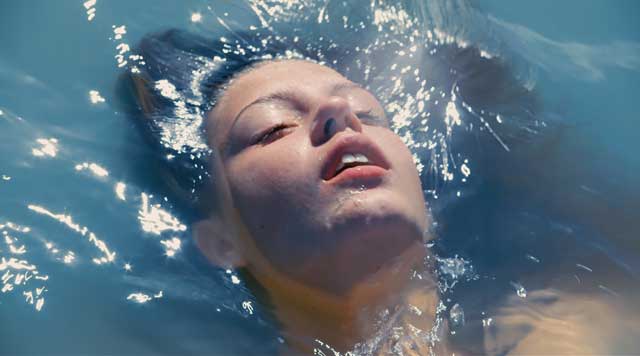
Blue is a gorgeous trip, a story that lets the audience share in its passion and sadness. The film flirts with tragedy, but ultimately its heartbreak is eclipsed by a visual reality that’s grounded in beauty: Adèle’s pouty, confused adolescent expression; sunlight as it filters through the trees on a first date; the tenderness of first kisses, passionate kisses, and sad kisses; the deep blue of Adèle’s dress in the final scene; Emma’s sky-blue hair; the serenity of the ocean’s blue as Adèle floats and lets it wash away her post-breakup fear.
Blue Is the Warmest Color is currently playing in theaters around the country.