Will Canadian Visual Artists Finally See Resale Royalties?
Proponents of a new measure say royalties will allow visual artists to benefit from their career growth over time.

Visual artists in Canada may soon receive royalties from the resale of their works after the government announced its intent to amend its copyright laws last month.
In Prime Minister Mark Carney’s first budget bill, passed narrowly on November 17, the government said it intended to establish an “Artist’s Resale Right,” a directive that would entitle artists to royalties from secondary and future sales of their artworks. One clause of the bill states that the measure would help create secondary income streams for visual artists, who are among Canada’s lowest earners and, like artists in the United States, currently do not receive royalties if their work's value increases after its initial sale.
Proponents of the measure say royalties will allow artists to benefit from their career growth over time, and that it will particularly benefit Indigenous artists whose work is “commonly exploited on the secondary market,” according to the nonprofit Canadian Artists' Representation/Le Front des artistes canadiens (CARFAC). A similar bid for royalties failed in Canada in 2022.
Artist's Resale Right (ARR) is commonly recognized by countries in the European Union, entitling artists to a cut of each subsequent sale of their artworks. In France, for example, artists can pocket 3% an art sale of between €50,000 €200,000 ($58,189.50 and $232,758). In the United Kingdom, a work must sell for at least £1,000, and royalties are capped at £12,500 (~$1,332.51 and ~$16,657.34, respectively). The UK law applies to artists during their lifetime and for the 70 years following their death. The United States does not currently recognize a federal Artist’s Resale Right, and a California law implementing up to 5% in royalties for artists was struck down in 2018 after a federal judge ruled that federal copyright laws prevented the measure.
The Canadian government has not announced specific royalties yet, nor a timeline for the implementation of an Artist’s Resale Right. A spokesperson for the Department of Canadian Heritage told Hyperallergic that amendments to the country's copyright laws will be brought forth “at the earliest possible opportunity, with details to be made public when the bill is tabled.” The spokesperson added that the government expects the budget bill to support Indigenous artists, who make up 4.1% of visual artists in the country and are most highly represented in the visual arts, as compared to other creative disciplines.
April Britski, CARFAC's national executive director, believes that artists in Canada could receive between CA$3 and CA$5 million in total royalties annually (~$2.13 and $3.55 million) under an official Artist's Resale Right. The organization has issued a proposal recommending that the government implement 5% royalties on all works selling for at least CA$1,000 (~$721.07).
“[The Artist's Resale Right] is particularly beneficial for Indigenous and senior artists, and it is a critical step forward in improving the economic conditions of Canadian artists,” Britski told Hyperallergic in an email.
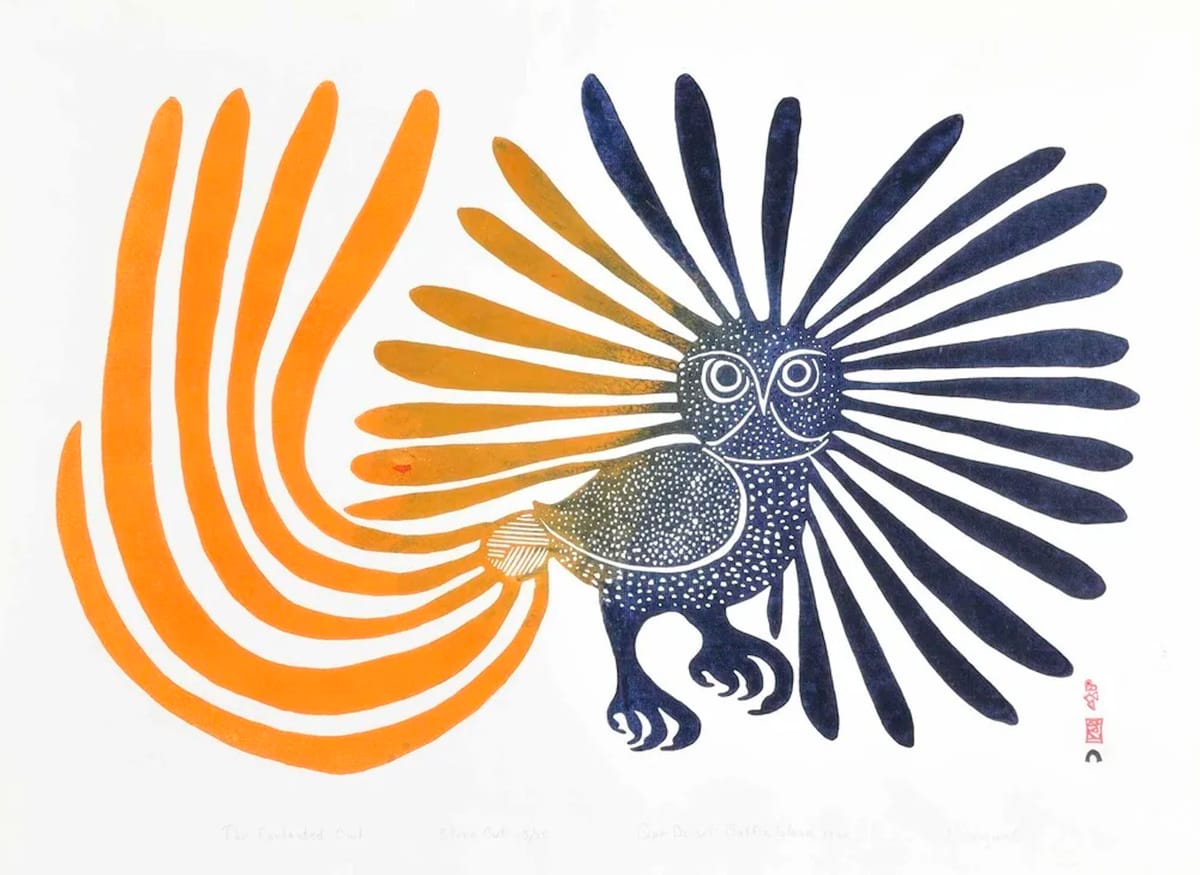
CARFAC’s website cites late Inuk artist Kenojuak Ashevak’s sale of editions of her stonecut print “Enchanted Owl” (1960) in support of an Artist's Resale Right. An edition was later resold for CA$216,000 (~$156,131.50) in 2018, and one is now in the collection of the Brooklyn Museum. Neither Ashevak nor her estate received any of the profits from the resale of her work.
“There can often be a huge markup on secondary sales of their work, so ARR is an important opportunity for economic reconciliation,” Britski continued.
A second budget bill with further details about the copyright amendments and resale right is expected to reach the House of Commons later in the winter, according to Britski.
“We're not quite there, but it is coming, and Canadian artists will soon be able to share in the profits made on their work in the secondary market,” Britski said.