Could Colorado Create the Country's First Artist Corporation?
A new bipartisan bill could help enshrine intellectual property rights and expand healthcare access for cultural workers.


Colorado state legislators will consider creating a new legal framework for artists to incorporate their practices, a move that could enshrine intellectual property rights and expand healthcare access for cultural workers.
A new bipartisan bill introduced in the state’s legislature last month would establish the country’s first-ever Artists Corporation, or A-Corp, a distinct limited liability corporation (LLC) for which only artists would be eligible.
Because Colorado permits businesses from across the country to register as corporations in the state, if enacted, the bill could have far-reaching impacts for both individual artists and collectives whose members reside outside the state.
Behind the push for a simplified way for artists to incorporate their work is Yancey Strickler, entrepreneur and former CEO of the popular creative crowdfunding site Kickstarter. He first pitched his A-Corps idea during a TED talk last year, after which some attendees recommended Colorado, seen as an art-friendly state, as a launching point for artist corporations.
“People have been doing their one-offs on their own things for decades,” Strickler said in an interview with Hyperallergic. “Now we're saying: ‘Hey, there's a benefit to systematizing it and giving everyone access to the smartest, leading-edge thinking about how to protect and value your work.’”
Strickler shared that he had personally earned significant revenue from books he wrote and sold as part of the Dark Forest Collective, a group of 16 writers publishing texts about the internet and online culture. When he considered forming a business to manage the group’s income, he felt that other structures, like C-corporations and S-corporations, did not fit an artistic mission, and found the process “alienating and confusing.”
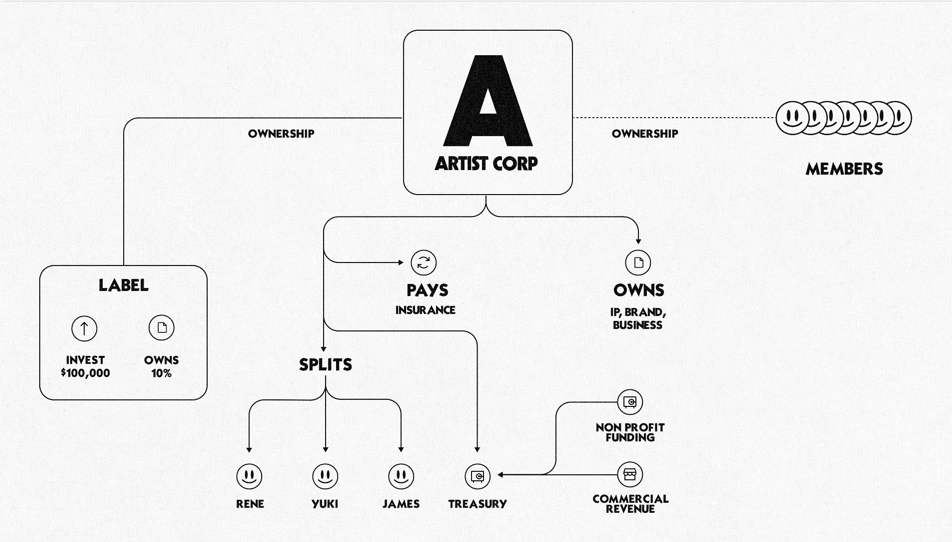
While artists can form custom LLCs that fit their needs, the costs of doing so are high, he said. A-Corps could make that process more affordable.
“ We imagine creating more of a shared system that we are all a part of,” Strickler explained. “Whereas right now we're all individually going to lawyers and getting our custom structures made for ourselves, each of us paying the same $10,000 to somebody, and through that we're not creating any larger power.”
If the bill gets passed, Strickler said his next move will be to push Colorado health insurers to grant A-Corps access to group plans, which would be more affordable than individual plans.
The current bill text proposes forming A-Corps on the basis of an artist’s mission statement, which would differ from other corporation models that prioritize shareholder value. The new framework would also allow artists to have investors without granting these shareholders ownership of their artistic output.
Strickler said that lawmakers in at least six states have expressed interest in passing A-Corps legislation, but declined to name them.
His nonprofit organization, the Artists Corporation Foundation, surveyed 1,609 artists from April 2025 to February 2026 to inform its A-Corp advocacy. The majority of respondents, who were primarily visual artists, said they struggled to afford health insurance. Nearly 40% of artists said they earned less than $20,000 per year from their work, “confirming the economic precarity the A-Corp is designed to address,” the survey noted.
Strickler expects the bill to be enacted in July 2027. Democrat Jeff Bridges and Republican Marc Catlin are sponsoring the bill in the state Senate, and Democrat Matthew Martinez and Republican Rick Taggary are backing the bill in the Colorado General Assembly.
Cosponsors for the A-Corps legislation did not respond to Hyperallergic’s requests for comment.