Diedrick Brackens’s Tapestries Beckon the Light of Freedom
In this Bay Area artist’s hands, weaving becomes a site of experimentation and refusal.

SAN FRANCISCO — What does a weaver weave today? That's a question that San Francisco-based textile artist Diedrick Brackens asks himself perennially. In a new exhibition at Yerba Buena Center for the Arts, he offers a visually arresting and deeply moving answer.
Guest-curated by Eungie Joo, gather tender night marks Brackens’s first solo exhibition in the Bay Area and a return to the region where he received his MFA in 2014 at the California College of the Arts (CCA). Bringing together 15 tapestries made since 2020 and three new works from 2026 shown here for the first time, this homecoming exhibition unfolds as a meditation on personal memory, myth, and the natural world. As Brackens has said, “Being Black, being queer, and working in a medium that’s been disregarded […] I feel very fully that this is my inheritance.”
Working on a loom with hand-dyed cotton and acrylic yarn, Brackens constructs stories, illustrated and embedded in the medium itself. Time itself feels gathered: past traditions are reworked through the present and projected toward imagined futures within a shared, communal space. He does not align with a single craft lineage, but rather with what feels like a more expansive, social, transcultural one, his practice drawing from West African weaving, California fiber art, European tapestry, and the improvisational ethos of Gee’s Bend quilting.
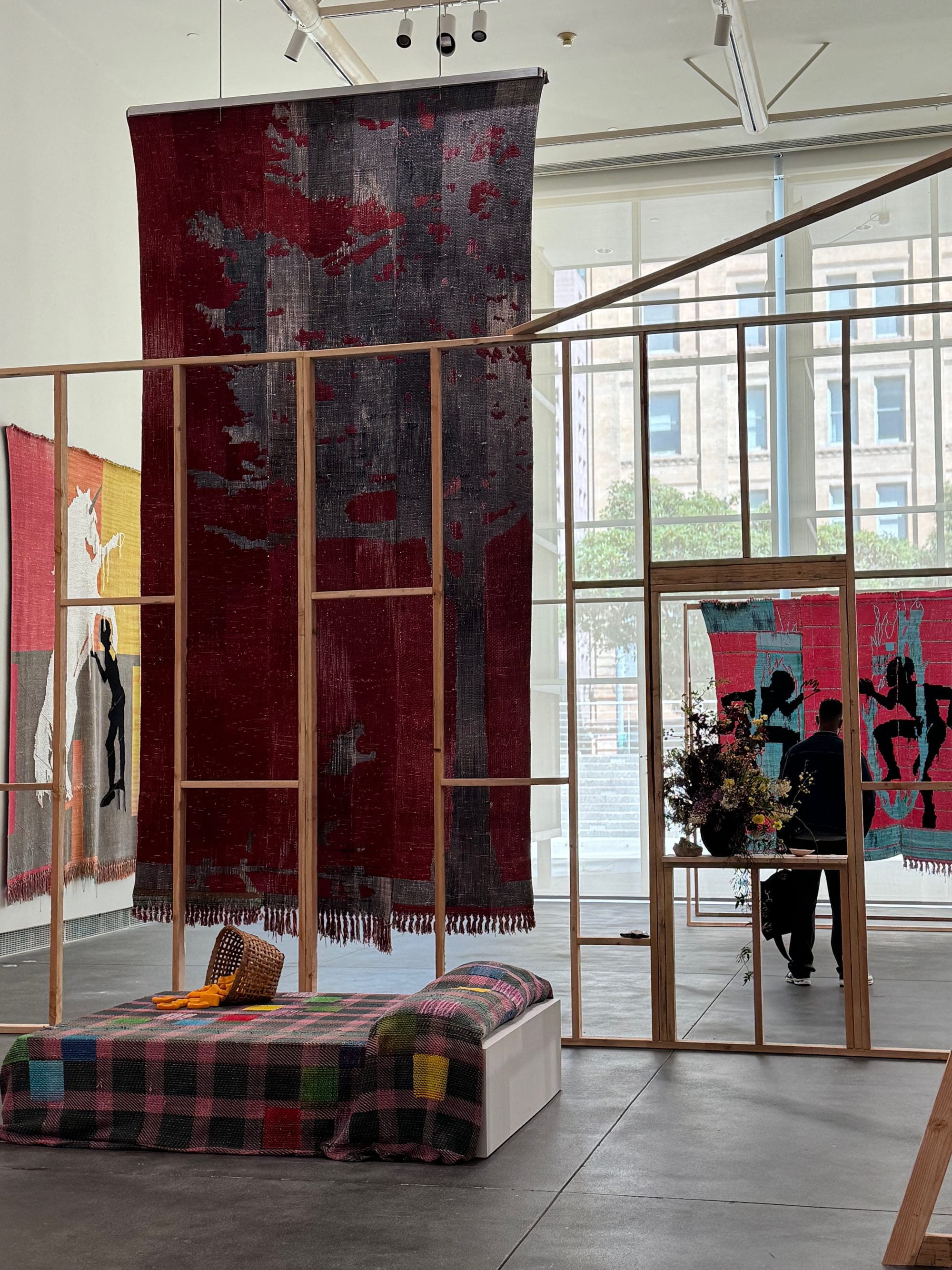
Tapestries are suspended on wooden structures throughout the gallery, creating a spatial, immersive, almost cinematic experience. Each work reads like a still frame from a larger narrative: bodies lean, float, flex, embrace, or dissolve into color fields. A central installation, clearing (2026) — an evolution of earlier work, Independence Day (2018), shown at Hammer Museum’s biennial Made in LA — extends this language into three dimensions. A scaffold-like structure with no walls, but with what appears to be a window sill with a vase of flowers, contains a bed with a quilt and a handwoven basket of Dove soap (its scent reminiscent of the artist’s Texan childhood.) Here Brackens translates weaving into lived space, where its utilitarian origins and its expressive, aesthetic possibilities — such as care and ritual — become indistinguishable.
Brackens’s approach is shaped by his time at CCA, where he studied with Josh Faught, who coined the term “sloppy craft.” This ethos, the permission to be irreverent, to leave works open-ended, and to treat both front and back as active surfaces, quietly undergirds the exhibition. Threads hang loose, edges remain unfinished, and the textile process is made visible. In Brackens’s hands, weaving becomes a site of experimentation and refusal, challenging traditions that privilege polish while foregrounding transmission: how knowledge is passed down, altered, and sustained. Now a teacher of textiles at CCA himself, Brackens explains that his pedagogy is inextricably mixed into the logic of his practice.
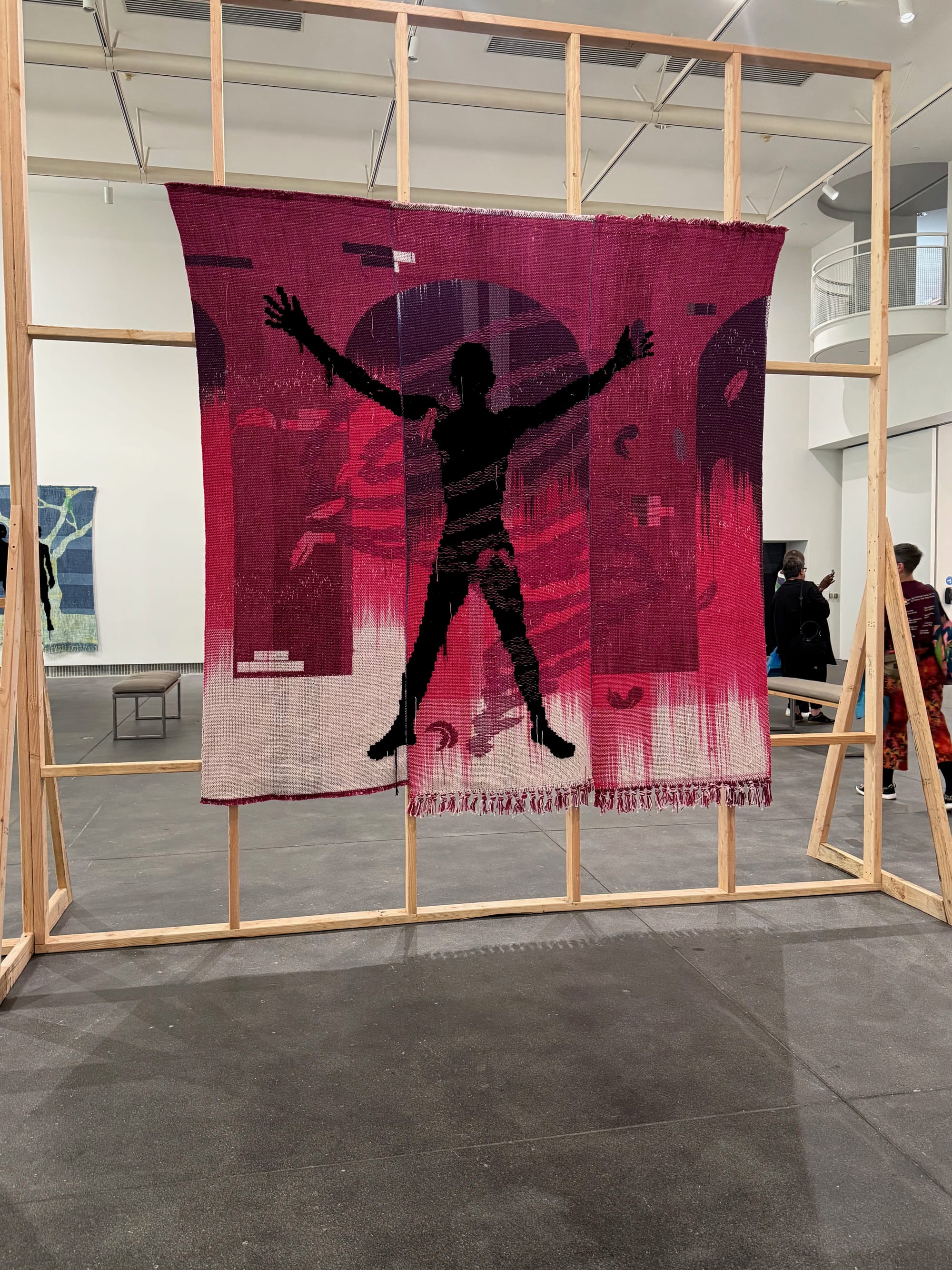
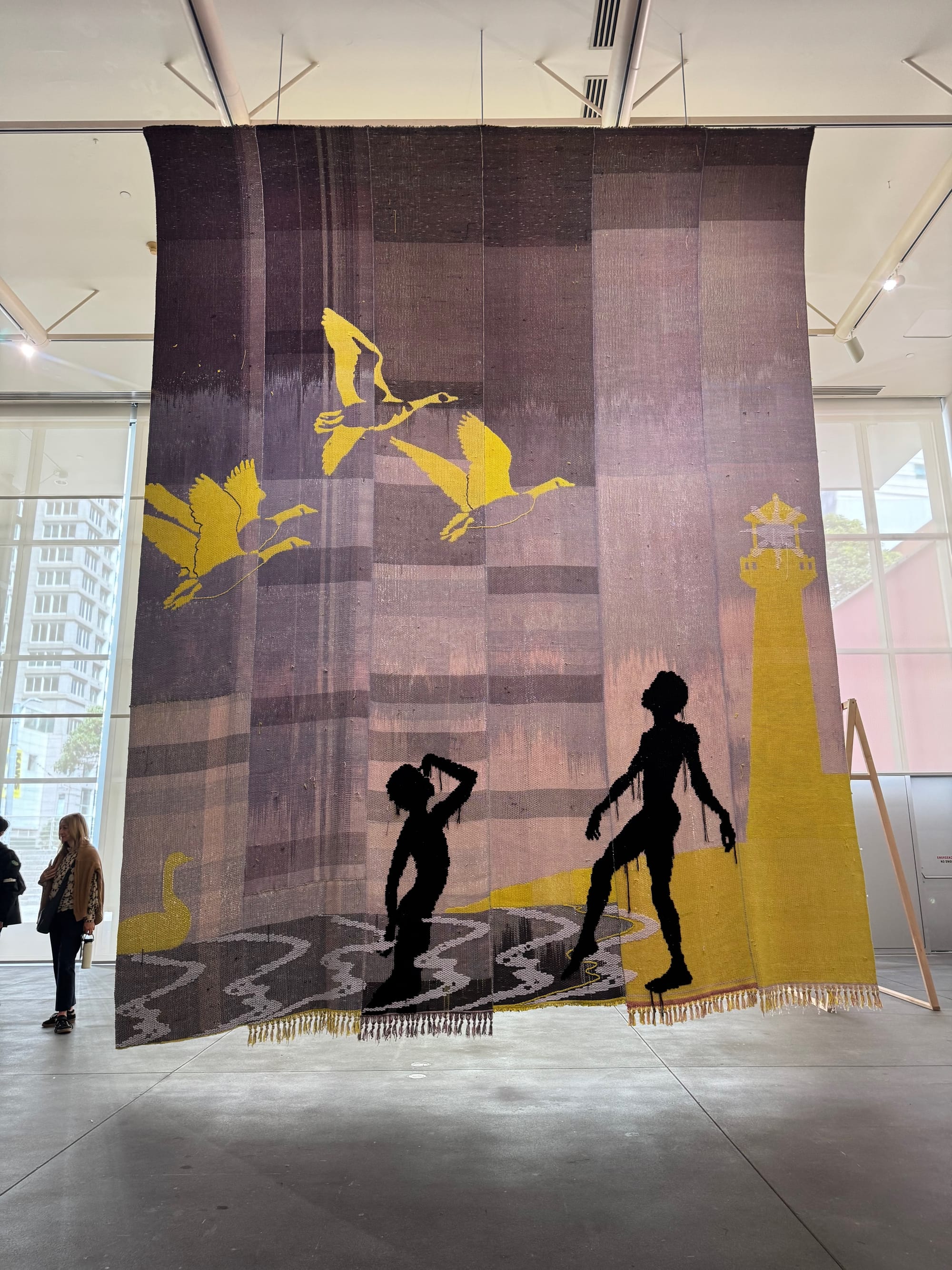
The artist is known for his silhouetted Black figures, which recall those of Kara Walker and Kerry James Marshall and are woven from black cotton with threads hanging off limbs. (Cotton, a material inseparable from the violence of its history.) In gather tender night, Brackens pushes further into the body’s entanglement with the natural, spiritual, and animal worlds. "Blood Compass" (2023), his largest tapestry to date, depicts four geese advancing toward a distant lighthouse as two Black figures stand in water below, gazing upward. Drawing on the internal migratory systems birds carry within their bodies — within their blood — Brackens seems to reframe Black migration as a form of embodied knowledge shaped by both memory and trauma. The two-sided work, its back devoid of frontal human figures, is a quiet, luminous meditation on histories of displacement, return, and survival.
Walking through gather tender night, I was reminded of a recent celebrated juke joint sequence in the film Sinners by Ryan Coogler, another great Bay Area artist, in which nocturnal figures gather through music and dance across time in a shared symbolic Black space. Brackens achieves something similar through weaving and in this San Francisco exhibition in particular. Here, it is not sound but warp and weft, which holds and honors multiple histories, thread by gentle thread.
gather tender night continues at the Yerba Buena Center for the Arts, San Francisco, through August 23. The exhibition was curated by Eungie Joo.