Edward Hopper’s Distinctly American Solitude
American bombast is, more than anything, a mask, which Hopper understood well.

Editor’s Note: The following text has been excerpted with permission and adapted from American Elegy: Reflections on 250 Years of the Dis-United States by Ed Simon, published by Ig Publishing on June 2 and available online and in bookstores.
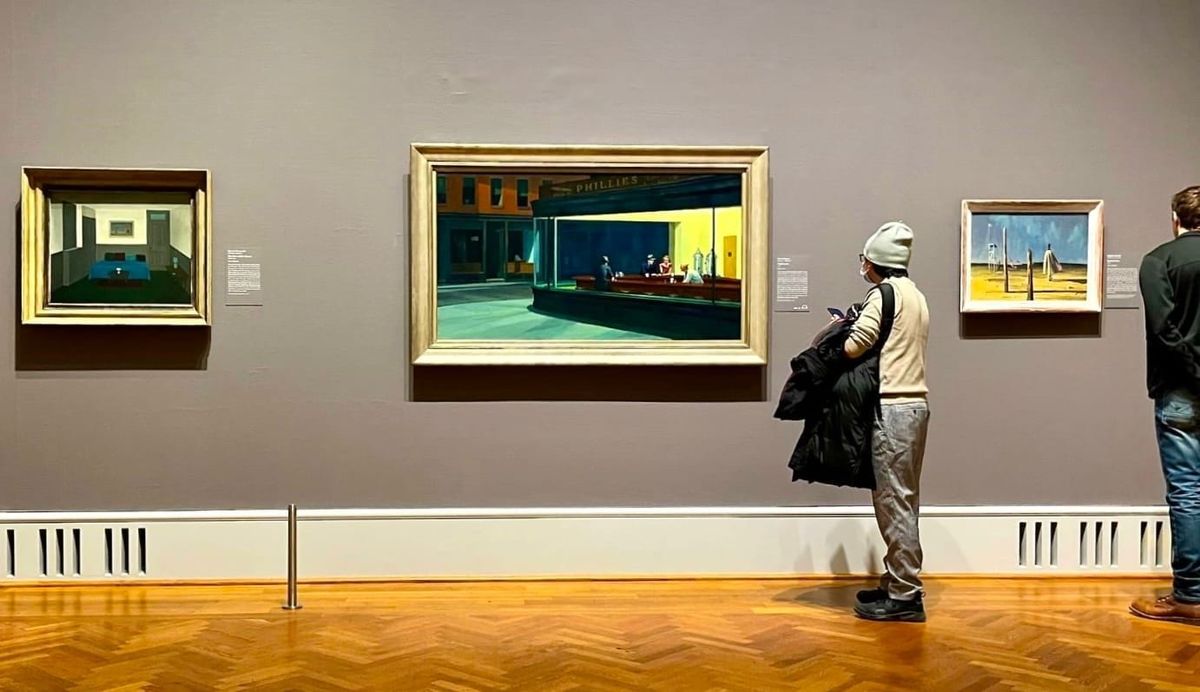
The exact location of the late-night diner depicted in Edward Hopper’s celebrated, disdained, over-exposed, frequently parodied, and beloved painting, "Nighthawks" (1942), is a matter of some conjecture. Yet, for all of those who recognize the painting (nearly everyone), it can’t help but feel that it’s a place where you’ve gotten a cup of coffee before.
A consummate example of the realist style of painting, Hopper depicts a diner sometime after the witching hour as viewed from across a silent city street. A wall of curved glass separates the three customers and the soda jerk within; the exact entrance to the establishment is unclear, contributing to Hopper’s ability to obscure nature with a superficial realism. The vibrant reds of the brick and the greens of the awning are still apparent even with the darkness of the empty street, but the light from within the diner almost appears as if it’s immanent. Around the counter — there are no booths or tables — sit the customers, a couple in the corner and a lonely man on the other side. All are dressed in keeping with the early war years in which Hopper painted the piece — fedoras and suits, the redhead in a dress the color of her hair. The server is wearing an apron and a paper cap, and he’s busy with something underneath the counter. There are two gleaming metal coffee machines near the couple who are in front of a door, perhaps to the bathroom.
Everything is cleaner and crisper than in actual reality, the surfaces of Hopper’s world polished to an exacting glean. Above the diner is a sign that says “Phillies,” but that’s an advertisement for five-cent cigars, not an indication of setting. Hopper claimed that the painting was inspired by “a restaurant in Greenwich Village where two streets met,” but the location normally suggested, where Seventh Avenue and 11th Street converge with Greenwich Avenue, was home to a gas station in 1942, the year the painting was created. As is more likely, and almost always the case with Hopper, the diner was a figment of his imagination, located in an America more real than the one that we all live in. After all, what’s more American than a diner? The dream of eggs and bacon, pancakes and waffles, a BLT and a burger, or at least a cup of joe with limitless refills. Whether a stand-alone building on a rural blacktop, a corner shop in a suburban strip mall, or the kind of big city lunch counter envisioned by Hopper, the diner is a universal American establishment. All the more so because of its 24-hour convenience. London and Paris close after the shows; even the bars in New York shutter at 4am, but diners offer the possibility of all-night sustenance. This is ostensibly for convenience’s sake, offering meals to shift workers and truckers, late-night drunks and insomniacs. But more than that, the diner in the hours before dawn is a third space between work and home, a respite from the monotony of ordinary time, a kind of refuge for the lonely.
Hopper is often configured as the great artist of loneliness — empty offices, abandoned apartments, solitary men and women at sundry hours of the night entrapped by their own selfhood. “Hopper, too, is one of the disaffected,” writes Gail Levin in Edward Hopper: An Intimate Biography. “His lonely and uneasy figures in everyday situations and common settings suggest” a spiritual crisis “in the manner typical of modernism.” It’s a pose that outside of some genres, such as noir, is not usually ascribed to the American character, where the stereotype emphasizes a kind of puppyish exuberance, an unthinking extroversion when compared to our supposedly more serious and introspective cousins across the Atlantic. And yet Hopper — Paris-trained though he may have been — is supremely American, and not just in his choice of subjects from empty New York streets to Cape Cod mornings. Hopper is so American because he isolates a variety of solitude that’s particularly American, despite the slur that reduces the national personality to nothing but bombast, friendliness, and lack of volume control. In a nation as massive as the United States, filled with empty countryside, anonymous suburbs, and alienating cities, a type of loneliness is a social currency. American bombast is, more than anything, a mask, which Hopper understood well.
Hopper is frequently understood as an anomaly in the post-war years, as realism declined and the capital of international art transitioned from Paris to New York, the new avant-garde abstract expressionism replacing the figurative painting that had dominated the national academies in the decades previously. There is some truth to that, for though his critical stock has never waned, Hopper’s mode of representation almost seemed to err more towards illustration than cutting-edge art in that period when Willem de Kooning, Jackson Pollock, and Mark Rothko produced works that eschewed any figuration at all. In the Abstract Expressionists there was a new artistic vernacular, what critic Clement Greenberg explained in his 1965 Art and Literature as being a matter whereby “realistic, naturalistic art had dissembled the medium, using art to conceal art; Modernism used art to call attention to art.” Of course, Hopper was himself a consummate Modernist, and as stated earlier his “realism” was often strangely anything but. And yet the swirls, drips, splashes, and splotches of Abstract Expressionist pieces — Pollock’s "1950 Number 1," or de Kooning’s "Excavation" — delineate art into its most elemental of forces of color and shape rather than mere representation. There has been, in the decades since cynical post-modernism has reigned ascendant, a tendency to see the abstract expressionists as a conveniently depoliticized aesthetic that the State Department and the (CIA-funded) Congress for Cultural Freedom could conveniently gesture towards regarding American artistic superiority during the Cold War. But as Louis Menand observes in The Free World: Art and Thought in the Cold War, “it is not the case that Pollock’s work, or abstract expressionism generally, received special support from the government or American museums.” Which is to say that such works were part of an organic avant-garde themselves, which spoke to American aesthetics (and critiqued it as well) through novel methodologies. If there is a tradition that connects a Hopper to a Pollock, de Kooning, or Rothko, despite differences in technique and composition, it’s this special characteristic of American solitude. Hopper painted loneliness, but many of the Abstract Expressionists did as well, at least in their own manner.

Nowhere is this clearer than in the work of Rothko, a Latvian Jewish refugee from a Europe that had immolated itself, a man who stripped art of all artifice and in the process crafted a stunningly iconoclastic type of painting that functioned as spiritual exercise. Far more than in the work of de Kooning, the Dutchmen still haunted by the myth of figuration, or in the frenetic spasms of a Pollock, Rothko was capable of painting the exact feeling of solitude that the figures in a Hopper painting are feeling. Almost any mid-period Rothko could be chosen to demonstrate this principle, for example, his "Orange and Yellow" (1956). Here, the two colors are magnified in size and intensity, as is the case with any of Rothko’s explorations of hue. The shining joyfulness of orange and yellow may dissuade some from seeing this as a painting fundamentally at home with aloneness (though a summer day can be as macabre as any in November), but that is also to confuse solitude with loneliness. Rather, what’s conveyed is the kind of singular, primordial chaos of the self, the experience of God before creation, when the absence and the void provide the kind of raw non-materials through which everything else is paradoxically constructed. There is something fair in the idea that this approach to solitude has something to do with American rugged individualism, and that at its core such sentiments are noxious. But in a far more profound manner, the variety of singular creation exulted by a Rothko isn’t some entrepreneurial myth, but an expression of the mystical belief in spiritual self-creation. Rothko is a painter (unlike Hopper) who suffers in reproduction. One has to really stand before the altar of "Orange and Yellow," stripped of the distracting senses as much as possible, to be fully enveloped in Being. To experience being an agent truly and totally by oneself, ever charged with creating the world anew in every sublime second of this eternal present.