The ICA at VCU Brings Immersive Installation "Deo Vindice" to Richmond
The gallery-sized installation at the Institute for Contemporary Art combines Greek mythology with Civil War history to examine white supremacy and hegemonic power.

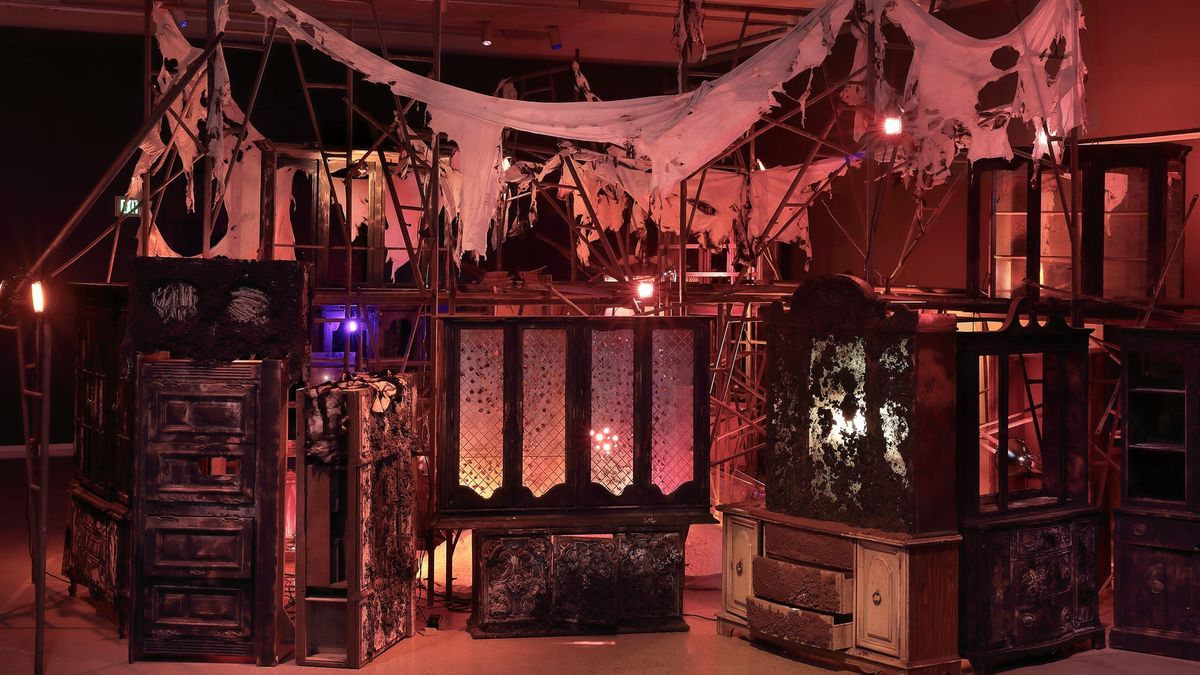
The Institute for Contemporary Art (ICA) at Virginia Commonwealth University (VCU) presents the Southeastern debut of Abigail DeVille’s Deo Vindice (Orion’s Cabinet) (2025), an immersive, gallery-sized installation that recalls the burning of Richmond in 1865.
On view through August 18, Deo Vindice is a sweeping assemblage of charred Colonial-style cabinets inspired by photographs of Richmond set ablaze in the last days of the Civil War. The installation was commissioned for the critically acclaimed MONUMENTS exhibition at the Museum of Contemporary Art, Los Angeles, in collaboration with The Brick.
“In the MONUMENTS exhibition, Deo Vindice was situated among decommissioned Confederate statuary and other artworks that interrogate the unresolved legacies of Lost Cause revisionism and myth-making,” notes exhibition curator Amber Esseiva, Senior Curator and Director of Curatorial Affairs at the ICA. “Presenting the work here in Richmond allows us to continue that essential inquiry into power, erasure, and public memory in the historically charged context our location provides.”
When it became clear that Union forces would capture Richmond in April 1865, the capital and industrial center of the Confederacy, Southern officials ordered their men to burn the city’s warehouses in order to prevent the munitions and railway foundry Tredegar Iron Works from falling into Union hands. Less than a week later, Robert E. Lee would surrender to Ulysses S. Grant at Appomattox, marking the end of the war.
Curio cabinets have historically served as status symbols, especially in the South, protecting and displaying a family’s heirlooms. In the exhibition, DeVille arranges the cabinets in clusters to mark the primary stars of the constellation Orion, a celestial system named for the hunter from Greek mythology who enraged the Earth goddess Gaia by vowing to kill every animal on earth. In doing so, she draws a comparison between Orion’s will to dominate and that of the Confederacy to maintain white supremacy and hegemonic power, even to the point of destroying their own communities.
The ragged cloth-draped scaffolding that connects the cabinets is of the type used in monument restoration, suggesting forms that have sheltered and enshrined distorted versions of historical memory, ensuring their survival despite the decades of scholarship disproving the myths.
Deo Vindice (Orion’s Cabinet) is curated by Amber Esseiva, Senior Curator and Director of Curatorial Affairs at the ICA, with Kennedy Jones, Curatorial Assistant. The installation is on view through August 18, 2026.
For more information, visit icavcu.org.