Europeans Vote on New Leonardo da Vinci Banknote Design

The European Central Bank’s shortlist for the Euro banknote redesign also includes prints of Ludwig van Beethoven, Miguel de Cervantes, and Marie Curie.

Europeans Vote on New Leonardo da Vinci Banknote Design
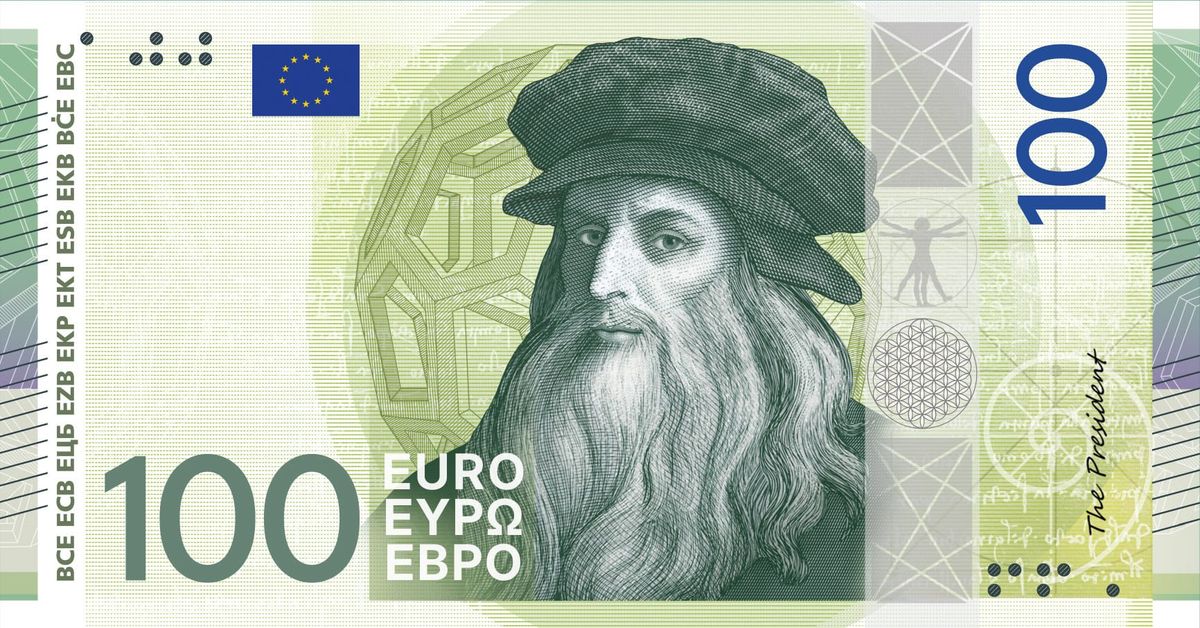
Myrsini Vardopoulou's design proposal featuring Leonardo da Vinci on the 100-euro banknote (all images courtesy the European Central Bank)

Leonardo da Vinci could appear on the 100-euro banknote in a few years, and you can help make that happen.

On Thursday, July 23, the European Central Bank (ECB) revealed 10 shortlisted design proposals for euro banknotes centered on either the theme of "European culture" or "rivers and birds" — marking the first full redesign of the bills since they began circulating in 2002.

Selected by an independent jury from a pool of over 1,200 graphic designers, the chosen artists hail from countries scattered across the European Union (EU). Each proposal includes respective designs for the five, 10, 20, 50, 100, and 200-euro banknotes, centered around two themes with strong public support, as determined by previous ECB-issued surveys.

Jan Robert Dünnweller's design proposal featuring Marie Curie on the 20-euro banknote

All artists who selected the "European culture" theme tackled designs of the same six influential people, including Ludwig van Beethoven, Miguel de Cervantes, Marie Curie, and Bertha von Suttner, the first woman to win the Nobel Peace Prize.

The proposals from artists who opted for "rivers and birds" merge six avian species with a specific EU building: a white stork with the Court of Justice; a northern gannet beside the Court of Auditors; and a wallcreeper in proximity to the Parliament.

PunktFormStrich's design proposal featuring a stork

The 10 proposals vary in approach, with some opting for geometric abstraction and others remixing photographs or paintings from other artists. Sourcing inspiration from the EU motto, "United in diversity," German artist Jan Robert Dünnweller mixed collage with hand-drawn portraits of European icons. "This visual diversity reflects a community where distinct parts form a new whole without losing their individual character," Dünnweller told Hyperallergic.

When tasked with incorporating da Vinci into a design, the Berlin-based designer Anton Wendel recreated the same three-part composition he used for every other note in his proposal. "Our decision was to give the most famous face in art history no special treatment at all," Wendel said to Hyperallergic. On the flip side of Wendel's banknotes, constellations mark "the continent as geography and as shared sky."

Julián Garnés and Guillermo Rubio's design proposals for the five-euro banknote

Spanish artists Julián Garnés and Guillermo Rubio began conceiving their designs in January and decided to make their "European culture" designs vertical. "When you visit a museum, portraits are naturally vertical, just as landscapes are horizontal," Garnés told Hyperallergic. "We found it incredible to leverage this format to make the faces and their expressions deeper and more direct."

Along with the shortlisted designs, the ECB announced a public survey where Europeans can express their opinions about the proposals until September 21. After the survey closes, the governing council is expected to choose one proposal, which will be followed by a years-long process of developing, testing, producing, and then circulating the new banknotes.