Frieze LA Meets the Real World
Intentionally or not, this year’s edition brought issues of class, labor, and immigration into the fair tent.

SANTA MONICA, Calif. — Yesterday, February 26, Frieze LA kicked off with an exceptionally crowded opening and a reportedly brisk first day of sales at Santa Monica Airport. However, alongside the blue-chip paintings and emerging artists on view, the fair also illustrated — intentionally or not — issues being confronted outside of the tent, such as class, labor, and immigration. It made palpable the tension between the kind of capitalism that the art fair represents and which our art ecosystem rests upon — and indeed which artists need to survive — and the progressive values that many in the art world profess to support. Against such a backdrop, what is the role of the art fair?
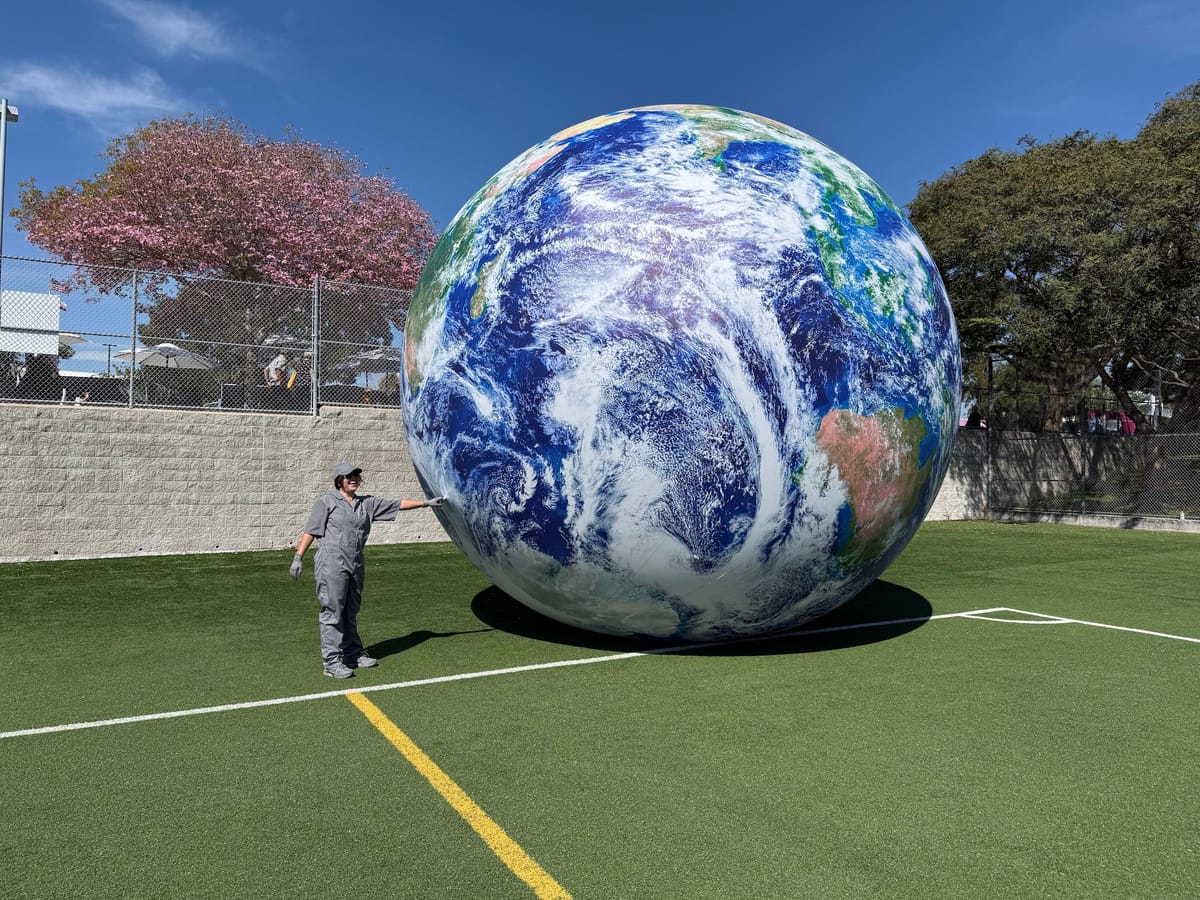
Outside the tent, Amanda Ross-Ho rolled a monumental inflatable globe around a soccer field in “Untitled Orbit (MANUAL MODE)” (2026), her site-specific durational performance happening each day of the fair as part of Frieze Projects. With the sun beaming down on her, she struggled to steady the orb against wind gusts, exemplifying the Sisyphean (or Atlesian, depending on your perspective) task of being an artist, making meaning from the cacophony of life.
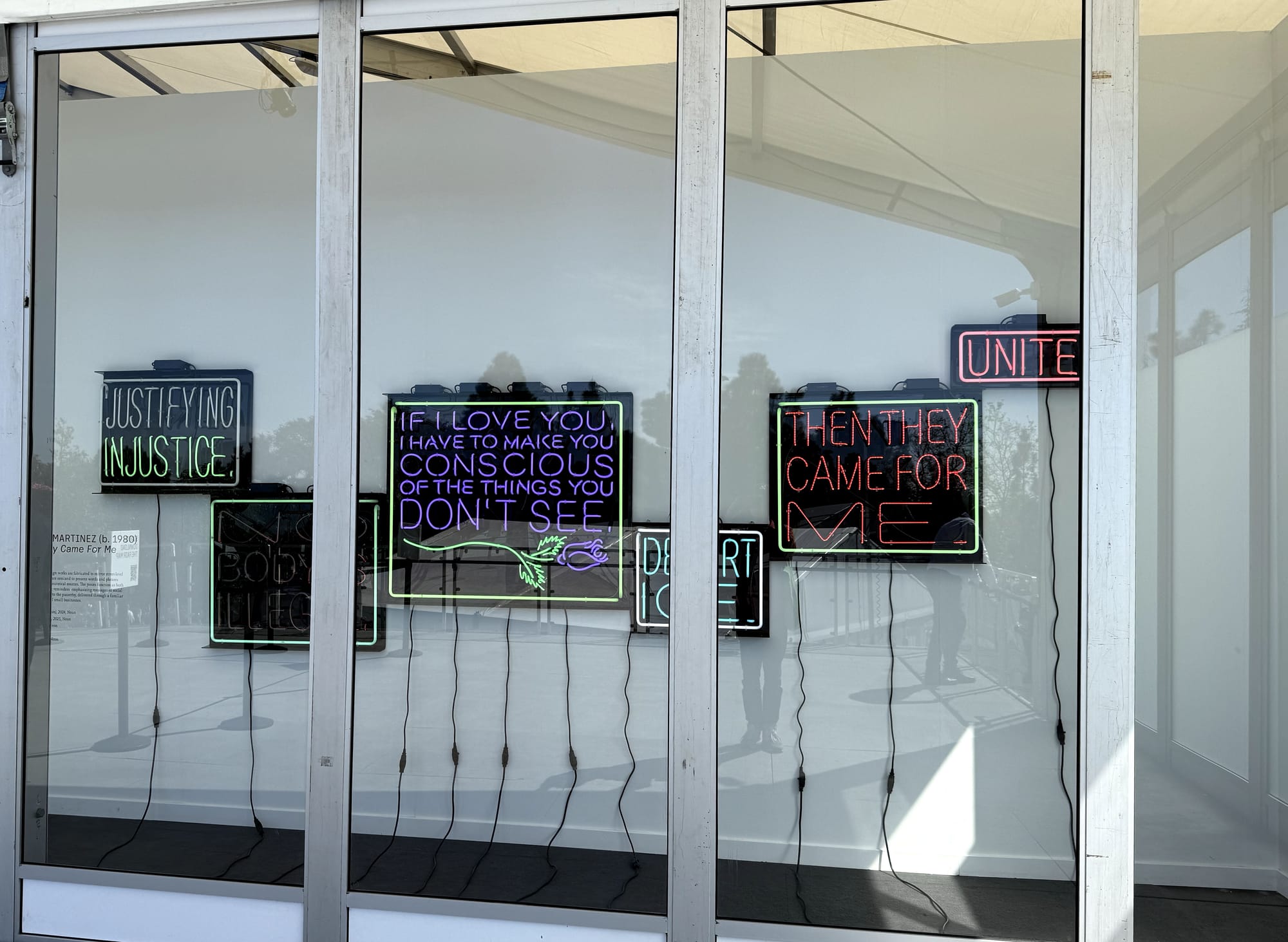
Near the entrance to the tent, glass cases housed neon signs by Patrick Martinez that read, “Deport ICE,” "No Body is Illegal,” and “Then They Came for Me.” Also visible on billboards throughout LA, their placement behind glass here seemed to temper their messages of solidarity — visible, but contained.
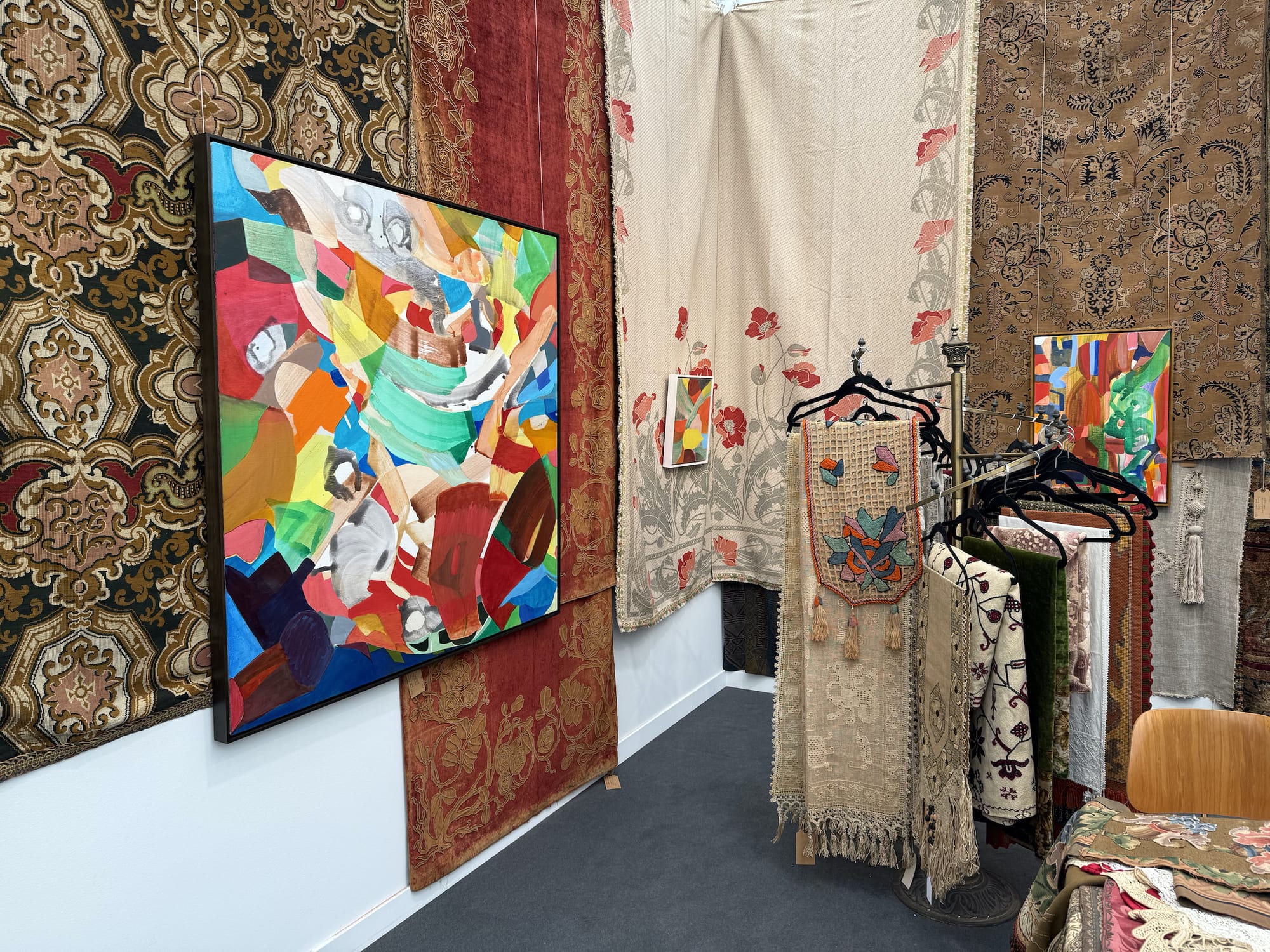
Inside the maze of booths, Parker Gallery had drawn a curious crowd to its pairing of colorful abstract paintings by Marley Freeman with antique tapestries, rugs, and wall hangings from Textile Artifacts, a store run by the artist’s father, Paul Freeman.
“We’re an oddity here. You can see the wonder in people’s faces. They can touch and feel, which they can’t do elsewhere,” Paul Freeman told Hyperallergic, before saying, “C’mon guys, be gentle!” to a group of visitors who were overzealously touching and handling the wares.
At Sebastian Gladstone, exquisitely carved marble sculptures by Nevine Mahmoud added a sense of grotesque transformation to the pristine gleaming white material, complemented by Emma Soucek’s rough and richly hued paper pulp abstractions.
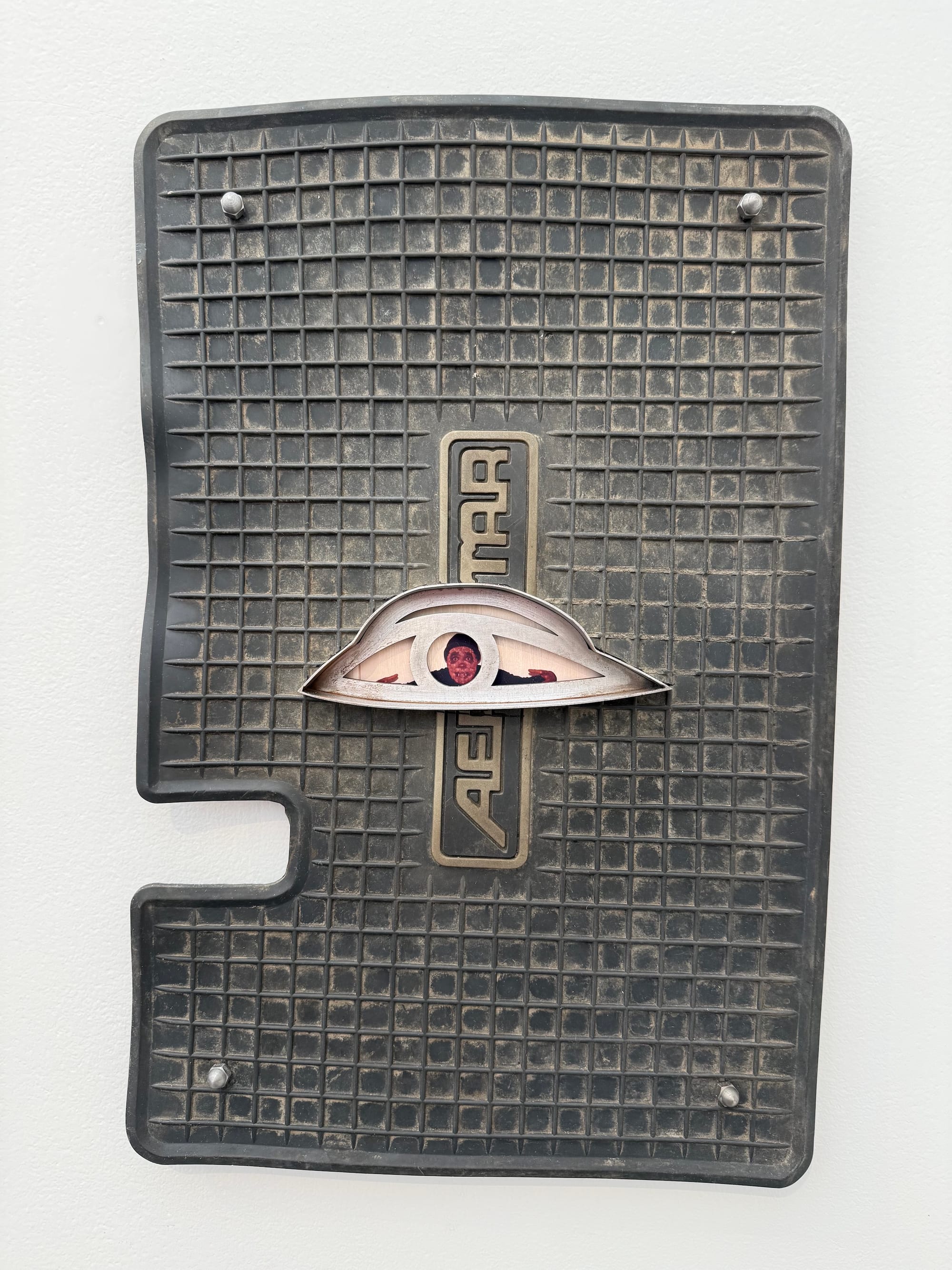
Chicago-based gallery Patron was showing sewn denim abstractions by Jamal Cyrus. Influenced by Moroccan mosaics as well as the patterning of redacted documents, the Houston-based artist threads together blue collar manual work with white collar crime through geometric abstraction. Meanwhile, Murmurs’s presentation of Y. Malik Jalal included assemblages made from dusty car mats into which the trained metalsmith embedded found photos in metal frames. Viewers must lean in close to discern the content of the cropped photos, almost putting their noses against the filthy mats, resulting in a mixture of intimacy and revulsion.
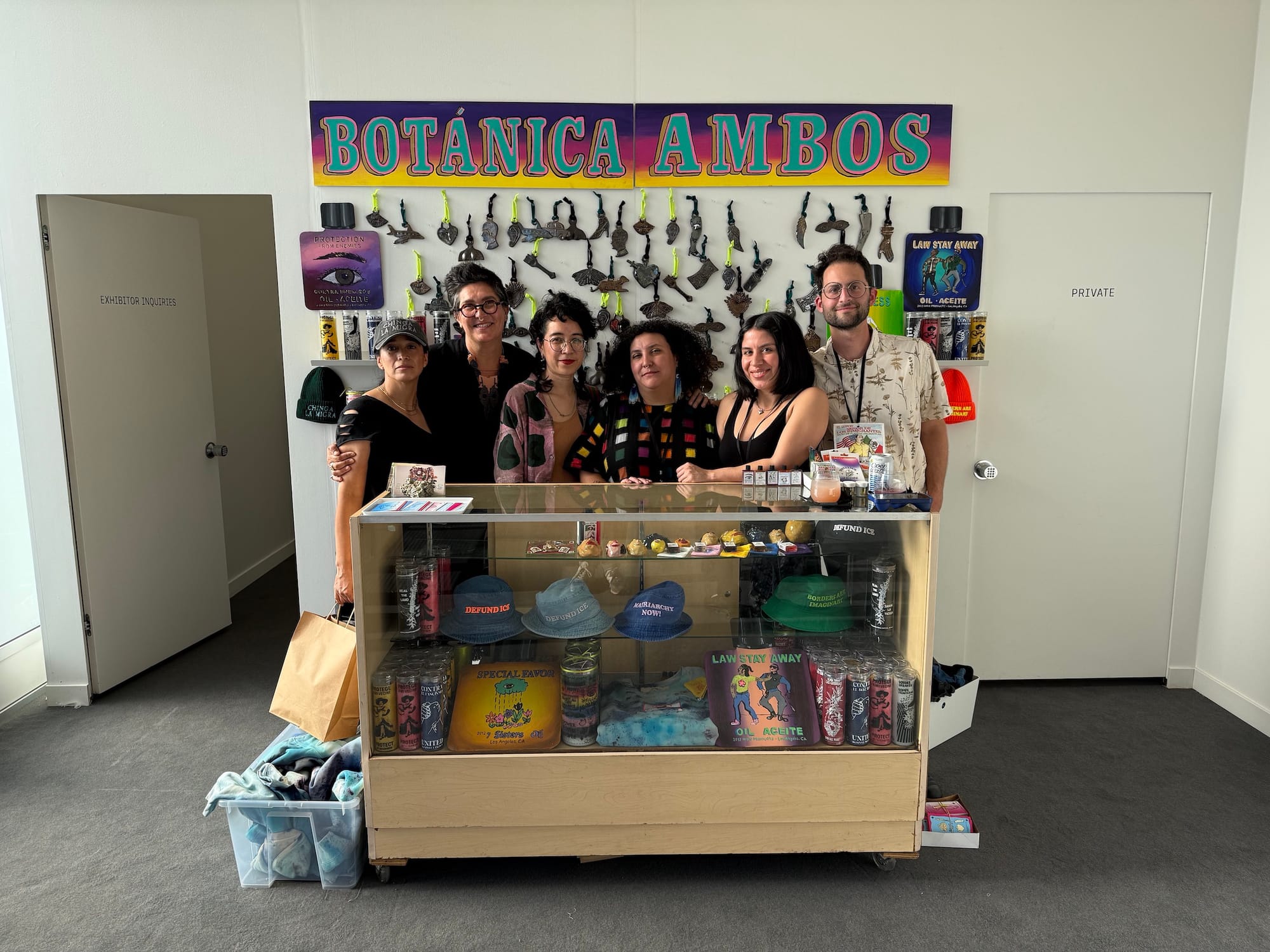
For the past few years, Frieze has offered space to Art Made Between Opposite Sides (AMBOS), a nonprofit that works with migrant communities and asylum seekers along the US-Mexico border. This year, they are selling veladoras or votive candles with messages such as “End All Wars” and “Heal the Land” and ceramic milagros made by students in their workshops. Their booth is modeled after a botánica, a common type of shop in Latin America and the diaspora that sells spiritual, religious, and folk medicine.
According to AMBOS Co-founder Tanya Aguiñiga, they were originally slated to be situated between the booths of Sprüth Magers, which exhibited a large John Baldessari installation, and Antony Meier Gallery, which showed delicate cut-velvet wall works by Jim Hodges. However, they were told by Frieze staff on Wednesday — the day before the fair opened — that they would have to relocate, with no explanation. They were eventually placed outside of the main fair area in a corner at the front of the tent, with no indication that they had moved (the fair map still lists their original location).
“The issue was around space, as Sprüth Magers had designed its installation to match the fair architecture and traffic paths that Frieze had outlined would surround its booth,” a spokesperson for Sprüth Magers told Hyperallergic. “The gallery was not made aware, prior to installation, that an additional stand would be placed between the two booths.”
Aguiñiga contests that assertion, saying that she had to send pictures of their proposal to Frieze to share with the galleries on either side of them so they would feel comfortable.
“As with any large-scale live event, layouts can evolve during installation for operational reasons,” a spokesperson for Frieze told Hyperallergic. “We don’t comment on on-site decisions during setup, but we value AMBOS’ participation in the fair and are pleased to be presenting ‘Botánica AMBOS’ as part of this year’s program.” (Anthony Meier did not return a request for comment.)
Aguiñiga says she considered pulling out, but decided to stay since a large percentage of AMBOS’s annual operating budget was raised at last year’s fair.
“It's not about me, it's about the communities that we represent,” she said. Still, she feels like the relocation of their booth further excludes the already marginalized groups they represent.
“If we're a special guest that’s invited, but they're not standing up for us, then this is not a safe space for us,” Aguñiga added. “They can't celebrate us for standing up against what's happening and then allow it to happen further.”
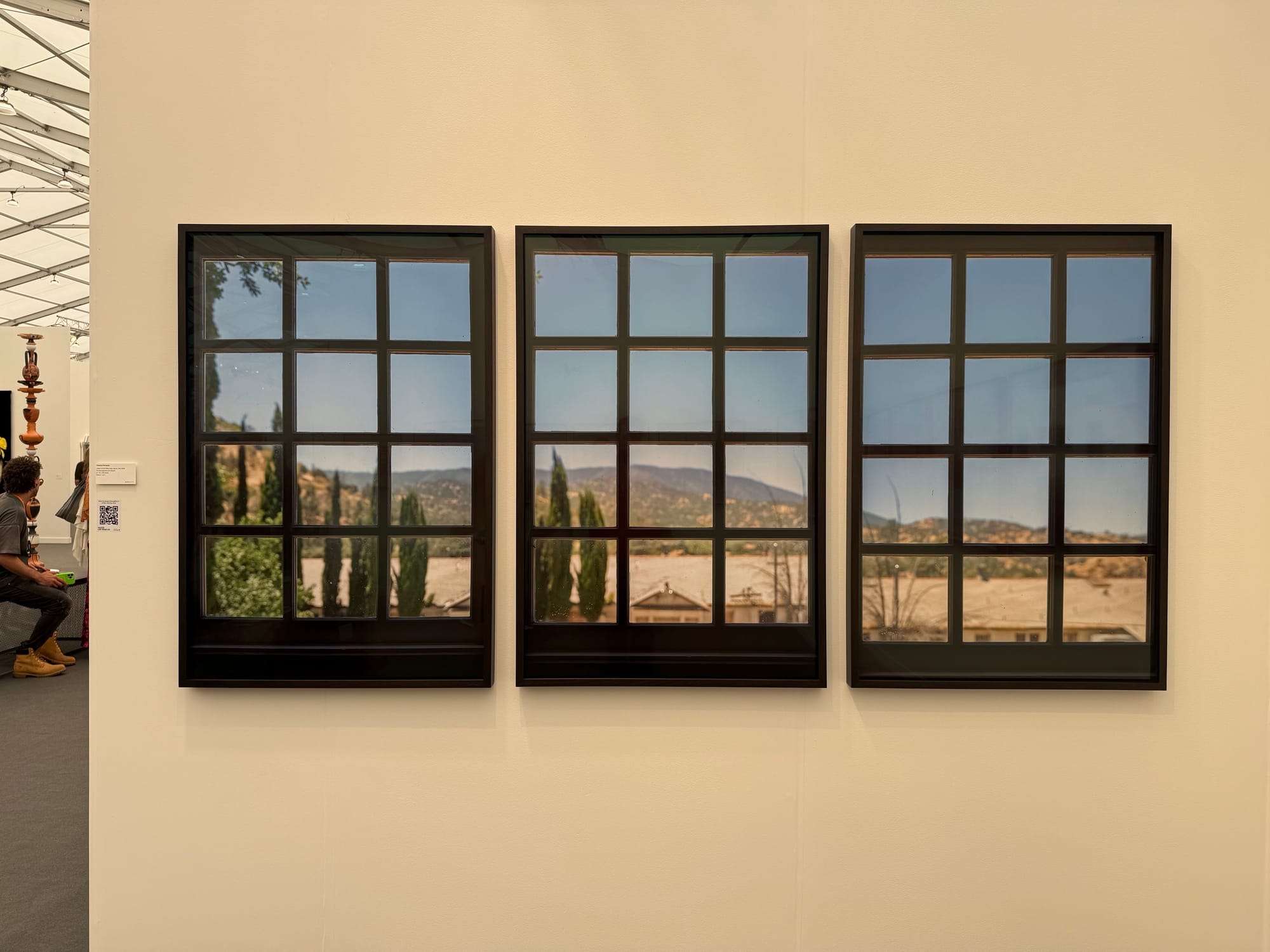
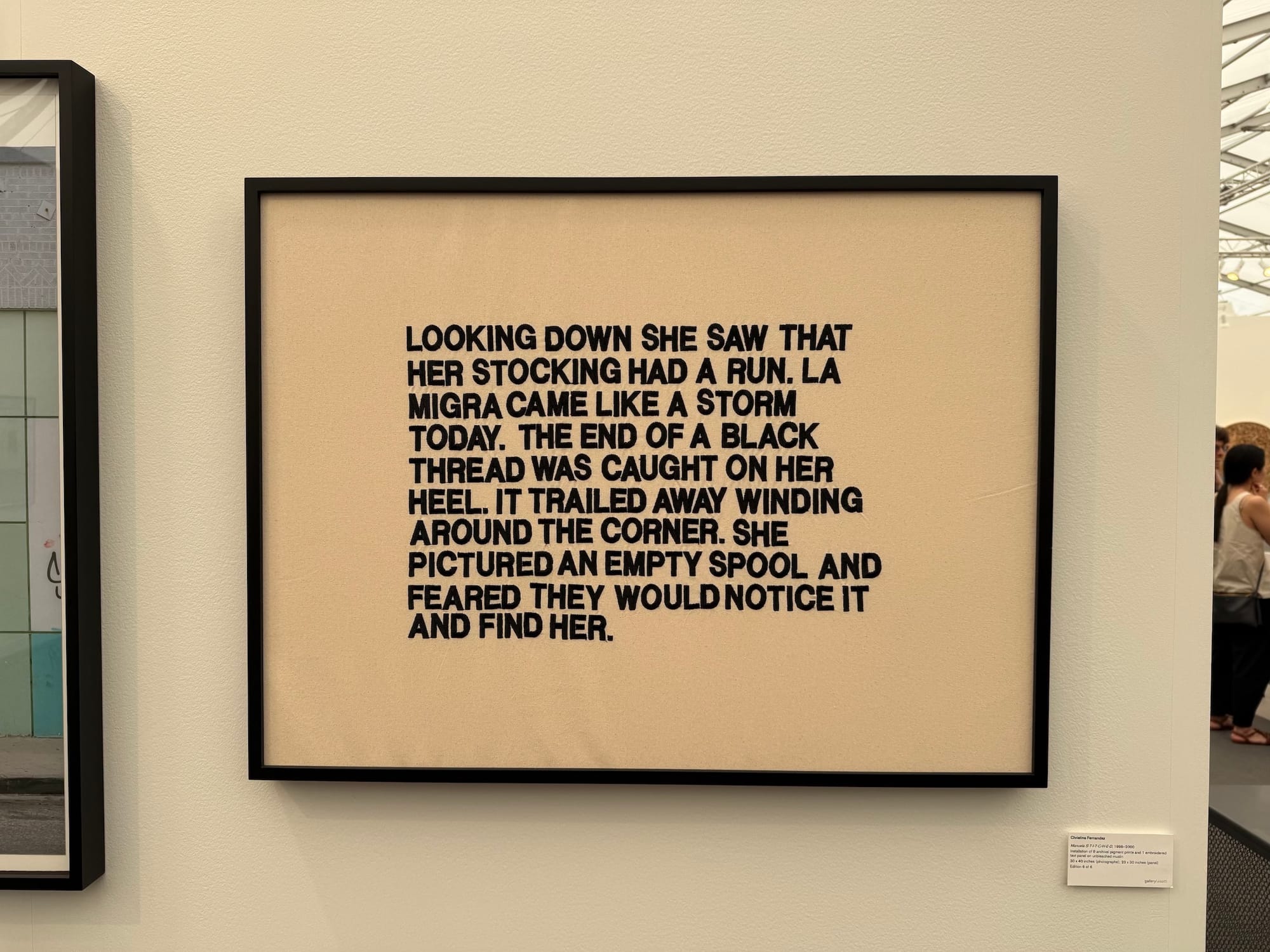
At Gallery Luisotti, Christina Fernandez laid bare forms of unseen labor with her photographs of the facades of garment shops in Northeast Los Angeles. Devoid of people, they still remain obscure, identified only by makeshift signs outside. The voices of workers are featured in embroidered text panels that hauntingly describe run-ins with ICE and “La Migra.” Her nearby triptych “Cesar I, II, III (Office View, Keene, CA)” (2025) offers three hopeful views through the windows at the headquarters of the United Farmworkers of America, the labor union founded by Cesar Chavez and Dolores Huerta.
Upon leaving the tent, the smell of frankincense wafted pleasantly through the air, coming from “Fountain: Sources of Light” (2026) by artist Cosmas & Damian Brown, another Frieze Project. Fragrant smoke poured from ceramic sculptures sitting atop painted oil drums, recalling the copal incense used in Indigenous practices throughout Mexico, where Brown grew up, and commonly sold in the botánicas throughout LA. In the distance, Ross-Ho could be seen slowly pushing her globe around the field, with several hours still to go before she was done for the day, only to pick up where she left off in the morning.
Ross-Ho pushing the inflatable globe around the turf field