Gabrielle Goliath Sounds a Call to Action in Venice
With “Elegy,” the South African artist proposes that grief is a necessary tool for building solidarity.

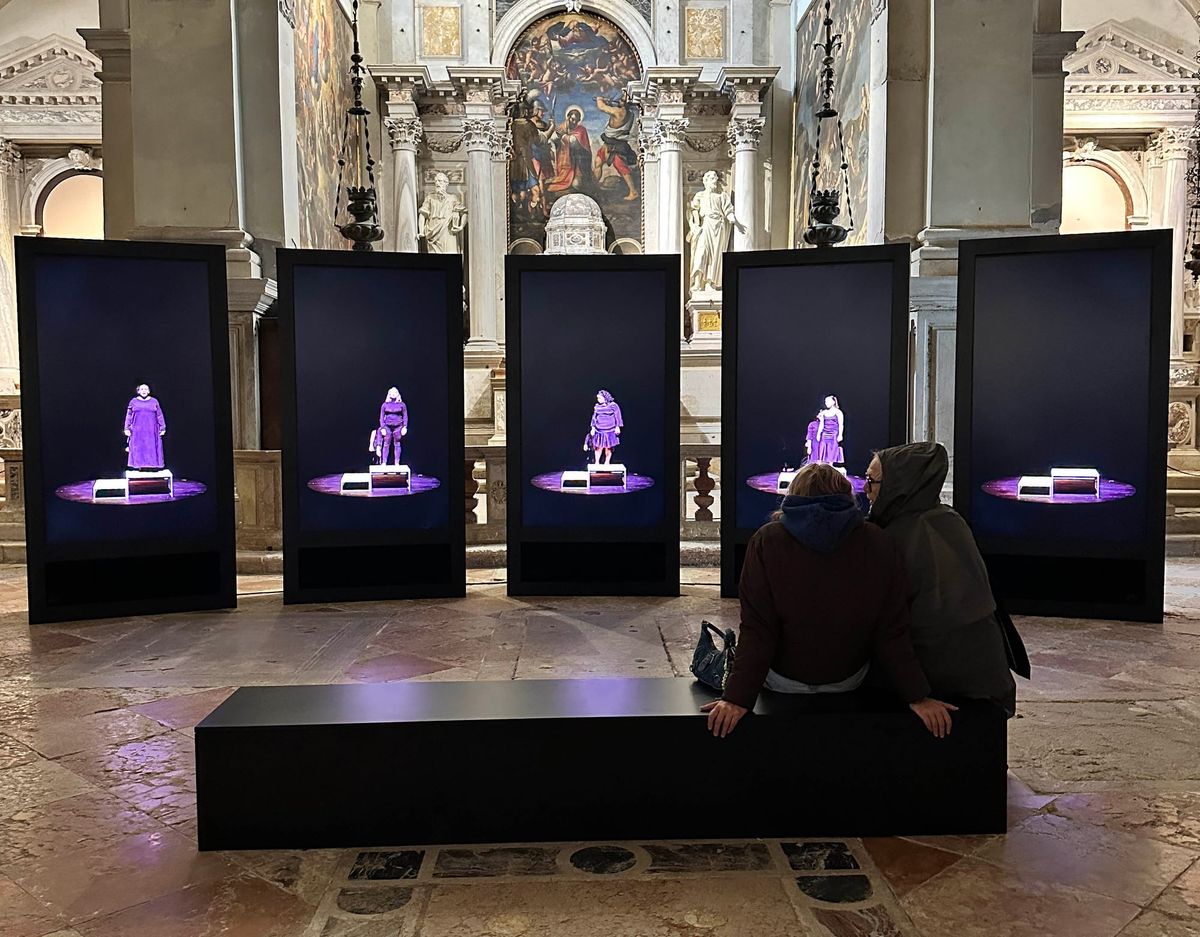
VENICE — In the baroque interior of the Chiesa di Sant'Antonin in Venice, Gabrielle Goliath’s show, Elegy, is South Africa’s unofficial pavilion for the 61st Biennale Arte. Unofficial, of course, because in January, just months before the global art exhibition was set to open, South Africa’s Culture Minister Gayton McKenzie overrode the decision of the independent committee that had long determined which artist would represent the country. McKenzie, the leader of the pro-Israel, far-right party Patriot Alliance, claimed that “South Africa’s platform was being used as a proxy by a foreign power to endorse a geopolitical message about the actions of Israel in Gaza” — the result of Goliath’s proposed inclusion of a memorialization of those killed in Israel’s genocide of Palestinians in Gaza. McKenzie’s decision stood at odds with South Africa’s actions two years earlier, when it filed suit, with the support of more than 30 other countries, at The Hague, seeking a declaration of Israel’s actions as illegal.
Goliath and her curatorial collaborator, Ingrid Masondo, filed suit against McKenzie, which was thrown out by South African courts.
The censorship of Goliath’s proposed contribution to the Biennale seems especially perverse when confronted with the actual installation, which is hauntingly beautiful and achingly tender. Three works, all part of her ongoing series Elegy, pay tribute to victims of violence: Elegy—Ipeleng Christine Moholane (2015), mourns a South African student killed in 2014 in the country’s ongoing femicide crisis; Elegy—for two ancestors (2024) conjures the memory of two women killed by Germany when they murdered tens of thousands of Ovaherero and Nama peoples in Namibia in the early years of the 20th century in response to an uprising against their colonial rule; Elegy—for a poet (2026) is made in honor of the Palestinian poet Heba Abunada, who was killed in an Israeli airstrike in Khan Yunis in October 2023.
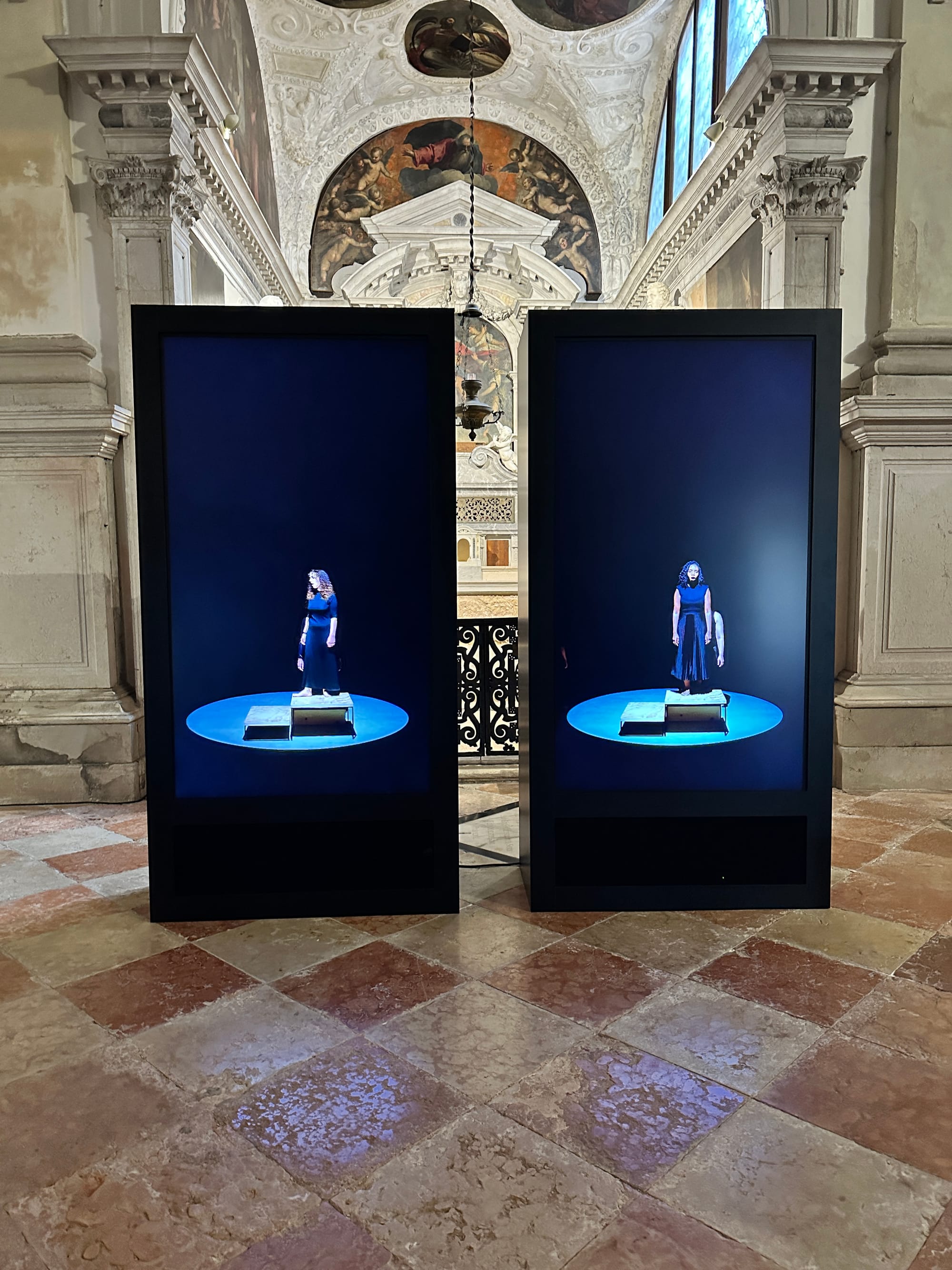
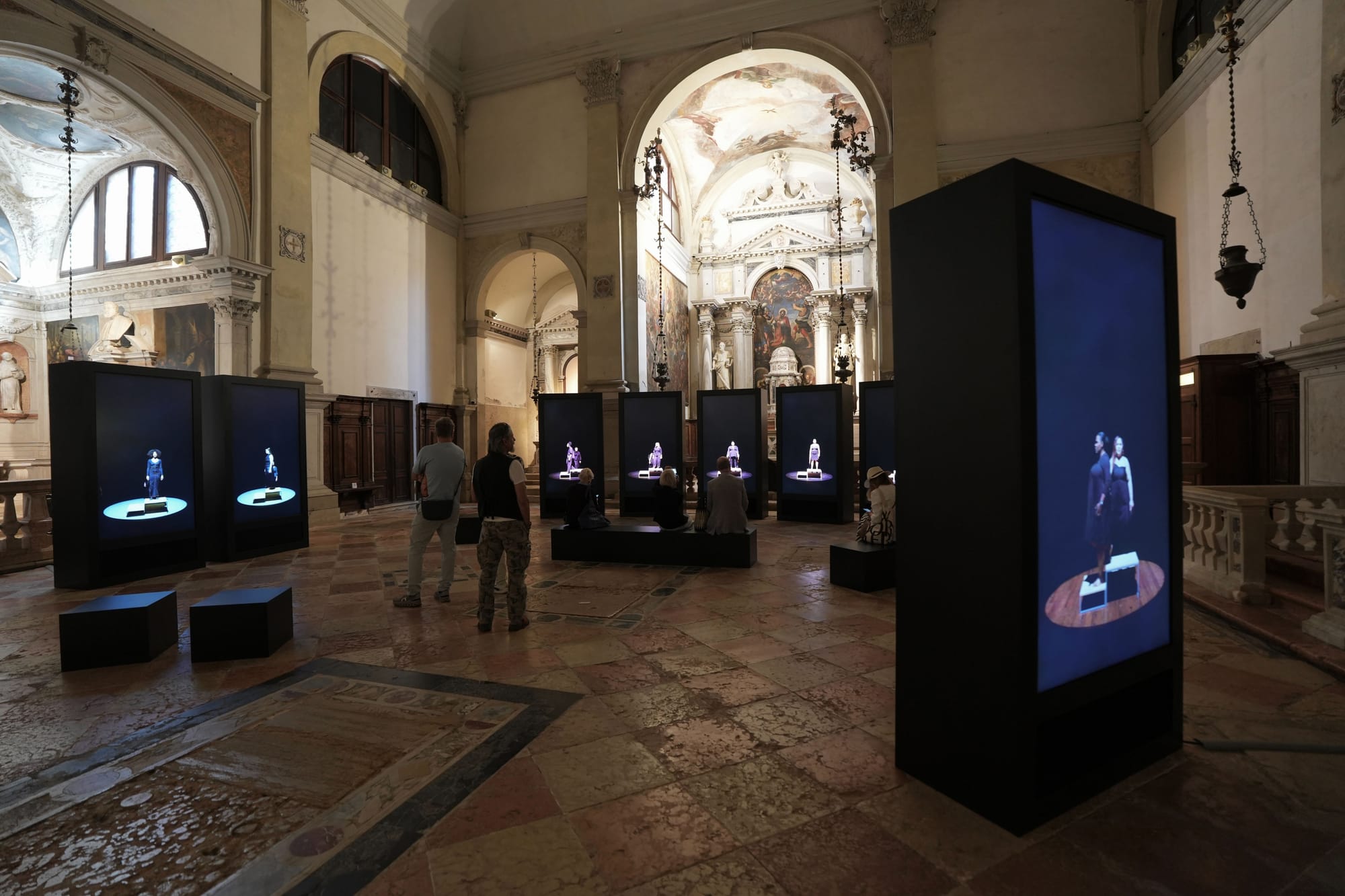
All three installations take a similar form: on freestanding, vertically-oriented LED screens, a series of women and genderqueer people, dressed in dark clothing and spotlit against a velvety, blue-black background, mount a dais, sounding a single note for as long as they are able. When their voices falter, when they run out of breath, another singer steps up to take their place. The number of screens varies — one for Ipeleng Christine Moholane, two for the Nama women whose names were not deemed important enough to preserve in the German archives, and five for those killed in Gaza. In the latter case, the last screen shows an empty dais, an invitation to us to participate in this act of remembrance, or a placeholder for the deaths yet to come in the ongoing crisis.
Though each work is distinct, in the vaulted space of the church, the voices meld, becoming a choir: All these acts of violence are connected both through geopolitics (the still unfinished work of decolonization) and, here, through sound. We, the viewers, not only hear the music that results, but we also feel it in our bodies thanks to the acoustics of the building. We are implicated, in other words — we are not allowed to simply watch. Neither does Goliath turn the victims of violence into a spectacle — we never see them, only their memorialization. It's a form of memorialization that keeps them present without turning them into objects of the viewer's gaze.
These laments for the dead are calls to action for those who are still here: Goliath refers to the “urgent, ongoing life-work of mourning.” Collective grief, Goliath seems to propose in this body of work, is a necessary tool for building solidarity — it constitutes a collective action, a precarious coalition of grievers, an impetus for change. How many revolutions have begun at a funeral? And, perhaps even more pointedly, how many atrocities have only deepened because of our failure to mourn? The example of Gaza is especially crucial here — from the start, the prohibition on naming the genocide, whether by governments or universities or museums or culture ministries, has prevented a collective coming to terms with the horror, not only our sadness and anger but also our complicity.
Venice is full of works right now that are meant to address the violence that unfolds across the globe, past and present: Lawrence Abu-Hamdan’s 450XL: The Story of a Fugitive Sound, which uses forensic sound analysis to document the first use of a sonic weapon against peaceful Serbian protesters; Roman Khimei and Yarema Malashchuk’s Wishful Thinking, which imagines a future in which Russian soldiers must account for their actions in the war; Amar Kanwar’s The Torn First Pages which examines the struggle for democracy in Myanmar; Zhanna Kadyrova’s Refugees, which involves rescuing plants from bombed out schools, libraries, and clinics across Ukraine; Tais Don, a textile woven by the nonagenarian Pereira Maia inscribed with the names of the 271 victims of a 1991 massacre in Timor-Leste, a project that took five years to complete; Dana Awantani’s May your tears never dry, you who weep over stones at the Saudi Pavilion, which reconstructs the mosaic floors of temples, mosques, synagogues and churches destroyed or in peril due to ongoing violence in west Asia. There are many more, of course. But what the best of these works does — and I believe Goliath’s Elegy is among the best I have seen here — is to shift our responsibility from feeling to doing, to turn the passive acts of witnessing and remembering into obligations to act in concert with others, across chasms of difference and experience, to preserve life above all.
Elegy continues at Chiesa di Sant’Antonin (Salizada S. Antonin,
Venice) through July 31.