Helen Levitt Captured the Poetry of New York City
A new survey publication serves as a testament to the photographer’s belief that the city’s working-class communities of color possessed a beauty and drama all their own.

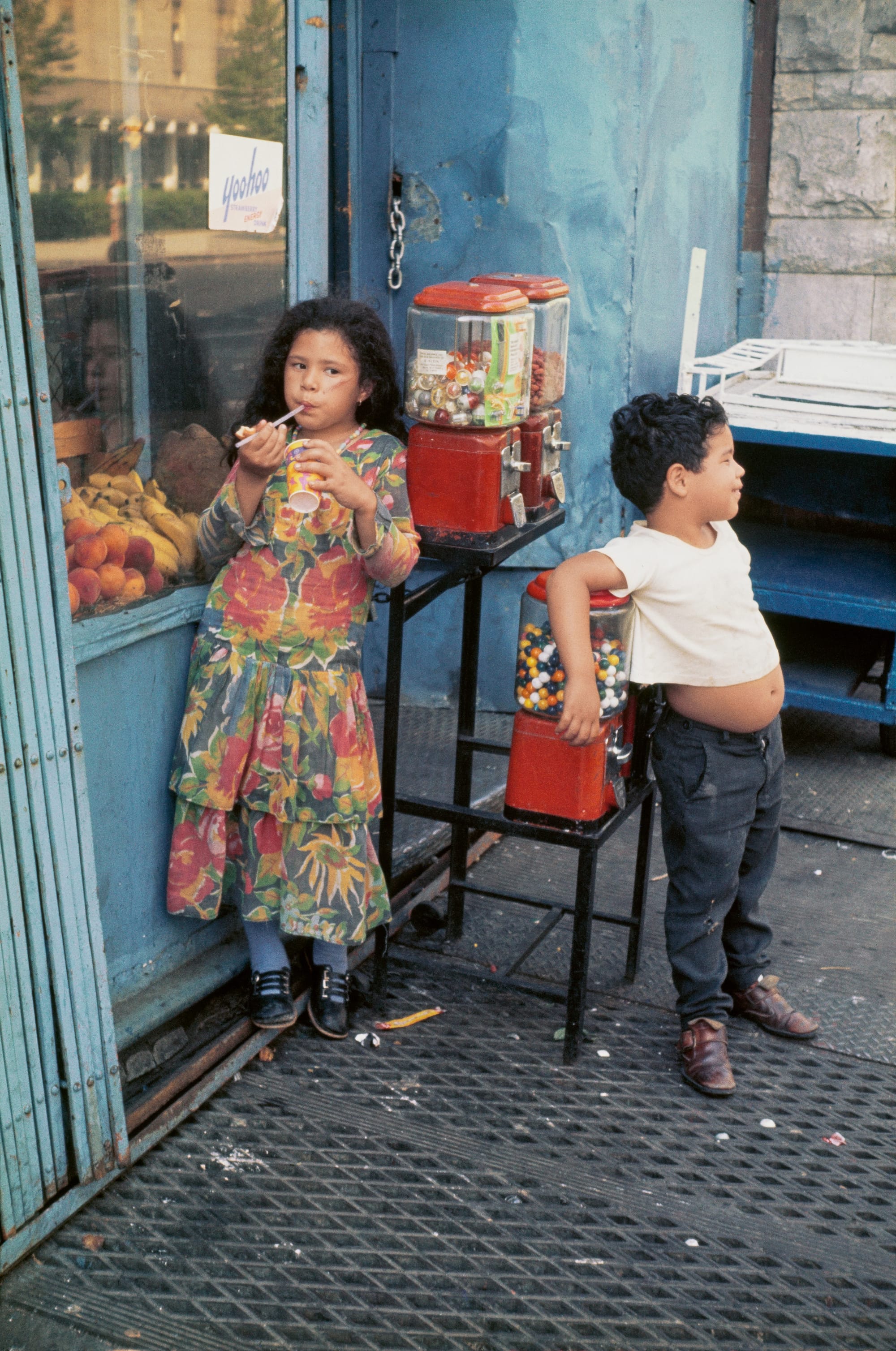
Photographer Helen Levitt, who was born in Bensonhurst in 1913 and died at the age of 95 in her fifth-floor apartment in Greenwich Village, lived in New York City her entire life (save for a five-month sojourn to Mexico) and never lost her Flatbush accent. She was friends with photographers Henri Cartier-Bresson and Walker Evans, and, like the latter, collaborated with writer James Agee, but she never received the level of attention and acclaim that her male contemporaries did. Though Levitt is perhaps best known for her photographs of children’s chalk drawings in the 1930s, they comprise only a fraction of her six-decade practice, whose emotional complexity and formal innovation continue to captivate. The comprehensive book Helen Levitt, edited by Joshua Chuang, draws from the breadth of her output with rarely seen images and scholarly essays that focus on her early expeditions with a Leica, 1941 trip to Mexico, experiments with color photography, two series taken in the New York subway, and final photographs from the 1980s.
Levitt was an avid reader and movie-goer who dropped out of high school because she was bored with rote memorization, as Chuang, who also organized a traveling exhibition of the same name, notes in his introductory essay. After apprenticing in a commercial photography studio, she bought her own camera and in 1934 joined the leftist New York Film and Photo League, where she met and befriended Cartier-Bresson, whom she said “made me ambitious.” In 1937, Levitt started teaching children’s art classes in East Harlem through the Federal Art Project and began photographing her pupils’ sidewalk chalk drawings. It was around this time that she sought out Evans, who took her on as a mentee, assistant, and, briefly, a lover.

The years 1938 to 1942 were incredibly productive for Levitt, as evidenced in the book’s rich collection of work from this period. The children’s chalk drawings are playful and mischievous, depicting the typical houses and family members along with the more provocative armed men and kissing figures. Levitt captures her students’ handwritten captions that range from the imaginative “Button to Secret Passage press” next to a small bullseye to the libelous “Bill Jones Mother is A Hore” (in looping script no less). In her insightful essay on the series, historian Lauren Graves celebrates Levitt’s departure from the representations of passive, endangered urban children to picture them instead as empowered agents “intellectually and physically activating their space.”
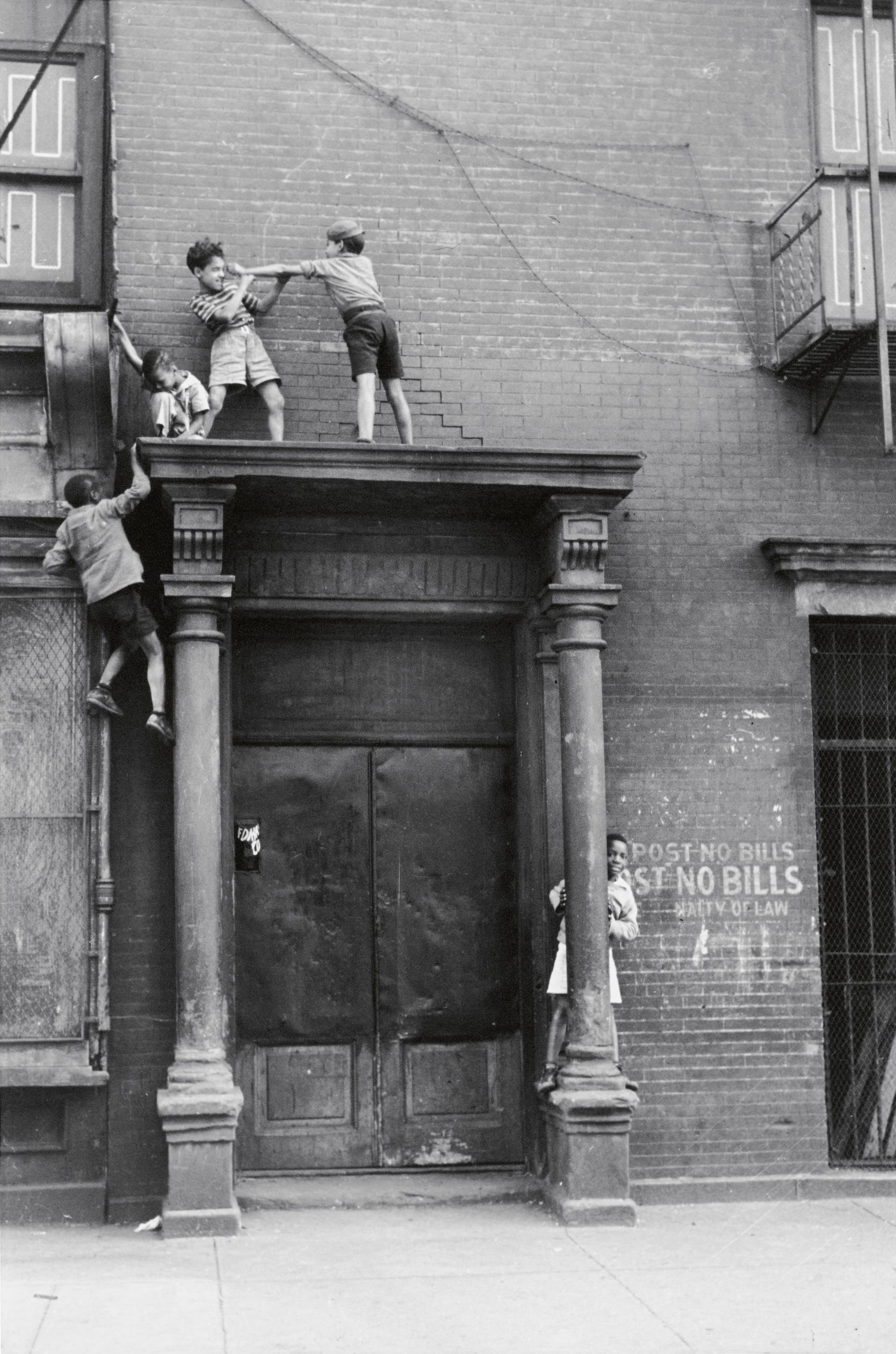
But it is the other photos from this period that testify to Levitt’s singular talent — her mastery of movement, body language, gesture, and gaze and remarkable ability to capture relationships within the social world of the New York streets. An older and younger woman sit on the sidewalk on either side of an open doorway in a photograph from 1940; though physically distant, their postures suggest a strong emotional engagement. Other young women gather outside storefronts in another 1940 image, chatting with each other while also giving their attention to some off-camera action. In a snapshot from 1945, three young Black men lean on a sidewalk mailbox, clustered in conversation, while a black cat strolls by; one man faces the camera and another idly turns his head towards it, but neither is fazed by Levitt the interloper.

“Levitt was interested in the unpredictability of public space, the unexpected meetings and alliances that are forged outside of the home,” art historian Freya Field-Donovan explains in her insightful contribution. Indeed, Levitt’s subjects seem to possess an unselfconscious manner of occupying space, an awareness of their existence within a broader social realm. The younger characters in Levitt’s photographs leap and play with abandon, climbing trees and buildings and improvising games in abandoned lots, unsupervised but never entirely outside the watch of a community of stoop-sitters and window-watchers. Looking at the photos in 2026, with our ubiquitous smartphone cameras and surveillance technologies, one can’t help but feel nostalgic for a life that was lived so much more out of doors.
And yet these lives are, emphatically, not those of New York’s wealthy or powerful. They are the working-class, diverse, and vibrant neighborhoods of Spanish Harlem, the Lower East Side, Hell’s Kitchen, the East Bronx, and Brooklyn. But unlike Jacob Riis, Lewis Hine, and other social documentary photographers, Levitt didn’t work with any particular political agenda other than the belief, still somewhat radical for its time, that the city’s working-class communities of color possessed a beauty and drama all their own. And while it certainly shares similar material and themes with that of social documentary photographers, her work “does not stake any claims about these issues or elicit sentimental responses,” as Field-Donovan observes. “Instead, Levitt’s works give shape to those delicate and elusive aspects of the social world without prescribing them, offering a vision of a collective culture.”

At the end of the 1940s, Levitt stopped photographing for nearly a decade, until a successful Guggenheim fellowship application allowed her to explore the nascent and expensive terrain of color photography. As artist Joel Sternfeld explains in the book, magazines rarely published color photos at the time, nor did galleries show them, leaving Levitt “nothing that offered any guidance in organizing the riot of color going on every day on the streets of New York.”
Despite a multitude of formal decisions and challenges, Levitt handled the new technology with characteristic deftness, producing a body of images that still electrify with their chromatic daring. Against a gritty palette of greys and browns, the garish green of an automobile or the shocking orange of a woman’s dress carry an amplified charge, though Levitt’s subject matter doesn’t change. A new generation of urban dwellers still hang out of windows, play in abandoned lots, and congregate on city sidewalks — the ongoing choreography of daily life in all its lyricism, chaos, and undeniable communion.


Helen Levitt (2026), edited by Joshua Chuang, is published by Thames and Hudson and available online and through independent booksellers.