How a Texas Town Became an Art Project
With fewer than 700 residents, Kingsbury has become a hub for cultural governance and sovereignty, largely thanks to advocacy led by arts organization Habitable Spaces.

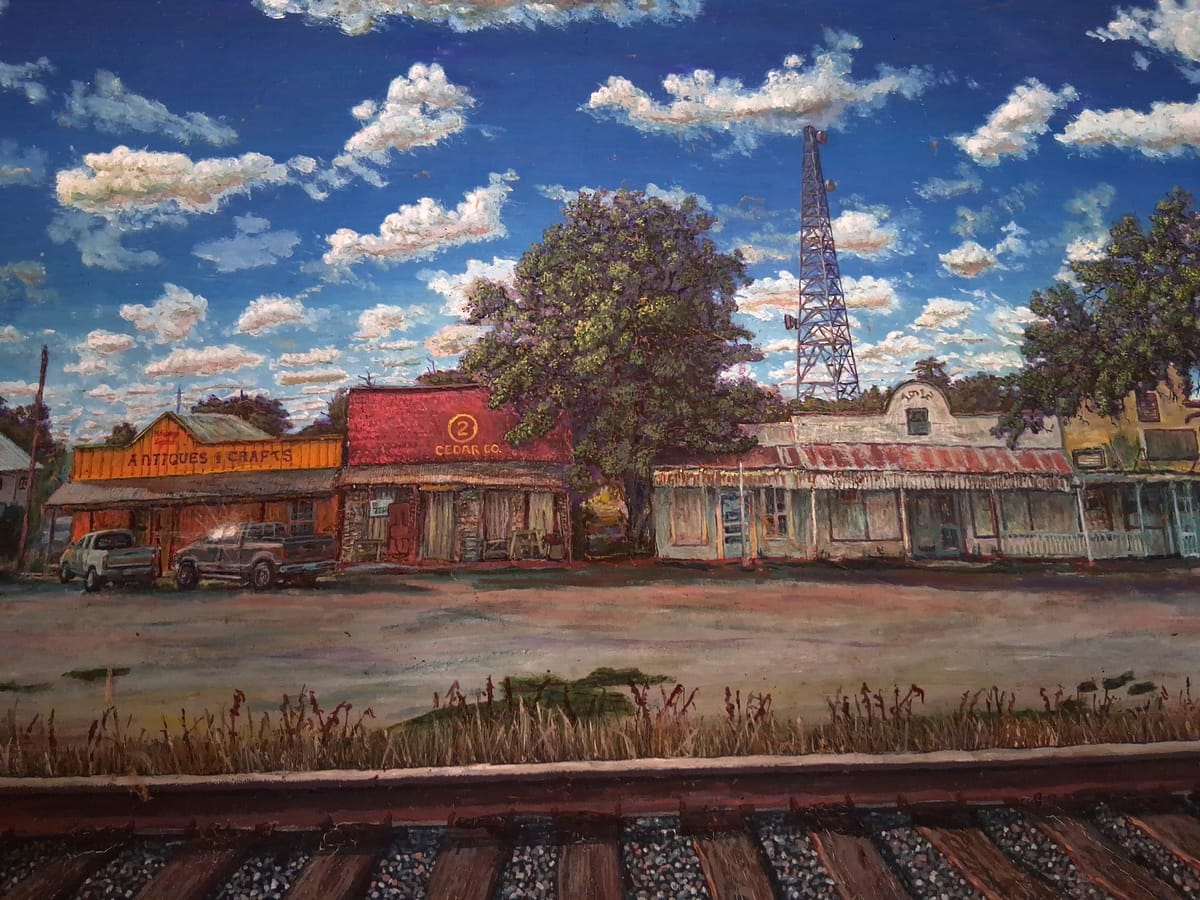
KINGSBURY, Tex. — I never thought a piece of utopia could be found in the middle of Texas. It feels audacious to entertain such a possibility when, miles north and south, detention centers imprison and sicken children and families. Where, like in much of the nation, the histories and rights of Black, Indigenous, and trans peoples and women are being erased, and where schools increasingly impose doctrine rather than encourage intellectual growth.
And then to encounter a semblance of a body politic grounded in care for what is shared — land, air, water — outside of an Indigenous tradition was unexpected.
For the past two years, I have been visiting the nonprofit art center Habitable Spaces in Kingsbury, a small town between San Antonio and Austin. Call it for love and research, a search for inspiration, perhaps some way to dream bigger than the institutional art system allows. As an artist, I believe now is the time for luminous visions to topple those producing endless, purposeless decay.
Habitable Spaces was founded by artists Alison Ward and her partner, Shane Heinemeier. Originally from Florida and Texas, respectively, the pair met in New York City after two decades in what could only be described as intense relationships with art.
Ward, a performance artist and Bronx Museum of the Arts AIM Fellowship alum, grew weary of the limitations imposed by the New York art market: low pay, institutional ambivalence, and the relentless cost of living. In 2011, they left to explore what it would mean to nurture a community rather than infuse one with competition, while also caring for themselves.
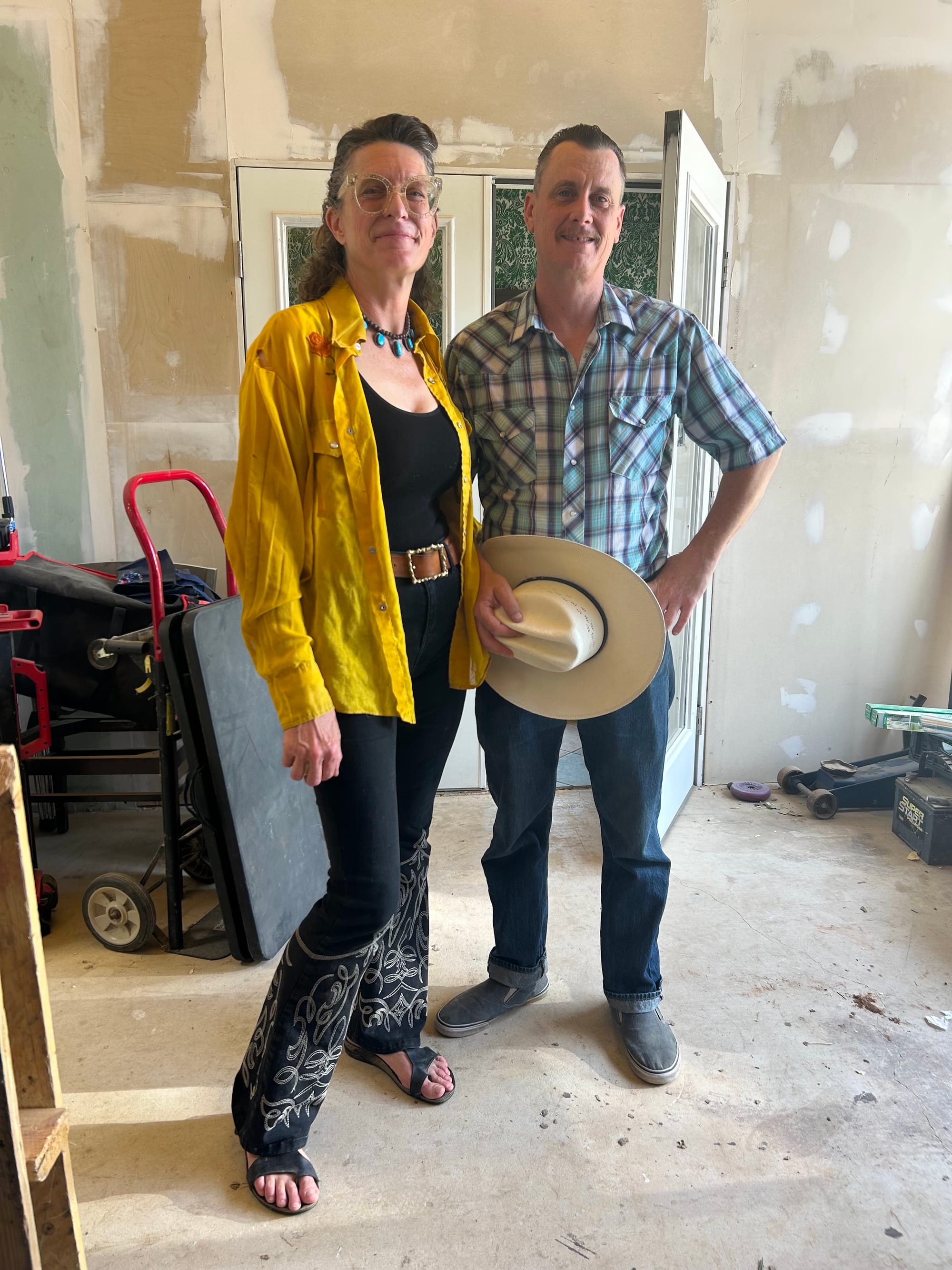
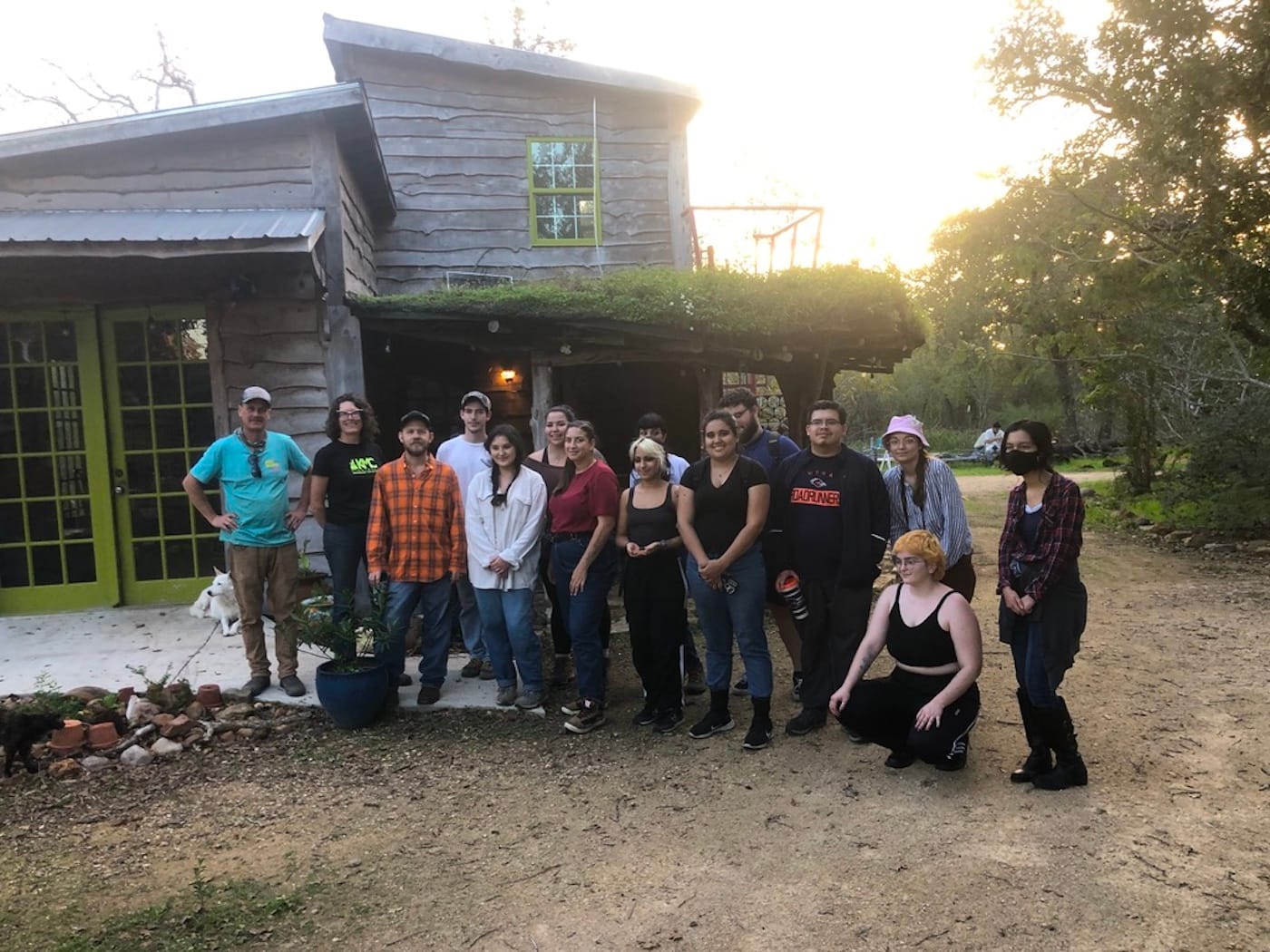
Using generational access to land, along with a tent and Kickstarter funds, they set out to do just that. Habitable Spaces is home to an artist residency, Nexus Gallery, a goat farm, chickens, and a forest touched with orange lichen on endemic Mesquite and Arita trees. They sustain themselves as most artists do: via grants, workshop gigs, and a small art crating business.
When I arrived for our interview in February, Ward, Heinemeier, and their collaborators were celebrating a National Endowment for the Arts (NEA) “Our Town” grant that the organization had recently been awarded. That evening, at one of their monthly full moon dinners, round wooden tables filled their wood shop. Before we ate, there was a toast. It was not to productivity or profit, but to gratitude, love, and kindness as forms of governance. I witnessed what felt like the beginning of a kind of worldly sovereignty: a mutual understanding and respect for land, for the generations who belong to it, and for those who, because of colonialism, now traverse it.
“We came to family land, pitched a tent, and just started building,” Ward told me the next day. “Our plan was to do tiny homes.” There are now seven tiny homes and one common house.
“We had no capital at all,” she continued. “We did a Kickstarter campaign to get down here, and that’s what we used to drill the well. We’ve always worked on a non-existent, shoestring budget. The wealth we’ve had is volunteers.”
As both an arts and agricultural organization, Habitable Spaces focuses on creating what Ward calls “a nexus between artists and farmers,” an intentional pairing.
“We are in a rural space, and we realize the impacts that artists can have on any space,” she said. “Let’s be honest, artists are gentrifiers.”
That awareness shaped their approach. Rather than replicate the art-world model used in places like Marfa, with Prada stores out in the middle of a desert, they chose a slower integration. “We do not want to be a Marfa,” Ward said plainly. “We don’t want art market values doing their own thing out here while ignoring and looking down on the populace.”
To become part of the community, they began with the volunteer fire department.
“It was a great way to give back to the community and do a charitable action people could understand,” Ward explained. “A lot of people out here didn’t get the art thing we were doing. So Shane joined the volunteer fire department.”
In the early days of Habitable Spaces, Ward and Heinemier focused on establishing artist residencies and inviting artists from outside the area, including Wanda Raimundi-Ortiz, Poncili Creacion Colectivo, and Eleanor Sholz. The intention was for artists to spend time in an environment different from the ones they were coming from, allowing them to rejuvenate and work on their practice, while also contributing to Habitable Spaces. In doing so, the program sought to build connections that expanded the role of art within communities and introduced artists from a range of disciplines, particularly those focused on interaction that fosters meaningful engagement.
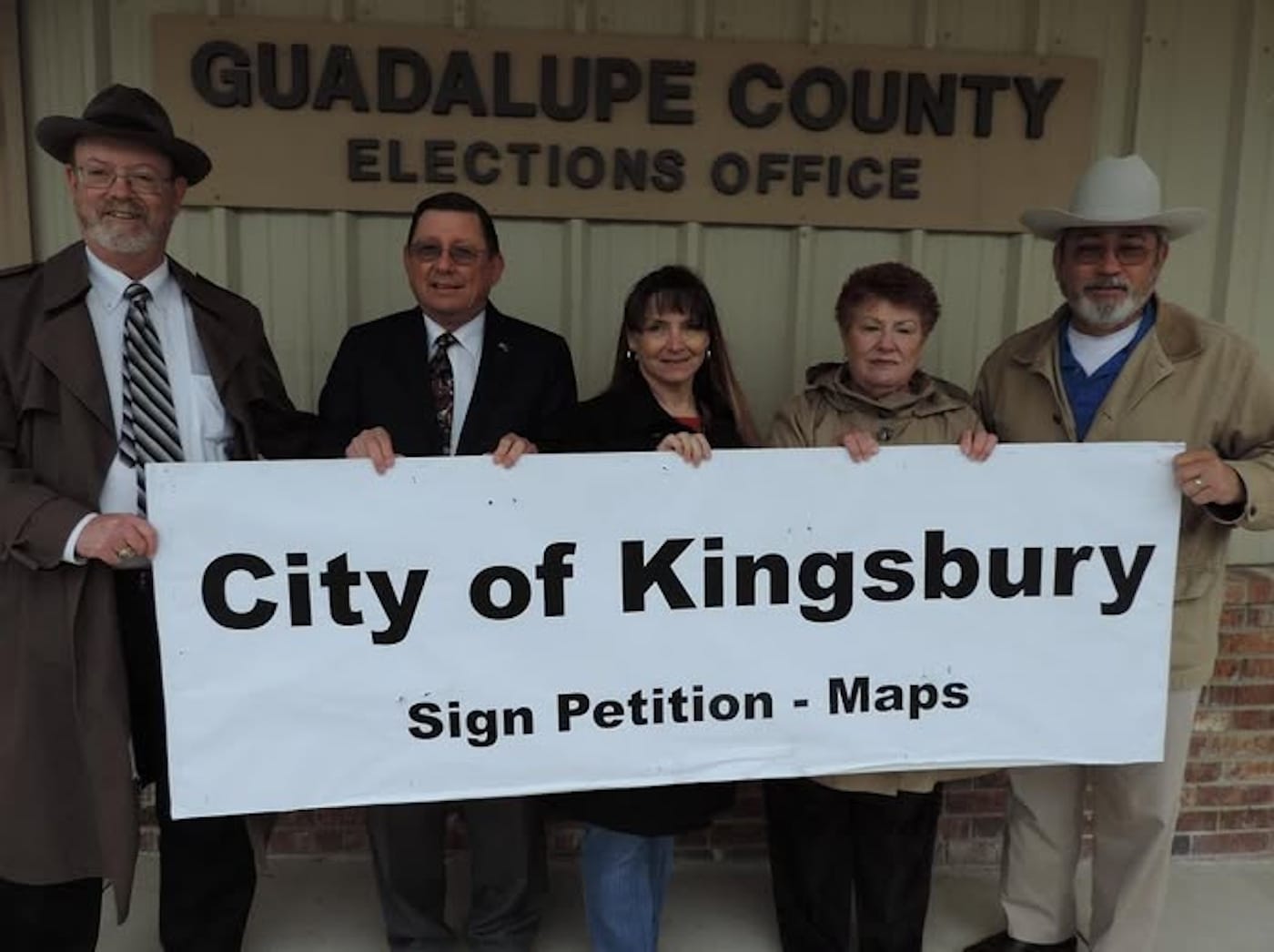
Through the department, they learned that Kingsbury was a town of fewer than 700 people with a name, a zip code, and a downtown, but was not officially incorporated. It existed in a legal gray zone. When the nearby city of Seguin reached a population threshold, it expanded its extraterritorial jurisdiction, absorbing Kingsbury into its city without formal consent.
“Myron Boerger, the fire chief at the time, was pestering everybody,” Ward recalled. “‘Y’all, we got to incorporate. Seguin’s coming for us.’”
I admitted to Ward that I hadn’t realized a town could be incorporated by its own residents.
“If people are going to try to do what we’re doing, it means getting involved,” she replied. “Get involved with your local politics. They are the most important politics you could be involved with.”
What followed was a year and a half of meetings, research, and rural organizing. Having lived in New York, Ward and Heinemeier recognized how quickly neighborhoods could transform. “Look at Chelsea, the East Village, and the South Bronx,” Ward said. “I mean, these neighborhoods, like on a dime, changed. So I was absolutely positive that Myron was correct.”
In a county where homes are often separated by long dirt roads and gates, canvassing was not simple. “Texans all have guns, so you don't just walk through a gate and go up somebody's door and knock on their door and ask them, ‘Do you want to incorporate?’” Ward said matter-of-factly. Instead of door-knocking, they set up on Interstate 90 with handmade signs. They organized barbecues, smoked brisket, and gathered signatures. (“‘We’ll brake for barbecue’ is very true in Texas,” Ward laughed.)
Once they secured 500 signatures, a vote was held in May 2015. The result was decisive: 66 to two in favor of incorporation. It was a landslide.
“Through all those meetings, we all became close friends,” Ward reflected, “Artists, farmers, ranchers, people from all different walks of life.”
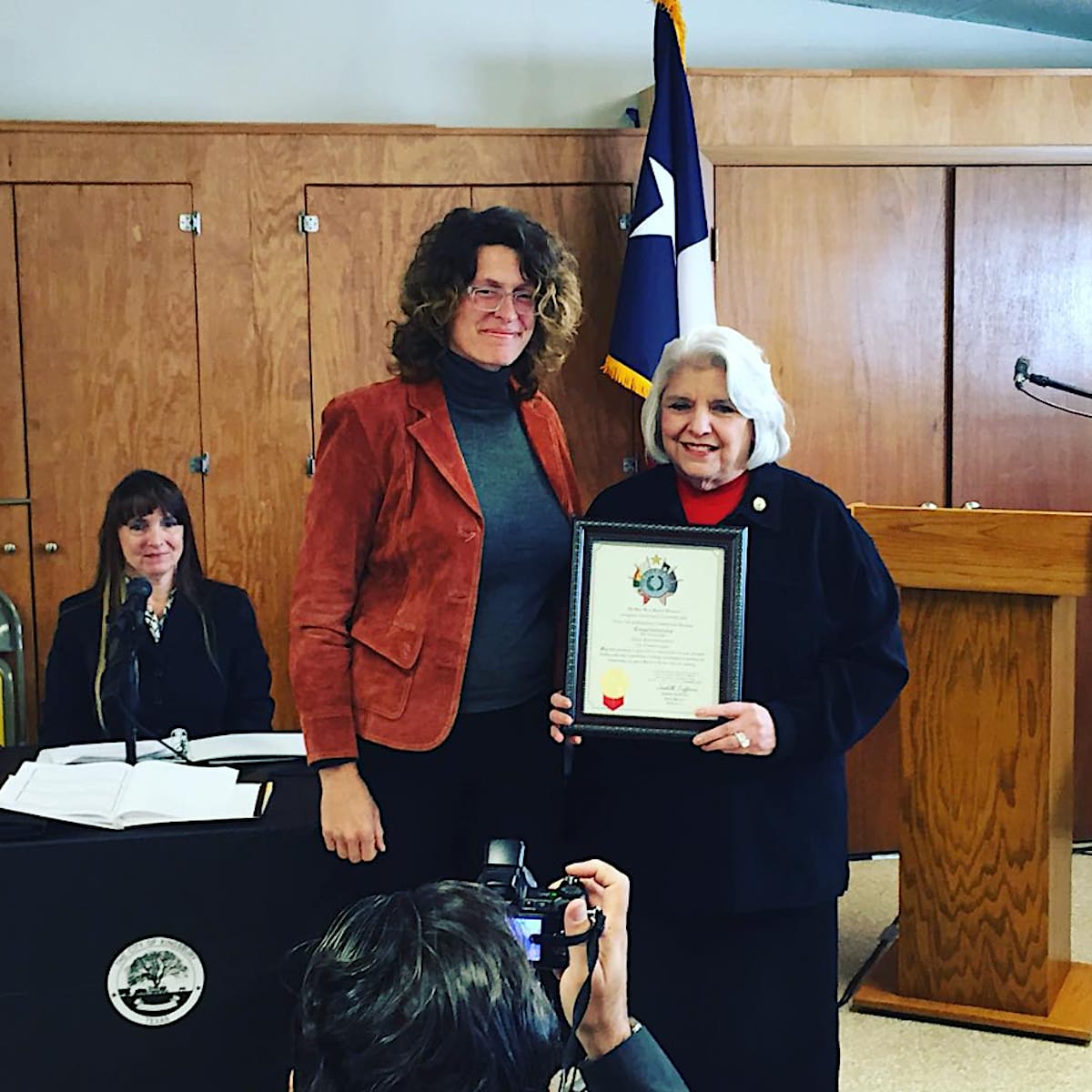
Kingsbury became a Type-C city, governed by three officials: a mayor and two commissioners. According to Ward, it’s the first city in Texas that formed with a government entirely led by women. She served as a commissioner for 10 years alongside Janet Ignasiak, a massage therapist, and worked with Mayor Shirley Nolen, who runs the local general store.
The Type-C designation allowed Kingsbury to become a “liberty city,” denoting a smaller municipal government that does as little as possible while protecting residents from external overreach. Incorporation allowed residents to collect franchise fees from utility companies and add a modest 1.5% sales tax to fund road maintenance and public needs.
Here, governance is also cultural. For starters, the city does not have law enforcement because the population largely does not feel that they need it. The fire department responds in most emergencies, and any domestic issues are handled by an auxiliary made up of nurses and therapists.
In addition to complying with state open meeting laws, every city council meeting is live-streamed on Facebook. “People are busy. They’re farming. They get up at four in the morning,” Ward said. “They don’t have time to sit at a meeting until 9:30pm. But they will turn on the livestream. And they engage and comment.” She explained that respectful debate guides the meetings, which often involve philosophy, good-faith discussions, and minds changed.
The most pressing issue facing Kingsbury now is development. The vast region between Dallas, Houston, and San Antonio is often referred to as the “Golden Triangle.” It is a rapidly urbanizing area with data centers proliferating everywhere, housing prices rising, and critical natural spring water systems being polluted in the arid climate.
“We’re all wondering what we can do to keep developers out. Corporations and developers will still try to get in,” Ward said. “These people have a lot of money. They try to use it to pay off people, by offering to build or fix a road in order to get in favor with a town.” Although their commitment to minimal governance sparks some debates about their responsibility as a community, social pressure discourages most residents from selling land to corporations.
“Selling land is very taboo around here,” Ward explained. “Community pressure matters. But at least for now, nobody in Kingsbury has sold any major properties, and we're all in the same mindset and united.”
If Kingsbury’s philosophy resembles libertarianism at first glance, Ward draws a sharp distinction. “A true libertarian would say, ‘If my next-door neighbor wants a nuclear waste site, that’s fine.’ Individual freedoms are more important than the whole,” she said. “But that waste can leak into the aquifer and destroy our mutual water. You can’t do that. That’s selfish.”
For Ward, the guiding concept is the commons — as she defines it, the air, water, and land. Under Ward’s advocacy, Kingsbury passed a resolution in July of 2024 recognizing the arts as part of the commons, a shared resource worthy of protection alongside natural ones.
“What about the creative commons? Creativity and art-making are part of our shared language as humans,” she said.
That resolution helped materialize the Kingsbury Commons Project, funded by the NEA “Our Town” grant, in 2025. Behind the newly acquired city hall building, which will feature composting toilets, three-quarters of an acre will become a public pavilion with a water feature to create a microclimate during Texas summers and include a food forest with native plantings.
“There’s nowhere to just relax in public with your friends,” Ward said. “I wanted to make a space where people could gather.”
At Habitable Spaces, a complementary classroom and greenhouse will support climate-resilient plant cultivation and host monthly full moon dinners. Perennial food forests will provide edible and medicinal plants for residents. In addition to developing the Kingsbury Commons Project, Habitable Spaces has launched the Nexus Gallery directly on site, where it features artists from within a 30-mile (~48.3-kilometer) radius of Kingsbury. Their next exhibition, opening at the end of June, will focus on the environment as muse.
Throughout our conversation, I returned to the idea of process. I had mentioned the late American activist Grace Lee Boggs, who believed revolutionary work must remain dialectical and evolving.
Ward nodded. “We constantly re-evaluate. How do you keep honest? How do you make sure what you’re after is still true? You have to move with people and move with the times.”
People are the process here. Not branding. Not speculation. Not extraction.
In a state where governance often feels punitive or exclusionary, Kingsbury represents a small but tangible experiment in participatory art making, a living artwork shaped through zoning debates, barbecue petitions, livestreamed meetings, and composting toilets.
“I think everybody should try to create their own utopia,” Ward told me before we parted. “Everybody should get involved with their local government.”
In Kingsbury, art is not a luxury good or a social accessory. It is a structuring principle that belongs to everyone there. A shared practice of care. And in the current moment, that feels radical.