In a Midtown Office, Artists Sift Through the Junkspace of Capitalism
An intergenerational group of artists confronts technology as both a pathogen and a cure for today’s cultural ailments in the husk of an office at 260 Madison.

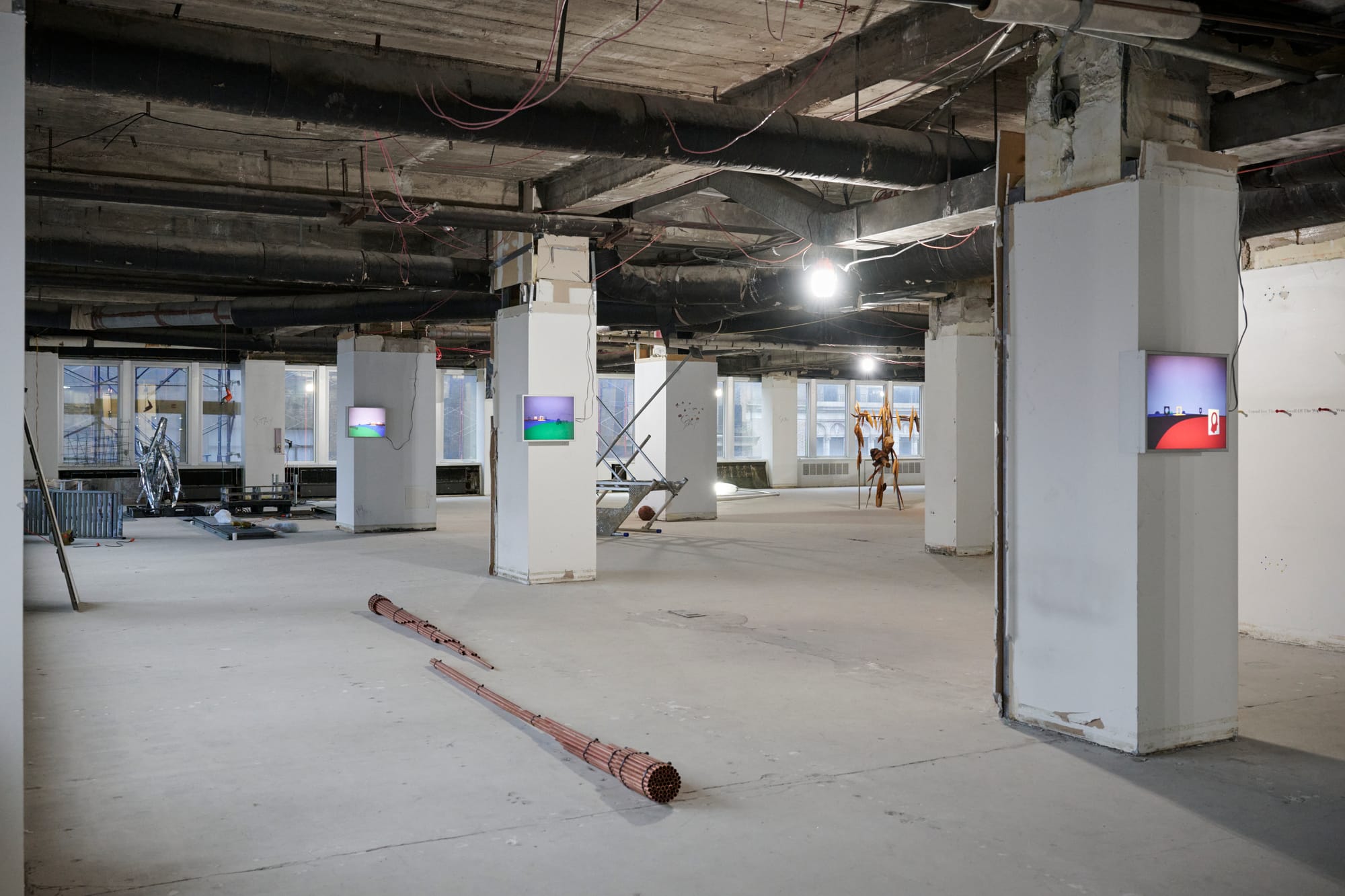
A few hours before 260 Madison opened on September 24, I trekked to its namesake address in Midtown to meet the curators. A security guard directed me to the 14th floor of the 1950s office building, where drop ceilings, an exposed HVAC system, and two people I assumed were the exhibition organizers dressed in corporate drag greeted me. They quickly clarified they were not; they were from AmTrustRE, the real estate company that offered the derelict 23,000-square-foot office space to the artists for free while preparing it — and three other unoccupied floors — for their next corporate tenants.
The three artists-turned-curators, Shaina Tabak, Dayana Matesheva, and Edison Niebla Rodríguez (the latter two of whom make up the duo DemonLovers Inc.), organized 260 Madison as an intergenerational, “inter-everything” show with work by over 50 artists, including self-taught and non-traditionally educated practitioners. On view through this Sunday, November 22, the show arrives just as the Whitney Museum of American Art opens artport: A History of Internet Art, signaling a new wave of institutional recognition for internet-grown art. With 260 Madison artists Maya Man, Rachel Rossin, and Eva and Franco Mattes among those included in the Whitney’s 25th-anniversary exhibition for its net art commissioning platform, the Midtown show feels especially urgent, if only because it takes place at the precipice of a paradigmatic shift within the art world.
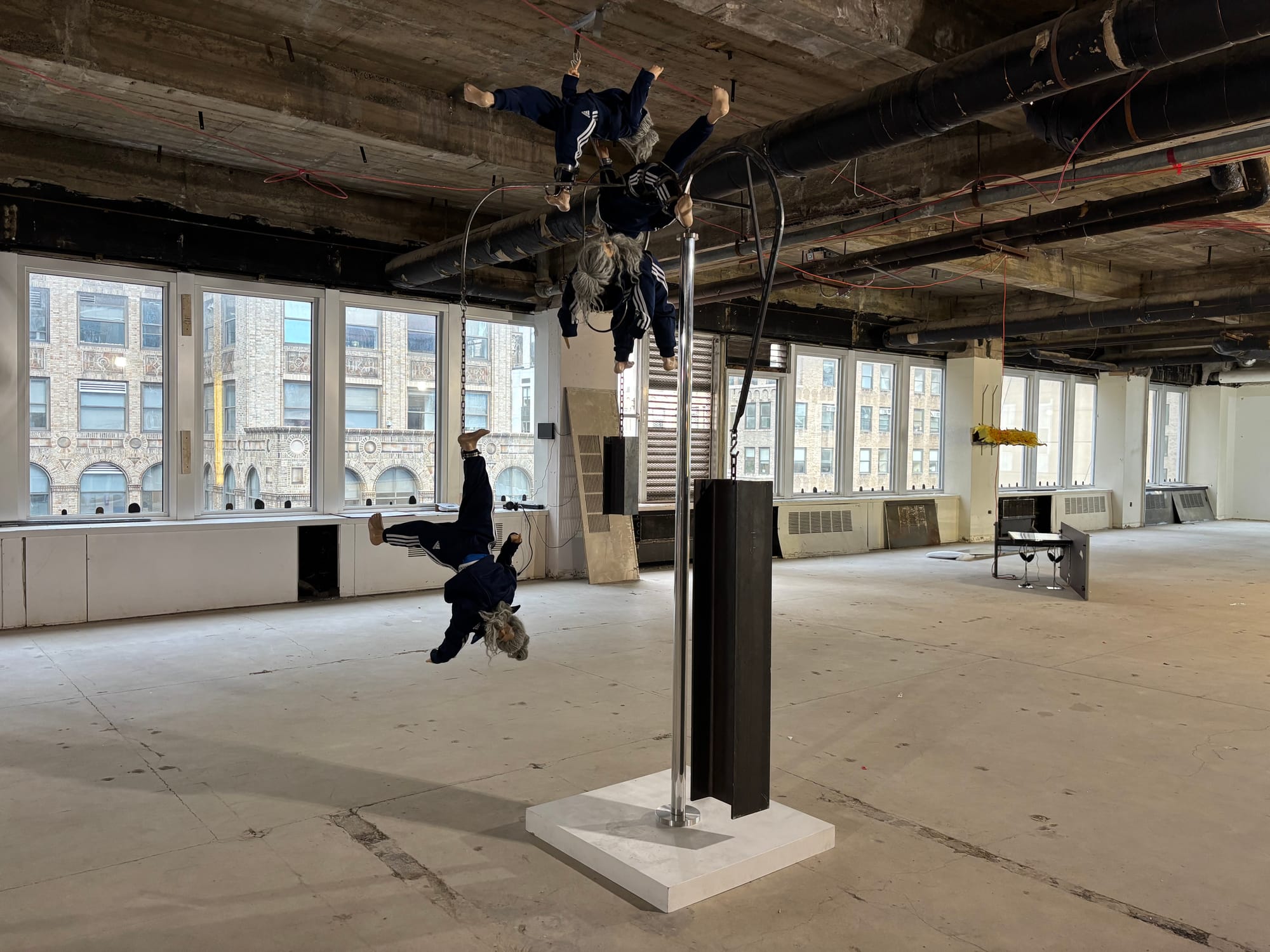
Upon entering the first room on the left, I was immediately met with artist Jon Kessler’s towering nine-foot-tall sculpture, in which four plastic male dolls in Adidas tracksuits dangled from a weighted contraption somewhere between a carnival ride and a torture device. Titled “It Takes a Global Village Idiot” (2018) after philosopher Marshall McLuhan’s early ’60s theory that information-age technology “recreates the world in the image of a global village,” the sculpture forces viewers to confront the fact that the quick fixes of amusement proffered by technology rely on the same methods of data extraction that undergird systemic violence. It’s an unsettling introduction to a show where, even in its more humorous, delusionally conspiratorial, or enchanting moments, discomfort is always in the periphery.
“We don’t want to make a show or art that tries to be some form of escapism,” Rogríguez told Hyperallergic during an interview the week after the opening. “It’s like the [Werner Herzog] quote, ‘The poet must not avert his eyes.’ If some art in the show seems depressing, it’s because we live in what seems a depressing time.”
Rodríguez and Matasheva, who are also a couple, began making work together seven years ago while studying film in Montreal. Their video-art duo is named after Olivier Assayas’s 2002 film Demonlover, where multiple global corporations compete for a new immersive Japanese hentai company through extreme methods of espionage, exploitation, and blackmail.
“DemonLovers is about the libidinal economy and how algorithms are weaponizing our very basic instincts and desires,” Matasheva told Hyperallergic, echoing Rodríguez’s interest in what he calls “financial Freud,” or the psychoanalytic dimension of digital capital flows.
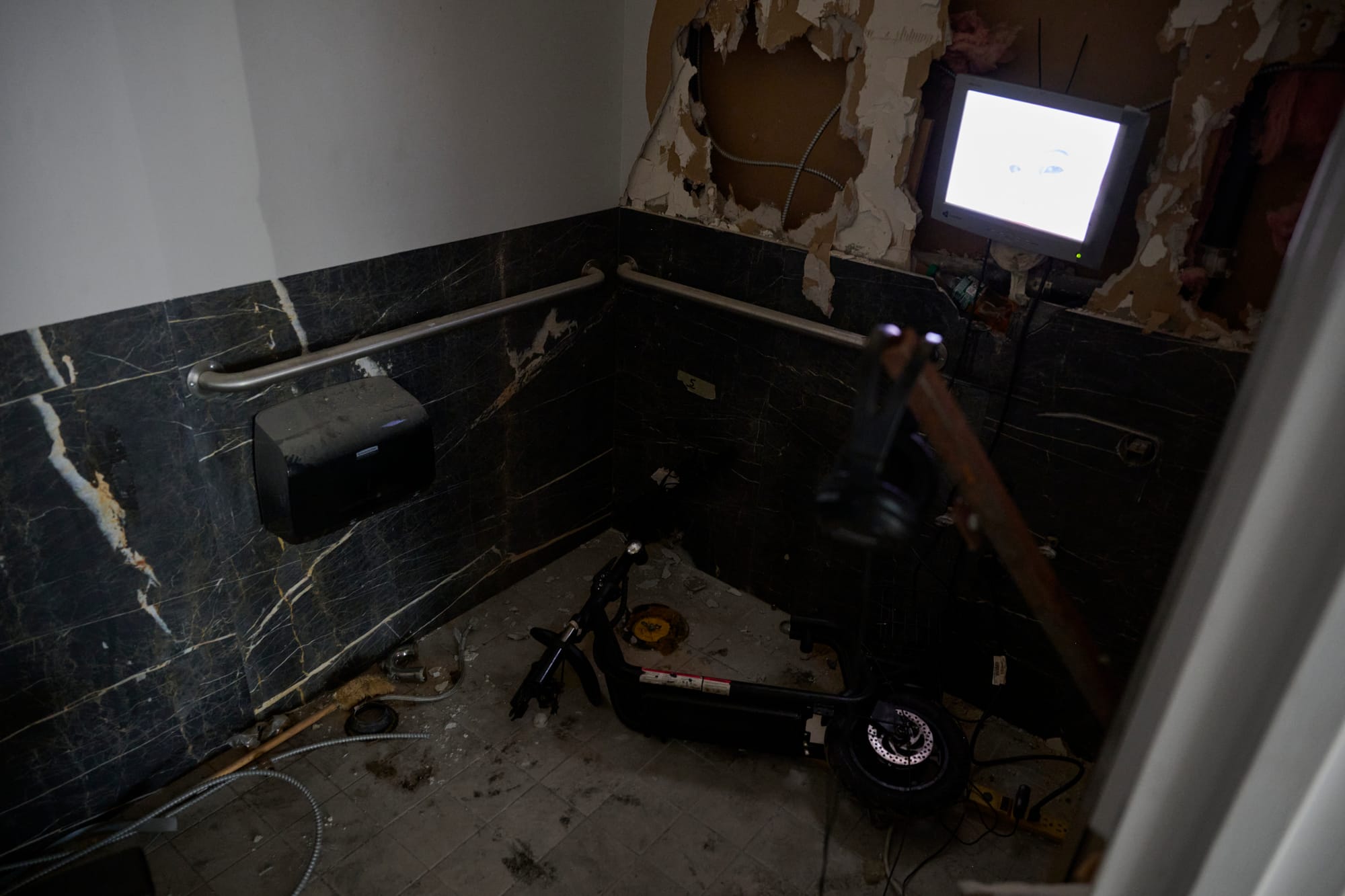
Both DemonLovers’s own two works in the show and those they curated certainly don’t shy away from the degradation associated with extractive economies, be it of the self, physical infrastructure, or the proverbial global village. Nearby Kessler’s work, Theresa Tomi Faison’s “The Long Tail” (2026) climbs up one of the floor’s load-bearing columns. Across the curved sculpture’s six screens, images of memes, forum screenshots, and phrases ruminating on contemporary capital flow all accumulate and dissolve downstream. The river of digital spam ends at the viewer’s feet, inculcating the audience, but also the space itself, which the curators characterize as shaped by "junkspace,” which architect Rem Koolhaas describes as the fallout that “remains after modernization has run its course.”
Among works that are either readymades or play with the form’s history — including Anthony’s Discenza’s windowsill pile of unopened credit card and loan offer letters in “Offers” (2026) and Eva and Franco Mattes’s distended taxidermied cat, “Longcat” (2026) — the corporate detritus can be difficult to parse from the artistic interventions. At one point, I mistook a few square feet of wallpaper with the Champion logo for a new work. The curators clarified during a later conversation that it was actually kept from the office’s previous tenants, HanesBrands, which owns Champion.
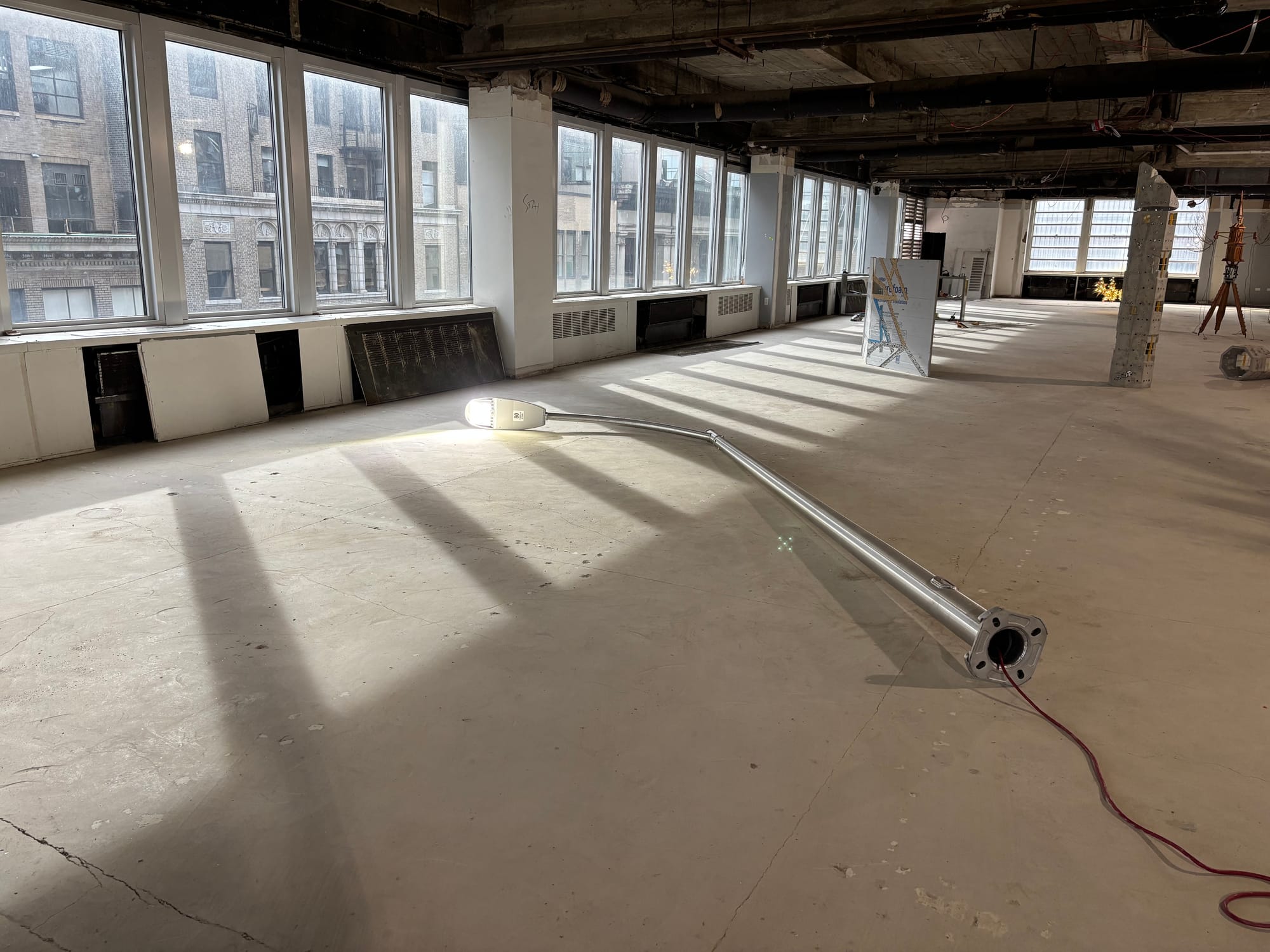
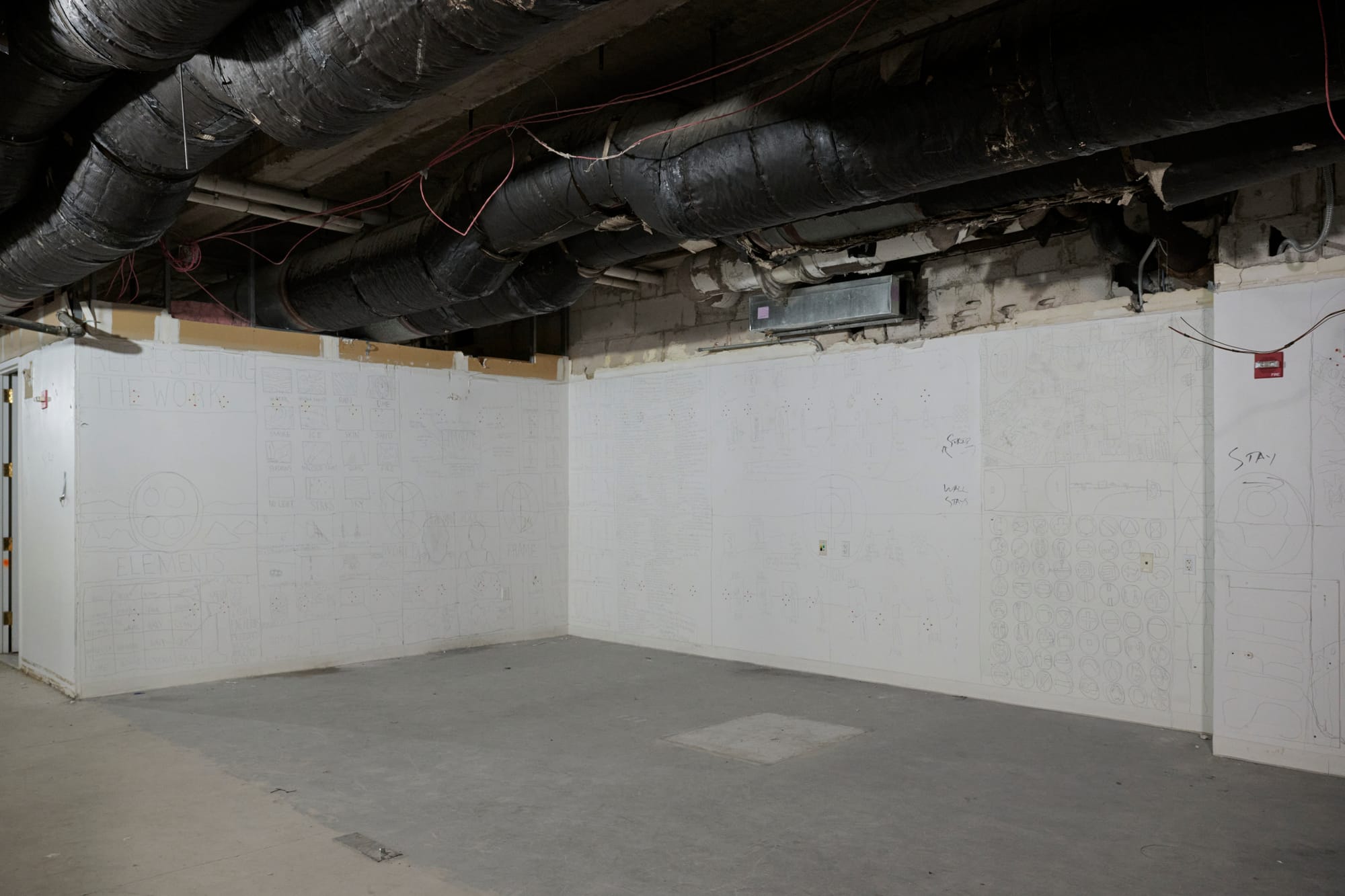
Having also inherited the space’s trove of gutted bathrooms, broken drywall, and stripped concrete floors (in short, its junkspace), the curators said they view 260 Madison through “layers of site responsiveness” more than anything. With some works, that connection emerged during the eleventh hour of installation. With others, the site occasioned the work itself. Ivana Dama used exposed air vents for “The Air Was Already Here” (2026), a sound work that channels air through reeds, transforming the invisible, inaudible rhythms of the space into what the artist describes as a “sculptural presence.” Pictures Generation artist Matt Mullican took a 47-foot span of unused wall space as an opportunity to reflect on his five-decade practice of constructing, deconstructing, and classifying systems of representation and perception with largely nonverbal symbols.
“He spent three days here drawing his entire practice on the wall, right from the beginning to the end,” Matasheva said regarding Mullicant’s monumental graphite piece, “Representing The Work” (2026). “He said he will give a lecture about it and that it's a very important work for him. It's kind of a conclusion of his practice.”
Meanwhile, the show’s video works are lodged into broken columns, ceiling alcoves, liminal backrooms, bathroom plumbing, abstract paintings, and even a hanging pink punching bag, a veritable reunion of the last decade of post-internet art movements. Alumni from Joshua Citarella’s publishing platform Do Not Research, the New Museum-affiliated Rhizome, and the traveling video and film screening series Open Secret, including Faison, Dana Dawud, Yehwan Song, and Ruba Al-Sweel, have contributed works. Many of them feature themes of surveillance, internet-induced conspiracy, and social media performance, as well as the technological, often AI-abetted methods of production that have come to define such enclaves.
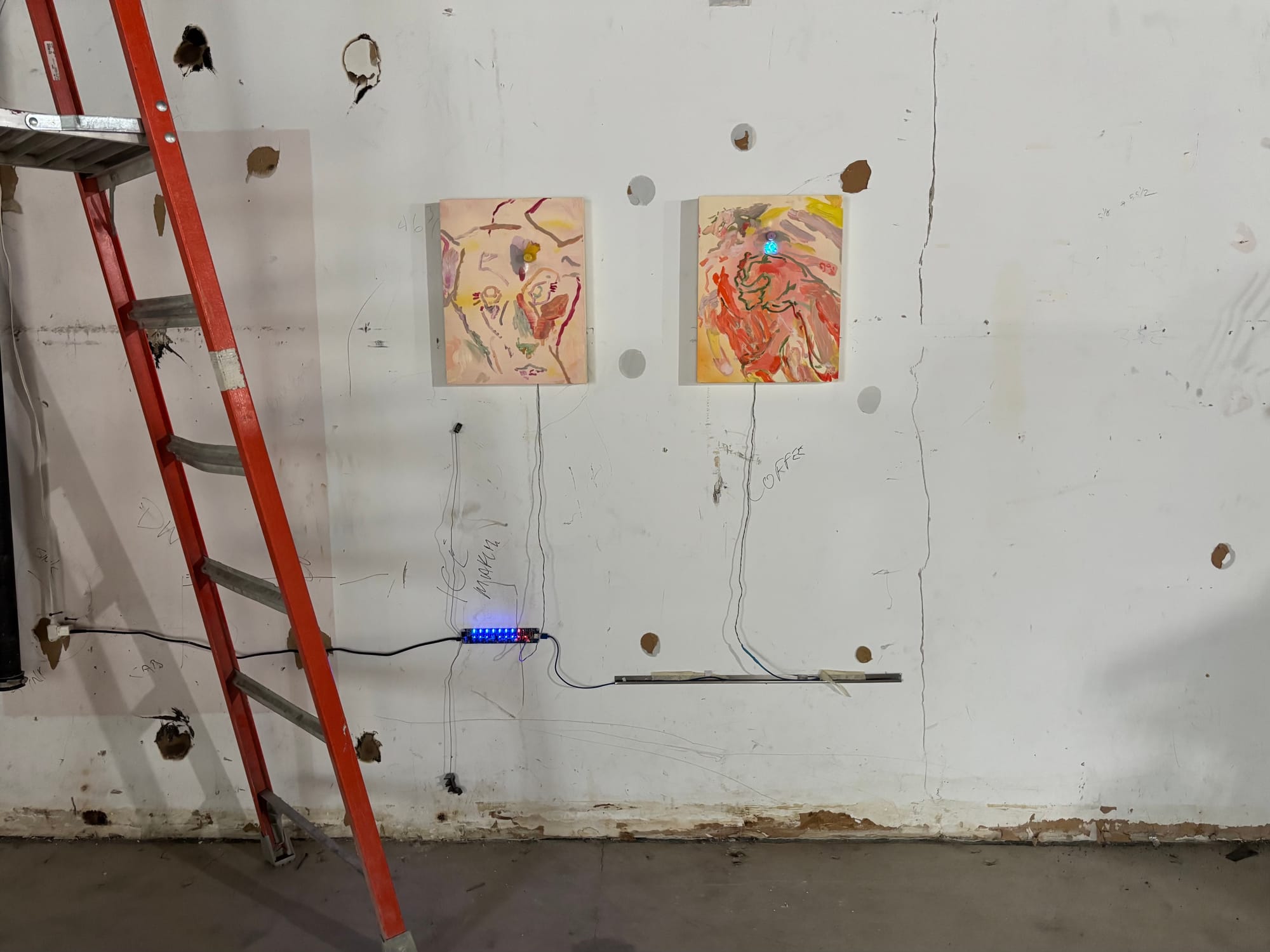
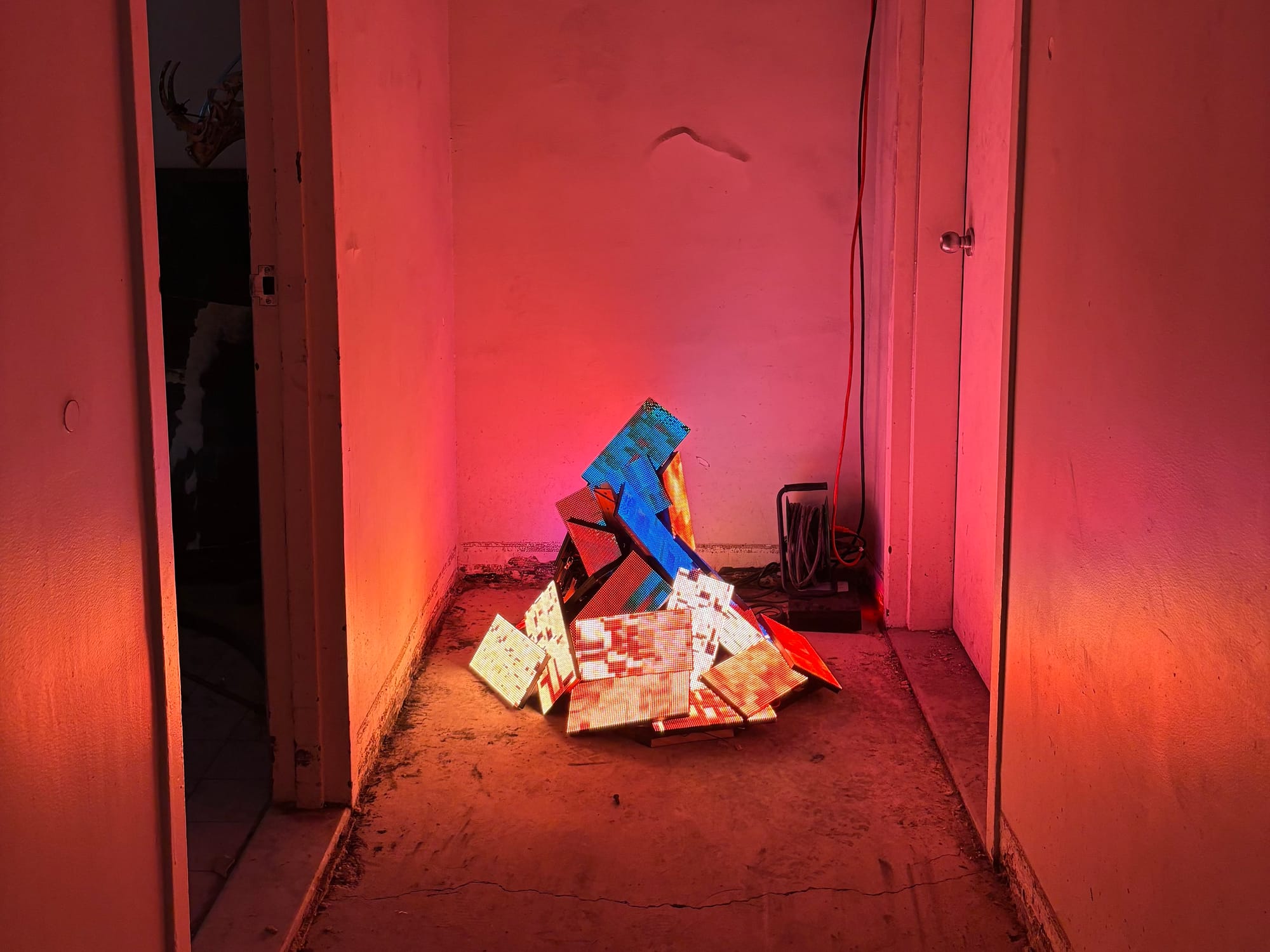
Yet, for all the immateriality and speculative knowledge that flows through these works, 260 Madison equally plumbs an idea of technology with a long, craft-driven history. Tabak, a sculptor with a background in furniture design, is the driving force behind this facet of the show — and the currents of divination, enchantment, and even sublimity that come with it.
“My practice is very handmade and material-focused, so I always know that that’s what I would contribute to the curatorial vision,” Tabak told Hyperallergic. “And just being in Midtown, you shouldn’t separate a show from what’s happening around it.
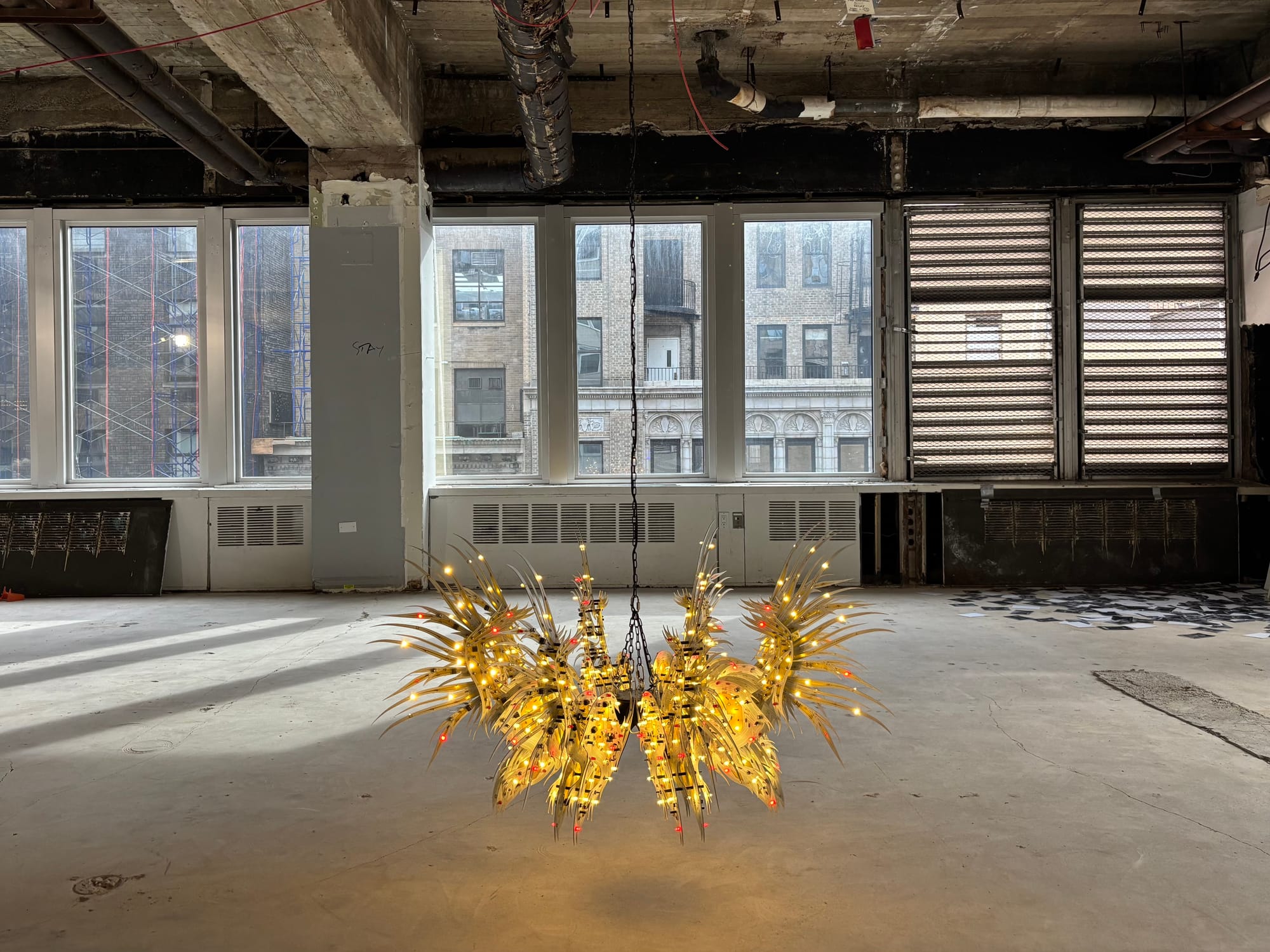
Tabak was particularly interested in curating works that “blur the line between the hand and technology,” inviting artists who “haven’t had a lot of chances to show in art contexts, whether it’s because they are in the design world or have nine-to-fives” to participate in the exhibition. She explains that many of them complicate the very notion of technology and its use, citing Brian Oakes’s “Vessel 9” (2025), which gathers 3D-modeled circuit boards into a suspended “techno-Gothic” chandelier, and Ryan Decker’s “The Wavemaker Falters” (2026), which uses a motorized, rudder-like instrument to swoosh water through a raised vessel resembling a spaceship.
“We view technology not as something that has arrived in the 20th century, but something that has made humanity possible,” Matasheva said, expanding on Tabak’s comment. “Language is a technology, a chisel is a technology, everything is a technology.”
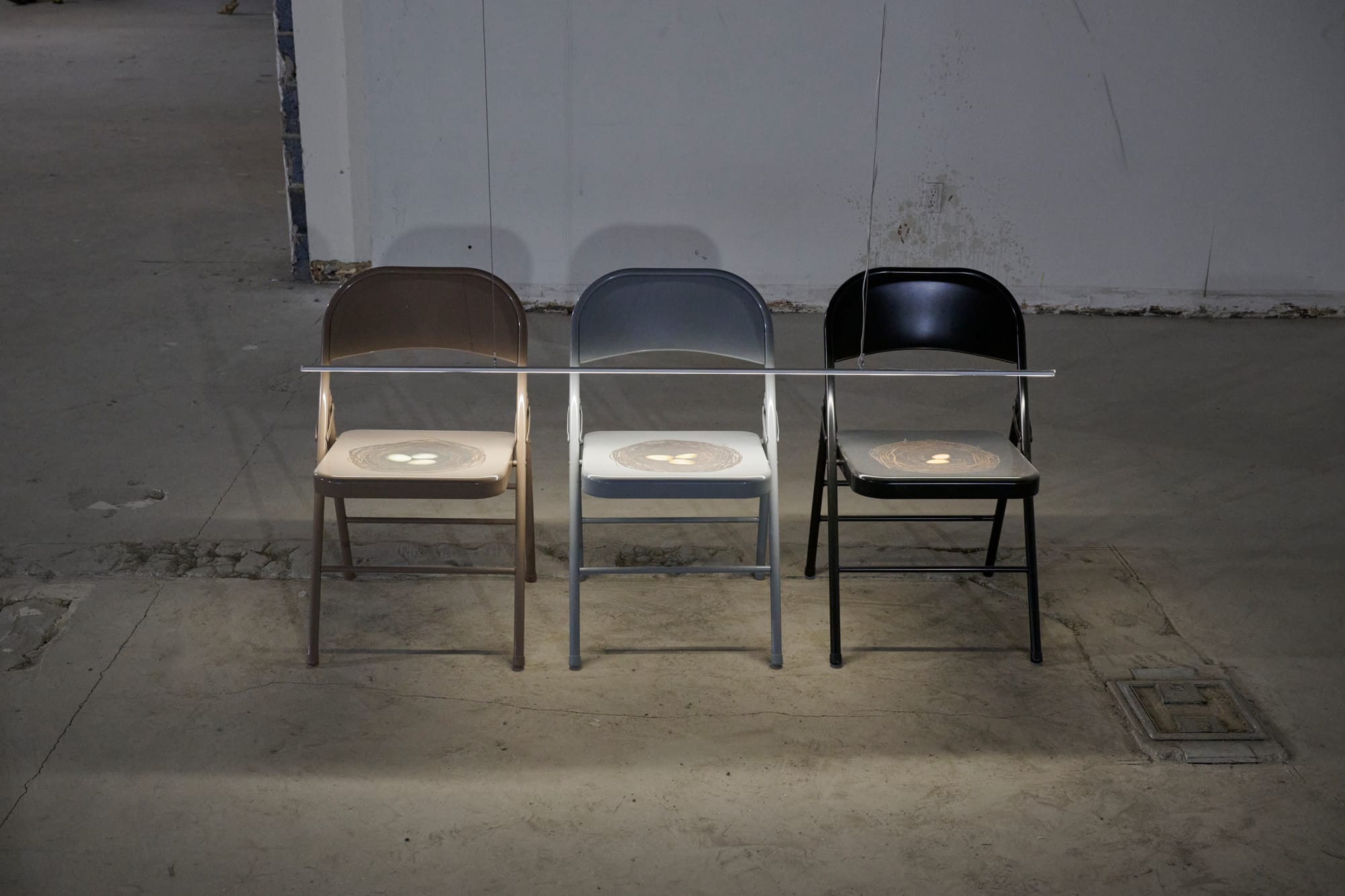
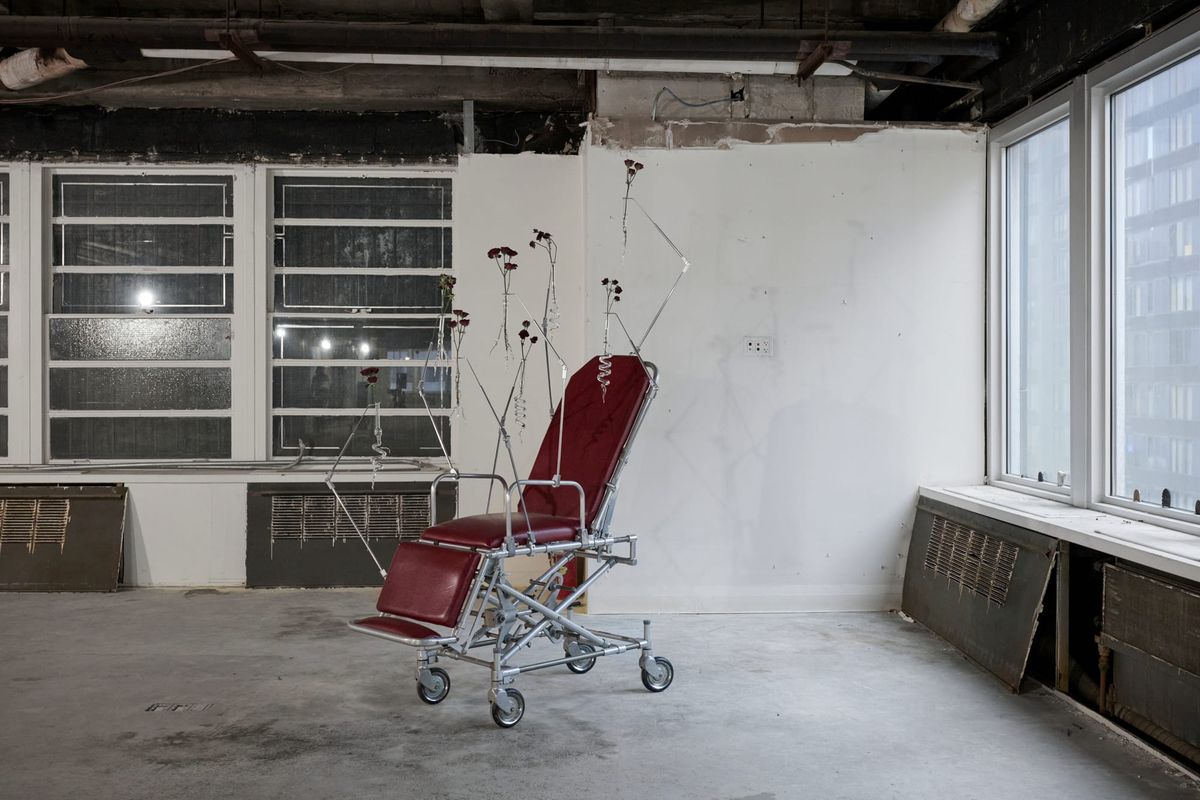
While many of the show’s craft-driven works conjure the anthropologist Alfred Gell’s idea that art is a technology that enchants, and in turn, becomes enchanted, others wield technology in the service of care. Kylie Mitchell repurposes a light-seeking solar robot and discarded electronic parts to move a found bird’s nest and egg toward a life-sustaining heat lamp. A few dozen feet away, Gregory Kalliche’s installation “Black-tailed gull nest; Ring-necked Pheasant Nest; Mallard Nest” (2016) suspends an LED light over three metal folding chairs printed with images of bird egg nests. Ben Gould’s “Ark II” (2026), on the other hand, augments a hospital gurney with eight aluminum armatures that hold fresh red roses inside coil-shaped glass vials. Doubling as a literal manifestation of Shakespeare’s “this mortal coil” phrase in Hamlet, the sculpture’s sterile infrastructure butts against the transitory visual comfort proffered by its flowers, mirroring a healthcare ecosystem wherein privatization, optimization, and tech automation have whittled medicine’s promises of care, healing, and empathy into mere aesthetic veneers.
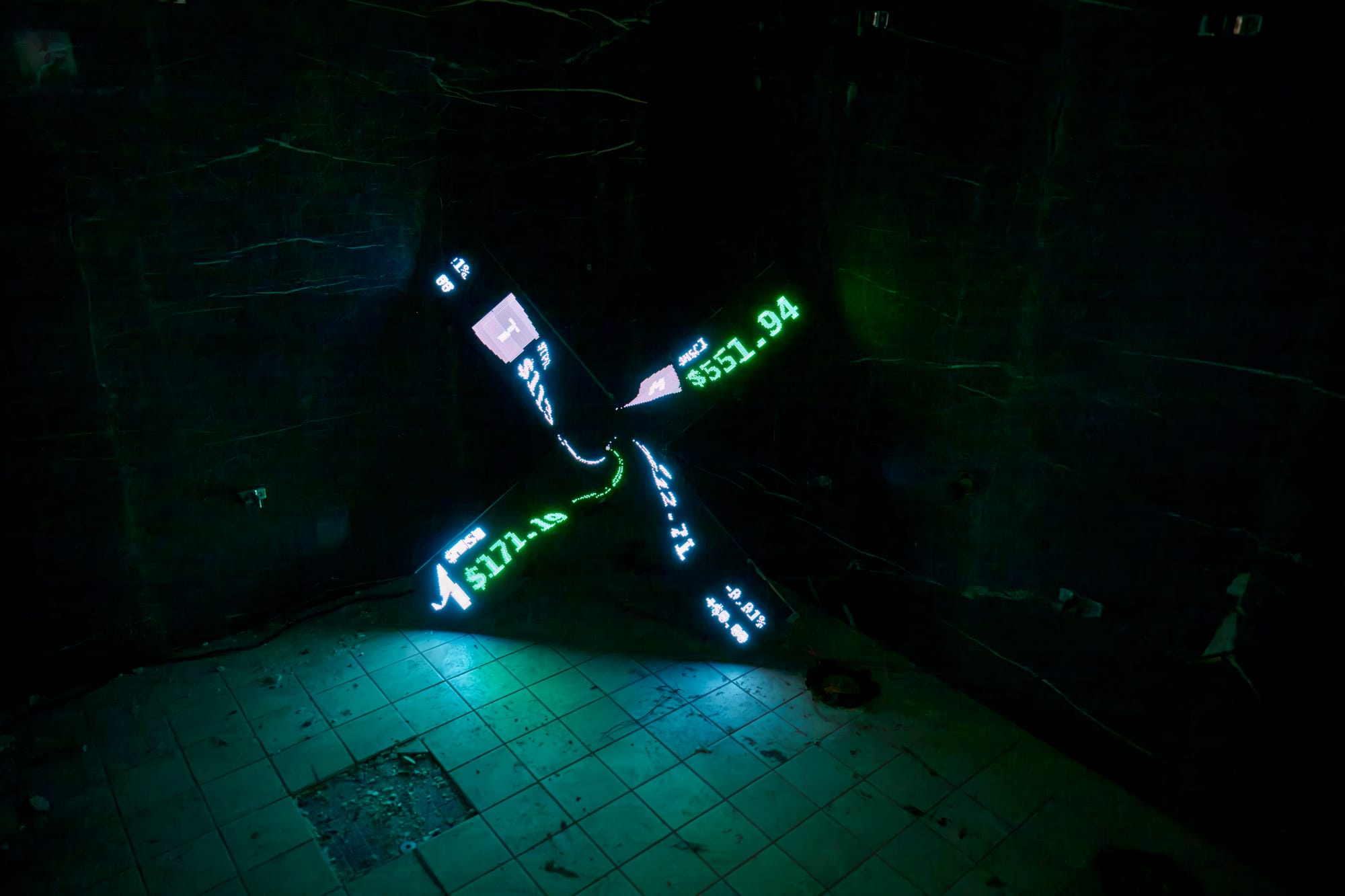
It’s no coincidence that many of the works in 260 Madison position technology as both a pathogen and cure for today’s cultural ailments. In fact, when the real estate developers initially contacted Columbia University’s School of the Arts, it was to invite artists to “activate” a 36,000-square-foot gutted Duane Reade on the building’s ground floor. The developers eventually retracted their offer and moved the exhibition to the 14th floor, citing ongoing construction. Meanwhile, the original plan for 260 Madison to occupy the husk of the Duane Reade will be realized in a different form next month. Now serving as the building’s new temporary lobby, the former pharmacy will play host to a different group exhibition curated independently by Tabak. Opening December 3, HOW I FEEL will feature artists working across sculpture, social architecture, photography, painting, performance, and programming, including Jessica Vaughn, Quay Quinn Wolf, André Magaña, and 260 Madison’s Grayson Cox and Luke Murphy. How the forthcoming Duane Reade show contends with this moment of tech-induced economic entropy, so intense that even an entity as extractive as a real-estate company cannot commit to its own speculations, remains to be seen.