Jasper Johns Keeps Looking
He has never lost his love for art and artists, while recognizing that nothing stays in time.

In his poem “My Heart Leaps Up” (1802), William Wordsworth writes: “My heart leaps up when I behold/ A rainbow in the sky … The Child is father of the Man.” The subjective “I” was central to his poetry, as opposed to the self-erasing perspective of another English Romantic poet, John Keats. Over time, the “I” of Wordsworth, who famously defined poetry as “the spontaneous overflow of powerful feelings … recollected in tranquility,” morphed into the existential angst of the Abstract Expressionist “I.” Spontaneous gestures replaced peaceful recollections.
Jasper Johns seemed to reject the tortured, in-the-moment “I” of Abstract Expressionism, ironically commenting on the heroism and spontaneity associated with Jackson Pollock and Willem de Kooning in his early work. Using encaustic, a wax-based medium that hardens quickly, rather than dries slowly, Johns’s paintings of the American flag, targets, maps, alphabet, and numerals do not look unplanned or improvised. He took “things the mind already knows,” things “that are seen but not looked at, not examined,” (TIME, May 4, 1959), and did something and then something else to them, until the transformation was complete, and what was a known entity became art, an integral part of his visual language. Each addition to his vocabulary expanded his ability to explore subjects neglected in American art, as is clearly seen in his new exhibition at Gagosian, Between the Clock and the Bed.
The first thing Johns chose to transform — it is more correct to say that it chose him — was the American flag, which he saw himself painting in a dream. He made “Flag” (1954–55), in the collection of the Museum of Modern Art, by dipping strips of newsprint and cloth in hot wax before fixing them to an outline drawn in pencil on a bedsheet.
Years ago, when I told Johns that the combination of materials he used in “Flag” must be a “conservator’s nightmare,” he answered: “Yes, it is falling apart, just like me.” By connecting the vulnerable painting to his aging body, Johns underscored a link that has always been there: “Flag” is a vulnerable, physical body existing in time. The painting’s birth is documented in the layered process of its coming into existence, and it registers each decision Johns made.
A precise, highly analytical individual, Johns gained insight into how dreams mirror his and our existence as he made the familiar design of stars and stripes into art. Isn’t remembering a dream uniting two separate states that can never become one? Don’t the encaustic-dipped stars in the blue canton mirror our isolation from each other as we sleep and dream through the night? What do the actions the mind sees the body doing in a dream, such as painting the flag, have to do with the sleeping body? Is it possible to unite them into one state of being? This is some of what Johns learned and reflected upon while making “Flag.” It was where his use of preexisting things, and his implicit rejection that one had to be original, all began.
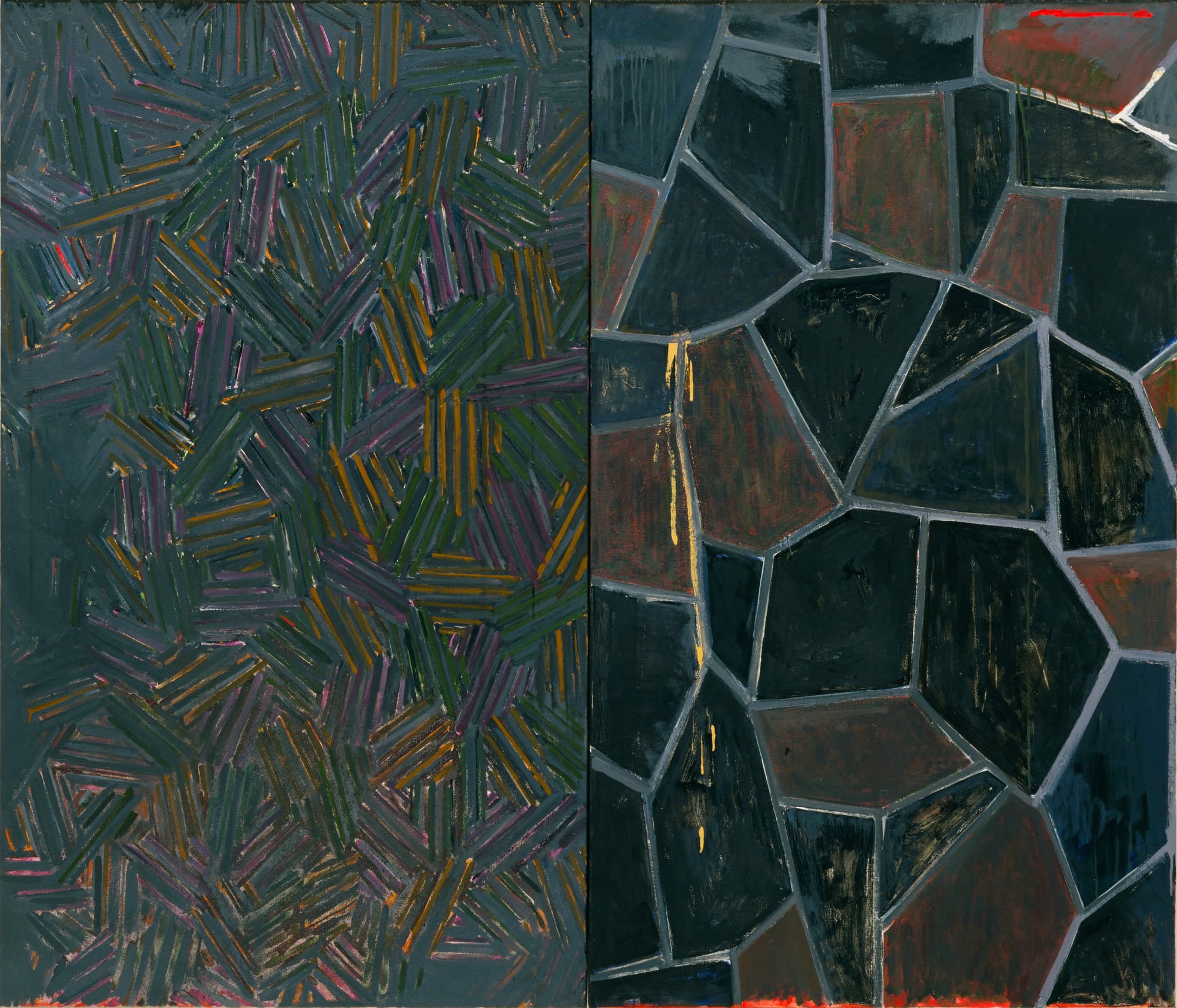
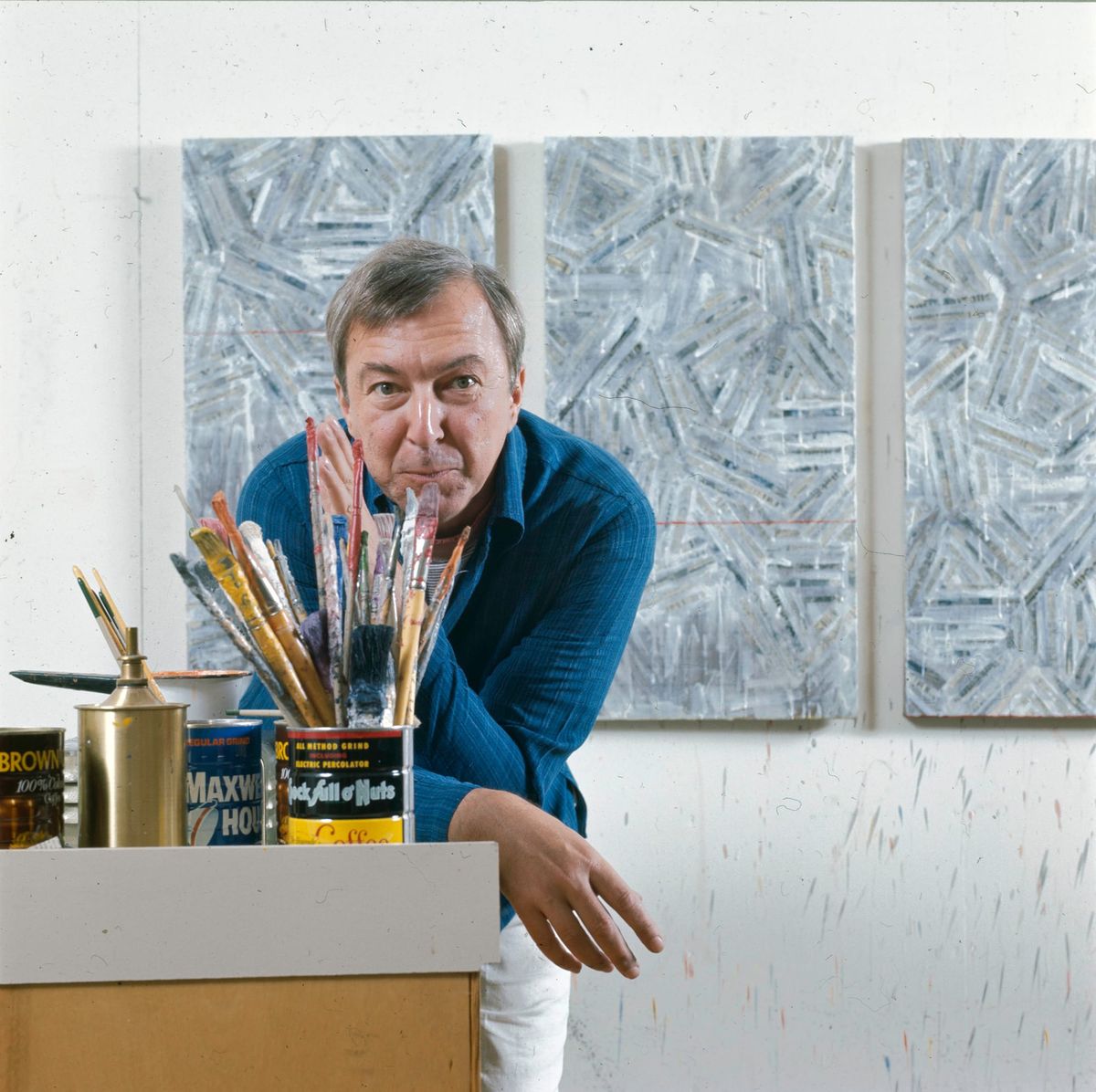
Johns's use of crosshatch — seen in many paintings in this show — first appears in the left part of the four-panel painting, “Untitled” (1972). The middle two panels incorporate the motif of the flagstone pattern, and the panel on the far right contains fragments of body parts and a section in which wooden boards traverse the plywood surface. According to an interview with Michael Crichton (1976), Johns saw those marks on a passing car and knew at once that he would incorporate them into his next painting. “It had all the qualities that interest me," Johns said, “literalness, repetitiveness, obsessive quality, order with dumbness, and the possibility of complete lack of meaning.”
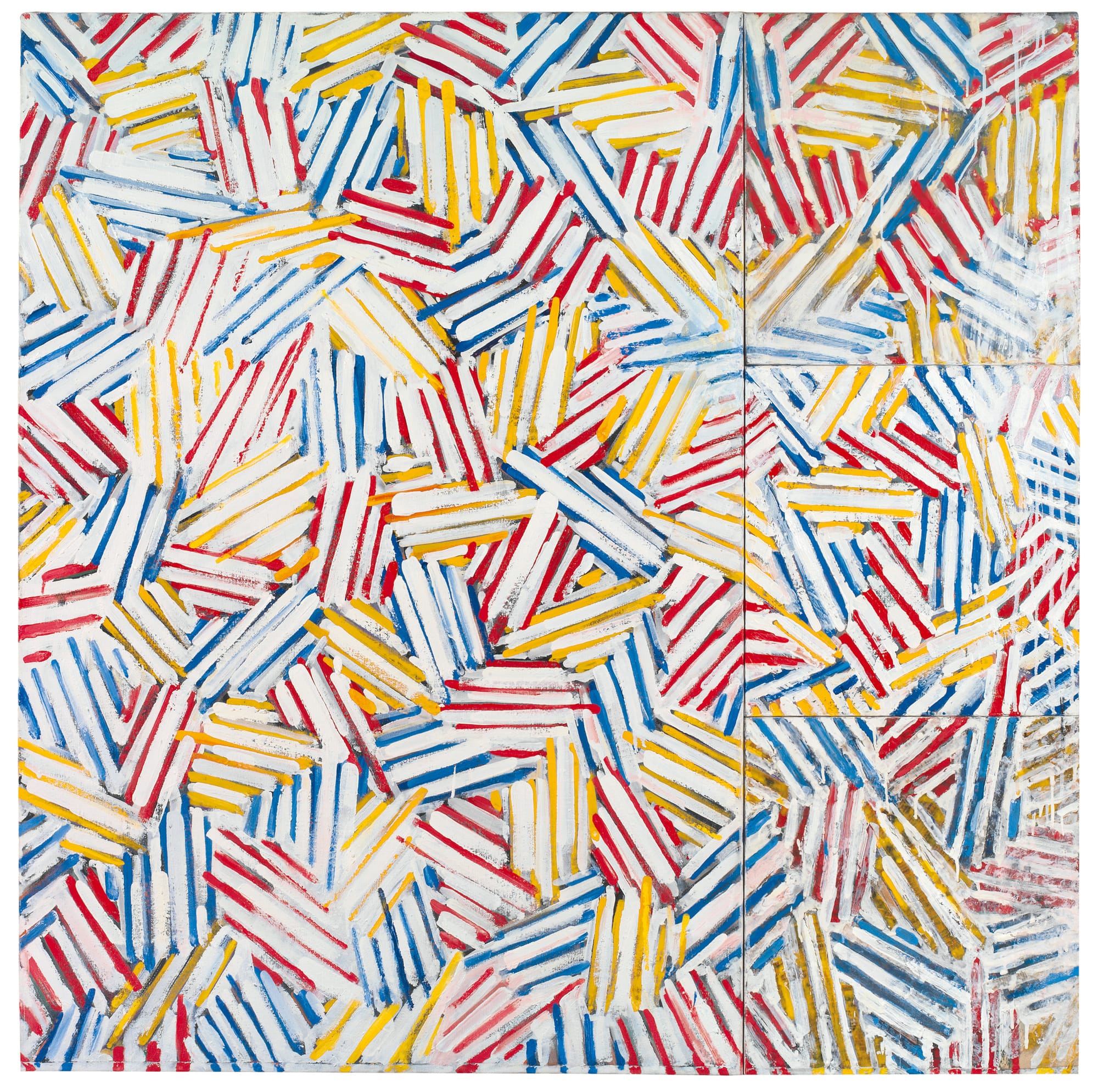
From 1972 until 1982, when he completed the trompe l’oeil painting “In the Studio” (1982), Johns was preoccupied with the crosshatch in his work, and what he could discover and convey through repeating and reorienting a cluster of unequal parallel lines that evoke both mechanical repetition and human obsessiveness. It is this decade of Johns’s work that Between the Clock and the Bed focuses on. In the paintings, works on paper and vellum, and prints on display, we are invited to engage with Johns’s relentless exploration of the relationship between an individual’s mind and body as they live in time, as well as reflect upon the gamut of feelings held in these works of extreme compression, layering, and repetition.
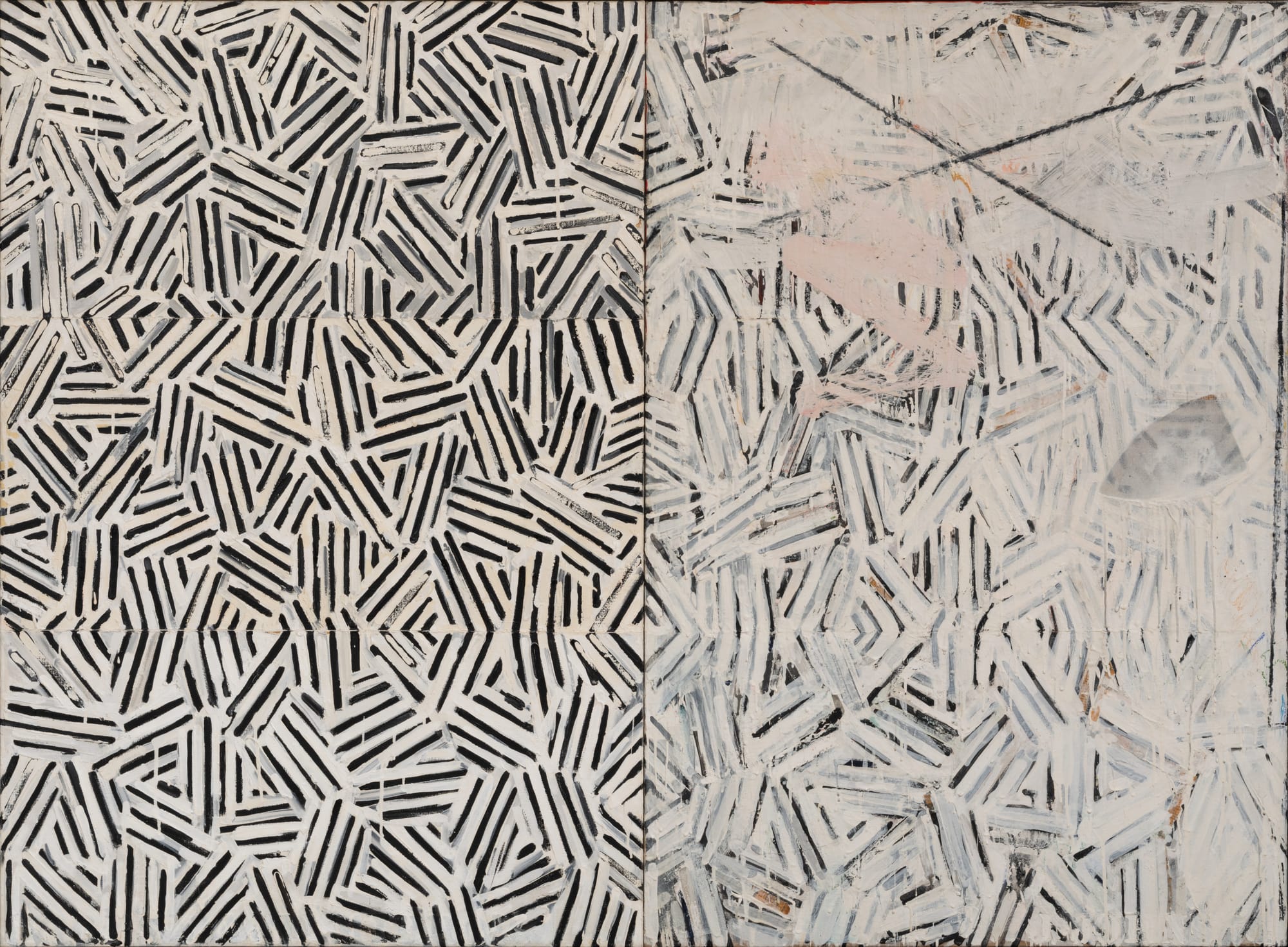
Titles such as “Corpse and Mirror" (1974), “Weeping Women” (1975),” and “Between the Clock and the Bed” (1982–83), all included in this exhibition, reinforce the artist’s use of crosshatch, encaustic, heated outline, melted drips, and traced circles as synonymous with the recognition of mortality and regeneration, the impermanence of certain experiences of beauty (dance and a light snow, for instance), grief, pain, vulnerability, and feelings of inescapable isolation that haunt us all. It is an exhibition rife with the inseparability of sadness and joy, irremovable scars and healing.
The impression left by the heated iron in the right panel of “Corpse and Mirror” is a literal scar, but it is the mind that remembers pain, not the marked body. In the essay “Sketchbook Notes” published in Juilliard (winter issue,1968-69, edited by Trevor Winkfield), Johns invented two figures, the “spy” and “the watchman,” as surrogates for the mind and body, offering insight into how he understood his studio practice: “The spy must remember himself & his remembering,” while “ the watchman leaves his job & takes away no information.” The mind, not the body, remembers the dream, pain, love, and regret, but it is the body that makes art, looks at the falling snow and the dancers. This conundrum of agency and helplessness, of the tug between control and lack of it, is to be found everywhere in Johns’s work.
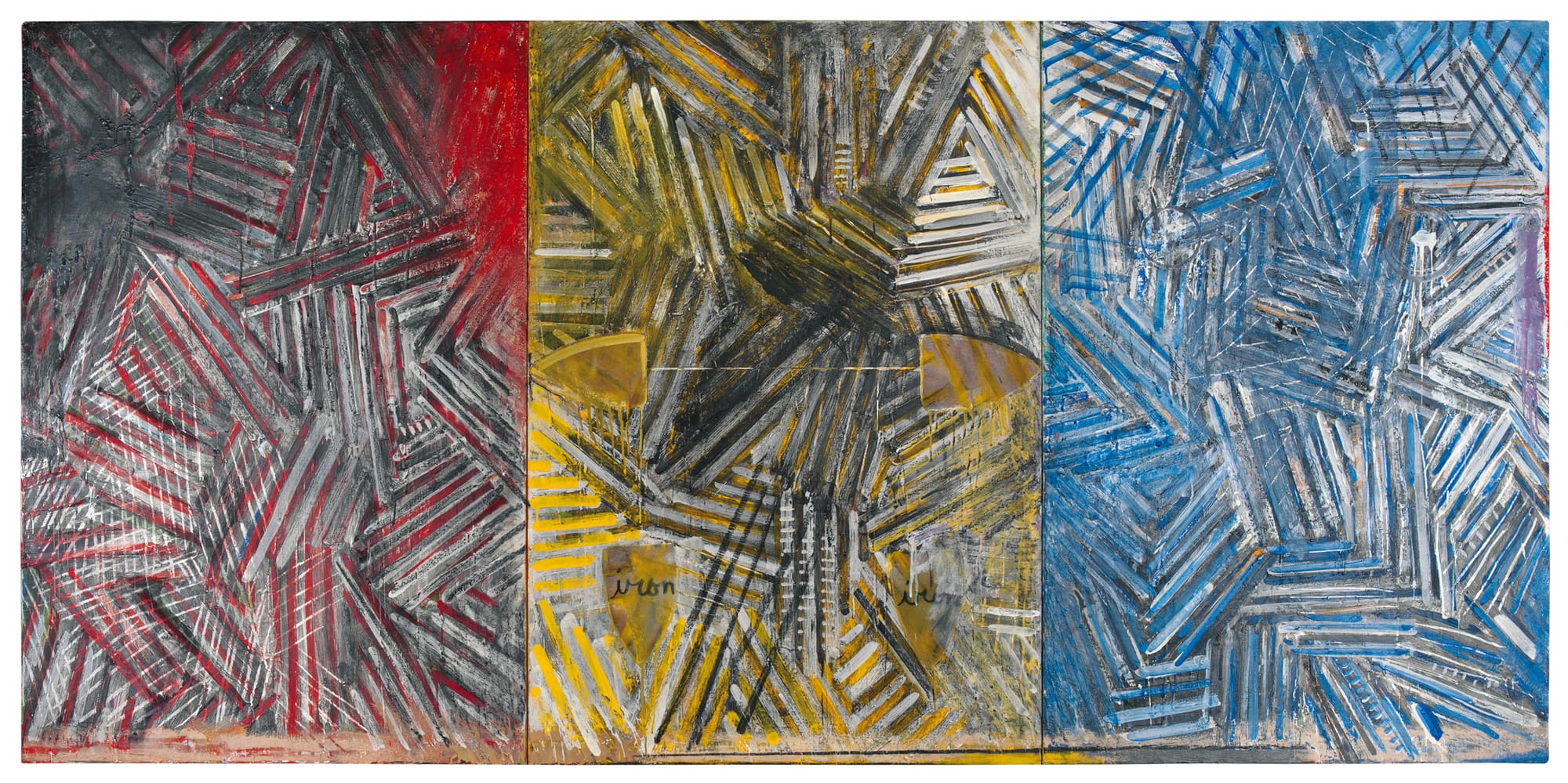
In “Weeping Women” — the title alludes to Picasso’s “Weeping Woman” (1937), done after the bombing of Guernica by the German Airforce — Johns uses the crosshatch and subdued primary colors to suggest three frontal portraits of a woman. In contrast to Picasso’s use of the double-hatched line to depict figures, which he does not shed as he approaches abstraction, Johns uses layers of crosshatching to move toward figuration without abandoning abstraction. Both artists push toward the border separating abstraction and figuration without crossing over. By coming at it from the opposite direction, Johns inhabits and understands what Picasso does in his proto-cubist work without imitating him. He stays true to himself, while adhering to the rigidity of his marks.
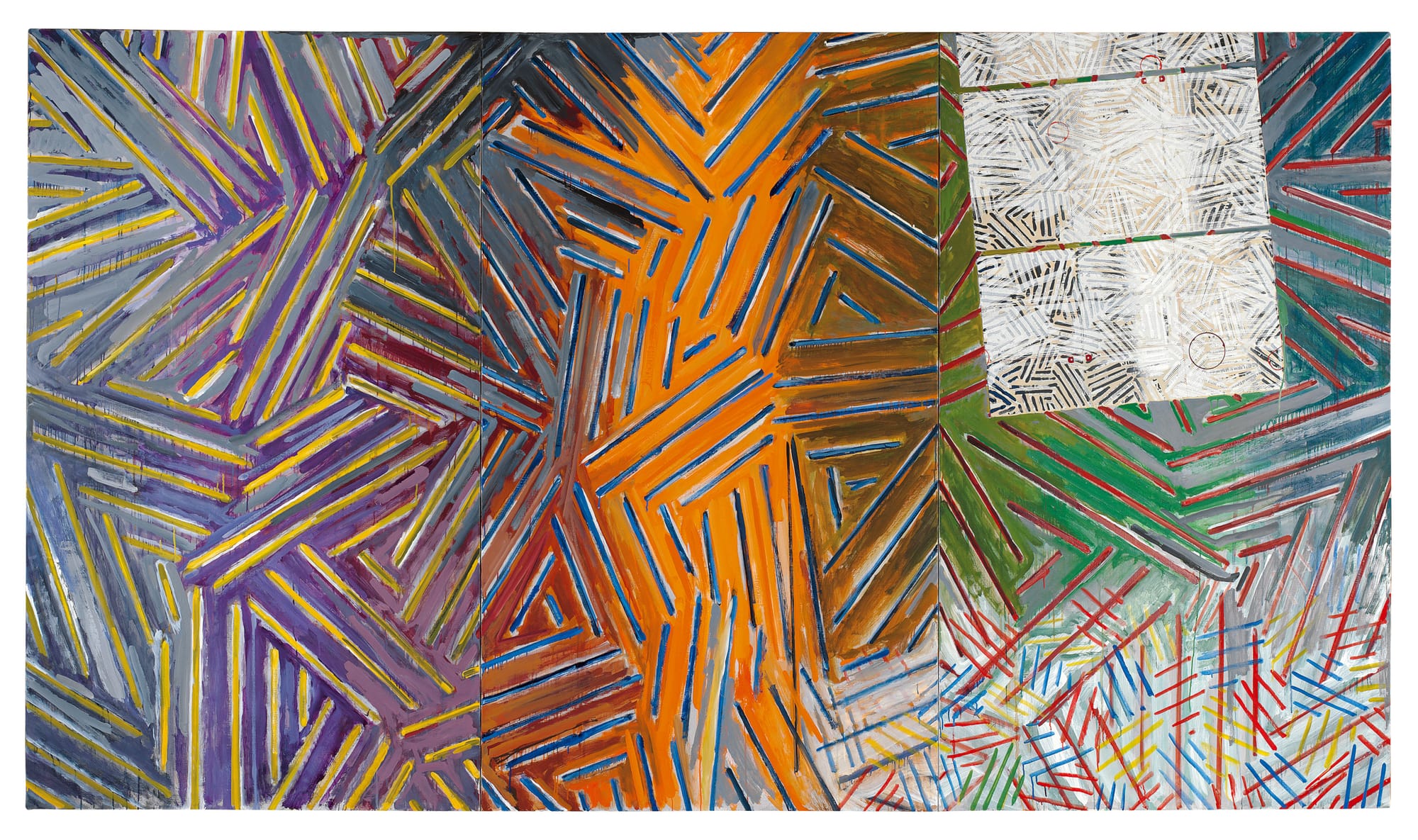
Johns’s three large paintings titled “Between the Clock and the Bed” (two 1981, one 1982), after an eponymous 1940–43 work by Edvard Munch, all on view in the Gagosian exhibit, marks another change, as he develops a different way to approach the figure without crossing over. Here, the title evokes the absent figure. Together, the glowing orange shape with blue cross-hatch lines in the middle pane coalesces into a figural presence. The combination of the orange area and the orientation of the blue lines suggests, ever so slightly, that the featureless presence is walking toward the bed.
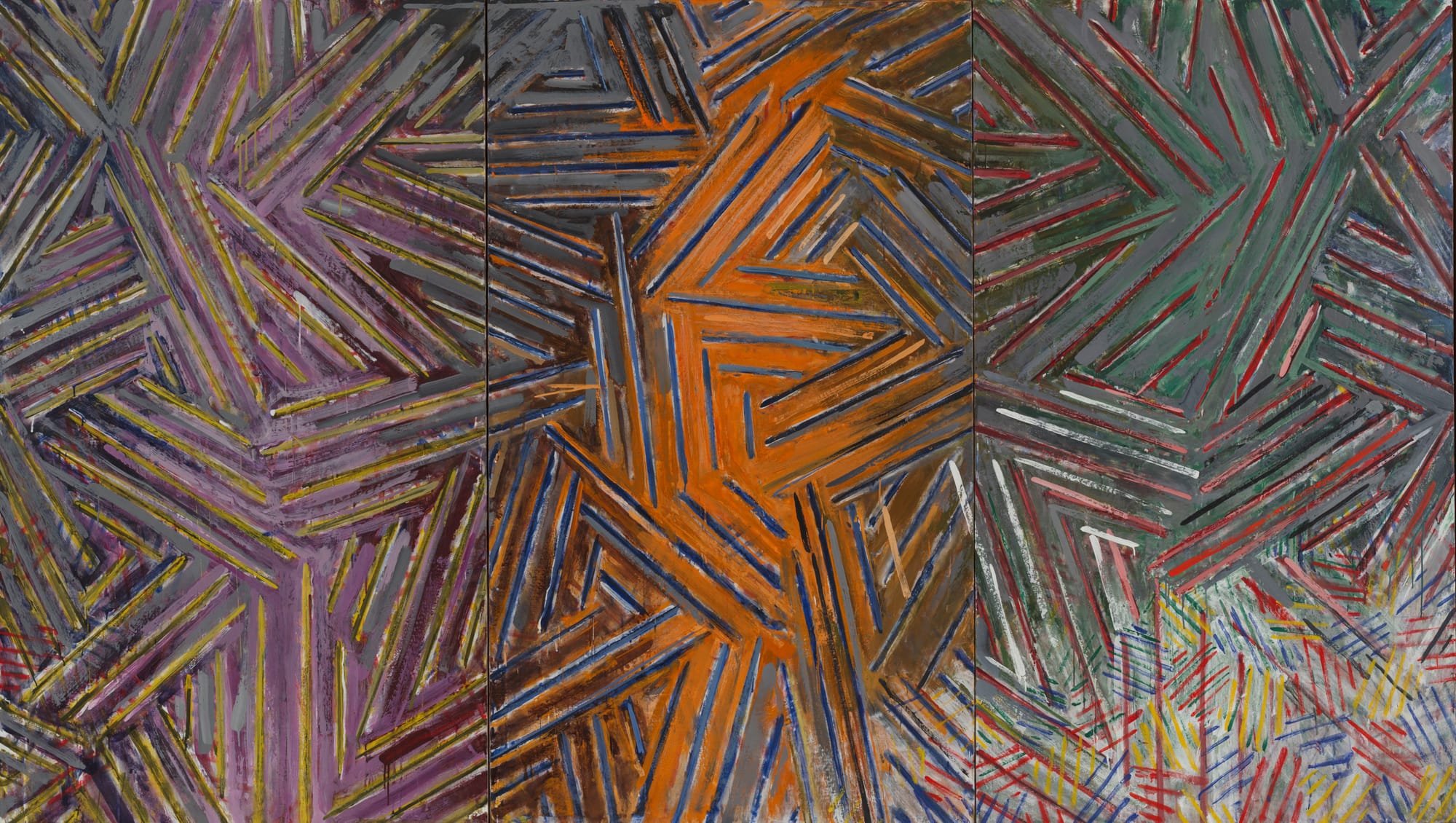
This reading is one way to complete the painting. Is the figure disappearing as it approaches the bed, signified by an overlay of red, yellow, and blue lines that echo the placement and pattern of the bedspread in the Norwegian artist’s work, a self-portrait? In his work, Munch has stepped out of his sunlit studio into an unlit bedroom and is standing between a grandfather clock with no hands and a small bed with a striped coverlet on it. Standing slumped and stiff, his hands hanging by his side, he is old, tired, forlorn, and vulnerable. Johns’s figure, on the other hand, is line and light; the orientation of the ghostly figure suggests he has accepted mortality as unavoidable.
As in his visual dialogue with Picasso, working solely with an abstract vocabulary that means nothing without a context, Johns finds a way to inhabit Munch’s painting while maintaining his integrity. The force of his authenticity should remind us that, for all his accomplishments and genius, Johns has never lost his love for art and artists, while recognizing that nothing stays in time. This is what makes his work human; he has chronicled the ways his body and mind mirror his brief moments in both this world of things and infinity, while celebrating the pleasures of looking and thinking. He has kept looking.
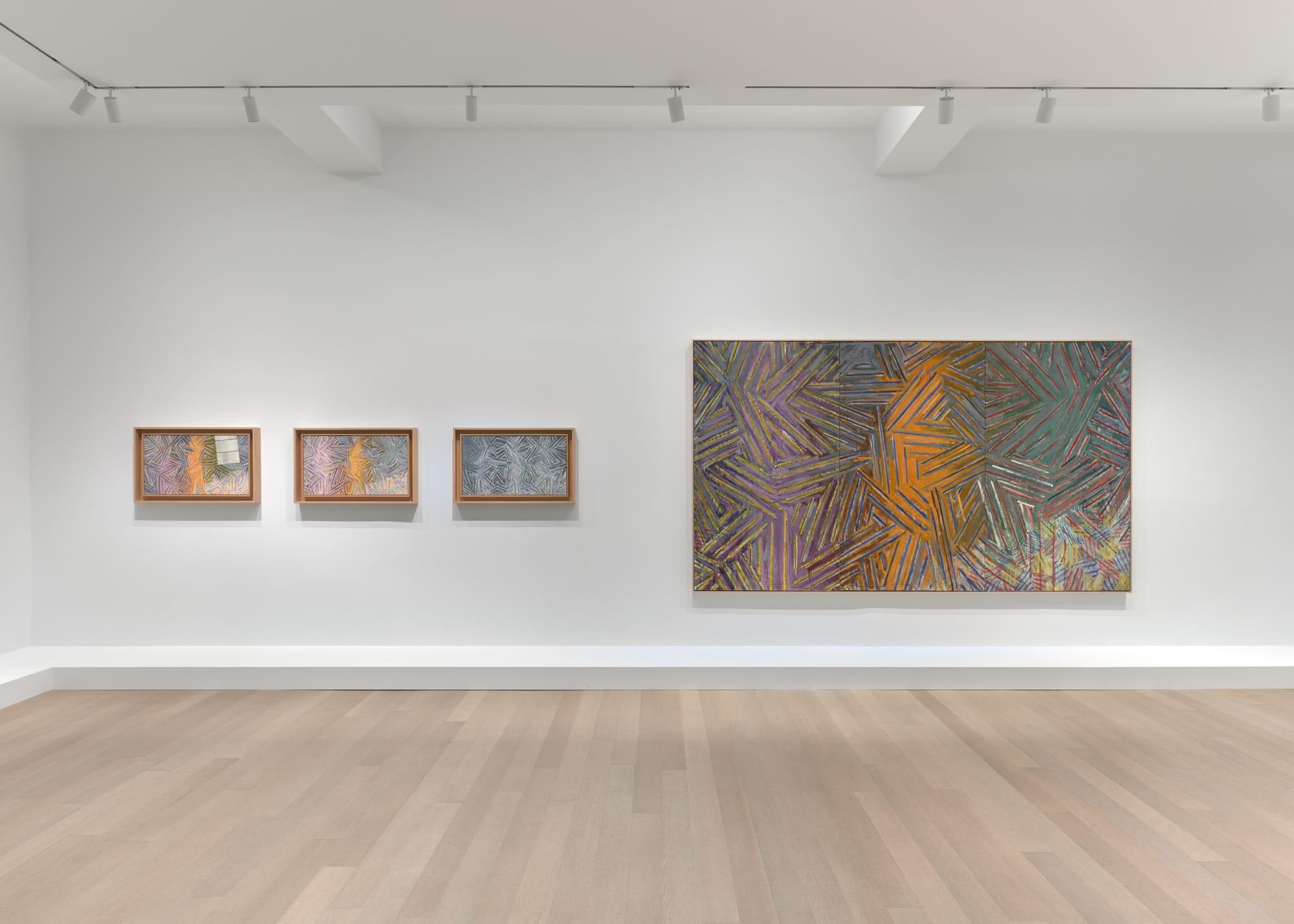
Jasper Johns: Between the Clock and the Bed continues at Gagosian (980 Madison Avenue, Upper East Side, Manhattan) through April 24. The exhibition was organized by the gallery.