Judge Orders Trump Administration to Reinstate Exhibits on Slavery
The Philadelphia display was dismantled last month after federal directives to remove negative representations of US history on public sites.

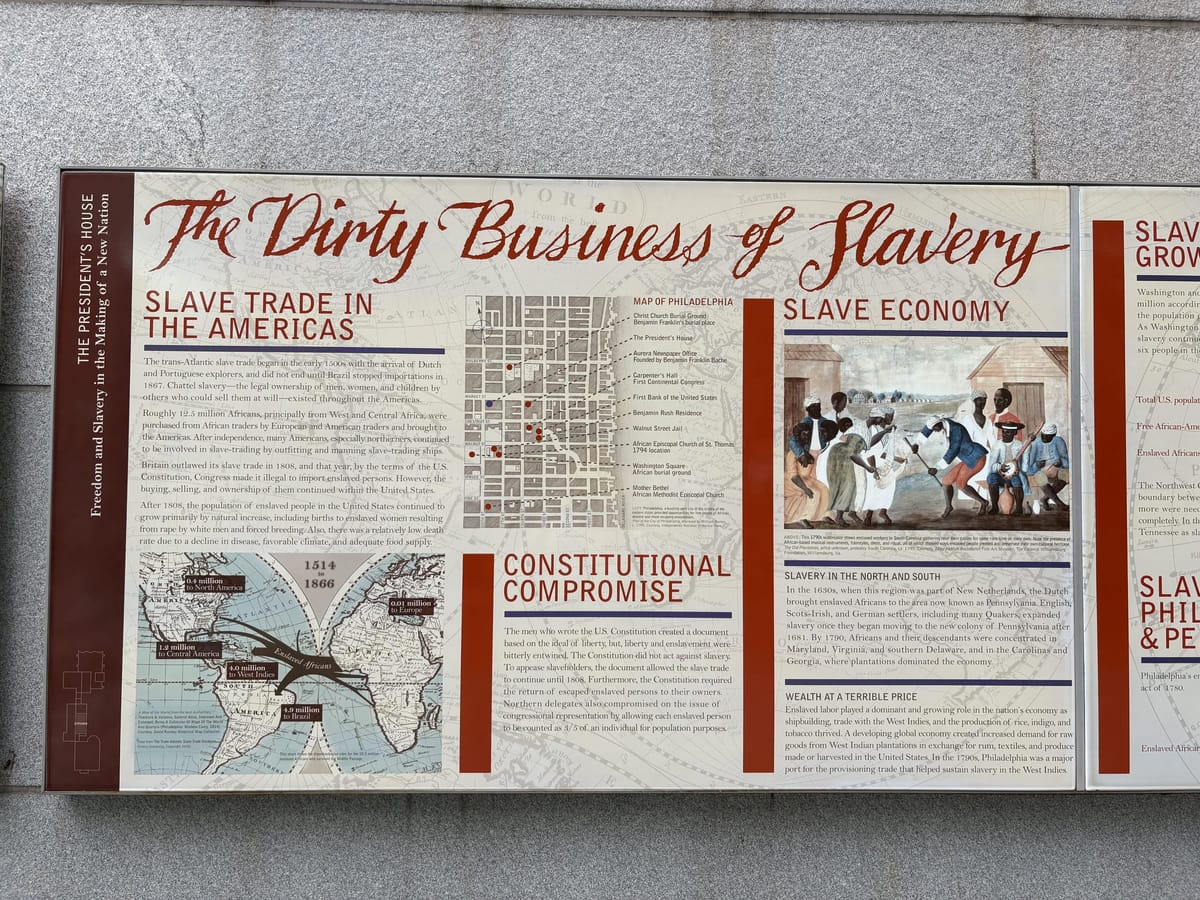
The Trump administration must restore exhibits examining the role of slavery in early United States history after a preliminary ruling by a Philadelphia federal judge yesterday, February 16.
Last month, federal employees descended on the President’s House in Independence National Historical Park, a site overseen by the National Park Service (NPS) that once held the country's first presidential mansions. Following a Trump mandate to remove public displays that paint US history in a “negative light,” officials dismantled the outdoor exhibition Freedom and Slavery in Making a New Nation.
The city of Philadelphia responded by suing the NPS and the Department of the Interior (DOI), arguing that the National Park Service lacked the authority to alter the exhibition that the city had co-commissioned.
In a 40-page opinion, Judge Cynthia M. Rufe ordered the Trump administration to restore the exhibits it had removed for the duration of the litigation.
Rufe extensively references the dystopian novel 1984 (1949) by George Orwell, comparing the Trump administration's actions in Philadelphia to the fictional Big Brother’s Records Department, which identified and destroyed “all copies of books, newspapers, and other documents which had been superseded.”
“As if the Ministry of Truth in George Orwell’s 1984 now existed, with its motto ‘Ignorance is Strength,’ this Court is now asked to determine whether the federal government has the power it claims—to dissemble and disassemble historical truths when it has some domain over historical facts,” Rufe wrote. “It does not.”
Among the exhibits taken down at the administration’s request were references to the Constitution’s failure to outlaw slavery, a map of the trans-Atlantic slave trade, and a video display by filmmaker Louis Massiah featuring portrayals of individuals enslaved by George Washington.
The judge argued that the city would likely prevail in its allegations that the government’s dismantling of the exhibition was "arbitrary and capricious."
Rufe also expressed support for the city’s argument that the exhibition’s removal would cause “irreparable harm” if not reversed.
“Each person who visits the President’s House and does not learn of the realities of founding-era slavery receives a false account of this country’s history,” Rufe wrote.
The ruling orders the DOI to reinstate the exhibit but does not cite a specific deadline.
Filmmaker Louis Massiah, whose video works were removed from the exhibition in January, celebrated Rufe's initial ruling as a victory for the community members, historians, and artists who created the display.
"Her words make clear that history is real, tangible, and necessary for just laws and just governance," Massiah wrote in an email to Hyperallergic.
"We assume that the struggle is not over, but this ruling makes clear that a wrong and a harm had been done in destroying this space," Massiah said.