Leah Ki Yi Zheng’s Personal I Ching
The artist is synthesizing the divergent cultural histories of Western oil painting and Eastern ink painting into one.

CHICAGO — When I learned that an exhibition by Leah Ke Yi Zheng, curated by Myriam Ben Salah and Karsten Lund, would be coming to the Renaissance Society, I timed an engagement I had in Chicago so I could see her work. My only regret was that I did not have enough time to go twice, as I did with her New York debut exhibition at David Lewis Gallery in 2023, which I reviewed. I also realized that I am still learning how to see Zheng’s work, which is one of the great pleasures of looking at art.
As much pleasure, intellectual stimulation, and self-reflection as I got from her work, and its engagement with Western oil painting and Eastern ink painting, I feel Zheng is at the beginning of something momentous — how these two divergent cultural histories can be synthesized into one. I believe that she is at the forefront of Asian-born artists reinventing the history of ink painting, while living in the diaspora. I say this because something more expansive and unpredictable is at stake in her work than personal identity, which focuses on representations of the self or “I” as something fixed rather than constantly changing.
While doing research for my review of Zheng’s first exhibition, I read an interview she did with Nicky Ni (Sixty Inches from Center, March 26, 2021):
My paintings branch off from the lineage of Chinese traditional paintings — it’s important for me to receive but also move beyond the influence of history. I use the same materials and techniques that a Chinese painter from the Five Dynasties and Ten Kingdoms period (907 AD–960 AD) would use, but I turn the scroll painting and its flatness into an object …. And silk is a seemingly delicate but strong and finicky material; it feels like skin.
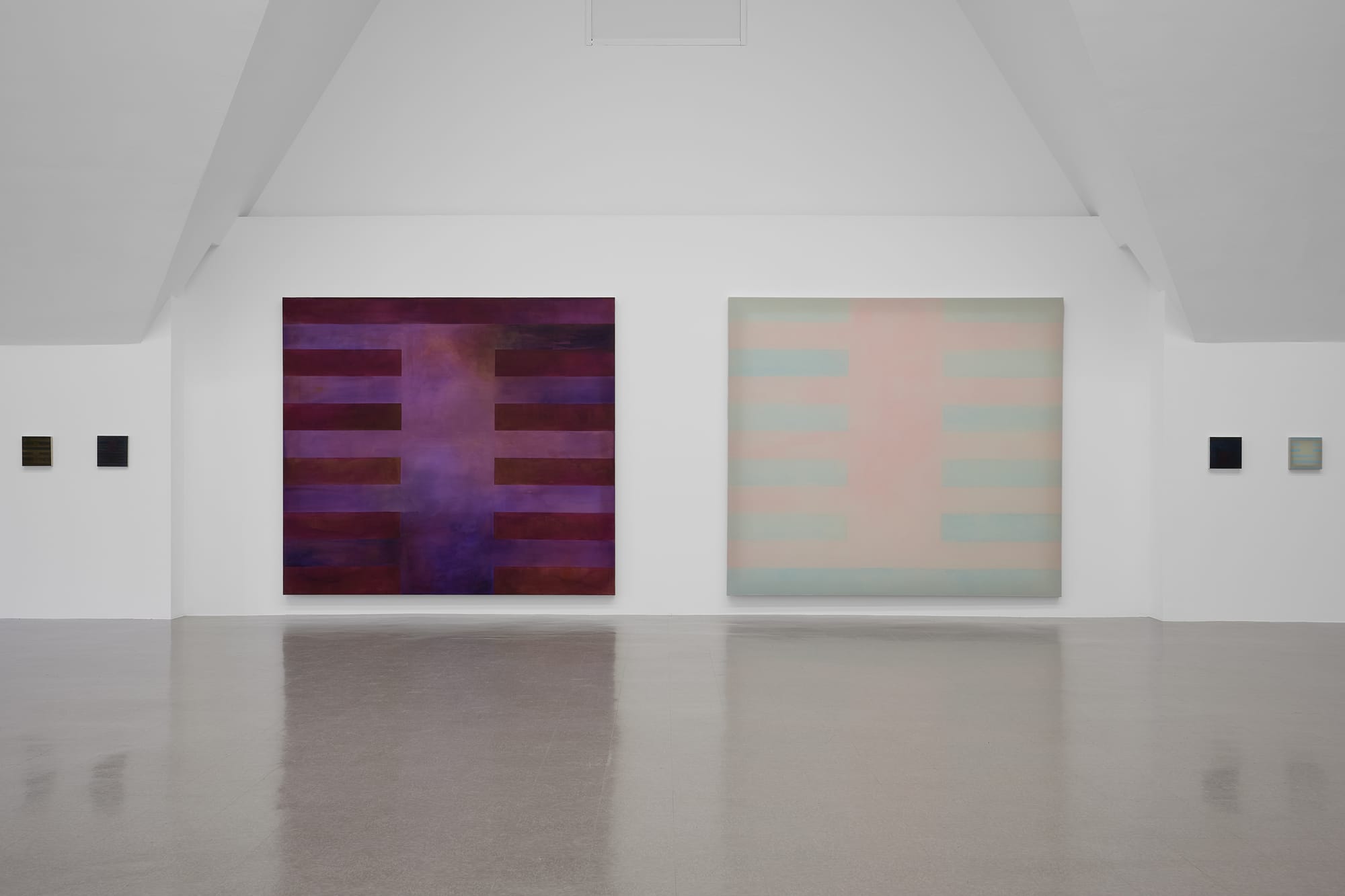
The I Ching (or Book of Changes) is an ancient Chinese divination text that is around 3,000 years old; its 64 hexagrams are oracular statements regarding how individuals should navigate their lives. Each hexagram is made of six stacked open or closed bars. In this regard, they are geometric signs and can be read as Western signs sans their prophetic wisdom.
Zheng’s decision to paint all the hexagrams in oil or acrylic on different kinds of silk can be linked to her ambition to “receive but also move beyond the influence of history” of both Chinese and Western art, particularly geometric abstraction, into a territory all her own.
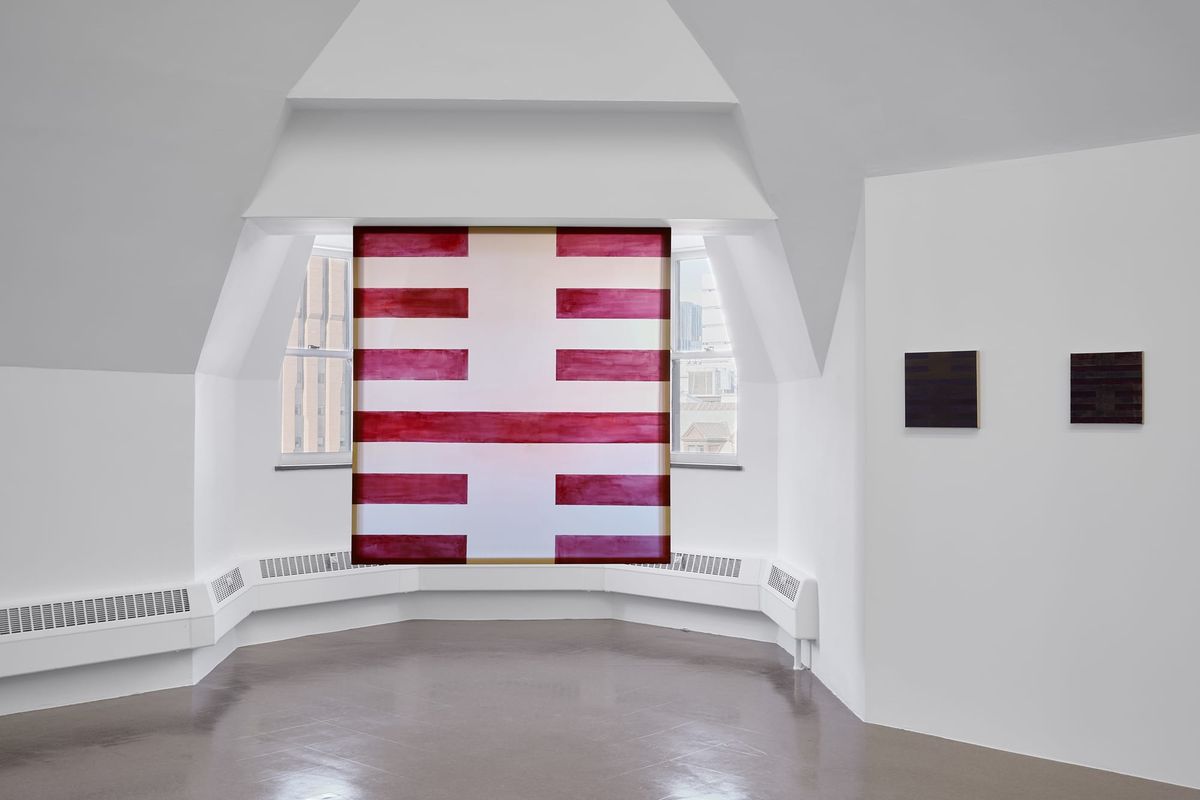
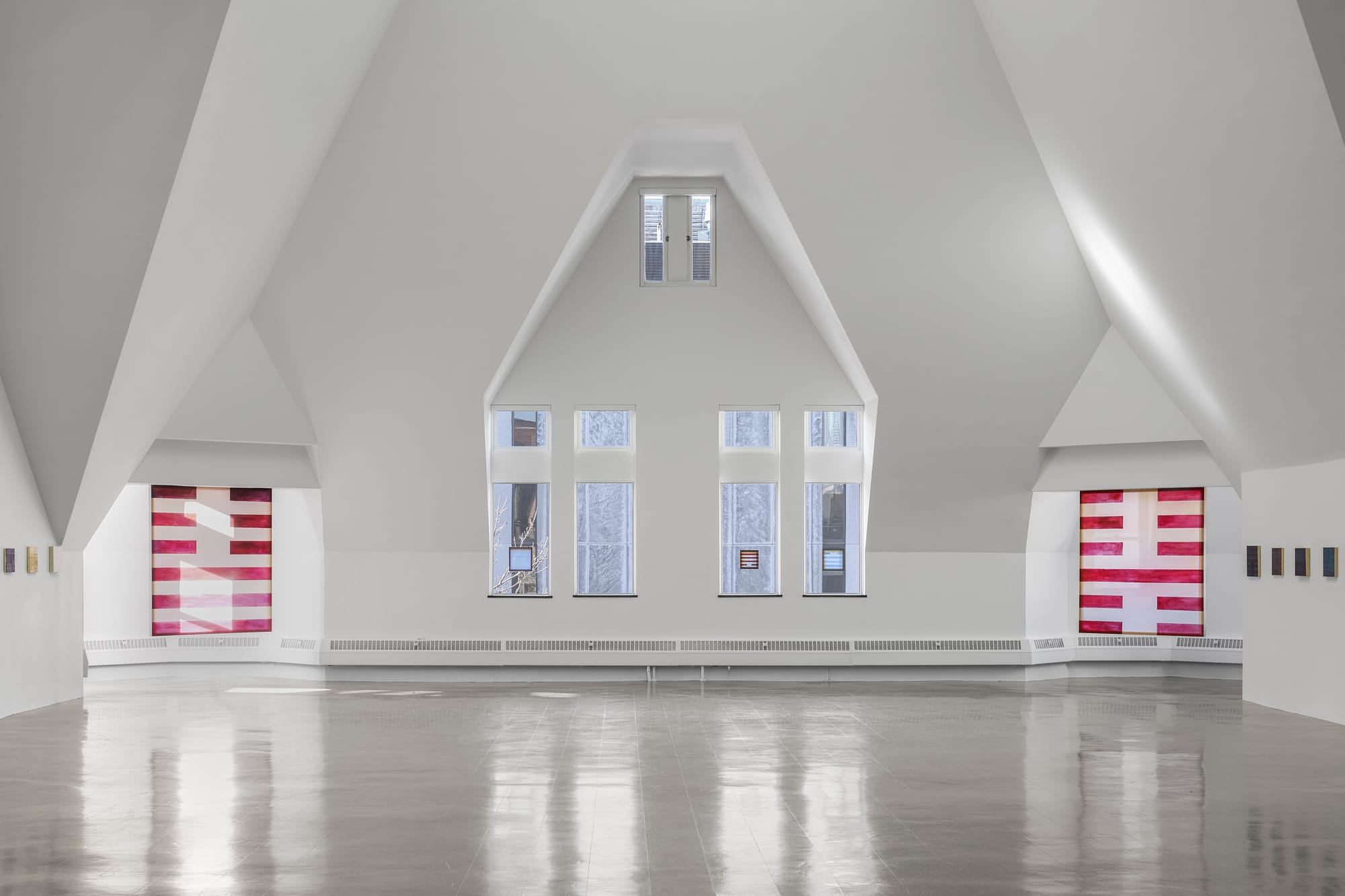
For the show, Zheng altered the architecture of the gallery, adjusting the height and width of certain walls and covering some windows, creating what the press release calls a “new rhythm” around the room to emphasize “the light of the here and now.” Zheng’s interest in the interaction of light and painting, from rough surfaces to the scrim-like supports through which light passes, expands upon Robert Ryman’s employment of natural light as a crucial component of his site-specific installations, as seen in his presentation at Dia Beacon.
The inverse of each other, No. 63 (known as “After Completion”) and No. 64 (known as “Before Completion”) hang on either side of the gallery’s front entrance. The two largest paintings, measuring 9 x 10 feet (~2.7 x 3m), hang on the inset wall opposite the gallery entrance; they pulled me into the room before I turned to see what Zheng had done with the space. Their size seems determined by the length and height of the wall on which they are hung. Done on semi-transparent silk, one of the paintings had six luminous celadon bars broken up by a soft pink ground. The figure-ground relation shifts, and we can see the pink as a vertical bar with 5 cross bars spanning the width of the painting. One of the many pleasures to experience in the exhibition, this optical oscillation undoes the hexagram’s reliance on six bars.
The viewer’s interaction with each of the paintings placed before the windows is different, depending on the weave of the silk and viscosity of the paint used by the artist. While Zheng sees all 64 paintings as a single work, each one stands on its own in terms of color and surface. Some are square, others rectangular. Not knowing how the entire group would take form, Zheng started out by “testing out different ideas and sizes,” as she told me in an interview.
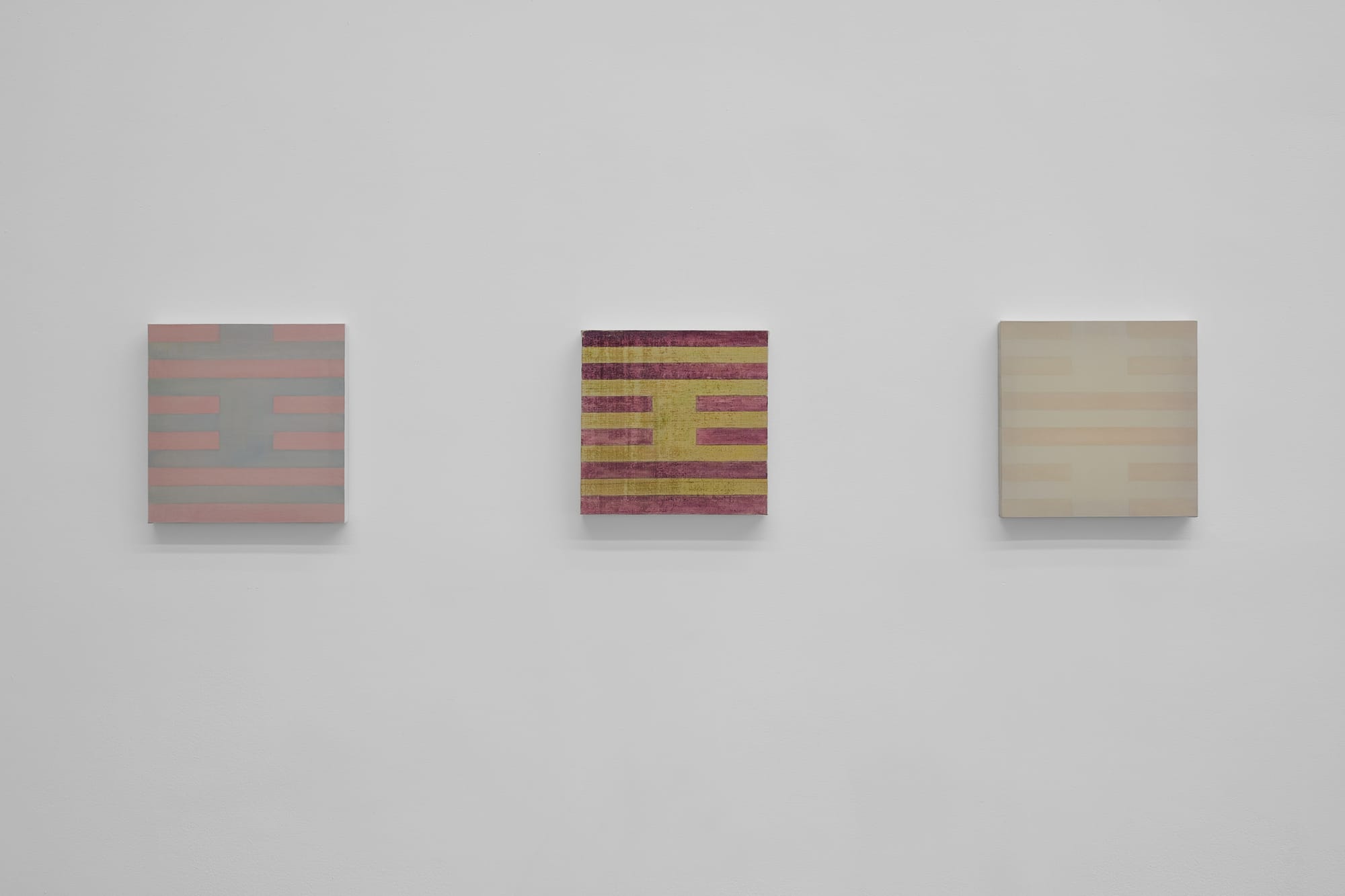
Zheng’s openness is felt throughout the exhibition — in the small changes in the size of the paintings, which includes ones that are 14 by 14 inches (~35.6 x 35.6 cm), 11 by 11 inches (~27.9 x 27.9 cm), and 9 by 9 ¼ inches (~22.9 x 23.5 cm), as well as 5 by 6 feet (~1.5 x 1.8 m). There is no set palette; some work tonally while others work by contrast. Nor is there a set surface or set of mediums. Zheng used thinned oil paint and viscous acrylic, and painted on surfaces that run from transparent to rough. The hexagram became a figure-ground structure for Zheng to explore, not replicate. In “No. 34”, for instance, she added an extra bar at the bottom, which alters the internal rhythm of the six bars, but goes unnoticed if you don’t look at each work singly, and see that the change makes this group Zheng’s interpretation of the I Ching hers and no one else’s. This extraordinary set of paintings should be kept intact and belongs in a museum.
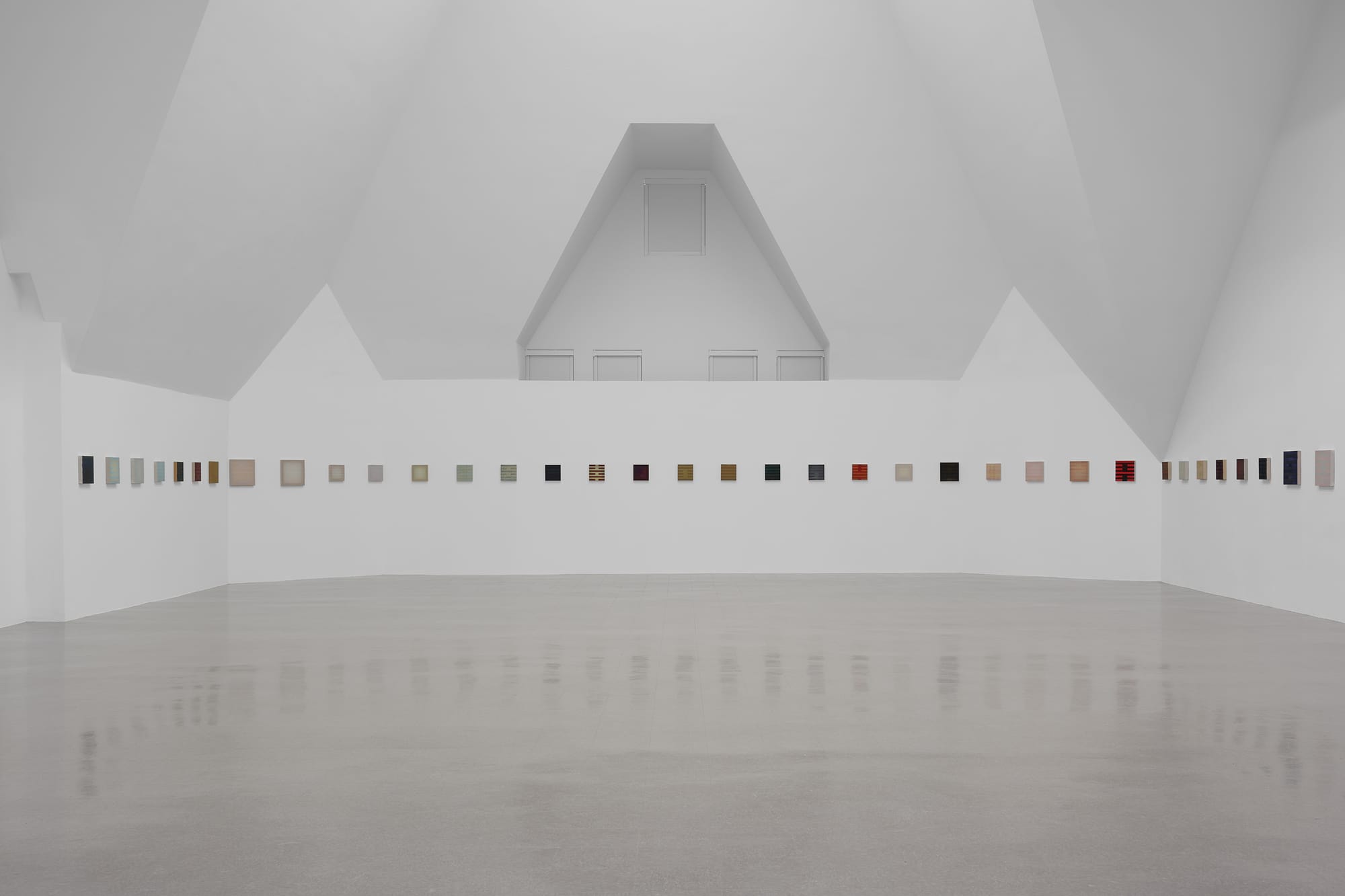
Leah Ke Yi Zheng: I Ching (Book of Changes) continues at the Renaissance Society (5811 S Ellis Avenue, Chicago, Illinois) through April 12. The exhibition was curated by Myriam Ben Salah and Karsten Lund.